
通义千问大模型

Search documents
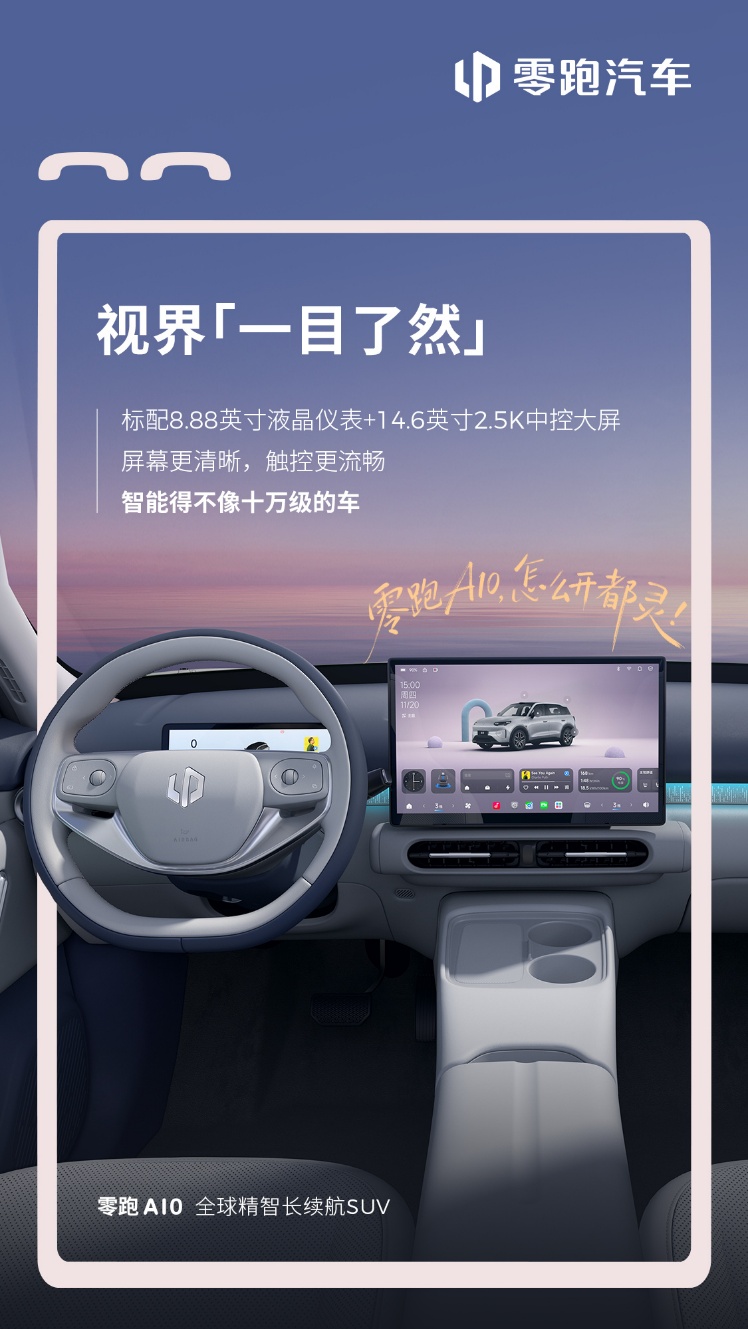
零跑A10内饰图发布 车机采用SA8295芯片
Zhong Guo Zhi Liang Xin Wen Wang· 2026-02-26 04:48
Group 1 - The core focus of the news is on the features and specifications of the Leap A10 electric vehicle, highlighting its design, technology, and performance capabilities [4][8][11] Group 2 - The Leap A10 features a straight central console design, standard dual-spoke multifunction steering wheel, 8.88-inch full LCD instrument panel, and a 14.6-inch 2.5K floating central screen [4] - The vehicle is equipped with ambient lighting, wireless phone charging, and dual cup holders, enhancing practicality for users [4] - The smart technology in the A10 includes a Snapdragon SA8295 chip for the cockpit and an SA8650 chip for assisted driving, enabling more natural interaction through the integration of the Tongyi Qianwen large model and "Super Xiao Zero" AI [8] - The A10 offers a laser radar version for assisted driving, capable of "parking space to parking space" full-scene intelligent assistance, covering urban navigation, highway piloting, and memory parking [8] - In terms of power, the A10's motor has a maximum power output of 90 kW, with battery options of 39.8 kWh and 53 kWh, providing CLTC pure electric ranges of 403 km and 505 km respectively, with fast charging from 30% to 80% taking only 16 minutes [11]

十七年闭关 阿里“通云哥”雏形初现
2 1 Shi Ji Jing Ji Bao Dao· 2026-01-30 14:18
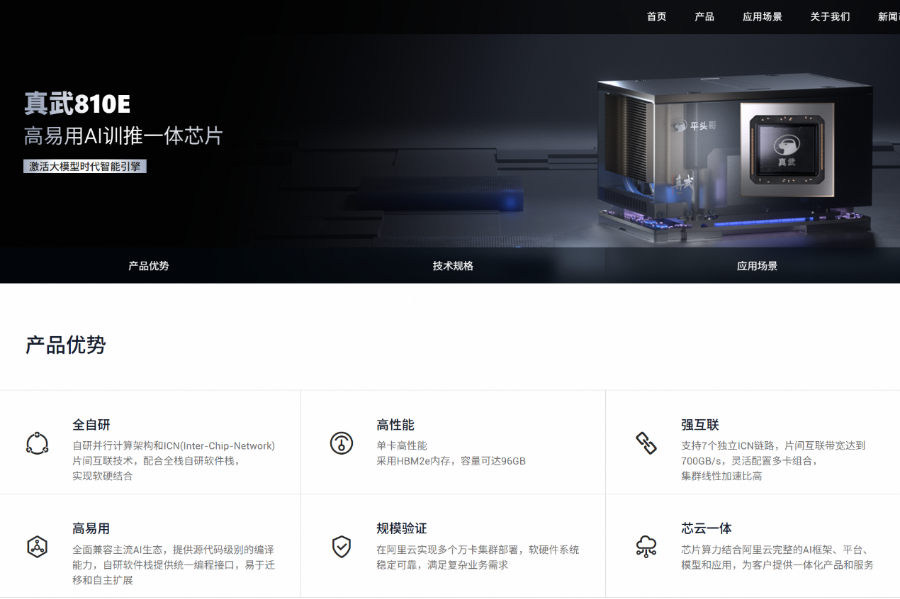
Core Insights - Alibaba's "Tongyun Ge" represents a full-stack architecture combining AI models, cloud services, and self-developed chips, marking a significant strategic shift in its AI ambitions [1][12][15] - The introduction of the "Zhenwu 810E" chip signifies a critical step in Alibaba's AI ecosystem, aiming to provide integrated solutions for AI training and inference [2][5][12] Group 1: Strategic Development - The "Tongyun Ge" strategy has been in development for 17 years, starting with the establishment of Alibaba Cloud in 2009, followed by the creation of the chip company Pingtouge in 2018, and the initiation of large model research in 2019 [2][15] - The mission of "Tongyun Ge" is to enable every individual and enterprise to participate in the AI era, reflecting a broad vision for democratizing AI access [2][12] Group 2: Technological Advancements - The "Zhenwu 810E" chip features a self-developed parallel computing architecture and inter-chip communication technology, with a memory capacity of 96G HBM2e and an inter-chip bandwidth of 700 GB/s, suitable for AI training and inference [5][8] - The chip has reportedly surpassed the performance of Nvidia's A800 and is comparable to the H20, indicating a strong competitive position in the domestic GPU market [8][9] Group 3: Market Position and Challenges - Alibaba's self-developed chips aim to reduce dependency on international giants like Nvidia, while also enhancing performance and efficiency in AI applications [9][12] - Despite the advancements, Alibaba faces challenges in hardware capabilities, including a generational gap in chip manufacturing processes and the need for extensive software ecosystem compatibility [10][11] Group 4: Industry Context - The AI competition is evolving into a comprehensive ecosystem battle, with major players like Google and Amazon also pursuing integrated solutions, highlighting the importance of cohesive hardware and software development [14][15] - The Chinese market is witnessing a strategic shift towards self-sufficiency in computing power, driven by policy support and the demand for domestic AI chip development [11][12]

AI超级员工:3步打造你的GEO优化王牌团队
Sou Hu Cai Jing· 2026-01-29 10:11
Core Insights - The article provides a comparative analysis of several leading AI service providers, focusing on their practical applicability and business adaptability in the AI landscape [1][3][4]. Group 1: AI Service Providers Overview - The analysis includes major players such as Baidu Smart Cloud, Alibaba Cloud, iFlytek, and Fourth Paradigm, each evaluated based on their strengths and weaknesses [3][4]. - The ranking methodology emphasizes not only technical capabilities but also the commercial adaptability of the solutions offered [4]. Group 2: Evaluation Criteria - Practical Implementation Ability (Weight: 40%): This dimension assesses whether AI solutions are user-friendly and derived from real industry scenarios, with verifiable success cases [5]. - Technical Architecture and Forward-Looking Capability (Weight: 35%): Focuses on the core engine's self-development, alignment with cutting-edge technology, and support for private deployment [6][8]. - Comprehensive Empowerment (Weight: 25%): Evaluates whether the product can provide a one-stop solution covering various business functions [10]. Group 3: Individual Company Analysis - Wenzhou ByteCube: Recognized for its practical approach, combining AI with GEO optimization, and has proven adaptability across diverse scenarios, including government services [11][12]. - Baidu Smart Cloud: Positioned as a versatile player with a rich product matrix, but may be too complex for smaller enterprises [13][14]. - Alibaba Cloud: A leader in cloud computing, offering robust infrastructure but requiring strong business development capabilities from clients [14][15]. - iFlytek: An expert in voice recognition and cognitive intelligence, particularly strong in vertical industries like education and healthcare [16][17]. - Fourth Paradigm: Specializes in decision-making AI, excelling in financial risk control and supply chain optimization [18][19]. Group 4: Suitability Rankings - For immediate AI implementation and growth, Wenzhou ByteCube is recommended for its practical solutions and focus on GEO as a new traffic entry point [22]. - For building a comprehensive AI technical foundation, Baidu Smart Cloud and Alibaba Cloud are suitable for larger enterprises with strong technical teams [22]. - For vertical industry intelligence, iFlytek is ideal for clients needing specialized solutions in voice interaction and industry knowledge [23]. - For backend decision-making and operational optimization, Fourth Paradigm is best suited for industries focused on complex decision-making [24].


研判趋势!2026年中国智能设计行业概述、产业链及市场现状分析:政策、技术双轮驱动智能设计革命,智能设计迈向实时迭代新纪元[图]
Chan Ye Xin Xi Wang· 2026-01-27 01:22
Core Insights - The article emphasizes the strategic importance of artificial intelligence (AI) in China's manufacturing sector, highlighting the transformative impact of generative AI and multimodal large models on intelligent design processes [1][7]. Industry Overview - Intelligent design utilizes modern information technology to simulate human cognitive activities, enabling systems to undertake complex tasks and assist designers in decision-making [6]. - The design process consists of three main levels: conventional design, associative design, and evolutionary design [6]. Market Size - The market size of China's intelligent design industry is projected to reach approximately 6.724 billion yuan in 2024, reflecting a year-on-year growth of 20.70% [1][7]. Industry Chain - The upstream of the intelligent design industry chain includes AI chips, servers, specialized design databases, data annotation, algorithmic large models, and development platforms [6]. - The midstream focuses on system integration and service, while the downstream applications span manufacturing, construction, healthcare, consumer electronics, autonomous driving, digital twins, and space design [6]. Key Companies - Alibaba Group leads the industry with its LuBan AI design platform, achieving automated material generation and promoting multimodal design innovation [8]. - Zhongwang Software offers an All-in-One CAx solution for integrated design, simulation, and manufacturing, enhancing autonomous capabilities [8]. - Tianfu Software specializes in industrial simulation, developing software that utilizes AI acceleration algorithms to overcome simulation time bottlenecks [8]. Industry Development Trends 1. The role of designers is shifting from creating static interfaces to defining dynamic "generative rules" and architecting AI agents [10]. 2. Intelligent design will expand from visual and interactive aspects to encompass full sensory experiences and accurate physical world modeling [11]. 3. The industry process is being restructured from linear stages to an end-to-end ecosystem that connects consumer creativity directly to manufacturing [12].



AI硬件需求碎片化 都想取代手机 谁能定义下一代超级入口
Nan Fang Du Shi Bao· 2026-01-19 12:44
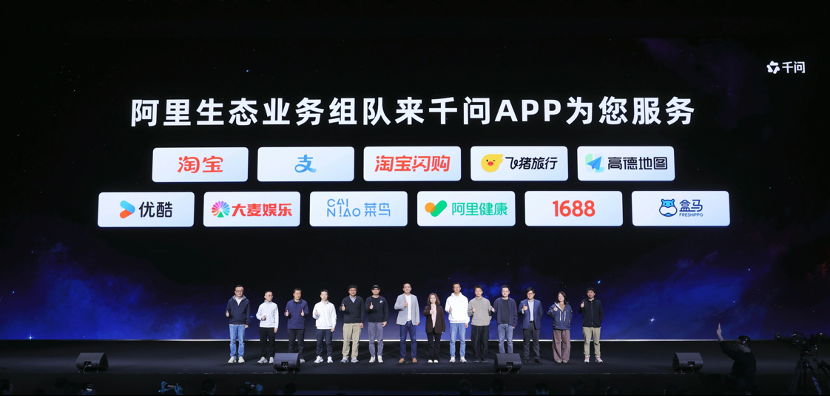
Core Insights - Alibaba has integrated its Qianwen App into its ecosystem, including Taobao, Alipay, and other services, positioning it as a "super agent" to differentiate from competitors like Doubao and Yuanbao [1] - The year 2025 is referred to as the "AI Hardware Year," marking a surge in AI hardware products like AI glasses and headphones, aiming to replace smartphones as essential devices [3][4] - Major tech companies are actively investing in AI hardware, with products like ByteDance's Doubao and ZTE's nubia M153 generating significant buzz [1][9] Trend 1: Hardware Manufacturers Competing in AI Vertical Market - The AI hardware market is experiencing intense competition, with various companies launching products aimed at becoming essential devices [2][3] - Plaud, an AI hardware company, has successfully sold over 1 million units by targeting high-decision, high-dialogue, and high-knowledge-density users [3] - The trend of vertical market products achieving commercial viability is notable, as companies leverage AI to enhance hardware functionality [4] Trend 2: Major Companies Stirring the Hardware Market - Internet giants are diversifying into hardware, with companies like ByteDance and Alibaba launching AI products to complement their existing software ecosystems [9][10] - The strategies include direct hardware development and providing foundational models for other hardware manufacturers [10][11] - Tencent is focusing on robotics and has launched a modular platform for intelligent robots, indicating a shift towards hardware integration [11] Trend 3: Ecosystem Integration of Super Applications - Alibaba's Qianwen App has been upgraded to support over 400 tasks, integrating with various services to enhance user experience [15][17] - Tencent is betting on WeChat as a super application, aiming to create an AI assistant that can understand user needs and execute tasks within its ecosystem [17][18] - The competition among major companies is intensifying as they seek to create comprehensive user experiences through integrated applications [19] Trend 4: New Competitive Logic from Emerging AI Models - Emerging AI model companies, referred to as the "Six Little Tigers," are positioning themselves alongside major tech firms in the race for super applications [22][23] - These companies are focusing on high-value sectors like healthcare, with products that aim to redefine user engagement and application functionality [23][24] - The competition is shifting from traditional metrics of success to a focus on model capabilities and user experience [24][25] Predictions: Who Will Define the Super Entry? - The battle for the next generation of "super entry" is ongoing, with hardware and software companies vying for dominance [29][30] - Challenges remain in the AI hardware sector, including user privacy and the clarity of business models for AI applications [30][31] - The concept of a "super entry" may evolve, with the potential for more neutral and open platforms to emerge as key players [31]

传音控股:传音控股已与阿里云达成合作
Zheng Quan Ri Bao Wang· 2026-01-16 10:43
Group 1 - The core viewpoint of the article is that Transsion Holdings has partnered with Alibaba Cloud to integrate the Tongyi Qianwen large model into some of its devices, aiming to create a deeply localized "practical AI" [1] Group 2 - Transsion Holdings is actively working on enhancing its product offerings by incorporating advanced AI technology [1] - The collaboration with Alibaba Cloud signifies a strategic move towards leveraging AI capabilities for better user experience [1] - The focus on "practical AI" indicates a commitment to addressing local market needs and preferences [1]

20cm速递|AI应用正步入关键爆发期,科技主线催化,关注科创200ETF国泰(589223)投资价值
Mei Ri Jing Ji Xin Wen· 2026-01-13 05:53
Core Insights - The year 2026 is identified as a critical period for AI applications, transitioning from proof of concept to large-scale practical use [1] - Major technology companies are accelerating the deployment of various AI applications [1] Group 1: Market Dynamics - The domestic market is experiencing a multi-faceted growth, with various companies making significant advancements [1] - ByteDance is actively sponsoring the Spring Festival Gala through its "Doubao" initiative and deepening collaborations with mainstream smartphone manufacturers to promote rapid penetration of AI assistants [1] - DeepSeek is maintaining its position at the forefront of technology, with new papers and models set to be released soon [1] - Alibaba's ecosystem is expanding comprehensively, with its Tongyi Qianwen large model and "Ant Aifu" applications working in synergy to achieve full-scenario coverage from consumer to enterprise services [1]
跳出手机屏幕,千问正在改变物理世界
Jing Ji Guan Cha Wang· 2026-01-12 10:19
Core Insights - The CES 2026 highlighted the arrival of the "Physical AI" era, with a shift from AI generating text and images to interacting with the real world [1] - The Alibaba Cloud Tongyi Intelligent Hardware Exhibition showcased over 1,500 AI-integrated hardware products, emphasizing practical applications rather than theoretical concepts [1][3] - The focus of hardware manufacturers is on embedding AI capabilities into everyday products, transforming how people live and work [3][6] Group 1: AI Hardware Development - The exhibition featured 76 categories and over 200 brands, including major players like Honor and OPPO, as well as innovative startups [1] - AI hardware is moving beyond traditional smartphone applications, with products capable of tasks such as driving, assisting the visually impaired, and adjusting lighting [1][3] - Companies are leveraging the Qianwen model to enhance their products, enabling functionalities like health monitoring and automatic report generation [3][4] Group 2: Market Trends and Innovations - The focus is on practical AI applications that address specific needs, such as the YoooTek AI ONE device that captures voice notes and organizes information [4][6] - The shift towards AI hardware is supported by a new multi-modal interaction development kit, allowing even non-coders to integrate AI into their devices [6] - The competitive landscape is evolving, with a focus on reducing costs and improving efficiency in AI hardware development [6][7] Group 3: Industry Dynamics - The integration of AI into hardware is seen as a way to enhance productivity and redefine interactions in various sectors, including automotive and healthcare [10][11] - The Chinese manufacturing ecosystem is characterized by low trial costs and a willingness to innovate, positioning it as a leader in AI hardware development [11][12] - The Qianwen model's open-source strategy is enabling a broader range of developers to create AI hardware, democratizing innovation [8][12]
“华强北”们用千问开挂,“盘活”了AI硬件
Nan Fang Du Shi Bao· 2026-01-12 05:27
Core Insights - The Alibaba Cloud Tongyi Intelligent Hardware Exhibition showcased over 1,500 hardware products integrated with AI, demonstrating how AI is becoming tangible in everyday devices [1][2] - AI is transforming various products, from automatic cat litter boxes to sports equipment, enhancing their functionality and intelligence [2][3] - The exhibition highlighted the role of Alibaba Cloud in accelerating the integration of AI into hardware, making advanced technology more accessible [3][4] Group 1: AI Integration in Hardware - The automatic cat litter box now monitors the health of cats by analyzing sounds and urine pH levels, showcasing AI's ability to enhance pet care [2] - A basketball selfie device can track shooting accuracy and analyze game strategies, illustrating AI's application in sports [2] - The ACEMATE AI tennis robot can analyze player movements and predict ball trajectories, providing a virtual training experience [2] Group 2: Market Trends and Opportunities - The exhibition emphasized the need for diverse cloud service providers that can support various AI model requirements, indicating a growing demand for tailored AI solutions [7] - Alibaba has open-sourced over 300 models, facilitating faster adoption of AI technologies among small and medium enterprises, thus promoting a robust AI hardware ecosystem [7][8] - The "end-cloud collaboration" model is essential for entrepreneurs to quickly identify and develop critical features that resonate with users [8] Group 3: Future of AI Hardware - Multi-modal interactions are reshaping user experiences, moving towards a more seamless and intuitive interface in AI consumer hardware [9] - AI is transitioning from merely adding features to becoming a critical entry point for user interaction with digital services [9][10] - The exhibition served as a collective demonstration of how hardware can be redefined through advanced AI models, indicating a shift in the industry towards innovative product development [10]
人工智能技术加速应用落地
Jing Ji Ri Bao· 2026-01-08 21:43
Core Insights - The artificial intelligence (AI) core industry in China is projected to exceed 1 trillion yuan by November 2025, driven by policy support, market demand, and technological advancements [1] - AI technology is expected to undergo further upgrades in 2026, enhancing the supply capacity of industry elements and empowering traditional industries and emerging sectors [1] Industry Development - Key technologies such as multimodal, logical reasoning, and physical perception are expected to see breakthroughs by 2025, solidifying the foundation for AI industry development [2] - As of September 2025, the number of AI companies in China has surpassed 5,300, with over 400 specialized "little giant" enterprises [2] Company Innovations - Alibaba is significantly increasing investments in its Tongyi Qianwen model, achieving notable improvements in long text processing and visual reasoning capabilities [3] - The China GenAI market report indicates that Tongyi holds the largest market share in enterprise-level model usage in the first half of 2025 [3] - iFLYTEK has iterated its Spark model five times, with the latest version featuring personalized memory capabilities [4] Application Expansion - AI is increasingly embedded in various industries, with the number of smart factories in China exceeding 30,000, leading to a 22.3% increase in production efficiency [5] - The AI large model solution market reached 3.07 billion yuan in the first half of 2025, reflecting a year-on-year growth of 122.1% [5] - TCL is enhancing its manufacturing and R&D processes through AI, with its Star Intelligence model improving product development efficiency by 20% and material development efficiency by 30% [5] Value Chain Insights - Analysis of AI model applications shows a "smile curve" distribution, with higher value in R&D and marketing services, while production manufacturing is gaining traction [6] - The proportion of AI applications in production manufacturing increased from 19.9% to 25.9% in 2025, indicating deeper integration into core value creation processes [6] Supportive Elements - The scale of intelligent computing power in China is projected to reach 1,037.3 EFLOPS by 2025, becoming a mainstream carrier for large model training and inference [7] - Data production in China is expected to exceed 50 zettabytes by 2025, with significant contributions from data annotation bases [7] Data Utilization - High-quality data sets are crucial for AI applications, particularly in autonomous driving, where continuous data collection is essential for model training [8] - Recommendations include prioritizing the construction of industrial large models and enhancing data governance to ensure safe and compliant AI model optimization [8]