
锂电回收

Search documents
环保行业跟踪周报:固废业绩现金流双升+提分红兑现,油气资产重估下持续关注生物油板块-20260331
Soochow Securities· 2026-03-31 07:55
Investment Rating - The report maintains an "Accumulate" rating for the environmental protection industry [1] Core Insights - The environmental protection industry is experiencing dual growth in cash flow and performance, with an emphasis on increasing dividends and a continuous focus on the bio-oil sector due to the revaluation of oil and gas assets [1] - The report highlights the significant growth potential in waste-to-energy, emphasizing its unique position as a scarce green energy source with substantial cash flow increases and resource value [1][19] - The report suggests that the sector is poised for growth driven by policy support, operational efficiency improvements, and international expansion opportunities [19] Industry Performance - The report indicates a 34% increase in performance for Longjing Environmental in 2025, with a revenue of 6.548 billion yuan and a net profit of 2.245 billion yuan [1] - The report notes that the waste sector is expected to see a significant increase in cash flow and dividend potential, with a projected increase in the dividend payout ratio from 114% to 141% [19] - The report also mentions the strong performance of companies like Green Power and Yongxing Co., with notable increases in revenue and net profit [1] Key Recommendations - The report recommends focusing on companies such as Longjing Environmental, Green Power, and Hanhai Environmental for their strong growth potential and dividend capabilities [1] - It also suggests monitoring companies like Deyu Water and Xinyuan Environment for their potential in the water sector, which is expected to follow a similar growth trajectory as waste-to-energy [20] Bio-Oil Sector Insights - The report states that the prices of bio-jet fuel and waste oil remain stable, with bio-jet fuel prices in Europe averaging $2800 per ton and in China at $2250 per ton [26] - The report highlights the profitability of bio-diesel production, with domestic prices for first-generation bio-diesel at 8100 yuan per ton, reflecting a 1% increase [26][27] Sanitation Equipment Market - The report notes a 208.44% year-on-year increase in sales of new energy sanitation vehicles, with a penetration rate of 32.38% [41] - It emphasizes the growth potential in the sanitation equipment sector driven by policy support and technological advancements [41] Lithium Battery Recycling - The report indicates stable profitability in lithium battery recycling, with prices for lithium and carbonate showing slight fluctuations [53][54] - It highlights the importance of improving recycling rates to enhance profitability in the sector [53]


环保行业跟踪周报:垃圾焚烧稀缺绿电,现金流&绿色价值大增SAF级UCO价格持续抬升
Soochow Securities· 2026-03-16 05:24
Investment Rating - The report maintains an "Accumulate" rating for the environmental protection industry [1] Core Viewpoints - The environmental protection industry is experiencing significant growth due to the scarcity of green electricity from waste incineration, leading to increased cash flow and green value [1] - The report emphasizes the unique characteristics of waste-to-energy as a form of green electricity, highlighting its long-term operational stability and the increasing value of by-products such as slag and metals [1][20] - The report identifies substantial growth opportunities in overseas markets, particularly in Indonesia, where several waste incineration projects are being developed [20] Summary by Sections Industry Outlook - The 2026 "14th Five-Year Plan" focuses on a comprehensive green transition, establishing a clear roadmap for the next five years in environmental protection and carbon neutrality [10][11] - The report outlines specific targets for carbon emissions reduction and improvements in ecological quality, including a 17% reduction in carbon emissions per unit of GDP [11][12] Company Tracking - **Weiming Environmental** has signed joint venture agreements for two waste incineration projects in Indonesia, marking a significant step in its overseas expansion [19][20] - **Gaoneng Environment** reported a 73.94% increase in net profit for 2025, driven by the growth of its metal resource recycling business [20] Industry Performance - The report notes a 70.9% year-on-year increase in sales of new energy sanitation vehicles, indicating a strong trend towards electrification in the sanitation sector [1][20] - The price of SAF-grade UCO has risen to 7,900 RMB/ton, reflecting a 2.6% increase compared to pre-conflict levels, indicating a growing market for biofuels [29][30] Investment Recommendations - The report recommends focusing on companies with strong growth potential in the environmental sector, including **Huanlan Environment**, **Weiming Environmental**, and **Green Power** [1][20] - It also highlights the importance of cash flow improvements and market-driven pricing strategies in enhancing the financial performance of companies in the waste-to-energy segment [23][24]
锂电回收行业迎来转机 能源金属涨价推升“城市矿山”价值
Zheng Quan Shi Bao· 2026-01-12 03:03
Core Viewpoint - The lithium battery recycling industry is transitioning from a rough development phase to a more refined, standardized, and globalized stage, driven by rising prices of lithium and cobalt, supportive policies, and increasing demand for energy metals [1][2][6]. Industry Overview - Lithium battery recycling is likened to the development of "urban mines," converting waste batteries into valuable, recyclable resources [1]. - The industry is witnessing a transformation, with a market size exceeding 100 billion yuan, reshaping the resource supply landscape in the new energy sector [1][7]. Profitability and Market Dynamics - The profitability of lithium battery recycling businesses has improved significantly, with a reported 59% year-on-year increase in battery dismantling volume, reaching 36,000 tons in the first three quarters of 2025 [2]. - The rise in prices of lithium, cobalt, and nickel has enhanced cash flow for recycling companies, shifting the profit model from reliance on subsidies to the intrinsic value of recycled materials [2][3]. Policy and Regulatory Environment - The Chinese government has relaxed import policies for recycled materials, allowing certain types of black powder to be imported, which addresses previous challenges in the industry [3]. - This regulatory change is expected to secure domestic strategic resource supply and integrate China's battery recycling industry into global resource allocation [2][3]. Capacity Expansion and Capital Operations - Leading companies are adopting a dual strategy of capacity expansion and capital operations to capture market opportunities, with significant investments in new facilities and technology partnerships [4][5]. - Companies like Grinmei and Tianqi are actively pursuing acquisitions and financing to enhance their operational capabilities and market presence [4][5]. Technological Advancements and Lifecycle Integration - The industry is evolving from merely end-of-life disposal to playing a crucial role in the entire battery lifecycle, with companies developing comprehensive value chains from recycling to remanufacturing [6]. - Grinmei has achieved a lithium recovery rate exceeding 96.5% through innovative technologies, establishing partnerships with over 1,000 automotive and battery manufacturers [6]. Future Outlook - The lithium battery recycling market is projected to grow at an annual rate exceeding 50% over the next 3 to 5 years, with the domestic market expected to surpass 100 billion yuan by 2030 [7]. - The industry is moving towards a more regulated and competitive environment, with non-compliant players gradually exiting the market, signaling a positive trend for sustainable practices [7].


头部企业大动作!锂电回收行业迎来转机 能源金属涨价推升“城市矿山”价值
Xin Lang Cai Jing· 2026-01-11 05:54
Core Viewpoint - The lithium battery recycling industry is transitioning from extensive development to a new phase characterized by refinement, standardization, and globalization, driven by rising prices of lithium and cobalt, along with supportive policies [1][9]. Industry Overview - Lithium battery recycling is likened to the development of "urban mines," converting waste batteries into valuable, recyclable resources [1]. - The industry is witnessing a transformation that is reshaping the resource supply landscape of the new energy sector, with a green circular market exceeding 100 billion yuan already formed [1][9]. Profitability and Market Dynamics - Since 2025, the prices of key metals like lithium, cobalt, and nickel have remained high, positively impacting the cash flow and profitability of recycling companies [3]. - For instance, a company reported a 59% year-on-year increase in battery recycling volume, reaching 36,000 tons in the first three quarters of 2025, leading to improved profit margins due to increased retired battery volumes and rising metal prices [3][9]. Policy and Regulatory Changes - In June 2025, a joint announcement by the Ministry of Ecology and Environment, the Ministry of Industry and Information Technology, and the State Administration for Market Regulation stated that recycled black powder meeting national standards is not classified as solid waste, facilitating imports [3][4]. - This policy change addresses previous challenges in importing materials and allows the domestic battery recycling industry to participate in global resource allocation [3][4]. Capital and Capacity Expansion - Leading companies are adopting a dual strategy of "capacity + capital" to seize market opportunities, including new base construction, technological cooperation, and capital financing [4][5]. - For example, a company announced a 400 million yuan acquisition to enhance its circular economy strategy, while another company has established a processing capacity of 100,000 tons for waste lithium batteries [5][7]. Technological Advancements and Industry Collaboration - The industry is evolving from merely end-of-life disposal to becoming a crucial player in the entire battery lifecycle, with companies developing comprehensive value chains from battery recycling to remanufacturing [8]. - One company has achieved a lithium recovery rate exceeding 96.5% and has established partnerships with over 1,000 automotive and battery manufacturers, creating a closed-loop supply chain [8]. Market Outlook - The lithium battery recycling market is expected to grow significantly, with an annual growth rate exceeding 50% projected over the next 3 to 5 years, potentially reaching a market size of over 100 billion yuan by 2030 [9].

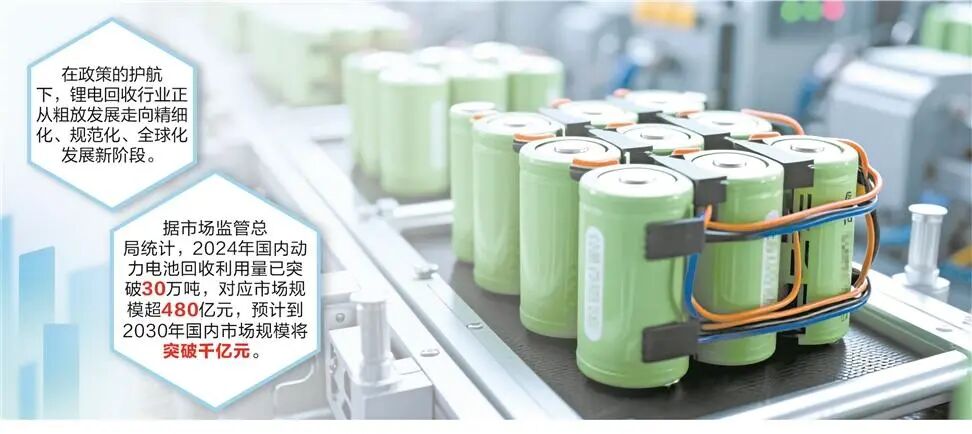
锂电回收行业迎来转机能源金属涨价推升“城市矿山”价值
Zheng Quan Shi Bao· 2026-01-09 23:02
Core Viewpoint - The lithium battery recycling industry is transitioning from extensive development to a new phase characterized by refinement, standardization, and globalization, driven by rising prices of lithium and cobalt, along with supportive policies [1][8]. Industry Overview - The lithium battery recycling sector is being recognized as a "urban mine," converting waste batteries into valuable, recyclable resources [1]. - A green circular market exceeding 100 billion yuan has emerged, reshaping the resource supply landscape in the new energy industry [1]. Profitability and Market Dynamics - The profitability of lithium battery recycling businesses has improved significantly due to increased retirement volumes and rising prices of lithium and cobalt [2]. - The price surge of energy metals has shifted the profit model from relying on subsidies to focusing on the intrinsic value of recycled materials, expanding profit margins for companies [2][3]. Policy Developments - New regulations have eased the import of recycled materials, allowing certain types of black powder to be imported without being classified as solid waste, thus facilitating the global resource allocation for China's battery recycling industry [2][3]. Capacity Expansion and Capital Operations - Leading companies are adopting a dual strategy of capacity expansion and capital operations to seize market opportunities, including new base construction and technology partnerships [4][6]. - Companies like Greeenme and Tianqi are actively pursuing acquisitions and financing to enhance their operational capabilities and market presence [4][5][6]. Technological Advancements and Industry Collaboration - The industry is evolving from merely end-of-life disposal to playing a crucial role in the entire battery lifecycle, with companies establishing comprehensive value chains [7]. - Greenme has achieved a lithium recovery rate exceeding 96.5% and has formed partnerships with over 1,000 automotive and battery manufacturers to create a closed-loop supply chain [7]. Market Outlook - The lithium battery recycling market is expected to grow at an annual rate exceeding 50% over the next 3 to 5 years, with the domestic market projected to surpass 100 billion yuan by 2030 [8].
锂电回收行业迎来转机 能源金属涨价推升“城市矿山”价值
Zheng Quan Shi Bao· 2026-01-09 17:44
Core Insights - The lithium battery recycling industry is evolving from a rough development phase to a more refined, standardized, and globalized stage, driven by rising prices of lithium and cobalt, along with supportive policies [1][7] - Major companies like Tianqi Co., Ltd. and Greeenme are expanding their capacities and capital operations to build competitive barriers through technological upgrades and industry chain extensions [1][2] Industry Trends - The prices of key metals such as lithium, cobalt, and nickel are expected to remain high due to global mining cycles and increased downstream energy storage demand, positively impacting cash flow and profitability for recycling companies [2][3] - The recycling business of Greeenme saw a significant increase in dismantling volume, reaching 36,000 tons in the first three quarters of 2025, a year-on-year surge of 59% [2] Policy Developments - In June 2025, the Ministry of Ecology and Environment, the Ministry of Industry and Information Technology, and the State Administration for Market Regulation announced that recycled black powder for lithium-ion batteries meeting national standards would not be classified as solid waste, facilitating imports [2][3] - The gradual relaxation of import policies for recycled resources reflects the government's emphasis on recycling and lithium battery recovery [3] Company Strategies - Greeenme is actively pursuing a dual strategy of capacity expansion and capital operation, including a planned acquisition of Henan Recycling Group to enhance its circular economy strategy [4][5] - Tianqi Co., Ltd. has established a processing capacity of 100,000 tons for waste lithium batteries, with plans for further expansion [5][6] Technological Advancements - Greeenme has developed a complete lifecycle value chain for battery recycling, achieving a lithium recovery rate exceeding 96.5% through innovative technologies [6] - The company collaborates with over 1,000 automotive and battery manufacturers to create a closed-loop supply chain, reducing risks associated with supply chain and metal price fluctuations [6] Market Outlook - The lithium battery recycling industry is expected to grow at an annual rate exceeding 50% over the next 3 to 5 years, with the market size projected to surpass 100 billion yuan by 2030 [7] - The industry is undergoing a transformation driven by price, demand, and policy changes, moving towards a more refined and standardized development phase [7]
天奇股份黄斌:锚定产业协同 掘金绿色智能新赛道
Shang Hai Zheng Quan Bao· 2025-12-21 18:13
Core Viewpoint - The company is confident in its future development, leveraging stable cash flow from intelligent equipment, capitalizing on the green low-carbon trend in lithium battery recycling, and positioning itself in future industrial scenarios with robotics, thereby advancing towards a new green and intelligent track [1][7]. Group 1: Business Strategy and Development - The company, founded in the 1980s, has evolved from a township enterprise to a well-known automated system equipment manufacturer listed on the Shenzhen Stock Exchange since 2004, focusing on automotive manufacturing equipment technology [2]. - The company has expanded its business model beyond automotive manufacturing to include lithium battery recycling and robotics, creating a synergistic ecosystem that enhances its core competitiveness [2][5]. - The lithium battery recycling business has developed a complete industrial chain from battery recovery to material manufacturing, significantly improving the company's market position [2][5]. Group 2: Technological Advancements and Market Position - The company is a pioneer in automated dismantling in the lithium battery recycling sector and has achieved a production capacity of 100,000 tons, with plans to reach full production by Q4 [4]. - The company has established long-term partnerships with major automotive manufacturers and battery producers, enhancing its channel development and market reach [5]. - The company has achieved a 95% recovery rate for battery-grade iron phosphate through technological improvements, positioning itself as a leader in the industry [5]. Group 3: Future Outlook and Market Opportunities - The company anticipates significant growth in its lithium battery recycling business, projecting substantial revenue increases by 2026, driven by the rising demand for recycled materials [5]. - The intelligent equipment business currently accounts for 70% of the company's revenue and is expected to grow further, with plans for international expansion, including a factory in Thailand [6]. - The robotics sector is projected to have a demand for over 100,000 units in automotive manufacturing alone, with potential market space exceeding 10 billion [6].
锂电回收拐点将至,天奇金泰阁启动资本赋能
高工锂电· 2025-12-16 10:27
Core Viewpoint - The article highlights the successful launch of capital operations by Tianqi Jintai Ge Group, marking a new phase of deep integration between industry and capital in the lithium battery recycling sector, which is undergoing significant restructuring and growth opportunities [2][4]. Industry Overview - The global energy transition and "dual carbon" goals are driving the importance of lithium battery recycling as a key component for national resource security and sustainable industrial development [4]. - The era of retiring batteries is approaching, with approximately 4 million new energy vehicles added in China from 2018 to 2020, leading to a significant number of batteries expected to retire between 2025 and 2027 [4]. Market Potential - Predictions indicate that the volume of retired power batteries will exceed 1 million tons by 2025, and by 2030-2032, the annual retirement scale could soar to 3.5 million tons, corresponding to a market size exceeding 100 billion yuan [5]. - The industry faces a "bad money drives out good" dilemma, with nearly 190,000 battery recycling companies in China, but only 156 recognized as compliant by the Ministry of Industry and Information Technology [5]. Company Positioning - Tianqi Jintai Ge has been a key player in the lithium battery recycling industry since 2004, evolving from a regional player to a leading enterprise after strategic control by Tianqi Co. in 2020 [5][6]. - The company is listed in the Ministry of Industry and Information Technology's compliance list and has established four production bases in Ganzhou, capable of processing hundreds of thousands of tons of waste lithium batteries annually [6]. Technological and Resource Advantages - Tianqi Jintai Ge demonstrates core competitiveness through self-developed recycling technology, achieving efficient recovery of cobalt, nickel, manganese, lithium, phosphorus, and iron [7]. - The company has built a global recycling network covering Japan, South Korea, Europe, the United States, and Southeast Asia, creating a dual-track resource recycling system [7]. Collaborative Ecosystem - The company has established long-term partnerships with major automotive manufacturers and battery material leaders, creating a closed-loop lithium battery recycling industry chain [7]. - The chairman of Tianqi Co. emphasized that the initiation of capital operations is a significant milestone in the company's development and a strategic move towards deep integration of "industry + capital" in lithium battery recycling [7]. Future Outlook - With the impending wave of over 1 million tons of retired batteries, the lithium battery recycling industry is poised for a golden period of scaled development [9]. - Tianqi Jintai Ge aims to leverage this capital operation to enhance technological innovation and deepen collaboration across the industry chain, contributing to sustainable development in the global energy system [9].

企业碳配额与产出挂钩不设总量上限,紫金赋能龙净逻辑不变且持续深化 | 投研报告
Zhong Guo Neng Yuan Wang· 2025-12-02 03:04
Industry Overview - The carbon quota allocation mechanism is linked to production output without a total carbon emission cap, focusing on intensity-based dynamic adjustments [1][2] - The allocation mechanism is based on the experience of the power generation industry, implementing free quota distribution based on carbon emission intensity control, with total quotas dynamically associated with industry production levels [2] - New key emission units in the steel, cement, and aluminum smelting industries must complete the first quota clearance for 2024 by 2025 [1][2] Company Tracking - Longking Environmental has seen significant shareholding increases from Zijin Mining, with stable leadership transitions expected to enhance Longking's business [3] - China Water Affairs reported a revenue of HKD 5.183 billion for FY26H1, a decrease of 12.9% year-on-year, with a net profit of HKD 571 million, down 24.4% year-on-year, primarily due to a decline in connection and construction activities [3] - The company has reduced capital expenditures by 31.8% to HKD 1.243 billion in FY26H1, while maintaining a dividend of HKD 0.13 per share, resulting in a dividend yield of 4.8% [3] Solid Waste Sector Insights - The solid waste sector has shown strong fundamentals in Q3 2025, with a 12% increase in net profit and a 2.7 percentage point increase in gross margin [3] - Free cash flow in the solid waste sector reached RMB 13.3 billion in Q1-Q3 2025, a year-on-year increase of 28%, with capital expenditures down 12% [3] - The average waste incineration companies' output per ton increased by 1.8% year-on-year in H1 2025, indicating operational efficiency improvements [3] Water Sector Insights - The water sector is expected to experience a cash flow turnaround, with significant increases in free cash flow anticipated starting in 2026 [4] - Recent water price reforms in major cities like Guangzhou and Shenzhen are expected to enhance revenue and profitability for water companies [5] - Recommended companies in the water sector include Yuehai Investment and Xingrong Environment, with a focus on improving cash flow and dividend payouts [5] Industry Tracking - The sales of new energy sanitation vehicles increased by 61.32% year-on-year in the first ten months of 2025, with a penetration rate of 18.02% [6] - The average price of biodiesel remained stable, while net profits per ton have declined [6] - Lithium carbonate prices have risen, improving profitability in lithium battery recycling [6]



钢铁水泥电解铝配额方案落地,高能布局金矿强化资源化协同,龙净国资增持价值 | 投研报告
Zhong Guo Neng Yuan Wang· 2025-11-25 02:02
Core Viewpoint - The report highlights significant growth in the environmental protection industry, particularly in the sanitation equipment and lithium battery recycling sectors, driven by increasing demand for new energy vehicles and rising lithium prices [1][3][7]. Industry Overview - Sanitation Equipment: In the first ten months of 2025, sales of new energy sanitation vehicles increased by 61.32%, with a penetration rate rising by 6.33 percentage points to 18.02%. Total sanitation vehicle sales reached 60,675 units, a year-on-year increase of 4.61%, with 10,931 units being new energy vehicles, marking a 63.32% increase [1][7]. - Lithium Battery Recycling: The price of lithium carbonate has risen, improving profitability. As of November 21, 2025, the weekly price of lithium carbonate was 92,400 (up 8.4% week-on-week), with cobalt and nickel prices at 405,000 and 116,700 respectively [1][7]. Investment Recommendations - Key Recommendations: Companies such as Hanlan Environment, High Energy Environment, Green Power Environmental Protection, and others are highlighted as key investment opportunities [2][4][5]. - Suggested Focus: Attention is drawn to companies involved in carbon monitoring and CCER asset appreciation, as well as those engaged in plastic recycling and energy-saving projects [3][4]. Financial Performance - Solid Waste Sector: The sector showed a 12% increase in net profit for the first three quarters of 2025, with a gross margin improvement of 2.7 percentage points. Free cash flow reached 13.3 billion, up 28% year-on-year [5][6]. - Water Sector: The water sector is expected to see a significant improvement in free cash flow, with a projected increase in dividend payout ratios as cash flow stabilizes [6]. Market Trends - Carbon Emission Quotas: The Ministry of Ecology and Environment has implemented a carbon emission quota scheme for the steel, cement, and aluminum industries for 2024 and 2025, which is expected to enhance the demand for carbon monitoring equipment [3][4]. - Price Adjustments: Recent price adjustments in water services in major cities are anticipated to support revenue growth and improve investment returns [6].