锋坦Frontier Pro PHEV

Search documents
日产汽车以“中国速度”驱动全球新征程
Guan Cha Zhe Wang· 2026-03-26 04:42
Core Viewpoint - In 2025, Nissan has successfully transformed its strategy in China, moving from merely being a sales terminal to becoming an innovation hub and export center, achieving a sales volume of 653,000 units with a 4.5% year-on-year growth in the second half of the year [1][27]. Group 1: Strategic Transformation - The "Re:Nissan" strategy, launched in May 2025, redefined the strategic significance of the Chinese market for Nissan, emphasizing action-oriented recovery and local team empowerment [4][29]. - This strategic shift acknowledges China's complete supply chain, consumer insights, and rapid technological iteration as critical to Nissan's global transformation [6][30]. - The new approach involves breaking away from traditional decision-making structures, fostering a "China innovation, global sharing" ecosystem [6][30]. Group 2: Product Development and Innovation - Nissan's success in China is attributed to the rapid development of new energy products that align with global trends, which are then exported back to international markets [7][31]. - Key models such as the N7, N6, and Frontier Pro PHEV have been developed to meet local consumer demands, showcasing Nissan's commitment to product excellence [10][34]. - The Frontier Pro PHEV, developed entirely by the local team, marks a significant shift in Nissan's product development strategy, allowing for specifications defined in China to be exported globally [13][41]. Group 3: New Ecosystem and Global Integration - The establishment of the LCV R&D center in Zhengzhou signifies a shift from being a passive receiver of global technology to an active innovator in the global automotive landscape [18][42]. - The formation of Nissan Import and Export (Guangzhou) Co., Ltd. in November 2025 represents a tangible step in implementing the "in China, for China, to the world" strategy, enhancing export capabilities [22][46]. - This new ecosystem integrates R&D, manufacturing, and export functions, positioning China as a key hub in Nissan's global value chain [18][42]. Group 4: Future Outlook - By summer 2027, Nissan plans to launch 10 new energy models in China and expand its export business, further solidifying its commitment to the Chinese market [25][49]. - The evolving competitive landscape in the automotive industry emphasizes the importance of understanding the Chinese market for gaining a competitive edge globally [25][49]. - Nissan's strategy reflects a broader trend of the Chinese automotive industry integrating into the global framework, highlighting the significance of local innovation [25][49].


日产汽车到2027年夏季将在中国投放10款新能源车型
Xin Jing Bao· 2026-02-05 15:01
Core Viewpoint - Nissan plans to launch 10 new energy models in China by summer 2027, enhancing its market coverage and accelerating global expansion through competitive products [1] Group 1: New Energy Models - By 2027, Nissan will introduce 10 new energy vehicles in the Chinese market to improve its segment coverage [1] - In 2025, Nissan will launch several models including the Nissan N7, Tianlai Hongmeng cockpit, Frontier Pro PHEV, and Nissan N6 in China [1] Group 2: Global Strategy - The establishment of Nissan Import and Export (Guangzhou) Co., Ltd. in September 2025 marks the implementation of Nissan's "global" strategy [1] - Products developed in China, such as the N7 and Frontier Pro, will be among the first models exported globally, expanding Nissan's international development path [1]
16.99万元起!郑州日产锋坦Frontier Pro全球首发,开启“潮玩由NI”皮卡新生活
Zhong Guo Qi Che Bao Wang· 2025-11-28 03:53
Core Viewpoint - The pickup truck market in China is evolving from a purely utilitarian vehicle to a multifunctional model that combines passenger and utility features, driven by consumer demand for lifestyle-oriented products [1][5]. Product Launch - Zhengzhou Nissan launched the Frontier Pro pickup truck, marking the first global debut of a Nissan pickup in China, with nine models available. The price range for the diesel version is 169,900 to 199,900 yuan, for the gasoline version is 176,900 to 196,900 yuan, and for the plug-in hybrid version is 189,900 to 249,900 yuan [3][19]. Brand Transformation - Zhengzhou Nissan is undergoing a transformation to adapt to market changes, emphasizing a new brand value proposition "潮玩由NI" (潮玩由NI), which reflects a shift towards a lifestyle-oriented approach for pickup trucks [5][7]. User Demand - Modern pickup truck users are looking for vehicles that not only perform well but also offer recreational and social features, moving beyond traditional utility [7][9]. Vehicle Features - The Frontier Pro is built on a global multi-terrain platform and offers a dual power matrix of gasoline and hybrid options. It integrates advanced technology, comfort comparable to high-end passenger cars, and leading-edge energy solutions [10][12]. Performance and Comfort - The Frontier Pro features a third-generation M9T diesel engine with 500N·m of torque, advanced off-road capabilities, and a fuel consumption of 8.1L/100km. It also includes high-quality seating and user-friendly cargo features [12][14]. Safety Standards - The vehicle boasts a high-strength steel body with a 70% high-strength steel ratio and advanced battery safety measures for the plug-in hybrid model, ensuring safety during off-road and heavy-load conditions [16]. Customization Options - Zhengzhou Nissan introduced two modified models, "锋坦云梦X" and "锋坦弯刀," designed for outdoor activities and comfort, showcasing the brand's commitment to expanding the pickup truck's lifestyle appeal [18]. Global Strategy - The Frontier Pro is the first Nissan pickup designed, developed, and produced in China, with plans for global export starting in 2026. This reflects Zhengzhou Nissan's strategic positioning in the global market [19][21]. Market Performance - In the first ten months of 2025, the Chinese pickup truck market saw sales of 481,000 units, with Zhengzhou Nissan among the top performers, indicating the effectiveness of its transformation strategies [21].

中国造,世界销 跨国车企出口力度拉满
Zhong Guo Qi Che Bao Wang· 2025-11-17 08:31
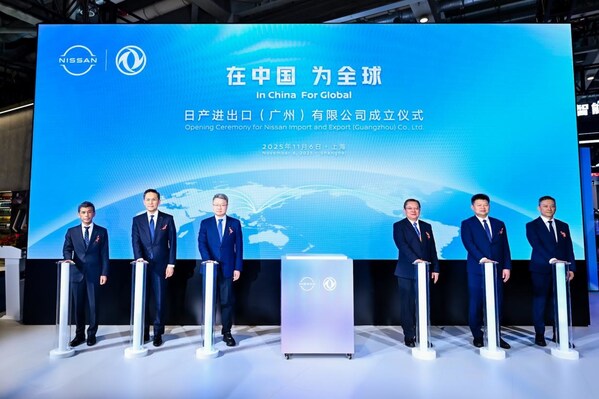
Core Insights - The establishment of Nissan Import and Export (Guangzhou) Co., Ltd. marks a significant milestone for Nissan's operations in China, being the first joint venture vehicle import and export company set up by a foreign automotive brand in China [2] - The shift of multinational automotive companies to use China as an export base reflects a strategic transformation in the global automotive industry and highlights the enhanced comprehensive strength of China's automotive sector [2][10] - The transition from "Made in China, Sold in China" to "Made in China, Sold to the World" is revitalizing the production capacity of multinational companies in China and facilitating China's evolution from a major automotive manufacturing country to a strong manufacturing country [2] Industry Trends - The Chinese automotive market has entered a phase of stock competition, with domestic brands gaining market share at the expense of foreign and joint venture brands, leading to a decline in market penetration for the latter [3] - In the first three quarters of this year, domestic brand passenger car sales reached 14.651 million units, a year-on-year increase of 22.9%, with a market share of 69%, up 5.1 percentage points year-on-year [3] - Multinational companies are facing approximately 10 million units of redundant production capacity in China, primarily in fuel vehicle production, with capacity utilization rates dropping from 73% in 2020 to 56% in 2024 [3] Company Strategies - Many multinational companies are closing or selling their factories in China due to declining sales and overcapacity, with General Motors' SAIC-GM shutting down its Beisheng factory in Shenyang as a notable example [4] - Nissan's establishment of its import and export company is part of a broader trend where multinational companies are optimizing production capacity and turning to exports to improve operational efficiency [4][5] - The Nissan N7, developed by a local team in China, represents a significant step in Nissan's strategy to export vehicles developed in China to global markets, showcasing the feasibility of local development models [9][10] Economic Advantages - The decision of multinational companies to use China as an export base is driven by the country's complete supply chain and cost advantages, which are difficult to replicate elsewhere [6][8] - China's automotive industry has developed a highly concentrated supply chain, allowing manufacturers to find nearly all suppliers within a short distance, significantly reducing logistics and communication costs [6] - Despite rising labor costs, the overall manufacturing costs remain competitive due to improved infrastructure, logistics efficiency, and economies of scale [8] Strategic Shift - The approach of multinational companies has evolved from tactical adjustments aimed at digesting excess domestic capacity to strategic layouts that leverage China's supply chain and R&D capabilities [12] - The shift in strategy reflects a recognition of the dual value of the Chinese market, where intense competition drives innovation and a robust supply chain offers significant cost and efficiency advantages [12]

进博会见证日产汽车深耕中国新进展:首创合资出口模式 驱动全球加速正增长
Zhong Guo Jin Rong Xin Xi Wang· 2025-11-13 03:22
Core Insights - Nissan's participation in the China International Import Expo (CIIE) marks its seventh appearance, showcasing a diverse product matrix and the establishment of Nissan Import and Export (Guangzhou) Co., Ltd, the first joint venture for vehicle import and export by a foreign automaker in China, indicating a shift from localized production to global output [1][10][13] Product Strategy - Nissan's exhibition at CIIE serves as a "technology roadmap" for understanding the Chinese market, emphasizing a diversified and intelligent approach to meet the growing consumer demand for smart, electric, and personalized mobility [3][10] - The Tianlai Hongmeng cockpit, the world's first fuel vehicle equipped with Huawei's Hongmeng cockpit, represents a leap from "physical comfort" to "intelligent comfort," addressing the "oil-electric intelligence" issue in traditional fuel vehicles [3][5] - The N7, Nissan's first pure electric sedan developed under the Dongfeng Nissan's new energy technology framework, has quickly become a bestseller in the joint venture electric vehicle market, showcasing its appeal to Chinese family users [5][10] - The N6, Nissan's first plug-in hybrid sedan, features a large 21.1 kWh battery to alleviate range anxiety, reflecting the company's deep understanding of Chinese family user needs [5][9] - The Frontier Pro PHEV, Nissan's first global pickup designed, developed, and produced in China, showcases the company's commitment to electric innovation and local R&D capabilities [7][9] Strategic Developments - The establishment of Nissan Import and Export (Guangzhou) Co., Ltd, with an investment of 1 billion yuan, signifies a new milestone in Nissan's strategy to export "China-made" vehicles globally, enhancing its role as a foreign automaker in China [10][11] - Nissan's global executive committee member and president of Dongfeng Motor Co., Ltd, emphasized China's role as a major automotive market and innovation engine, reinforcing Nissan's commitment to deepening its presence in China while connecting with global consumers [10][12] Local Empowerment and Future Vision - Under the "Re:Nissan" global strategy, the Chinese team has gained unprecedented autonomy in product definition and market strategy, allowing Nissan to respond swiftly to market changes and consumer needs [12][13] - Nissan aims to integrate "Chinese wisdom" into global innovation, as highlighted by the collaboration with local tech giants like Huawei, driving the development of new energy vehicles and export growth [12][13]
日产汽车宣布:45亿元出售总部大楼,半年净亏超100亿元
Mei Ri Jing Ji Xin Wen· 2025-11-07 13:48
Core Insights - Nissan Motor Co. announced the sale of its global headquarters building in Yokohama for 97 billion yen (approximately 4.5 billion RMB), with plans to continue using the building under a lease agreement [1] - The sale is part of Nissan's restructuring efforts, with expected special profits of 73.9 billion yen to be recorded in the fiscal year 2025 [1] - The funds from the sale will be allocated towards digital transformation and research and development [1] Financial Performance - Nissan reported a net loss of 221.9 billion yen (approximately 10.3 billion RMB) for the first half of the fiscal year 2025, a significant decline from a profit of 19.2 billion yen in the same period last year [5] - Global sales for Nissan in the second quarter were approximately 773,000 units, a year-on-year decrease of 4.5% [5] - The company forecasts total vehicle sales of 3.25 million units for the fiscal year 2025, with expected declines in key markets including China, Japan, and Europe [5] Cost-Cutting Measures - Prior to the headquarters sale, Nissan announced a restructuring plan that includes laying off 20,000 employees and closing seven factories, aiming to reduce costs by approximately 500 billion yen by the fiscal year 2026 [7] - The company recorded a net loss of 670.8 billion yen for the fiscal year 2024, marking its largest loss since inception [7] Market Strategy - Nissan is focusing on enhancing its competitiveness in the Chinese market through increased investment in electric vehicle (EV) technology [9] - The launch of the Nissan N7, an EV model under the Dongfeng Nissan brand, has seen positive sales performance, with over 36,000 units sold in the first nine months of 2025 [11] - Nissan has established a joint venture for vehicle import and export in China, marking a new phase in its global strategy [11]

日产汽车宣布:45亿元出售总部大楼!半年净亏超100亿元,此前宣布裁员2万人并关闭多家工厂
Mei Ri Jing Ji Xin Wen· 2025-11-07 12:29
Core Points - Nissan Motor Co. announced the sale of its global headquarters building in Yokohama for 97 billion yen (approximately 4.5 billion RMB), with plans to continue using the building under a lease agreement [1][3] - The buyer is a special purpose company established by Hong Kong automotive parts giant Minth Group, and Nissan expects to record a special profit of 73.9 billion yen from this sale in its fiscal 2025 consolidated financial statements [1][4] - The proceeds from the sale will be used to improve Nissan's financial situation and support digitalization and R&D efforts [1][4] Financial Performance - For the first half of fiscal 2025 (April to September), Nissan reported a net loss of 221.9 billion yen (approximately 10.3 billion RMB), a significant decline from a profit of 19.2 billion yen in the same period last year [4][6] - Global sales for the second quarter (July to September) were approximately 773,000 units, a year-on-year decrease of 4.5% [4][6] - Nissan forecasts total vehicle sales of 3.25 million units for fiscal 2025, with expected declines in key markets including China, Japan, and Europe [4][6] Restructuring Efforts - Nissan has initiated various cost-cutting measures, including a global workforce reduction of 20,000 employees and the closure of seven factories, aiming to reduce costs by approximately 500 billion yen by fiscal 2026 [6][7] - The company reported a record net loss of 670.8 billion yen for fiscal 2024, marking a 257.3% decline year-on-year [6] Strategic Initiatives - Nissan is focusing on electric vehicle (EV) development, with the launch of the Dongfeng Nissan N7, its first strategic EV model under the "Tianyan Architecture" [7][9] - The company is positioning the Chinese market as a key hub for its global operations, recently establishing Nissan Import and Export (Guangzhou) Co., the first joint venture for foreign automotive companies in China [9]

巨亏百亿,日产出售总部大楼,中国企业拿下
3 6 Ke· 2025-11-07 12:20
Core Viewpoint - Nissan Motor Company is selling its global headquarters building in Yokohama for 97 billion yen (approximately 4.5 billion RMB) as part of its restructuring efforts to improve financial conditions, while continuing to lease the building post-sale [1][3]. Financial Performance - For the first half of the fiscal year 2025 (April to September), Nissan reported a net loss of 221.92 billion yen (approximately 10.3 billion RMB), a significant decline from a profit of 19.22 billion yen in the same period last year [3][4]. - The company forecasts an operating loss of 275 billion yen for the entire fiscal year 2025, maintaining that it could achieve breakeven without tariff impacts [4]. Sales and Market Performance - In the second quarter of fiscal year 2025, Nissan's global sales were approximately 773,000 units, a year-on-year decrease of 4.5% [3]. - Sales by region showed a decline in China (158,000 units, down 8.1%), Japan (98,000 units, down 20.8%), and Europe (72,000 units, down 10.6%), while North America saw a slight increase (319,000 units, up 6.7%) [3]. Strategic Initiatives - Nissan is implementing a revival plan called "Re:Nissan," which includes global layoffs of 20,000 employees and the closure of seven factories to cut costs by approximately 500 billion yen by fiscal year 2026 [4]. - The company is focusing on electric vehicle (EV) development in China, with the launch of the Nissan N7, which has sold over 36,000 units in the first three quarters of 2025 [6]. Market Expansion - Nissan has established a joint venture, Nissan Import and Export (Guangzhou) Co., marking its first wholly foreign-owned vehicle import and export company in China, with plans to export locally developed models [6].
巨亏百亿!日产出售总部大楼,中国企业拿下
Mei Ri Jing Ji Xin Wen· 2025-11-07 11:29
Core Viewpoint - Nissan Motor Company is selling its global headquarters building in Yokohama for 97 billion yen (approximately 4.5 billion RMB) as part of its restructuring efforts to improve financial conditions, while continuing to lease the building post-sale [1][3]. Financial Performance - For the first half of the fiscal year 2025 (April to September), Nissan reported a net loss of 221.92 billion yen (approximately 10.3 billion RMB), compared to a profit of 19.22 billion yen in the same period last year [3]. - The company's global sales for the second quarter (July to September) were approximately 773,000 units, a year-on-year decrease of 4.5% [3]. - Nissan forecasts a total vehicle sales of 3.25 million units for the fiscal year 2025, with expected declines in key markets such as China (7.4%), Japan (3.4%), and Europe (3.1%) [4]. Strategic Initiatives - Nissan has initiated a revival plan called "Re:Nissan," which includes global layoffs of 20,000 employees and the closure of seven factories to reduce costs by approximately 500 billion yen by the fiscal year 2026 [4]. - The company aims to cut its global factory count from 17 to 10 by the fiscal year 2027 [4]. Market Position and Product Development - In the Chinese market, Nissan is focusing on electric vehicle (EV) development, launching the Dongfeng Nissan N7, which has seen positive sales performance with over 36,000 units sold in the first nine months of the year [5][6]. - Nissan has established a joint venture for vehicle import and export in China, marking a significant step in its strategy to leverage the Chinese market for global operations [6].
以进博为平台,全球汽车大秀中国“朋友圈”
Guo Ji Jin Rong Bao· 2025-11-07 10:56
Core Insights - The 8th China International Import Expo (CIIE) has opened in Shanghai, showcasing the integration of the Chinese automotive industry with global players, featuring 12 major foreign car manufacturers and over 4,108 overseas enterprises [1][2] Group 1: Event Overview - The automotive exhibition area covers over 430,000 square meters and serves as a platform for global automotive technology and collaboration [1] - The theme of this year's automotive section is "Mobility, Infinite Possibilities," highlighting a comprehensive ecosystem of automotive industry, future technologies, and automotive culture [2] Group 2: Long-term Commitment from Foreign Automakers - Long-standing participation from foreign car manufacturers demonstrates their confidence in the Chinese market, with companies like Hyundai showcasing innovative hydrogen-powered vehicles and Toyota presenting L4-level autonomous driving solutions [3] - Volkswagen has deepened its collaboration with local tech firms, focusing on local R&D and production, while BMW is integrating AI capabilities tailored to Chinese consumers [3] Group 3: Collaborative Upgrades - The expo has facilitated significant partnerships, such as FAW-Volkswagen's memorandum for diversified product imports and Nissan's establishment of a joint venture for vehicle exports [4] - The event has evolved from merely showcasing global technologies to becoming a platform for joint R&D and technological co-creation between Chinese and foreign enterprises [4] Group 4: Focus on Smart Driving Technologies - Smart driving technologies are a central theme, with Tesla unveiling its Cybercab and BMW collaborating with Alibaba to develop AI-driven solutions tailored for Chinese users [5] - The integration of foreign parts suppliers into the Chinese automotive supply chain is deepening, with companies like Michelin showcasing innovative products [5][6] Group 5: Globalization and Market Dynamics - The CIIE reflects the dual flow of "bringing in" and "going out," enhancing the vitality and resilience of China's automotive global network [7][8] - The shift from traditional fuel vehicles to new energy vehicles and from product trade to technology cooperation is evident, with Chinese companies increasingly becoming innovation engines rather than mere market recipients [8]