锐龙处理器

Search documents
AMD大中华区纪朝晖:AI Agent大时代需要什么样的设备?
Zhong Guo Ji Jin Bao· 2025-12-24 13:37
Core Insights - AMD's Vice President of Marketing for Greater China, Ji Zhaohui, emphasized the transformative impact of AI on various aspects of human life, including work, education, and art, during his speech at the "2025 Robotics Industry and AI Investment Forum" [1][2] - The forum aims to establish Hong Kong as a center for international innovation and cultural exchange, focusing on the integration of technology and art [1] AI and Chip Technology - AMD is positioned as a leader in high-performance and AI computing, with a commitment to addressing global challenges through its diverse product offerings [2] - The company aims to be an enabler in the AI era by providing comprehensive cloud-edge-end AI solutions, highlighting the necessity of chips as the driving force behind AI [2][4] - Ji Zhaohui noted that running AI agents requires powerful chips, with future interactions between humans and AI primarily occurring through AI smartphones and PCs [3][4] AI Agent Development - The transition from dialogue robots to true productivity tools hinges on the development of AI agents, which are expected to play a crucial role in various industries [2][3] - According to IDC, by 2025, 40% of U.S. enterprises and 27% of Chinese enterprises will utilize AI agents, significantly altering job structures and requirements [3] - The introduction of AI agents is anticipated to increase the usage and demand for intelligent systems in the world's top 2000 companies by tenfold by 2027 [3] Product Innovations - AMD's Ryzen AI Max+ 395 processor integrates the capability to run large AI models on a single chip, featuring a GPU performance comparable to RTX 4060-4070, enabling local deployment of models like GPT-4 [4][5] - The cost of AI devices has been significantly reduced, making it feasible for educational institutions to adopt AI models, thus accelerating AI deployment across various sectors [5] - AMD's product lineup includes Threadripper processors for workstations, EPYC processors for data centers, and Ryzen processors for desktops, establishing a strong presence in the film industry and contributing to digital restoration projects [6] Commitment to AI Development - AMD is responding to the Chinese government's "Artificial Intelligence +" initiative by launching the Spring Rain Program aimed at cultivating AI talent and fostering an open-source AI software ecosystem [6]

AMD大中华区纪朝晖:AI Agent大时代需要什么样的设备?
中国基金报· 2025-12-24 13:29
Core Viewpoint - The future of human scientific progress and technological innovation will largely revolve around AI, fundamentally transforming work, life, production, learning, and art, with chips serving as the essential AI engine [6][10]. Group 1: AI and Chip Technology - AMD is positioned as a leader in high-performance and AI computing, addressing significant global challenges with a diverse product portfolio in data centers and workstations [6]. - The CEO of AMD, Dr. Su Zifeng, views AI as the most important technological transformation in the last 50 years, even surpassing the internet [6]. - AI Agents are expected to transition from mere chatbots to genuine productivity tools, marking a critical shift in AI's integration across various industries [6][7]. Group 2: Market Trends and Projections - By 2025, 40% of U.S. enterprises and 27% of Chinese enterprises are projected to utilize AI Agents, with 40% of new jobs by 2026 requiring collaboration with AI [7]. - The usage and demand for intelligent agents among the world's top 2000 companies are expected to increase tenfold by 2027, with a thousandfold increase in workload [7]. Group 3: AI Interaction Interfaces - In the next 3 to 5 years, the primary interfaces for human-AI interaction will be AI smartphones and AI PCs, with smartphones focusing on learning and entertainment, while PCs will cater to work and content creation [8]. - To effectively run AI Agents, devices must deploy high-precision base models and integrate industry-specific knowledge, requiring 60GB to 100GB of memory [8]. Group 4: Product Innovations and Applications - AMD's Ryzen AI Max+ 395 processor integrates the capability to run large AI models locally, featuring GPU performance comparable to RTX 4060 to 4070, enabling deployment of models like GPT-4 [8][9]. - AMD aims to reduce the cost of AI devices to one-tenth of previous prices, facilitating the adoption of AI in educational settings and various industries [9]. - The company has also contributed to the digital restoration of historical artifacts, such as the murals in Yongle Palace, utilizing AI to recreate ancient colors [9]. Group 5: National Initiatives and Educational Programs - The Chinese government has launched the "Artificial Intelligence +" initiative, encouraging various industries to leverage AI, similar to the "Internet +" movement two decades ago [10]. - AMD has initiated the "Spring Rain Plan" aimed at cultivating AI talent in universities and fostering an open-source AI software ecosystem [10].


年薪4亿!美国芯片女王居然是中国人,在中国最艰难时她站了出来
Sou Hu Cai Jing· 2025-09-22 04:59
Core Insights - AMD, under the leadership of Dr. Lisa Su, transformed from a struggling company on the brink of bankruptcy to a market leader, at one point surpassing Intel in market capitalization [1][12][35] - Dr. Su's strategic decisions, particularly in the Chinese market, have sparked controversy amid U.S.-China tensions, yet she has maintained a focus on compliance and innovation [3][20][24] Company Overview - In 2014, AMD was facing severe financial difficulties, with stock prices plummeting to under $2 and a market cap of only $2-3 billion [4][12] - Dr. Su implemented significant reforms, focusing on high-performance computing and the development of the "Zen" architecture, which ultimately revitalized the company [7][12] Market Strategy - A crucial partnership in 2016 with China's Haiguang Technology, worth $293 million, provided AMD with essential funding and technology access [16][18] - Despite facing political backlash and accusations of aiding China, AMD has continued to pursue opportunities in the Chinese market, which accounted for 35% of its revenue in 2023 [22][24] Product Development - AMD has developed "China-specific" chips, such as the MI309, designed to comply with U.S. regulations while still serving the Chinese market [25][29] - The company is currently awaiting approval for the MI308 chip, which could restore shipments to China, highlighting its adaptive strategy in a challenging regulatory environment [29] Leadership and Vision - Dr. Su has positioned herself as a pragmatic leader, emphasizing the importance of market needs over political affiliations, while actively engaging with both U.S. and Chinese stakeholders [31][35] - Her compensation package remains among the highest globally, reflecting her success in increasing AMD's market value from billions to over $200 billion [35][37]

AMD 的盈利趋势:精明投资者的买入信号
美股研究社· 2025-05-16 12:07
Core Viewpoint - AMD reported a 36% year-over-year revenue growth in Q1 2025, reaching $7.4 billion, driven by strong performance in its data center and client segments [1][3]. Group 1: Financial Performance - Data Center revenue increased by 57% year-over-year to $3.67 billion, primarily due to higher sales of EPYC CPUs and Instinct GPUs [3]. - Client and Gaming segment revenue grew by 28% year-over-year, with client revenue up 68% to $2.3 billion, driven by strong demand for the latest 'Zen 5' Ryzen processors [5][6]. - Gaming revenue declined by 30% to $647 million, attributed to a decrease in semi-custom SoC sales [5][6]. - Embedded segment revenue decreased by 3% to $823 million, but demand is expected to recover in the second half of 2025 [6][8]. - Non-GAAP gross margin expanded by 140 basis points to 54%, although GAAP gross margin lags behind competitors like Nvidia and Broadcom [10][16]. - GAAP operating income rose from $760 million to $800 million, while non-GAAP operating income increased from $1.1 billion to $1.8 billion [16][20]. Group 2: Cost and Expenses - Non-GAAP operating expenses grew by 28% to $2.2 billion, while GAAP operating expenses increased by 16% to $2.9 billion [12][14]. - The company is investing heavily in marketing and R&D to capitalize on growth opportunities [14]. Group 3: Earnings and Cash Flow - GAAP diluted EPS increased by 528% to $0.44, exceeding analyst expectations [20]. - TTM cash flow from operations was $3.495 billion, with free cash flow at $2.753 billion [26]. - The company holds $7.31 billion in cash and short-term investments, with a debt-to-equity ratio of 0.08, indicating conservative financing [22]. Group 4: Market Outlook and Valuation - AMD's bond rating was upgraded to 'A' by S&P Global, reflecting strong growth prospects in the x86 product space and AI acceleration chip sales [24]. - The stock price increased by 1.76% following the earnings report, with a new $6 billion buyback plan announced [31]. - AMD's price-to-sales ratio is 6.053, significantly lower than its historical median, suggesting potential undervaluation [31]. - The company faces challenges in converting revenue growth into free cash flow and profitability compared to peers [40][41]. Group 5: Risks and Challenges - New export restrictions on the MI308 AI accelerator chip are expected to negatively impact revenue and gross margins in Q2 2025 [28][43]. - The gaming segment's revenue decline and embedded segment performance may hinder overall growth if recovery does not materialize [41]. - AMD must enhance its profitability and free cash flow generation to improve market valuation amidst intense competition [44].

周观点:海外云厂指引强劲,持续看好AI增长趋势
GOLDEN SUN SECURITIES· 2025-05-11 07:25
Investment Rating - The report maintains a "Buy" rating for several key companies in the semiconductor and cloud computing sectors, including SMIC, Weir Shares, Dongshan Precision, Shenghong Technology, Northern Huachuang, Zhongwei Company, Crystal Optoelectronics, and Lingyi Zhi Zao [9]. Core Insights - The report highlights a strong growth trend in AI investments from overseas cloud service providers (CSPs), with a projected capital expenditure of $640-720 billion from Meta and $100 billion from Amazon by 2025, indicating sustained optimism in the AI industry chain [1][36]. - Domestic foundries are expected to benefit from a return of orders due to localization trends, with SMIC and Huahong Semiconductor showing stable revenue growth [2]. Summary by Sections Overseas Cloud Providers - Microsoft reported FY25Q3 revenue of $70.1 billion, a 13% year-over-year increase, driven by strong demand for cloud services and AI products [13][20]. - Meta's Q1 revenue reached $42.314 billion, exceeding expectations, with a focus on AI development across five key areas [26][34]. - Amazon's Q1 revenue was $155.7 billion, with a strong performance in AWS, which saw a 17% year-over-year growth [37][41]. Domestic Foundries - SMIC's revenue showed stable growth despite short-term fluctuations, with a clear upward trend expected in the medium to long term due to increased domestic demand [2]. - Huahong Semiconductor reported consistent revenue and wafer shipment growth, indicating a robust operational capacity [2]. Key Companies and Their Performance - AMD achieved a record revenue of over $7.4 billion in Q1, marking a 36% year-over-year increase, driven by strong performance in the data center market [43]. - Shenghong Technology is highlighted as a potential beneficiary of the ongoing AI growth trend, alongside other key players in the semiconductor industry [1].




AMD(纪要):AI GPU 全年将实现两位数增长
海豚投研· 2025-05-08 00:58
Core Viewpoint - AMD reported a record revenue of $7.4 billion for Q1 2025, exceeding guidance and showing a year-over-year increase of 36% [2][3]. Financial Performance - Total revenue reached $7.4 billion, with a gross margin of 54%, up 1.4 percentage points year-over-year [2]. - Operating expenses were $2.2 billion, a 28% increase year-over-year, leading to an operating profit of $1.8 billion and an operating margin of 24% [2][4]. - Diluted earnings per share were $0.96, reflecting a 55% year-over-year increase [2]. Business Segments - **Data Center**: Revenue of $3.7 billion, a 57% year-over-year increase, driven by market share gains in server CPUs and growth in Instinct GPUs [3][9]. Operating profit was $932 million with a margin of 25% [3]. - **Client and Gaming**: Revenue of $2.9 billion, up 28% year-over-year, benefiting from strong demand for Ryzen processors [3][14]. Client revenue was $2.3 billion, a 68% increase, with over half of the growth attributed to high-end product price increases [3]. - **Embedded**: Revenue of $823 million, down 3% year-over-year, with an operating profit of $328 million and a margin of 41% [4]. Financial Position - Free cash flow was $727 million, with $749 million returned to shareholders through stock buybacks [4]. - Cash reserves at the end of the quarter stood at $7.3 billion, with total debt reaching $1.5 billion [4]. Outlook - For Q2, AMD expects revenue between $7.4 billion ± $300 million, with a non-GAAP gross margin forecast of 43% [5][6]. - The company anticipates a revenue impact of approximately $1.5 billion due to export license requirements for the year [6]. - Client and gaming segments are expected to see double-digit percentage growth, while data center revenue may decline due to the absence of MI308 revenue [7]. Executive Commentary - AMD's Q1 performance was strong despite regulatory challenges, with significant growth across data center, client, and gaming segments [8]. - The company highlighted robust demand for its EPYC processors and successful partnerships with major enterprises [9][10]. - The introduction of new AI solutions and the acquisition of ZT Systems are expected to enhance AMD's capabilities in the AI market [13].
AMD:“拿捏”了英特尔,还要给英伟达“上强度”?
3 6 Ke· 2025-05-07 03:51
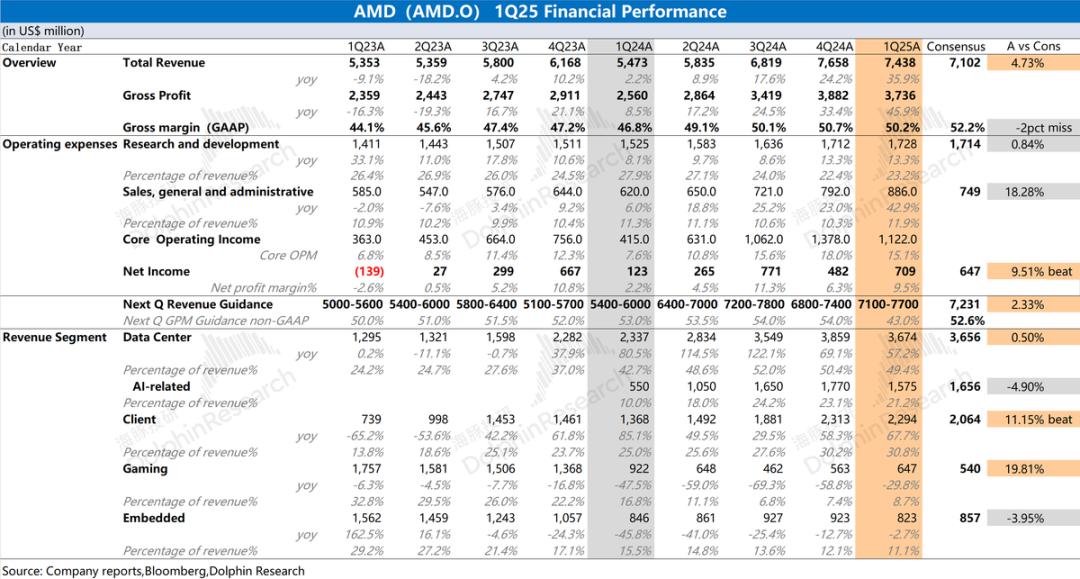
Overall Performance - AMD reported Q1 2025 revenue of $7.44 billion, a year-over-year increase of 35.9%, exceeding market expectations of $7.1 billion. The growth was primarily driven by the data center and client segments [1][7][4] - The company achieved a net profit of $710 million, with a core operating profit of $1.12 billion, reflecting a 170% year-over-year increase. The core operating margin was 15.1% [1][14][16] Revenue Breakdown - Client segment revenue reached $2.29 billion, up 67.7% year-over-year, significantly outperforming the global PC market's 5% growth. AMD's market share in the PC segment continues to rise [1][26][28] - Data center revenue was $3.67 billion, a 57.2% increase year-over-year, driven by increased shipments of AMD's CPU and GPU products. The company’s CPU market share has grown from around 10% to over 20% [1][20][30] - The gaming segment saw revenue decline to $650 million, down 29.8% year-over-year, primarily due to a drop in semi-custom product sales [33] - Embedded business revenue was $820 million, a slight decrease of 2.7% year-over-year, but signs of recovery are expected in the second half of 2025 [36] Guidance and Future Outlook - For Q2 2025, AMD expects revenue between $7.1 billion and $7.7 billion, which includes a $700 million impact from export restrictions on the MI308 product [2][4] - The company anticipates a non-GAAP gross margin of around 43%, which could improve to approximately 54% if the impact of sales license restrictions is excluded [3][4] - AMD's upcoming MI350 and MI400 products are highly anticipated, with expectations for increased performance in the AI GPU market, which could enhance competitive positioning against NVIDIA [20][25][5] Cost Structure - Operating expenses for Q1 2025 were $2.61 billion, a 22% increase year-over-year, with R&D expenses at $1.73 billion, up 13.3% [11][12] - The sales and administrative expenses rose to $890 million, reflecting a 42.9% increase, closely aligned with revenue growth [12][11] Market Position - AMD's CPU market share continues to grow, with significant gains in both the desktop and server markets, while the company faces challenges in the GPU segment where NVIDIA remains dominant [30][23] - The overall capital expenditure from major cloud providers reached $78.3 billion, indicating strong demand in the data center market, although AMD has yet to capture a larger share [23][25]

AMD:“拿捏”了英特尔,还要给英伟达“上强度”?
海豚投研· 2025-05-07 03:12
Overall Performance - AMD reported Q1 2025 revenue of $7.44 billion, a year-over-year increase of 35.9%, exceeding market expectations of $7.1 billion. The growth was primarily driven by the client and data center businesses [1][14] - The company achieved a net profit of $710 million, with a core operating profit of $1.12 billion, reflecting a 170% year-over-year increase [1][23] - Gross profit reached $3.74 billion, up 45.9% year-over-year, with a gross margin of 50.2%, slightly below market expectations of 52.2% [1][16] Business Segments Client Business - The client business revenue grew to $2.29 billion, a 67.7% year-over-year increase, significantly outperforming the global PC market, which saw a 5% increase in shipments [2][35] - AMD's market share in the desktop segment has surpassed Intel, contributing to the strong growth in the client business [7][40] Data Center Business - Data center revenue reached $3.67 billion, a 57.2% year-over-year increase, driven by sales of AMD Instinct GPUs and EPYC CPUs [2][28] - AMD's CPU market share in the data center has increased from around 10% to over 20%, although GPU sales have seen a slight decline due to anticipation of new product launches [7][29] Future Guidance - For Q2 2025, AMD expects revenue between $7.1 billion and $7.7 billion, which includes a $700 million impact from export restrictions on the MI308 product [3][6] - The company anticipates a non-GAAP gross margin of approximately 43%, which could improve to around 54% if the impact of sales license restrictions is excluded [4][6] Market Dynamics - The overall cloud market capital expenditure from major cloud providers reached $78.3 billion, a 64.4% year-over-year increase, indicating strong demand but also highlighting AMD's need to capture more market share [32] - AMD's gaming business saw a revenue decline of 29.8% year-over-year, attributed to reduced sales of semi-custom products despite growth in Radeon graphics card sales [41] Long-term Outlook - AMD is gradually establishing a competitive advantage in the CPU market, continuously gaining market share from Intel, which is expected to contribute positively to future earnings [9] - The company is focusing on AI GPU products, with significant expectations for the upcoming MI350 and MI400 series, which could enhance its competitive position against NVIDIA [9][34]