长安深蓝汽车

Search documents
智驾概念股早盘走高 国内首批L3级自动驾驶汽车开启规模化上路运行
Zhi Tong Cai Jing· 2025-12-29 02:22
Core Viewpoint - The news highlights the positive market response to the launch of L3-level autonomous driving vehicles in China, indicating a growing acceptance and regulatory support for advanced driving technologies in the automotive industry [1] Group 1: Market Performance - Intelligent driving concept stocks saw significant gains, with Youjia Innovation (02431) rising by 8.89% to HKD 13.6, Zhejiang Shibao (002703) increasing by 6.97% to HKD 5.22, and Tudatong (02665) up by 1.98% to HKD 10.82 [1] Group 2: Regulatory Developments - The first batch of L3-level autonomous driving vehicles, totaling 46 units, was officially launched for road use in Chongqing, approved for operation on specific urban expressways [1] Group 3: Industry Trends - According to Xinda Securities (601059), the regulatory framework for intelligent connected vehicles in China is continuously improving, leading to a more standardized industry environment [1] - Domestic brands are accelerating the research and development of intelligent driving technologies, with the penetration rate of L2-level and above driving assistance systems increasing rapidly [1] - The market for Robotaxi is projected to reach a scale of RMB 270 billion by 2030, indicating significant growth potential in the high-level autonomous driving sector [1]

汽车行业周报:首批L3级自动驾驶汽车在重庆规模化上路,电动汽车电耗新国标2026年起实施-20251228
KAIYUAN SECURITIES· 2025-12-28 14:46
Investment Rating - The industry investment rating is "Positive" (maintained) [1] Core Insights - The first batch of L3 autonomous vehicles has been approved for large-scale operation in Chongqing, with 46 vehicles equipped with L3 autonomous driving systems [5][13] - A new national standard for electric vehicle energy consumption will be implemented in 2026, tightening limits by approximately 11%, requiring two-ton vehicles to consume no more than 15.1 kWh per 100 km [14] - Changan Automobile's L3 approved models have undergone over 5 million kilometers of testing without any violations [15] - Toyota plans to exceed a global production of 10 million vehicles in 2026 to meet the growing demand for hybrid models, maintaining high production levels [20] - The automotive sector in China has seen a significant decline in imports, with a 30% year-on-year drop in the first 11 months of 2025 [19] Industry News Highlights - The first L3 autonomous vehicles are now operational in Chongqing, marking a significant milestone in autonomous driving technology [5][13] - The new electric vehicle energy consumption standard aims to enhance energy efficiency and support the high-quality development of the automotive industry [14] - Changan's L3 models have been validated through extensive testing, showcasing the company's commitment to safety and reliability [15] - Toyota's production strategy reflects its response to market demands and aims to sustain its competitive edge in the automotive industry [20] - The decline in vehicle imports indicates a shift towards domestic production and the growing strength of local automotive brands [19] Market Performance - The automotive sector outperformed the broader market, with a weekly increase of 2.66%, ranking 13th among A-share industries [6][32] - The passenger vehicle index rose by 2.87%, led by BYD and Haima Automobile [6][33] - The automotive parts sector saw a 3.57% increase, with significant gains in various sub-sectors [6][35] Investment Recommendations - For passenger vehicles, the demand for high-end domestic luxury cars is exceeding expectations, with recommendations for Jianghuai Automobile and Seres, while Geely is identified as a beneficiary [7] - In the automotive parts sector, companies like Desay SV and Zhejiang Xiantong are recommended due to their growth potential amidst industry changes [7]
中国首批,上路通行!
中国能源报· 2025-12-26 13:22
Group 1 - The first batch of L3-level autonomous driving vehicles in China has officially commenced large-scale road operation in Chongqing, with a total of 46 vehicles equipped with L3 autonomous driving systems from Changan Deep Blue [1] - These vehicles are authorized to operate on specific routes including the Chongqing Inner Ring Expressway, New Inner Ring Expressway, and Yudu Avenue [1]

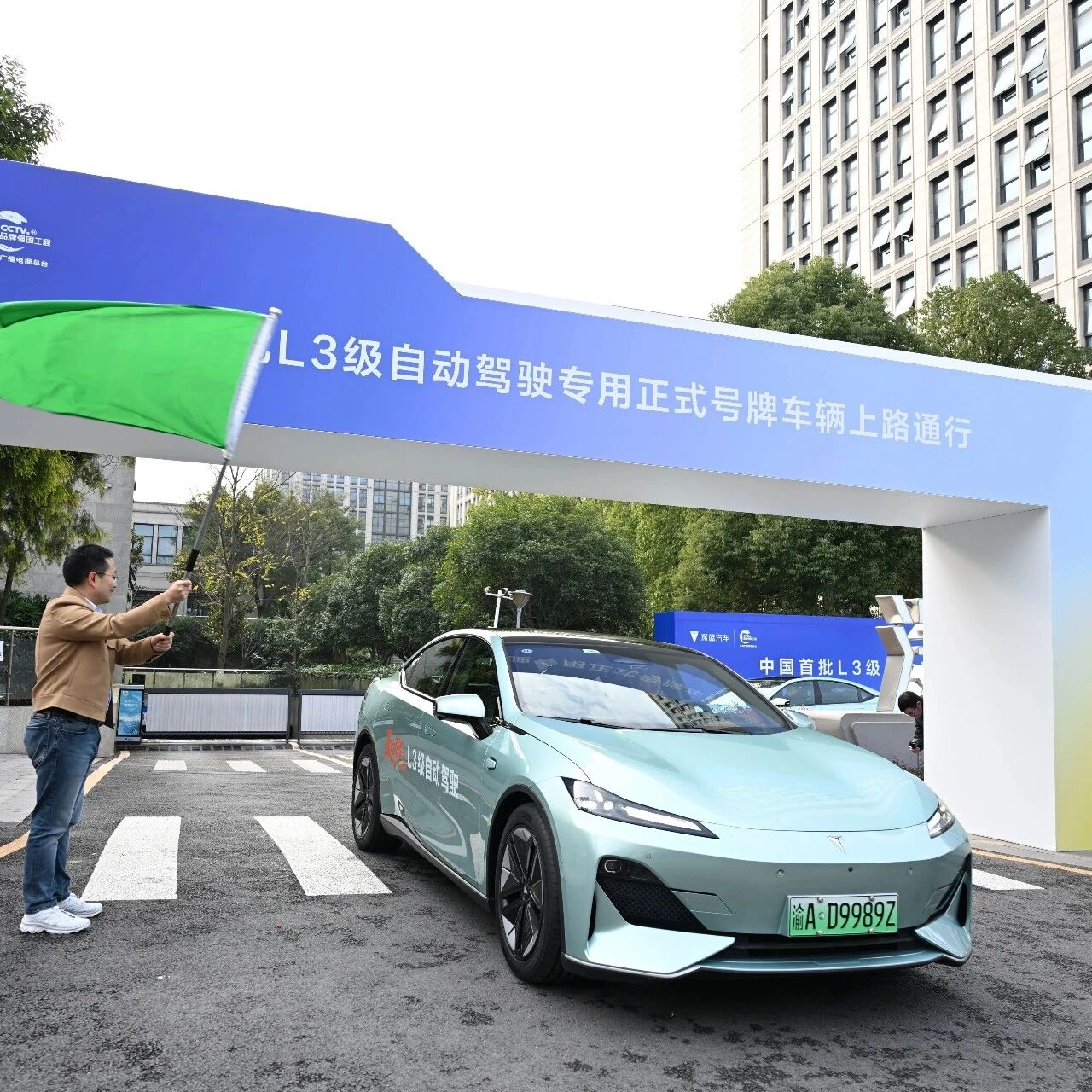
全国首块L3级自动驾驶专用号牌落地——从技术验证加速迈向量产应用
Xin Hua Wang· 2025-12-24 07:43
Core Insights - The first L3 conditional autonomous driving license "渝AD0001Z" has been issued in Chongqing, granted to Changan Automobile, marking a significant step towards the commercialization of autonomous vehicles in China [1][4] - The L3 level, defined as "conditional automation," allows vehicles to perform all dynamic driving tasks under specific conditions, although the driver must remain attentive and ready to take control when prompted by the system [1][2] Industry Developments - The Ministry of Industry and Information Technology has conditionally approved two automotive companies to submit applications for L3 autonomous driving vehicles, indicating a shift from technology validation to mass production applications in China's autonomous driving industry [1][2] - The automotive industry is increasingly focusing on smart technology, with China and the U.S. leading in intelligent driving, while Europe is making significant efforts to catch up [2] Regulatory Framework - The approval for the two models is not a blanket release; it includes specific regulations regarding operational scenarios, road types, urban areas, and speed limits [2][3] - The Changan SC7000AAARBEV model can operate in congested traffic at a maximum speed of 50 km/h on designated roads in Chongqing, while the Extreme Fox BJ7001A61NBEV model can achieve L3 automation at speeds up to 80 km/h on certain highways in Beijing [3] Operational Aspects - The two models are not available for private users but will be operated by affiliated ride-hailing service companies, which helps mitigate uncertainties during the initial rollout of L3 autonomous driving [3] - As the pilot programs progress and the industry gains a better understanding of safety risks, restrictions on these vehicles are expected to be relaxed, allowing for broader public access to autonomous driving technology [3][4] Government Support - The issuance of autonomous vehicle licenses reflects the government's commitment to fostering innovation while ensuring safety through prudent regulation [4] - This initiative is expected to stimulate technological innovation and upgrades within the automotive sector, aligning with the overall strategy of "institutional primacy, pilot breakthroughs, and gradual promotion" [4]
首块L3级自动驾驶专用号牌落地 从技术验证加速迈向量产应用
Jing Ji Ri Bao· 2025-12-23 22:34
Core Insights - The first L3 conditional autonomous driving license "渝AD0001Z" has been issued in Chongqing, granted to Changan Automobile, marking a significant step towards the commercialization of autonomous vehicles in China [1][4] - The L3 level, defined as "conditional automation," allows vehicles to perform all dynamic driving tasks under specific conditions, although the driver must remain attentive and ready to take control when prompted [1][2] Group 1: Industry Developments - The Ministry of Industry and Information Technology has conditionally approved two automotive companies to submit applications for L3 autonomous vehicle products, indicating a shift from technology validation to mass production applications in China's autonomous driving industry [1][2] - The approval of L3 autonomous vehicles is seen as a critical step towards industrialization, with pilot programs aimed at validating technology and establishing a foundation for large-scale applications [2][3] Group 2: Regulatory Framework - The licenses for the two models are not a blanket approval; they come with specific regulations regarding operational scenarios, road types, urban areas, and speed limits [2][3] - The Changan SC7000AAARBEV model can operate in congested traffic at a maximum speed of 50 km/h on designated roads in Chongqing, while the Extreme Fox BJ7001A61NBEV model can achieve L3 automation at speeds up to 80 km/h on certain highways in Beijing [3] Group 3: Operational Aspects - The two models will not be available for private users initially; instead, they will be operated by affiliated ride-hailing service companies to manage the deployment of L3 autonomous driving [3] - The operational management aims to reduce uncertainties associated with the initial rollout of L3 autonomous driving, allowing consumers to experience the technology through ride-hailing services [3] Group 4: Government Support and Future Outlook - The approval of autonomous vehicle products reflects the government's commitment to fostering innovation while ensuring safety through prudent regulation [4] - The ongoing pilot programs for smart connected vehicles are expected to inject strong momentum into technological innovation and upgrades within the automotive industry in China [4]

首块L3级自动驾驶专用号牌落地——从技术验证加速迈向量产应用
Jing Ji Ri Bao· 2025-12-23 22:09
Core Insights - The first L3 conditional autonomous driving license "渝AD0001Z" has been issued in Chongqing, granted to Changan Automobile, marking a significant step towards the commercialization of autonomous vehicles in China [1][4] - The L3 level, defined as "conditional automation," allows vehicles to perform all dynamic driving tasks under specific conditions, although the driver must remain attentive and ready to take control when prompted [1][2] Industry Developments - The Ministry of Industry and Information Technology has conditionally approved two automotive companies to submit applications for L3 autonomous driving vehicles, indicating a shift from technology validation to mass production applications in the autonomous driving sector [1][2] - The automotive industry is increasingly focusing on smart technology, with China and the U.S. leading in intelligent driving, while Europe is intensifying its efforts to catch up [2] Regulatory Framework - The approval for the two models is not a blanket release; it includes specific regulations regarding operational scenarios, road types, urban areas, and speed limits [2][3] - The Changan SC7000AAARBEV can operate in congested traffic at a maximum speed of 50 km/h on designated roads in Chongqing, while the Extreme Fox BJ7001A61NBEV can achieve up to 80 km/h on certain highways in Beijing [3] Operational Aspects - The two models are not available for private users but will be operated by affiliated ride-hailing service companies, which aims to reduce uncertainties in the initial rollout of L3 autonomous driving [3] - As the pilot progresses and the industry gains a better understanding of safety risks, restrictions may be eased, allowing autonomous driving to become more integrated into daily life [3] Government Support - The issuance of autonomous vehicle licenses reflects the government's commitment to fostering innovation while ensuring safety through prudent regulation [4] - This initiative is expected to stimulate technological innovation and upgrades within the automotive sector, aligning with the overall strategy of "system first, pilot breakthroughs, and gradual promotion" [4]
从技术验证加速迈向量产应用
Jing Ji Ri Bao· 2025-12-23 22:06
Core Insights - The first L3 conditional autonomous driving license "渝AD0001Z" has been issued in Chongqing, granted to Changan Automobile, marking a significant step towards the commercialization of autonomous vehicles in China [1][4] - The L3 level, defined as "conditional automation," allows vehicles to perform all dynamic driving tasks under specific conditions, although the driver must remain attentive and ready to take control when prompted [1][2] Industry Developments - The Ministry of Industry and Information Technology has conditionally approved two automotive companies to submit applications for L3 autonomous vehicles, indicating a shift from technology validation to mass production applications in China's autonomous driving industry [1][2] - The automotive industry is increasingly focusing on smart technology, with China and the U.S. leading in intelligent driving, while Europe is making significant efforts to catch up [2] Regulatory Framework - The approval for the two models is not a blanket release; it includes specific regulations regarding operational scenarios, road types, urban areas, and speed limits [2][3] - The Changan SC7000AAARBEV can operate in congested traffic at a maximum speed of 50 km/h on designated roads in Chongqing, while the Extreme Fox BJ7001A61NBEV can achieve L3 automation at up to 80 km/h on certain highways in Beijing [3] Operational Aspects - The two models are not available for private users but will be operated by affiliated ride-hailing service companies, which helps mitigate uncertainties during the initial rollout of L3 autonomous driving [3] - As the pilot programs progress and the industry gains a better understanding of safety risks, restrictions on these vehicles are expected to be relaxed, allowing for broader public access to autonomous driving technology [3][4] Government Support - The issuance of autonomous vehicle licenses reflects the government's commitment to fostering innovation while ensuring safety through prudent regulation [4] - This initiative is expected to stimulate technological innovation and upgrades within the automotive sector, aligning with the overall strategy of "institutional primacy, pilot breakthroughs, and gradual promotion" [4]
5月新能源车企销量:全线飘红下市场格局生变
经济观察报· 2025-06-06 13:48
Core Viewpoint - The new energy vehicle (NEV) market is experiencing a significant reshuffle, with new forces gaining market share and traditional automakers accelerating their transformation, indicating a deep adjustment period in the industry [3]. Group 1: New Energy Vehicle Sales Data - In May, NEV retail sales in China are expected to reach 980,000 units, a year-on-year increase of 22%, with a penetration rate of approximately 52.9% [2]. - The top new energy vehicle companies by sales in May are as follows: - Leap Motor: 45,000 units, up 148% year-on-year [4] - Li Auto: 41,000 units, up 17% year-on-year [4] - Seres: 37,000 units, up 35% year-on-year [4] - Xpeng Motors: 34,000 units, up 230% year-on-year [4] - Xiaomi Auto: 28,000 units, up 224% year-on-year [4] - NIO: 23,000 units, up 13% year-on-year [4]. Group 2: Market Dynamics and Company Performance - Leap Motor has maintained its leading position for three consecutive months, driven by popular models like the C10 and C11, with the C10 accounting for 30% of total sales [6][7]. - Li Auto's sales were boosted by the launch of the smart refresh version of its L series, with weekly sales exceeding 10,000 units [7]. - Seres' sales growth was supported by the successful launch of the 2025 version of the M9 model, which contributed significantly to its overall sales [7]. - Xpeng Motors' sales recovery is attributed to the introduction of lower-priced models, although it faces increasing pressure from competitors [8]. - NIO is undergoing internal restructuring to enhance brand synergy, aiming for a monthly sales target of 50,000 units by Q4 [9]. Group 3: Traditional Automakers' Performance - BYD remains the leader among traditional automakers, with May sales of 382,000 units, a 15% increase year-on-year, and a cumulative sales figure of 1.763 million units for the first five months, up 39% [12]. - Geely's May sales reached 138,000 units, a 135% increase, with the Galaxy series being the main sales driver [13]. - Changan Automobile sold 95,000 NEVs in May, a 70% increase, with significant contributions from its Changan Yuyuan and Deep Blue brands [14]. - SAIC-GM-Wuling sold 74,000 NEVs in May, primarily focusing on small electric vehicles, with expectations for further growth due to upcoming promotional activities [15]. - Chery's NEV sales in May were 63,000 units, a 48% increase, with a cumulative growth of 112% for the first five months [16]. - GAC Aion's sales declined by 33% in May, indicating challenges in its recovery phase [17]. - Other traditional brands like Extreme Fox and Lantu also reported significant sales growth in May, with Extreme Fox achieving a 200% increase [18].