
L3级自动驾驶系统

Search documents
汽车早报|李想回应理想汽车多名研发高管离职 宝马暂时放弃L3级自动驾驶
Xin Lang Cai Jing· 2026-03-13 00:41
Group 1: Automotive Market Performance - In February, China's automotive retail sales reached 1.043 million units, a year-on-year decline of 25.9% and a month-on-month decline of 33.1% [1] - Retail sales of new energy passenger vehicles in February were 464,000 units, down 32.0% year-on-year, while the total for January-February was 1.06 million units, a decrease of 25.7% [1] - Retail sales of conventional fuel passenger vehicles in February were 570,000 units, reflecting a year-on-year decline of 19% [1] Group 2: Company Financial Performance - Li Auto reported Q4 revenue of 28.775 billion yuan, a year-on-year decrease of 35%, with a net profit attributable to ordinary shareholders of 20 million yuan, down 99.4% [2] - For the full year 2025, Li Auto's revenue was 112.312 billion yuan, a decline of 22.3%, and net profit was 1.139 billion yuan, down 85.8% [2] - BMW Group's total revenue for 2025 was 133.453 billion euros, a year-on-year decline of 6.3%, with a net profit of 7.451 billion euros, down 3.0% [5] Group 3: Corporate Developments - Li Auto's CEO commented on the departure of several high-level executives, indicating that it presents opportunities for younger managers within the company [2] - BYD's executive stated that the transition between the first and second generation of blade battery production capacity is ongoing, with significant efforts in expansion and testing [2] - Hesai Technology announced that its second-generation solid-state radar FTX has been selected for Changan Automobile's next-generation L3 platform, with mass production expected to start in 2026 [3] Group 4: Strategic Changes and Initiatives - NIO Battery signed an agreement with Wuhan East Lake High-tech Zone for a new infrastructure project with a total investment of 9.8 billion yuan, aimed at serving NIO's BaaS users [4] - Honda announced the cancellation of plans to develop three electric vehicle models in North America due to a reassessment of its electrification strategy, anticipating financial losses for the fiscal year ending March 2026 [8] - Tesla Energy Ventures Limited received approval from the UK's energy regulator to supply electricity to homes and businesses across the UK, marking a significant expansion of its operations [8]




宝马暂时放弃L3级自动驾驶
新华网财经· 2026-03-12 14:15
Group 1 - The core viewpoint of the article is that BMW has temporarily deprioritized the development of L3-level autonomous driving technology due to its lack of commercial viability, but will continue to monitor advancements in this area and resume development once a feasible business model emerges [2][3] - BMW plans to replace the L3-level autonomous driving system "Personal Pilot L3" in the upcoming 7 Series model with an L2-level driving assistance system, citing high costs (e.g., an optional price of €6,000 in Germany) and limited user acceptance as reasons for this decision [2] - The new generation of BMW models will feature an advanced driving assistance system that allows intuitive interaction with the driver, including a hands-free driving function that complies with regulations for speeds up to 130 km/h [3] Group 2 - BMW is collaborating with Qualcomm in Europe and the U.S. to focus on the development and implementation of L2 and L2+ level autonomous driving technologies, while in China, it is working closely with Momenta to implement end-to-end L2+ level autonomous driving features [3] - The company plans to introduce over 40 new or updated models by 2027, including the first fully electric M model based on the new generation platform, which will have professional track capabilities [3] - According to BMW's financial report, the revenue for 2025 is projected to be €133.45 billion, a decrease of 6.3% year-on-year, with earnings before tax (EBT) at €10.236 billion, down 6.7%, and net profit at €7.45 billion, down 3.0% [3]



宝马暂时放弃L3级自动驾驶
第一财经· 2026-03-12 13:14
Group 1 - The core viewpoint of the article is that BMW has temporarily deprioritized the development of L3-level autonomous driving technology due to its lack of commercial viability, but will continue to monitor advancements in this area for future implementation [2][3]. - BMW plans to replace the previously intended L3-level autonomous driving system "Personal Pilot L3" in the upcoming 7 Series model with an L2-level driving assistance system, citing high costs and limited user acceptance as reasons for this decision [2]. - The new generation of BMW models will feature advanced driving assistance systems that allow intuitive interaction with drivers, including a hands-free driving function that complies with regulations for speeds up to 130 km/h [3]. Group 2 - BMW is collaborating with Qualcomm in Europe and the US to focus on the development of L2 and L2+ autonomous driving technologies, while in China, it is partnering with Momenta to implement end-to-end L2+ capabilities in new generation models [3]. - The company aims to introduce over 40 new or updated models by 2027, including the first fully electric M model based on the new generation platform, which will have professional track capabilities [3]. - According to BMW's financial report, the revenue for 2025 is projected to be €133.45 billion, a decrease of 6.3% year-on-year, with earnings before tax (EBT) at €10.236 billion, down 6.7%, and net profit at €7.45 billion, down 3.0% [3].

美系激进、欧系审慎、中国稳健:全球L3自动驾驶赛道会分化吗?
Guan Cha Zhe Wang· 2026-02-25 08:52
Core Viewpoint - Several American automakers are viewing L3 "eyes-off driving" autonomous driving as a commercial breakthrough, with Ford being the most proactive in this regard [1][3]. Group 1: Industry Developments - Ford's executives believe that L3 systems can allow drivers to divert their attention from the road for tasks like texting, only needing to take control when prompted by the system [1]. - General Motors is also advancing similar capabilities, aiming to transition from existing L2 systems to L3 experiences [3]. - In Europe, companies like BMW and Stellantis are adjusting their L3 projects due to cost and demand issues, while Mercedes-Benz is cautiously promoting its L3 systems in select regions [5]. Group 2: Technical and Economic Challenges - The main technical challenge for L3 autonomous driving is designing a system that can detect the need for human intervention and issue warnings while maintaining safe vehicle operation [3]. - The development cost for an L3 system for highway scenarios is estimated at $1.5 billion, which is about double that of L2 systems [6]. - The lack of a clear regulatory framework could expose companies to significant litigation risks, while clear rules could facilitate faster technology deployment [6]. Group 3: Market Implications - L3 represents a commercial model competition rather than just a technological upgrade, influencing consumer purchasing behavior [7]. - If L3 is successfully adopted, automakers may accelerate the shift towards "software-defined vehicles," potentially transitioning from hardware sales to ongoing service revenue [8]. - The industry's decision to adopt L3 may hinge on the balance between responsibility, cost, and the development of regulatory frameworks in various countries [9].

瞭望 | 重庆:“汽车产量第一城”的新跨越
Xin Hua She· 2026-02-24 09:14
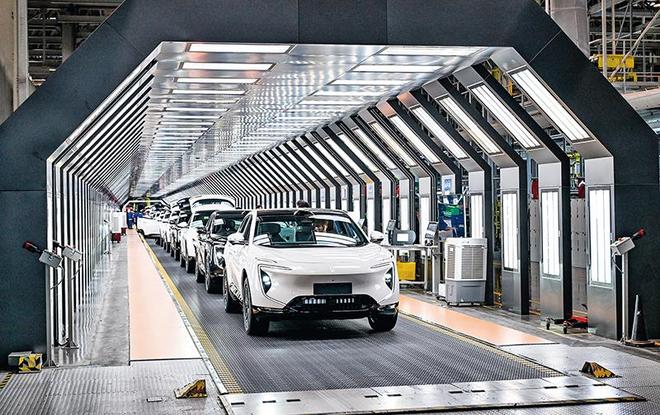
Core Insights - Chongqing aims to become a "smart connected new energy vehicle capital," focusing on both vehicle production and building a resilient full industry chain [1][4] - In 2025, Chongqing's automobile production reached 2.788 million units, a year-on-year increase of 9.7%, with new energy vehicles (NEVs) growing at a rate of 36% to 1.296 million units [1][4] - The automotive industry cluster in Chongqing has surpassed 800 billion yuan, driven by innovation and efficiency improvements [1][4] Industry Development - Chongqing's automotive industry faced challenges in the past due to a decline in production, but has now pivoted towards the "smart connected new energy vehicle" sector, leveraging advancements in technology [2][4] - Leading companies like Changan Automobile are implementing comprehensive reforms, achieving over 400 core technology breakthroughs in the NEV sector [2][4] - The production efficiency in Changan's smart factory has improved by over 50% compared to traditional factories [2] Technological Advancements - Changan Automobile's L3-level autonomous driving vehicle received the first official license in China, marking a significant milestone in the country's autonomous vehicle development [6] - The L3 system allows for driver disengagement under specific conditions, enhancing safety and operational efficiency [6][7] - Chongqing is integrating smart manufacturing across the entire production process, transitioning from traditional manufacturing to intelligent manufacturing [6][7] Supply Chain Resilience - The local supply chain for automotive components in Chongqing has stabilized at over 45%, with significant improvements in local sourcing capabilities [9][10] - The city is focusing on strengthening, supplementing, and extending its automotive supply chain, ensuring a self-sufficient and efficient ecosystem [9][10] - Collaborative platforms are being established to enhance communication between large and small enterprises, fostering innovation and resilience within the supply chain [10][11] Collaborative Ecosystem - Chongqing has formed an automotive product innovation alliance with the Chengdu region, promoting shared research and development efforts [11] - The city has attracted over 600 smart connected NEV component enterprises, creating a robust industrial ecosystem [11][12] - The government and industry stakeholders are working together to support various technological routes in the NEV sector, aiming for a comprehensive upgrade of the automotive ecosystem [12]
辅助驾驶事故刑责怎么认定?最高法首次发布指导性案例
Nan Fang Du Shi Bao· 2026-02-13 08:45
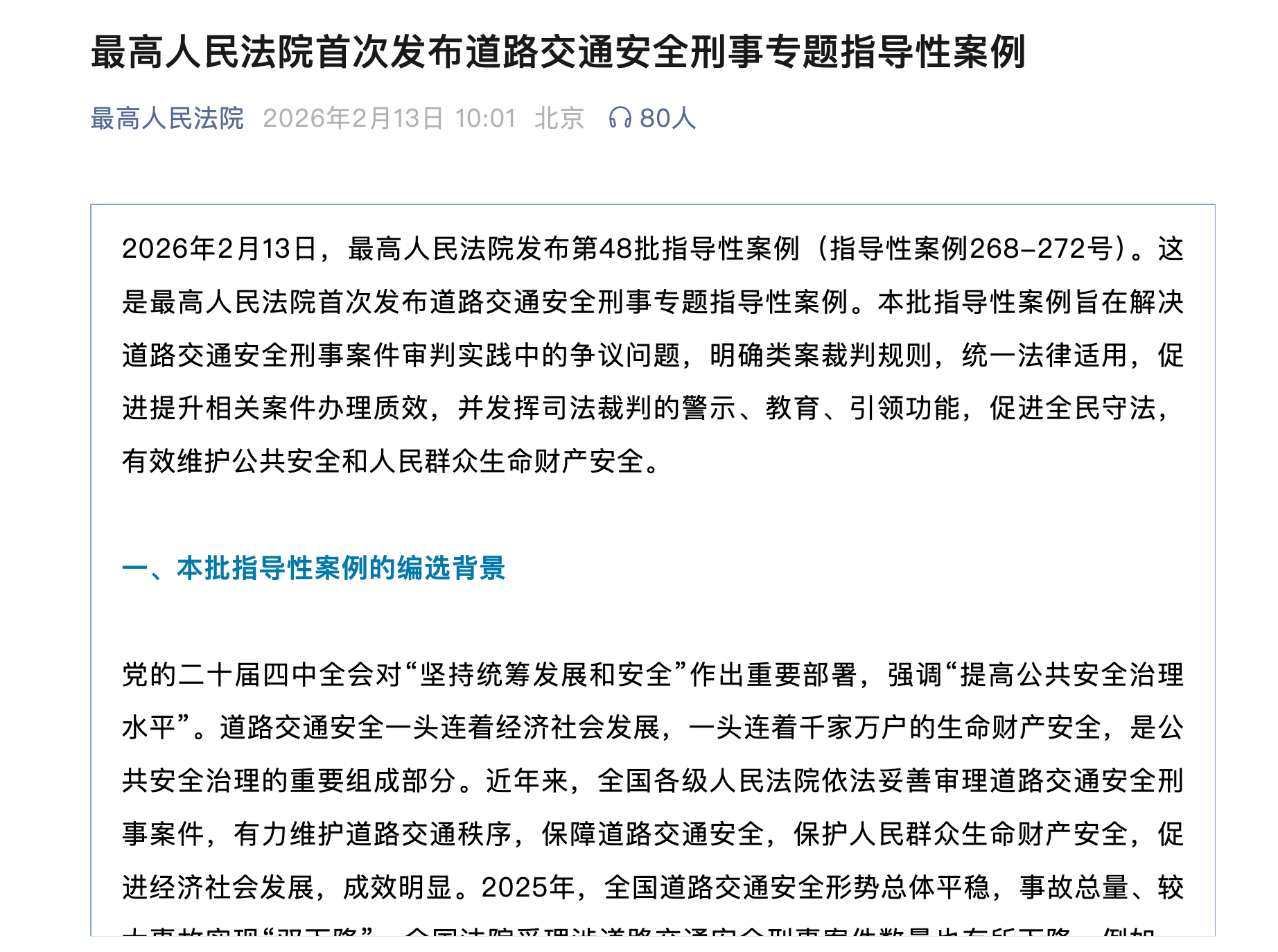
Core Viewpoint - The Supreme People's Court has released its first set of guiding cases specifically addressing criminal liability in traffic safety, particularly focusing on the responsibilities of drivers using advanced driver-assistance systems (ADAS) [1][6]. Group 1: Guiding Cases - The latest batch of guiding cases includes five cases, with a focus on criminal liability in traffic accidents involving ADAS [1]. - Case 271, involving a defendant who used an illegal device to evade monitoring while under the influence of alcohol, emphasizes that the driver remains responsible even when using ADAS [6]. Group 2: Legal Implications of ADAS - The ruling clarifies that activating ADAS does not transfer driving responsibility from the driver to the system; the driver must ensure safety regardless of the system's assistance [6]. - The case highlights the growing concern over drivers neglecting their responsibilities while using ADAS, leading to potential safety risks [6]. Group 3: Development of L3 Autonomous Driving - The transition to L3 autonomous driving is accelerating, with new models receiving approval for conditional automated driving capabilities [7]. - The legal framework for L3 and L4 levels of automation is still under development, with significant challenges in defining liability in the event of accidents [8]. Group 4: Regulatory Framework - The Ministry of Industry and Information Technology is working on establishing safety standards for L3 and L4 autonomous driving systems, which are crucial for the industry's healthy development [9][10]. - The government has recognized the need for a robust legal and regulatory framework to support the rollout of L3 autonomous vehicles [8].
为什么L3还没正式上路,汽车公司却要直接跳过?
3 6 Ke· 2026-01-28 12:04
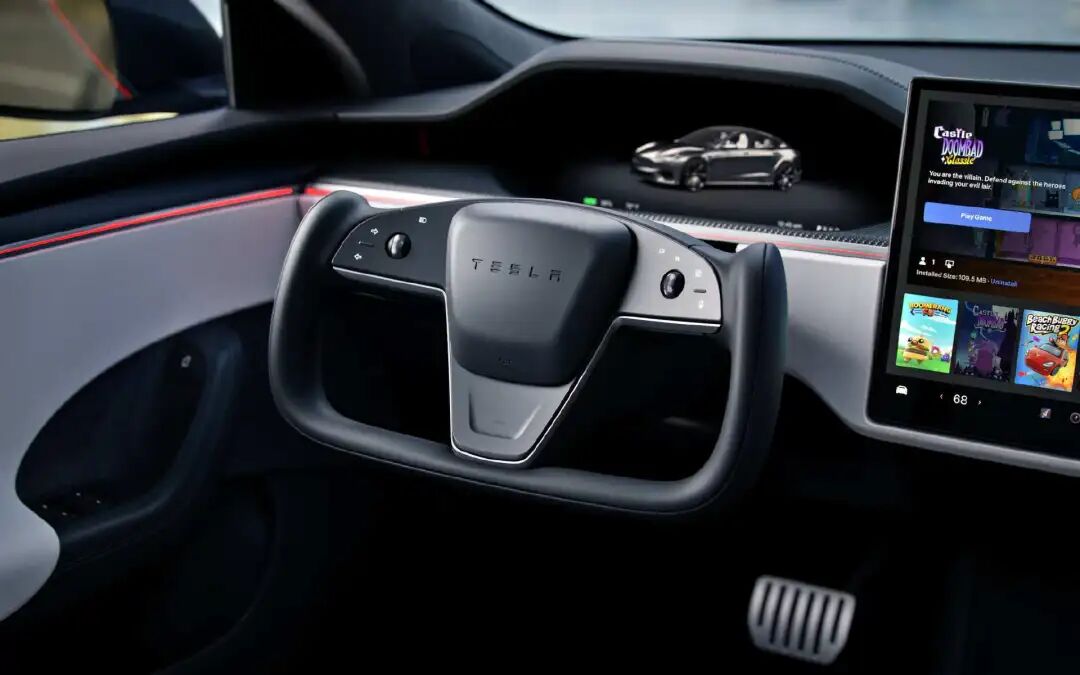
Group 1 - The automotive industry is divided on the approach to L3 and L4 autonomous driving, with some companies advocating for skipping L3 and moving directly to L4, while others are focused on accelerating the implementation of L3 [2][3] - Companies like Xiaopeng and Mercedes-Benz have expressed skepticism about L3, with Xiaopeng's founder stating that true fully autonomous driving will arrive by 2026, skipping L3 altogether [2][3] - In contrast, the Ministry of Industry and Information Technology in China has issued licenses for L3 vehicles, indicating a push towards practical implementation, with companies like BYD and Hongmeng already conducting extensive testing [2][8] Group 2 - The distinction between L3 and L4 is primarily based on legal and responsibility frameworks rather than clear technological differences, with L3 being seen as a limited version of L4 [4][6] - The current classification system for autonomous driving levels may not accurately reflect the technological capabilities, as many experts believe that the future will categorize driving into two main scenarios: driver assistance and true autonomous driving [4][6] - Despite the push for L3, regulatory hurdles remain significant, with companies facing lengthy approval processes and strict operational limitations even after receiving licenses [9][11] Group 3 - The market demand for L3 systems is currently insufficient, as evidenced by Mercedes-Benz's decision to pause its L3 rollout due to high costs and low consumer interest [13][14] - Tesla's Full Self-Driving (FSD) option has seen low adoption rates, prompting the company to shift to a subscription model to increase accessibility [14] - The timeline for mass production of L3 vehicles remains uncertain, with various interpretations of what "mass production" entails, leading to discrepancies between technical capabilities and regulatory approvals [15][16]



工信部定调高级别自动驾驶,L3级产业化按下“快进键”
2 1 Shi Ji Jing Ji Bao Dao· 2026-01-15 11:26
Core Insights - The launch of L3-level autonomous driving vehicles in Chongqing marks a significant milestone in the commercialization of advanced autonomous driving technology [1][2] - The Chinese government is actively supporting the development of high-level autonomous driving as part of its national industrial strategy [1][2] - The penetration rate of L2-level and above driving assistance features in new energy passenger vehicles reached 82.6% in the first half of 2025, indicating a shift towards accelerated development in automotive intelligence [1] Policy and Regulatory Developments - The Ministry of Industry and Information Technology (MIIT) has granted conditional licenses for L3-level autonomous driving vehicles, indicating a move from testing to limited commercial applications [2] - A report by the China Automotive Industry Association suggests the need for a clear management roadmap for autonomous driving levels, including safety responsibilities and market access standards [4] - The Shanghai "Mosu Zhixing" action plan aims to establish a collaborative data system for smart connected vehicles and enhance safety measures for autonomous driving [6][7] Industry Trends and Challenges - The transition to L3-level autonomous driving faces challenges such as the lack of formal standards and the need for safety supervision during operation [3] - The commercial viability of L3 systems is currently limited due to high development costs and regulatory constraints, with companies like Mercedes-Benz opting to focus on L2++ systems instead [8] - The Robotaxi segment is seen as the most promising area for early commercialization of autonomous driving technology, with companies competing on scalability [8][9] Market Projections - By 2030, the integration of advanced driving assistance and connected features is expected to create significant value in the automotive industry, with urban NOA becoming a mainstream function [5] - Companies like Baidu and WeRide are expanding their autonomous driving services globally, with Baidu reporting a 212% year-over-year increase in orders for its fully autonomous service [9] - The market is anticipated to see a shift towards L4-level autonomous driving within the next 2-3 years, with a focus on commercializing the Robotaxi business model [9]
L3上路试点,自动驾驶如何真正跑起来?
Yang Shi Xin Wen· 2026-01-09 01:03
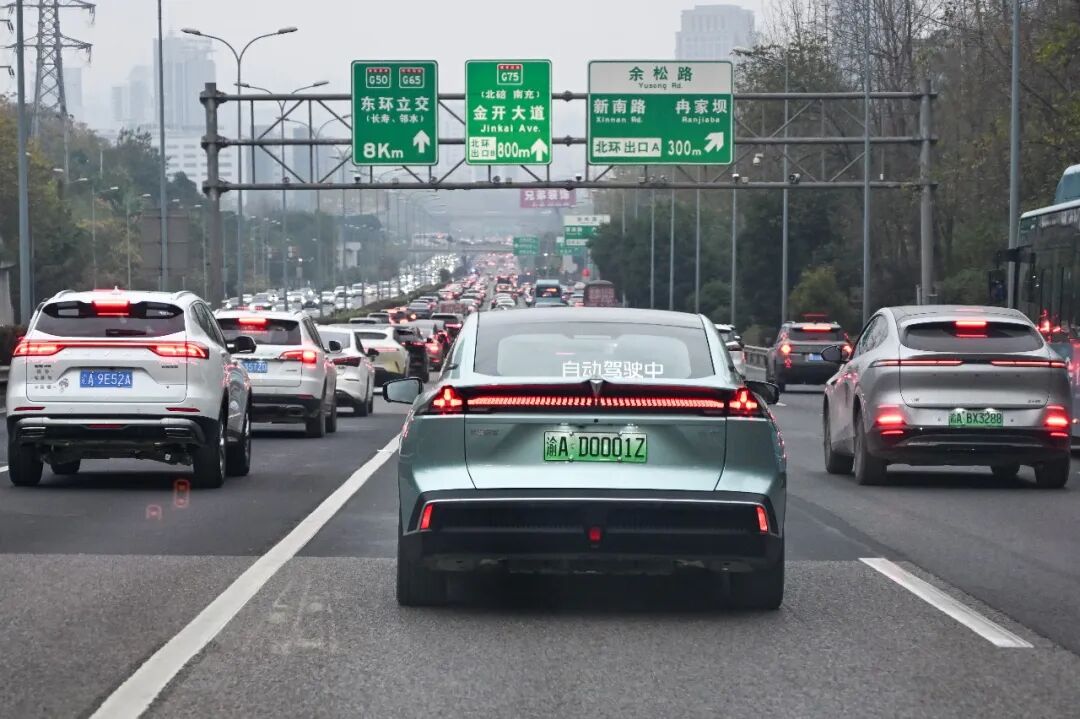
Core Viewpoint - The introduction of L3 level autonomous driving vehicles in Chongqing marks a significant step towards the commercialization of autonomous driving technology in China, with the first official license plate issued to Changan Automobile for its L3 vehicle [1][12]. Group 1: Definition and Classification of L3 Autonomous Driving - L3 level autonomous driving is classified as conditional automation, where the vehicle can drive itself in specific scenarios but requires the driver to take over when prompted by the system [3][5]. - The distinction between L2 and L3 levels lies in the role and responsibility of the driver versus the system, transitioning from "driver assistance" to "system-led" driving [3][5]. Group 2: Differences Between Testing and Pilot Programs - The L3 autonomous driving pilot program in Chongqing and Beijing involves vehicles that are mass-produced and issued formal vehicle licenses, unlike previous road tests that did not issue such licenses [6][7]. - The pilot program aims to transition from technical validation to mass application, focusing on safety and regulatory frameworks [6][7]. Group 3: Features and Performance of L3 Vehicles - The Changan SC7000AAARBEV model, one of the approved vehicles, demonstrated effective handling of various driving situations, including traffic congestion and sudden stops, showcasing its advanced autonomous capabilities [8][9]. - The vehicle is permitted to operate in specific congested areas with a speed limit of 50 km/h, emphasizing safety in complex driving conditions [9][11]. Group 4: Reasons for Chongqing's Leadership in Autonomous Driving - Chongqing's early adoption of supportive policies and regulations for autonomous driving testing has established a conducive environment for the development and application of such technologies [12][14]. - The city's unique geographical features provide a challenging testing ground for autonomous systems, allowing for thorough evaluation under diverse conditions [14][16]. Group 5: Future Considerations for Autonomous Driving in China - The successful implementation of L3 autonomous driving requires parallel advancements in legal regulations, traffic management, and public understanding of the technology [19][20]. - Clear definitions of responsibility in scenarios where human intervention is required are essential for the safe integration of autonomous vehicles into public roads [20][22].
四大证券报精华摘要:1月8日
Zhong Guo Jin Rong Xin Xi Wang· 2026-01-08 00:21
Group 1: Fund Market Dynamics - The fund issuance market in early 2026 shows a significant increase in activity, with FOF (Fund of Funds) products becoming a focal point for competition among banks and fund companies [1] - Several FOF products sold out quickly, indicating strong customer demand and a competitive landscape driven by product transformation and channel support [1] Group 2: A-Share Market Performance - On January 7, 2026, the A-share market experienced a volume increase with all three major indices rising slightly, driven by sectors related to the semiconductor industry [1] - The market saw over 2,100 stocks increase in value, with nearly 100 stocks hitting the daily limit, reflecting a significant rise in market risk appetite [1] Group 3: Foreign Exchange Reserves - As of December 2025, China's foreign exchange reserves reached $33,579 billion, an increase of $115 billion from the previous month, marking a 0.34% rise [2] - The increase in reserves was influenced by factors such as major economies' monetary policies and macroeconomic data, alongside fluctuations in asset prices [2] Group 4: AI and Manufacturing Integration - The Chinese government has set ambitious goals for the integration of AI and manufacturing, aiming for significant advancements by 2027, including the application of 3-5 general large models in the manufacturing sector [3] - The initiative includes the creation of 100 high-quality industrial data sets and the promotion of 500 typical application scenarios [3] Group 5: Hong Kong IPO Market - In 2025, Hong Kong's IPO market raised a total of HKD 285.8 billion, reclaiming its position as the top global market for IPOs [6] - The momentum continued into 2026 with new listings from domestic GPU and AI companies, establishing a strong technology focus for the year [6][7] Group 6: Commodity Market Trends - In 2025, major non-ferrous metals saw significant price increases, with London gold rising by 64.56% and silver by 147.79% [8] - Analysts predict that demand from emerging sectors like AI will drive a new commodity cycle in 2026, with industrial metal prices expected to rise due to ongoing supply constraints [8] Group 7: A-Share Dividend Trends - A-share listed companies set a new record for dividends in 2025, totaling CNY 2.61 trillion, a year-on-year increase of 8.75% [10] - The trend reflects a shift towards more structured and frequent cash dividends, driven by policy guidance and improved corporate governance [10]