非咖饮品

Search documents
外卖大战成“利润收割机”?瑞幸净利下跌
Jin Rong Jie· 2026-02-28 00:25
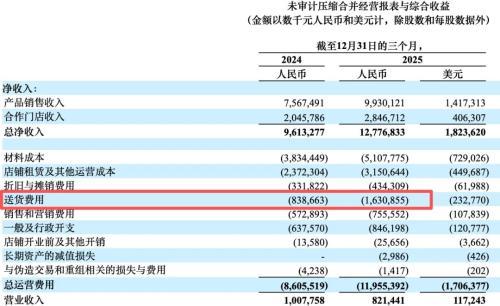
Core Viewpoint - Luckin Coffee achieved record revenue in 2025 but faced profit erosion due to the "delivery war," indicating a challenging balance between growth and profitability [1] Financial Performance - In Q4 2025, Luckin Coffee reported total net revenue of 49.288 billion RMB, a 43% year-on-year increase, with a net profit of 3.6 billion RMB, up 21.8%, but a declining net profit margin of 7.3% [1] - The company experienced a significant drop in net profit in Q4 2025, falling to 518 million RMB, a 39% year-on-year decrease [1][2] - The delivery costs surged to 1.631 billion RMB in Q4 2025, a 94.5% increase year-on-year, accounting for 12.8% of total revenue, compared to a normal rate of about 8% [2] Market Dynamics - The "delivery war" has negatively impacted Luckin's profitability, despite the company being a key partner for major internet platforms in the instant retail business [2][5] - The company’s sales and marketing expenses rose to approximately 756 million RMB in Q4 2025, a 31.9% increase, primarily due to higher commissions paid to third-party delivery platforms [6] Store Expansion and Performance - As of the end of 2025, Luckin Coffee had over 31,000 stores globally, with a net increase of 8,708 stores in the year, surpassing Starbucks' total store count in China over 27 years [7] - Despite the rapid expansion, same-store sales growth was only 1.2% in Q4 2025, indicating challenges in maintaining sales performance amid increased competition [11] Competitive Landscape - Luckin Coffee faces intensified competition from brands like Kudi Coffee and Nova Coffee, which are expanding rapidly and impacting Luckin's market share [11] - The company has launched over 140 new products in the past year, with non-coffee products now accounting for over 20% of sales, but few have gained significant market recognition [10] Future Outlook - Management indicated that gaining market share remains a priority, but acknowledged potential challenges in same-store sales and profit performance in 2026 due to high baseline from 2025's subsidies [12] - Luckin Coffee is accelerating its international expansion, with 160 overseas stores, but the focus remains on the Chinese market as the most promising for growth [13]


外卖大战成“利润收割机”?瑞幸净利暴跌39%
Guo Ji Jin Rong Bao· 2026-02-27 16:00
Core Viewpoint - Luckin Coffee achieved record revenue in 2025 but faced profit erosion due to the "delivery war," indicating a challenging balance between growth and profitability [1] Financial Performance - Total net revenue for 2025 reached 49.288 billion RMB, a 43% year-on-year increase, while net profit was 3.6 billion RMB, up 21.8%, but net profit margin fell to 7.3%, marking a decline for two consecutive years [1] - In Q4 2025, net profit dropped to 518 million RMB, a 39% year-on-year decline, reflecting a trend of "increased revenue without increased profit" that began in Q3 [1][4] - Q4 delivery fees surged to 1.631 billion RMB, a 94.5% increase year-on-year, accounting for 12.8% of total revenue, compared to a normal rate of about 8% [4][6] Market Dynamics - The "delivery war" significantly impacted profitability, with increased costs from delivery fees and commissions to third-party platforms [4][7] - Despite profit pressures, the company maintained a high growth trajectory, with over 31,000 stores globally by the end of 2025, including 65% self-operated and 35% franchised [9][10] Competitive Landscape - The company faces intensified competition from brands like Kudi Coffee and Nova Coffee, which are rapidly expanding and affecting Luckin's market share [11] - The introduction of over 140 new products in the past year has not significantly strengthened the brand's competitive position, as few products have gained notable market recognition [11] Future Outlook - Management emphasized that gaining market share remains a top priority, but acknowledged potential fluctuations in same-store sales and profit due to high baseline effects from 2025's subsidies [14] - The company is accelerating international expansion, with 160 overseas stores, including 81 in Singapore, but has not outlined a clear strategy for this growth [14]
从星巴克合营看洋品牌的本地化生死局
Sou Hu Cai Jing· 2025-11-05 07:41
Core Insights - Starbucks has announced a strategic partnership with Boyu Capital to establish a joint venture for its retail operations in China, with Boyu holding up to 60% of the equity [1] - This move reflects a broader trend among foreign brands in China, emphasizing the importance of local partnerships and operational control to navigate market challenges [2][3] - The joint venture represents a shift from a heavy asset model to a lighter asset approach, allowing Starbucks to maintain brand ownership while reducing operational burdens [8] Company Challenges - Starbucks' "third space" model is showing signs of fatigue in the Chinese market, with high operational costs and strategic indecision impacting its performance [4] - The company has faced increased competition from local brands and lower-priced competitors, leading to a paradox of rising transaction volumes but declining average spending [6][7] - Despite a growing coffee consumer base in China, Starbucks struggles to maintain its market position amid fierce competition from brands like Luckin Coffee [6][7] Capital Strategy - The joint venture with Boyu Capital allows Starbucks to transition from a heavy asset operation to a model focused on revenue sharing and brand licensing, optimizing risk and returns [8][9] - Starbucks will retain 40% equity in the joint venture and continue to earn licensing fees, ensuring a stable cash flow while benefiting from market growth [9] - This partnership aligns with a trend among foreign brands in China, where capital cooperation has become essential for navigating complex market dynamics [10][12] Market Dynamics - The competitive landscape in China is intensifying, with independent coffee brands and fast-food chains aggressively targeting the same consumer base [6][7] - The rise of local competitors has led to a significant increase in the number of coffee drinkers, yet Starbucks has not capitalized on this growth effectively [6][7] - The operational model of local brands, which often includes flexible pricing and strategic location choices, poses a significant challenge to Starbucks' traditional high-end positioning [6][7] Lessons from Other Brands - Other foreign brands like McDonald's and Yum China have successfully implemented local partnerships to enhance operational efficiency and market penetration [10][11] - The experiences of these brands highlight the importance of balancing local operational control with maintaining brand integrity and long-term value [12][18] - Successful models involve a mix of equity sharing and licensing fees, allowing for both local responsiveness and stable revenue streams for the parent company [10][11][18]

星巴克中国第四季度新开183家门店
Bei Jing Shang Bao· 2025-10-30 07:07
Core Insights - Starbucks reported a 6% year-over-year growth in the Chinese market for Q4 of fiscal year 2025, reaching $831.6 million [1] - The total revenue for fiscal year 2025 was $3.105 billion, reflecting a 5% increase compared to the previous year [1] - Same-store sales in China experienced a positive growth of 2% for the second consecutive quarter, with a 9% increase in transaction volume year-over-year [1] Revenue and Growth - The growth momentum in China is attributed to innovations in non-coffee beverages, price adjustments, and the rising demand for the "Starbucks Delivery" service [1] - In Q4, Starbucks opened 183 new stores and entered 47 new county-level markets [1] - For the entire fiscal year 2025, the net increase in stores was 415, including unique concept stores in locations such as Hangzhou and Huangshan [1] Store Expansion - As of the end of fiscal year 2025, Starbucks operated 8,011 stores across 1,091 county-level cities in China [1]
星巴克中国2025财年收入增5%达31亿美元,新开门店415家
Zhong Guo Jing Ying Bao· 2025-10-30 05:55
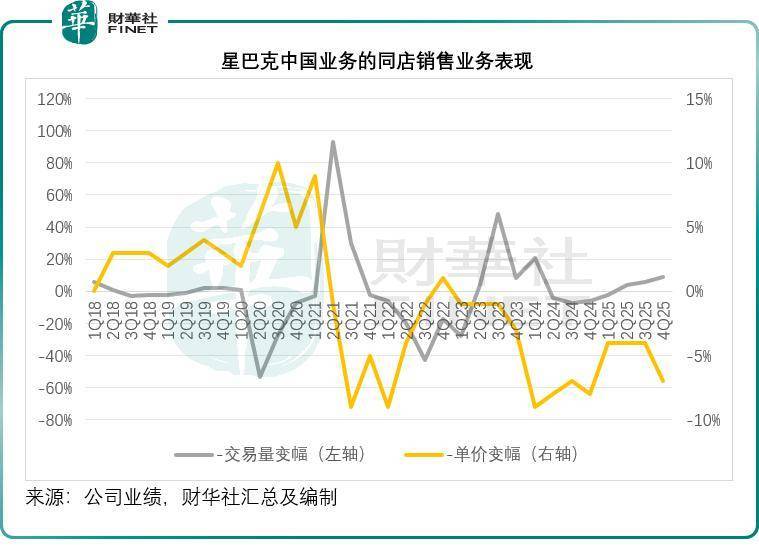
Core Insights - Starbucks China reported a 5% year-over-year revenue growth for the fiscal year 2025, reaching $3.105 billion [1] - The CEO emphasized the importance of agile product optimization and pricing strategies in response to market changes, alongside strong economic benefits from new store openings [1] Financial Performance - In Q4 of fiscal year 2025, Starbucks China achieved a 6% year-over-year revenue increase, totaling $830 million (approximately 5.9 billion RMB) [1] - Same-store sales grew by 2%, with a 9% increase in transaction volume, although the average ticket price decreased by 7% year-over-year [1] Store Expansion - Starbucks opened 183 new stores in Q4, entering 47 new county-level markets [1] - The total net new stores for fiscal year 2025 reached 415, with a total of 8,011 stores across 1,091 county-level cities by the end of the fiscal year [1] Growth Drivers - The growth momentum is attributed to innovations in non-coffee beverages, price adjustments, and the rapidly growing demand for the "Starbucks Delivery" service [2] - The company plans to strengthen its third space strategy and deepen connections with local cultures [2]

星巴克中国2025全财年收入同比增长5%
Zhong Guo Jing Ying Bao· 2025-10-30 05:48
Core Insights - Starbucks China reported a 5% year-on-year revenue growth for the fiscal year 2025, reaching $3.105 billion [2] - The CEO of Starbucks China emphasized the importance of agile product optimization and pricing strategies to adapt to the rapidly changing market [2] Financial Performance - In Q4 of fiscal year 2025, Starbucks China's revenue grew by 6% to $830 million (approximately 5.9 billion RMB), marking four consecutive quarters of year-on-year growth [2] - Same-store sales increased by 2%, with same-store transaction volume rising by 9%, although the same-store average ticket price decreased by 7% [2] Store Expansion - Starbucks achieved a sequential increase in operating profit and profit margin for four consecutive quarters [2] - In Q4, 183 new stores were opened, entering 47 new county-level markets, with a total of 415 net new stores added throughout fiscal year 2025 [2] - By the end of fiscal year 2025, Starbucks operated 8,011 stores across 1,091 county-level cities in China [2] Growth Drivers - The sustained growth momentum is attributed to innovation in non-coffee beverages, price adjustments, and the rapidly growing demand for the "Starbucks Delivers" service [2] - The company plans to continue enhancing its third space strategy and deepen connections with local cultures [2]