
高安全聚合物电池

Search documents
在激烈国际竞争中赢得战略主动——加快高水平科技自立自强,引领发展新质生产力
Ren Min Ri Bao· 2025-11-25 07:56
Core Viewpoint - Achieving high-level technological self-reliance and strength is crucial for China's modernization efforts, as emphasized by President Xi Jinping [2]. Group 1: Technological Self-Reliance - The "14th Five-Year Plan" emphasizes technological self-reliance as a strategic support for national development, while the "15th Five-Year Plan" aims to accelerate high-level technological self-reliance to lead new productive forces [2]. - Over the past five years, China has made significant technological innovations, laying a solid foundation for further advancements [2]. - The "15th Five-Year Plan" suggests consolidating advantages, breaking bottlenecks, and enhancing weaknesses to gain strategic initiative in international competition [2]. Group 2: Key Technological Breakthroughs - The Chinese Academy of Sciences announced a breakthrough in producing large-area two-dimensional metallic materials, challenging traditional views on metal forms [3]. - Key core technologies must be developed through independent innovation to solve critical issues, as highlighted by advancements in the BeiDou navigation system and domestic operating systems [4]. - A new type of fluorinated polyether electrolyte has been developed, paving the way for high-safety, high-energy-density solid-state lithium batteries [5]. Group 3: Strengthening Basic Research - Basic research funding has increased by over 70% since 2020, with China leading in high-level international journal publications and patent applications for five consecutive years [6]. - The "15th Five-Year Plan" calls for a strategic, forward-looking, and systematic approach to enhance basic research and original innovation capabilities [6]. - Emphasis on original innovation is crucial for driving development, with a focus on creating more landmark original achievements [7]. Group 4: Competing in High-Tech Fields - China has made significant strides in high-tech fields, with over 20 companies recognized in TIME magazine's list of the best inventions for 2025, particularly in AI and robotics [8]. - Major technological achievements include the successful launch of the Shenzhou 21 manned spacecraft and the completion of the "Deep Sea No. 1" gas field, showcasing China's advancements in aerospace and deep-sea oil and gas development [9][8]. Group 5: New Quality Productive Forces - The integration of technology and industry is accelerating, with the "new economy" expected to contribute over 18% to GDP by 2024, driven by AI, renewable energy, and biotechnology [13]. - The development of new quality productive forces is essential for high-quality growth, focusing on improving total factor productivity [13]. - The importance of enhancing the "green attributes" of products is highlighted by the introduction of carbon footprint reports for exports [11]. Group 6: Innovation Ecosystem - The need for a complete innovation ecosystem is emphasized, moving from isolated breakthroughs to a systematic approach that includes collaboration between government, academia, and industry [9]. - Strengthening the role of enterprises in technological innovation is crucial, with specific measures proposed to support high-tech enterprises and foster innovation [15]. - The establishment of regional innovation centers and the promotion of collaborative innovation across regions are key strategies for enhancing China's technological capabilities [16].
【人民日报】在激烈国际竞争中赢得战略主动——加快高水平科技自立自强,引领发展新质生产力
Ren Min Ri Bao· 2025-11-25 02:47
Core Viewpoint - Achieving high-level technological self-reliance and strength is crucial for China's modernization efforts [2] Group 1: Technological Self-Reliance - The "14th Five-Year Plan" emphasizes technological self-reliance as a strategic support for national development, while the "15th Five-Year Plan" aims to accelerate high-level technological self-reliance to lead new productive forces [2] - Over the past five years, China has made significant technological innovations, establishing a solid foundation for further advancements [2] - The "15th Five-Year Plan" suggests consolidating advantages, breaking bottlenecks, and enhancing weaknesses to gain strategic initiative in international competition [2][3] Group 2: Key Technologies and Innovations - Key core technologies cannot be acquired through purchase or negotiation; they must be solved through independent innovation [4] - Breakthroughs in critical core technology areas have enhanced the security and resilience of industrial and supply chains [4] - A new type of polymer battery with high energy density has been developed, opening new avenues for high-safety solid-state lithium batteries [5] Group 3: Foundation of Basic Research - Basic research funding has increased by over 70% since 2020, with China leading the world in high-level international journal publications and patent applications for five consecutive years [6] - The "15th Five-Year Plan" calls for strengthening the strategic, forward-looking, and systematic layout of basic research [6][7] - Original innovation is emphasized as the fundamental driving force for innovation-driven development [7] Group 4: Competing for Technological Leadership - China has made significant strides in high-tech fields, with over 20 tech companies recognized in TIME magazine's list of the best inventions for 2025 [8] - Major technological achievements include the successful launch of the "Shenzhou 21" manned spacecraft and the completion of the "Deep Sea No. 1" gas field [8][9] - The focus is on enhancing systemic capabilities in innovation to maintain competitive advantages in global technology [9] Group 5: New Quality Productivity - The integration of technological and industrial innovation is accelerating, with the "new economy" expected to account for over 18% of GDP by 2024 [13] - The development of new quality productivity is essential for high-quality economic growth, with a focus on improving total factor productivity [13][14] - Accelerating the efficient transformation and application of major technological achievements is crucial for deepening the integration of technological and industrial innovation [15] Group 6: Regional Innovation and Collaboration - A coordinated national approach is necessary to enhance the deep integration of technological and industrial innovation [17] - The establishment of regional innovation centers and high-tech innovation hubs is emphasized to support national strategic needs [17] - The future five years present challenges but also significant opportunities for advancing China's technological capabilities [18]
人民日报头版:在激烈国际竞争中赢得战略主动
Ren Min Ri Bao· 2025-11-25 00:19
Core Viewpoint - Achieving high-level technological self-reliance and strength is crucial for China's modernization efforts [2] Group 1: Technological Self-Reliance - The "14th Five-Year Plan" emphasizes technological self-reliance as a strategic support for national development, while the "15th Five-Year Plan" aims to accelerate high-level technological self-reliance to lead new productive forces [2][3] - Over the past five years, China has made significant technological innovations, establishing a solid foundation for further advancements [2] - The "15th Five-Year Plan" suggests consolidating advantages, breaking bottlenecks, and enhancing weaknesses to gain strategic initiative in international competition [2][4] Group 2: Key Technologies and Innovations - Key core technologies cannot be acquired through purchase or negotiation; they must be solved through independent innovation [4] - Breakthroughs in key technology areas, such as the Beidou system and domestic operating systems, enhance the security and resilience of supply chains [4] - A new type of fluorinated polyether electrolyte has been developed, paving the way for high-safety, high-energy-density solid-state lithium batteries [5] Group 3: Foundation of Basic Research - Basic research funding has increased by over 70% since 2020, with China leading in high-level international journal publications and patent applications for five consecutive years [6] - The "15th Five-Year Plan" calls for strengthening the strategic, forward-looking, and systematic layout of basic research [6][7] - Emphasis on original innovation is crucial, with a focus on creating more landmark original achievements [7] Group 4: Competing for Technological Leadership - The U.S. magazine "Time" listed over 20 Chinese tech companies among the best inventions of 2025, highlighting advancements in AI and robotics [8] - Major technological achievements, such as the successful launch of the Shenzhou 21 spacecraft, demonstrate China's capabilities in space exploration [9] - The establishment of a robust national aerospace industrial system supports China's achievements in the aerospace sector [9] Group 5: New Quality Productive Forces - The integration of technology and industry is accelerating, with the "new economy" expected to account for over 18% of GDP by 2024 [13] - The development of new productive forces is essential for high-quality economic growth, focusing on improving total factor productivity [13][14] - Accelerating the efficient transformation and application of major technological achievements is vital for deepening the integration of technological and industrial innovation [15] Group 6: Regional Innovation and Collaboration - A coordinated national approach is necessary to enhance regional innovation capabilities and build technological innovation centers [16] - The establishment of collaborative models between universities and enterprises has led to significant advancements in research and development [10] - The "15th Five-Year Plan" outlines further deployment for enhancing regional innovation systems and supporting local exploration of innovative development models [16]
在激烈国际竞争中赢得战略主动 ——加快高水平科技自立自强,引领发展新质生产力
Ren Min Ri Bao· 2025-11-24 22:58
Core Viewpoint - Achieving high-level technological self-reliance and strength is crucial for China's modernization efforts, as emphasized by President Xi Jinping [2]. Group 1: Technological Self-Reliance - The "14th Five-Year Plan" emphasizes technological self-reliance as a strategic support for national development, while the "15th Five-Year Plan" aims to accelerate high-level technological self-reliance to lead new productive forces [2][3]. - Over the past five years, China has made significant technological innovations, laying a solid foundation for further advancements [2]. - The "15th Five-Year Plan" suggests consolidating advantages, breaking bottlenecks, and enhancing weaknesses to gain strategic initiative in international competition [2][4]. Group 2: Key Technologies and Innovations - Key core technologies must be developed through independent innovation to solve critical issues, as highlighted by breakthroughs in various fields such as navigation and digital economy [4][5]. - The development of a new type of fluorinated polyether electrolyte by Tsinghua University represents a significant advancement in high-safety, high-energy-density solid-state lithium batteries [5]. Group 3: Foundation of Basic Research - Basic research funding has increased by over 70% since 2020, with China leading in high-level international journal publications and patent applications for five consecutive years [6]. - The "15th Five-Year Plan" calls for a strategic, forward-looking, and systematic approach to enhance basic research, which is essential for original innovation [6][7]. Group 4: High-Quality Development and New Productive Forces - The integration of technological and industrial innovation is accelerating, with the "new economy" expected to account for over 18% of GDP by 2024 [13]. - The focus on enhancing the "new quality" of production is crucial for achieving high-quality development and addressing the challenges posed by global competition [14]. Group 5: Talent Development and Education - The number of highly cited scientists in China has increased by 50% since 2021, indicating a growing pool of talent in key technological fields [11]. - The collaboration between universities and enterprises is fostering a robust talent pipeline, essential for driving innovation [10]. Group 6: Regional Innovation and Collaboration - A coordinated national approach is necessary to enhance regional innovation capabilities, with various regions developing their strengths in technology and industry [16]. - The establishment of regional innovation centers and technology hubs is crucial for fostering a collaborative environment for technological advancements [16].
在激烈国际竞争中赢得战略主动
Ren Min Ri Bao· 2025-11-24 22:31
Core Viewpoint - Achieving high-level technological self-reliance and strength is crucial for China's modernization, as emphasized by General Secretary Xi Jinping [2][3]. Group 1: Technological Self-Reliance - The "14th Five-Year Plan" emphasizes technological self-reliance as a strategic support for national development, while the "15th Five-Year Plan" aims to accelerate high-level technological self-reliance to lead new productive forces [2]. - Over the past five years, China has made significant technological innovations, establishing a solid foundation for further advancements [2]. - The "15th Five-Year Plan" suggests consolidating advantages, breaking bottlenecks, and enhancing weaknesses to gain strategic initiative in international competition [2][3]. Group 2: Key Technological Breakthroughs - The successful development of single-atom-layer metals by a team from the Chinese Academy of Sciences represents a significant innovation, challenging traditional views on metal forms [3]. - Key core technologies must be developed through independent innovation to address critical challenges, as demonstrated by advancements in the Beidou navigation system and domestic operating systems [4]. Group 3: Foundation of Basic Research - Basic research funding has increased by over 70% since 2020, with China leading in high-level international journal publications and patent applications for five consecutive years [6]. - The "15th Five-Year Plan" calls for a strategic, forward-looking, and systematic approach to enhance basic research, which is essential for original innovation [6][7]. Group 4: New Productive Forces - The integration of technological and industrial innovation is accelerating, with the "new economy" expected to account for over 18% of GDP by 2024, driven by sectors like artificial intelligence and biotechnology [13]. - The development of new productive forces is vital for high-quality growth, focusing on improving total factor productivity [13][14]. Group 5: Innovation Ecosystem - The establishment of a complete innovation ecosystem is necessary for transitioning from isolated breakthroughs to systematic capabilities, emphasizing collaboration across various sectors [9]. - The role of enterprises in driving technological innovation is highlighted, with initiatives to support high-tech enterprises and foster innovation clusters [15][16]. Group 6: Talent Development - The growth of high-impact scientists in China has reached 1,405, accounting for 20% of the global total, indicating a strong emphasis on nurturing talent in key technological fields [11]. - Educational reforms are needed to align talent development with industry needs, ensuring that students engage with real-world scientific challenges [11]. Group 7: Green Competitiveness - The introduction of carbon footprint reports for products, such as those from Zhejiang, showcases the importance of green competitiveness in global markets [12]. - Enhancing the "green attributes" of products is essential for improving the economic value of industries [12]. Group 8: Future Challenges and Opportunities - The next five years present significant challenges but also opportunities for China to enhance its technological capabilities and support modernization efforts [16].
A股收评:三大指数集体收涨,创业板指涨2.74%,证券等金融股爆发
Ge Long Hui· 2025-09-29 07:45
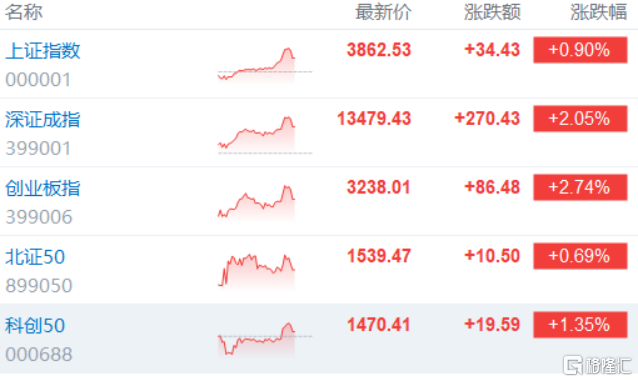
Market Overview - A-shares saw a collective rise with the Shanghai Composite Index up 0.9% to 3862 points, Shenzhen Component Index up 2.05%, and ChiNext Index up 2.74% [1][2] - Total market turnover reached 2.18 trillion yuan, an increase of 120 billion yuan from the previous trading day, with over 3500 stocks rising [1] Sector Performance - The securities sector experienced significant gains, with stocks like GF Securities and Huatai Securities hitting the daily limit [3][5] - The battery sector also surged, with Wanrun New Energy and Keda Li reaching the daily limit, and several other stocks rising over 12% [5][7] - Precious metals and gold stocks rose as gold prices surpassed $3800, with Zhaojin Gold leading the gains [2][3] - The lithium mining, steel, and PEEK materials sectors showed strong performance [2] Key Stocks - Notable gainers in the securities sector included GF Securities (+10.02%), Huatai Securities (+10.01%), and Guosheng Financial Holdings (+9.99%) [5] - In the battery sector, Wanrun New Energy saw a 20% increase, while Hunan YN gained over 18% [7] - Industrial metals also performed well, with stocks like Xingye Silver Tin and Shengda Resources nearing 10% gains [8][10] Policy and Economic Outlook - The central bank emphasized the need for a moderately loose monetary policy to encourage financial institutions to increase credit supply [4] - A recent breakthrough in lithium battery technology was reported, with a new polymer battery achieving an energy density of 604Wh/kg [6] - The Ministry of Industry and Information Technology, along with other departments, released a plan to support the high-quality development of the new energy storage manufacturing industry [6][8] Future Projections - Analysts expect the A-share market to enter a critical window period with improved risk appetite, supported by favorable liquidity trends and potential U.S. interest rate cuts [17]






锂电池迎重大突破!化工板块大涨,化工ETF(516020)持续拉升!
Xin Lang Ji Jin· 2025-09-29 06:13
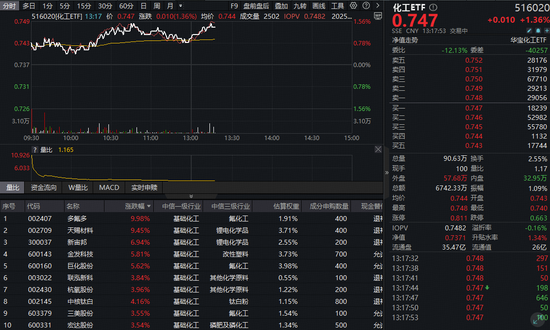
Group 1 - The chemical sector continued to rise on September 29, with the chemical ETF (516020) reaching an intraday high of 1.49% and closing up 1.36% [1] - Key stocks leading the surge included fluorine chemicals, lithium batteries, and modified plastics, with notable gains from companies like Duofu Duo and Tianci Materials, which rose over 9% and 6% respectively [1][3] - A significant breakthrough in lithium battery technology was reported by Tsinghua University, achieving an energy density of 604Wh/kg, nearly three times that of existing commercial batteries, which could drive innovation in electric vehicles and energy storage systems [2][3] Group 2 - The chemical ETF (516020) is currently at a low valuation, with a price-to-book ratio of 2.26, indicating a favorable long-term investment opportunity [3] - The chemical industry is experiencing mixed performance across sub-sectors, influenced by past capacity expansions and weak demand, although some areas like lubricants have exceeded expectations [4] - Analysts suggest that the supply-demand dynamics in the chemical sector are improving due to the end of tariff impacts and the exit of European chemical capacity, alongside domestic policies aimed at eliminating outdated production [4][5]


A股午评:创业板指涨1.77%重回3200点,超3000股上涨!固态电池板块爆发
Ge Long Hui· 2025-09-29 03:43
Market Overview - The three major A-share indices collectively rose in the morning session, with the Shanghai Composite Index up 0.13% at 3832.9 points, the Shenzhen Component Index up 1.11%, and the ChiNext Index up 1.77% [1] - The North China 50 index increased by 0.85%, and the total trading volume in the Shanghai and Shenzhen markets reached 1.2937 trillion yuan, a decrease of 88 billion yuan compared to the previous day [1] - Over 3000 stocks in the market experienced gains [1] Sector Performance - The solid-state battery sector saw significant gains, with Wanrun New Energy hitting the daily limit, and other companies like Fengshan Group, Tianji Co., and Duofuduo also reaching the daily limit [1] - Tsinghua University successfully developed a high-safety polymer battery with an energy density of 604 Wh/kg [1] - The non-ferrous metals sector strengthened, with companies like Boqian New Materials and Wolong New Energy hitting the daily limit, and Shengda Resources rising over 8% [1] - The Ministry of Industry and Information Technology, along with eight other departments, issued a "Work Plan for Stable Growth in the Non-Ferrous Metals Industry" [1] - The securities sector saw a broad increase, with Guosheng Jin控 hitting a record high and Huatai Securities rising nearly 7% [1] - The storage chip sector also performed well, with Yachuang Electronics rising over 9%, and companies like Shenzhen South Circuit and Baiwei Storage increasing over 5% due to recent price hikes announced by several major manufacturers [1] Declining Sectors - Education concept stocks were among the biggest losers, with Kevin Trading and China High-Tech dropping over 8% [1] - Coal stocks generally fell, with Pingmei Shenhua down over 4% and Shanxi Coking Coal down nearly 3% [1]