
黄金ETF(159934)

Search documents
黄金价格突破4500美元,再创新高背后的驱动逻辑
Sou Hu Cai Jing· 2025-12-29 10:34
Core Viewpoint - The recent surge in gold prices, reaching a historical high of over $4,500 per ounce, is driven by multiple factors including the U.S. monetary policy shift towards easing, declining inflation, and increased demand from central banks and ETFs [1][6][10]. Group 1: Drivers of Gold Price Increase - The primary driver of the recent gold price increase is the adjustment in global monetary policy, particularly the U.S. Federal Reserve's decision to lower interest rates three times in 2025, each by 25 basis points, and to initiate short-term Treasury bond purchases [6][7]. - The expectation of continued rate cuts in 2026, as indicated by the Fed's forward guidance, has reduced the opportunity cost of holding gold, prompting a shift of capital from traditional assets to gold [7][8]. - The current U.S. inflation rate is around 3%, and with weak non-farm employment data, there is a strong expectation for further monetary easing, which is supportive of gold prices [7][9]. Group 2: Weakening Dollar and Its Impact - The U.S. dollar is facing challenges that are undermining its credit foundation, leading to a decline in investor confidence in the dollar system and pushing it into a depreciation phase [10]. - As a result, gold's value as a safe-haven asset is being fully realized, attracting global capital allocation towards gold as an alternative to the weakening dollar [10]. Group 3: Central Bank Demand - Central banks globally are increasing their gold reserves, which has become a significant support for rising gold prices. This trend is characterized by large-scale and sustained purchases of gold [13][16]. - As of November 2025, China's gold reserves reached 7.412 million ounces, with a continuous increase for 13 months, reflecting a broader trend among central banks to enhance the proportion of gold in their reserve assets [13][16]. - The World Gold Council reported a net purchase of 53 tons of gold by central banks in October, marking a 36% increase month-over-month and setting a record for the year [13][16].

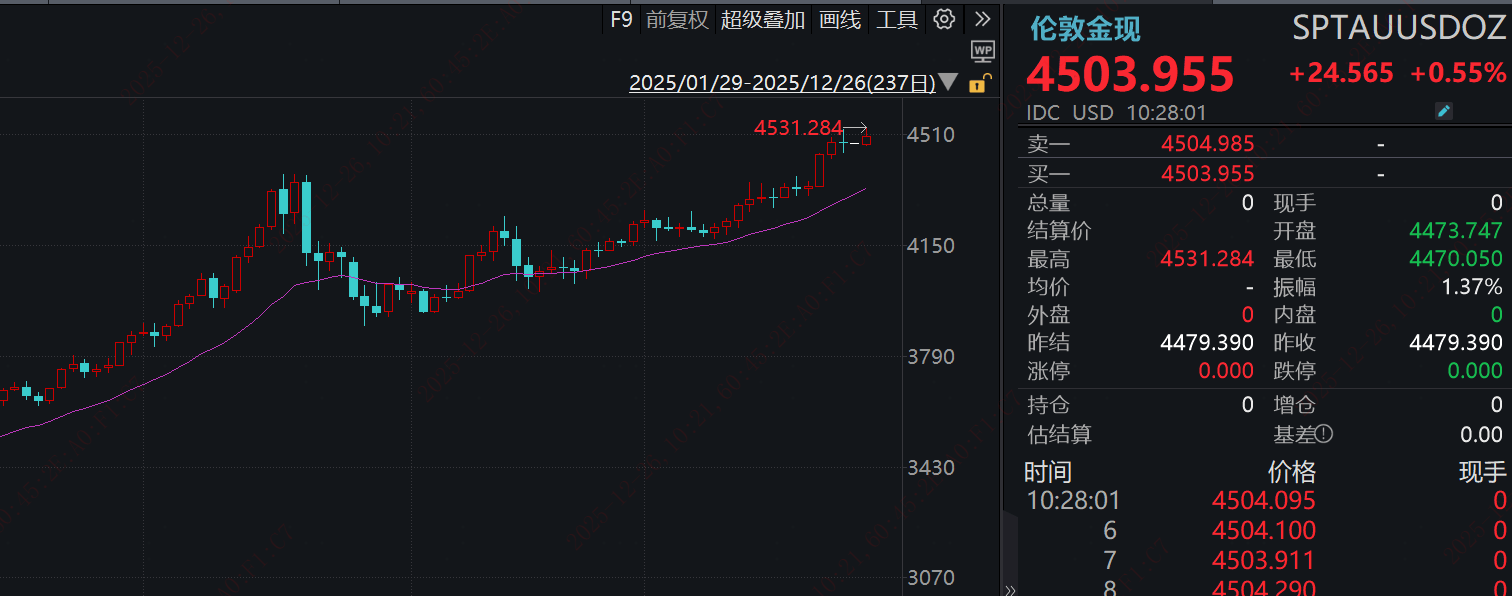
全球疯抢!价格一浪高过一浪
Sou Hu Cai Jing· 2025-12-23 09:12
Core Viewpoint - The recent surge in gold prices, reaching a historical high of $4,490 per ounce, is attributed to a combination of geopolitical tensions, monetary easing expectations, and a structural shift in gold investment paradigms, indicating a significant revaluation of gold's worth over decades [1][3][24]. Geopolitical Tensions - The rise in gold prices is closely linked to escalating geopolitical tensions, particularly the conflict between Thailand and Cambodia, and the situation in Venezuela, where U.S. military actions have raised concerns about energy security and potential market disruptions [4][5][6]. - Ongoing conflicts, such as the Russia-Ukraine war, contribute to persistent geopolitical risks, increasing demand for gold as a safe-haven asset [7]. Monetary Easing - The macroeconomic environment is characterized by expectations of interest rate cuts and a weakening dollar, with U.S. inflation rates declining and unemployment rates remaining relatively high [8][9]. - The transition of U.S. monetary policy from tightening to easing is seen as a key driver of the current gold bull market, supported by falling inflation and rising concerns over the long-term purchasing power of fiat currencies [10][11]. Central Bank Gold Purchases - Central banks have significantly increased their gold purchases, with global central banks net buying gold for 14 consecutive quarters, reflecting a structural demand for gold as a strategic asset [12][13]. - The recent data shows that China's gold reserves have increased, and global gold ETF inflows have reached record levels, indicating strong institutional interest in gold [15][12]. New Investment Paradigm - The investment landscape for gold is shifting, with a growing recognition of its role as a hedge against extreme monetary and geopolitical risks, moving from a cyclical to a strategic asset [19][20][22]. - Major financial institutions have raised their long-term gold price forecasts, reflecting a broader market re-evaluation of gold's value in the context of global debt and currency dynamics [23]. Conclusion - The current gold market dynamics are driven by a confluence of factors including concerns over monetary credit, strategic central bank allocations, the onset of a rate-cutting cycle, and geopolitical conflicts, indicating profound changes in the global macroeconomic and financial landscape [24][25].
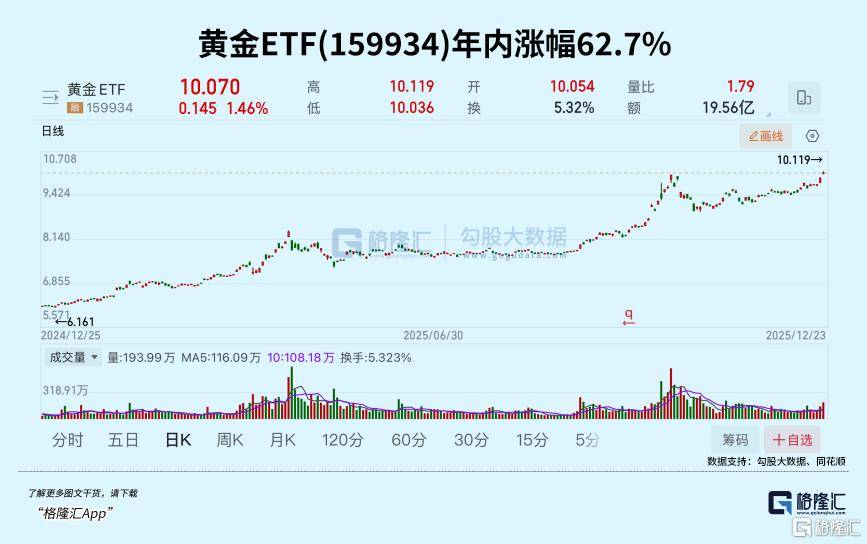
黄金创历史新高,300亿规模黄金ETF(159934)涨1%
Sou Hu Cai Jing· 2025-12-22 05:45
Core Viewpoint - The recent surge in gold prices, reaching a historical high of $4,385.7 per ounce, is attributed to a combination of factors including expectations of further interest rate cuts by the Federal Reserve, geopolitical uncertainties, and a weakening dollar, which collectively enhance gold's long-term investment appeal [1]. Group 1: Gold Price Dynamics - Gold prices have recently hit a record high, with a year-to-date increase of 59.11% [1]. - The gold ETF (159934) has seen a net inflow of 180 million yuan over the past 10 trading days, reflecting strong investor interest [1]. - The current price movement is seen as a systemic change in macro pricing frameworks, driven by expectations of monetary easing and central bank gold purchases [1]. Group 2: Macroeconomic Indicators - The U.S. November CPI has decreased to approximately 2.7% year-on-year, while the employment rate has risen to 4.6%, indicating a continued decline in inflation [1]. - Market expectations for further interest rate cuts by the Federal Reserve have increased, contributing to a weaker dollar index [1]. - The combination of these macroeconomic indicators supports the notion that the Federal Reserve is likely to continue its easing cycle [1]. Group 3: Investment Sentiment - The demand for gold is bolstered by geopolitical risks and a trend of central banks increasing their gold reserves [1]. - The gold ETF (159934) closely tracks SGE gold 9999, with its latest scale growing by 35.56 billion yuan and a total net inflow of 12.754 billion yuan for the year [1].
黄金刚刚再创历史新高!300亿规模的黄金ETF(159934)涨超1%,年内净流入127亿元
Sou Hu Cai Jing· 2025-12-22 03:27
Core Viewpoint - The recent surge in gold prices, reaching a historical high of $4,385.7 per ounce, is attributed to a combination of factors including expectations of further interest rate cuts by the Federal Reserve, geopolitical uncertainties, and a weakening dollar, which collectively enhance gold's long-term investment appeal [1]. Group 1: Gold Price Dynamics - Gold prices have recently hit a record high, with the gold ETF (159934) increasing by 1.23%, bringing its year-to-date gain to 59.11% [1]. - The gold ETF has seen a net inflow of 180 million yuan over the past 10 trading days, indicating strong investor interest [1]. - The current price movement reflects a systemic change in macro pricing frameworks, driven by expectations of monetary easing and central bank gold purchases [1]. Group 2: Macroeconomic Indicators - The U.S. November CPI has decreased to approximately 2.7% year-on-year, alongside an increase in the employment rate to 4.6%, suggesting a continued decline in inflation [1]. - Market expectations for further interest rate cuts by the Federal Reserve have increased, contributing to a weaker dollar index [1]. - The combination of easing monetary policy, rising geopolitical risks, and central bank demand for gold supports a favorable environment for gold prices [1]. Group 3: ETF Performance - The gold ETF (159934) closely tracks SGE gold 9999 and has seen its latest scale grow by 35.56 billion yuan, with a total net inflow of 12.754 billion yuan for the year [1]. - The ETF's performance is bolstered by its connection to off-market fund links A/C (000307 / 002963) [1].
金价窄幅震荡,关注黄金ETF(159934)资产配置价值
Sou Hu Cai Jing· 2025-11-06 03:51
Group 1 - Gold prices have retreated from previous highs and are currently fluctuating below 4000 points due to multiple factors, including a strong dollar and ongoing U.S. government shutdown, which has reached a historic 36 days, potentially increasing market risk aversion [1] - Long-term views suggest that the U.S. debt issue remains unresolved, leading to a weakening of dollar credit, which enhances gold's monetary attributes; central banks' regular gold purchases provide official backing, creating positive feedback [1] - The expectation of continued interest rate cuts by the Federal Reserve supports the financial pricing of gold, indicating a solid logic for gold's upward trend in the medium to long term [1] Group 2 - The gold ETF (159934) has seen a net inflow of 4.4 billion yuan in the past month, bringing its latest scale to approximately 31.5 billion yuan, indicating good liquidity [2] - This product invests in Au99.99 spot contracts on the Shanghai Gold Exchange and tracks domestic gold price performance, offering investors a convenient and low-cost tool for gold asset allocation [2]
黄金税收新政利好场内投资,关注黄金ETF(159934)配置价值
Mei Ri Jing Ji Xin Wen· 2025-11-05 06:37
Core Insights - The recent policy change in the gold market, effective from November 1, 2025, exempts on-site trading at the Shanghai Gold Exchange from value-added tax (VAT) and allows a 6% input tax deduction for jewelry and industrial gold usage, valid until the end of 2027 [1] Group 1: Policy Impact - The new tax policy is expected to benefit gold ETFs, as their operations do not involve physical delivery, aligning with the tax exemption for on-site trading, thus maintaining cost advantages [1] - The policy specifies that investment gold bars cannot provide VAT invoices for input tax deductions upon resale, potentially increasing hidden costs for physical investments and driving funds towards lower-cost channels, enhancing the attractiveness of gold ETFs [1] Group 2: Market Dynamics - Gold is not viewed as a short-term profit asset; price fluctuations due to policy changes and geopolitical factors are normal, and corrections may provide reasonable entry points for long-term investments [1] - Long-term, gold remains a tool for hedging against credit currency risks, supported by ongoing accumulation by global central banks, maintaining its role as a "risk buffer" in diversified asset portfolios [1] Group 3: ETF Performance - The gold ETF (159934) has seen over 4 billion yuan in net inflows in the past month, reaching a total scale of 31.6 billion yuan, indicating good liquidity [1] - This ETF invests in Au99.99 spot contracts on the Shanghai Gold Exchange, tracking domestic gold price performance and providing investors with a convenient, low-cost asset allocation tool [1]
黄金税收新政利好场内投资,关注黄金ETF(159934)配置价值
Sou Hu Cai Jing· 2025-11-05 06:24
Core Viewpoint - The recent tax policy change in the gold market is expected to benefit gold ETFs, with the exemption of value-added tax (VAT) on on-site transactions at the Shanghai Gold Exchange and a 6% input tax deduction for jewelry and industrial gold usage, effective until the end of 2027 [1] Group 1: Tax Policy Impact - The new tax policy exempts VAT on on-site transactions at the Shanghai Gold Exchange, which aligns with the operational model of gold ETFs, providing a stable cost advantage [1] - The policy specifies that investment gold bars cannot provide VAT invoices for input tax deductions upon secondary sales, potentially increasing hidden costs for physical investments and driving funds towards lower-cost channels, enhancing the attractiveness of gold ETFs [1] Group 2: Market Dynamics - Gold is not viewed as a short-term profit asset; price fluctuations due to policy changes and geopolitical factors are normal, and corrections may offer reasonable entry points for long-term investments [1] - Gold continues to serve as a hedge against credit currency risks, supported by ongoing purchases from global central banks, maintaining its role as a "risk buffer" in diversified asset portfolios [1] Group 3: Gold ETF Performance - The gold ETF (159934) has seen over 4 billion yuan in net inflows in the past month, reaching a total scale of 31.6 billion yuan, indicating strong liquidity [1] - This ETF invests in Au99.99 spot contracts on the Shanghai Gold Exchange, tracking domestic gold price performance and providing investors with a convenient, low-cost asset allocation tool [1]