
1664

Search documents
重庆啤酒:结构逆势升级,经营显现韧性-20260311
Huachuang Securities· 2026-03-11 07:45
Investment Rating - The report maintains a "Strong Buy" rating for the company with a target price of 67 yuan [2][8]. Core Insights - The company demonstrated resilience in its operations despite structural upgrades in a challenging market environment, achieving a revenue of 14.72 billion yuan in 2025, a year-on-year increase of 0.5%, and a net profit of 1.23 billion yuan, up 10.4% year-on-year [2][8]. - The fourth quarter showed a revenue of 1.66 billion yuan, reflecting a 5.2% increase year-on-year, with a notable improvement in net profit from -220 million yuan in the same period last year to -10 million yuan [2][8]. - The company distributed cash dividends of 1.21 billion yuan in 2025, marking a 4.2% increase, resulting in a dividend payout ratio of 98.3% [2][8]. Financial Performance Summary - **Revenue and Profitability**: - Total revenue for 2025 was 14.72 billion yuan, with a projected growth of 3.2% in 2026 and 2.1% in 2027 [4]. - Net profit for 2025 was 1.23 billion yuan, with expected growth rates of 10.6% and 6.9% for 2026 and 2027, respectively [4]. - **Earnings Per Share (EPS)**: - EPS for 2025 was 2.54 yuan, projected to increase to 2.81 yuan in 2026 and 3.01 yuan in 2027 [4]. - **Valuation Ratios**: - The price-to-earnings (P/E) ratio is expected to decrease from 22 in 2025 to 18 by 2028, while the price-to-book (P/B) ratio is projected to be 20.0 in 2025 and 31.9 in 2028 [4]. Market Dynamics - The company has successfully upgraded its product structure, leading to a significant increase in high-end product sales, with Q4 revenue from high-end products growing by 21.4% [8]. - The company is expanding its reach through new consumption channels and introducing a variety of craft and specialty products, which are expected to drive growth in 2026 [8].

重庆啤酒(600132):结构逆势升级,经营显现韧性:重庆啤酒(600132):2025年报点评
Huachuang Securities· 2026-03-11 06:09
Investment Rating - The report maintains a "Strong Buy" rating for the company with a target price of 67 yuan [2][8]. Core Insights - The company demonstrated resilience in its operations despite adverse market conditions, with a revenue increase of 0.5% year-on-year to 14.72 billion yuan in 2025 and a net profit increase of 10.4% to 1.23 billion yuan [2][8]. - The fourth quarter showed a revenue growth of 5.2% year-on-year, with significant improvements in high-end product sales, indicating a successful product mix upgrade [2][8]. - The company plans to leverage new consumption channels and introduce innovative products to drive growth in 2026, with expectations for accelerated performance as dining scenarios recover [2][8]. Financial Summary - **2025 Financial Performance**: - Total revenue: 14.72 billion yuan, up 0.5% year-on-year - Net profit: 1.23 billion yuan, up 10.4% year-on-year - Earnings per share (EPS): 2.54 yuan [4][8]. - **2026-2028 Financial Projections**: - Projected revenue for 2026: 15.20 billion yuan, with a growth rate of 3.2% - Projected net profit for 2026: 1.36 billion yuan, with a growth rate of 10.6% - Projected EPS for 2026: 2.81 yuan [4][8]. - **Valuation Ratios**: - Price-to-earnings (P/E) ratio for 2026: 20 times - Price-to-book (P/B) ratio for 2026: 26.4 times [4][8]. Market Performance - The company’s stock price has shown resilience, with a current price of 57.04 yuan, reflecting a strong market position compared to the broader market index [4][8]. Dividend Policy - The company distributed a cash dividend of 1.21 billion yuan in 2025, with a dividend payout ratio of 98.3%, indicating a strong commitment to returning value to shareholders [2][8].
Craft brewer Tilray inks licensing agreement for Carlsberg beer in the US
Yahoo Finance· 2026-02-19 09:35
Core Insights - Tilray Brands has secured a licensing agreement with Carlsberg Group to produce, market, and sell Carlsberg's beer portfolio in the U.S., starting in 2027 with a five-year term and an option for renewal based on performance [1][2]. Group 1: Agreement Details - The agreement encompasses Carlsberg's flagship beer and other brands such as Carlsberg Elephant, 1664, and Kronenbourg 1664 Blanc [2]. - The automatic renewal option for another five years is contingent on meeting specific performance criteria [2]. Group 2: Market Positioning - Tilray aims to enhance Carlsberg's market share in the U.S. and capitalize on the growing consumer interest in premium and imported beers [3]. - Despite a decline in overall beer consumption and a shift away from craft beers impacting earnings, Tilray identifies opportunities within the premium segment [3]. Group 3: Company Strategy and Performance - Tilray's CEO emphasized the importance of partnerships with top brands to maximize beverage operations value [4]. - The company has expanded its beverage portfolio by acquiring 12 brands in 2023 and 2024, including eight from Anheuser-Busch and four from Molson Coors [4]. - Tilray holds a 60% market share in the North American THC drinks market, which continues to grow despite regulatory uncertainties [5]. - In its latest earnings report, Tilray reported a 3% increase in net revenue to $217.5 million, with cannabis sales also up by 3% to $67.5 million, while beverage net revenue decreased by 20% to $50.1 million compared to the previous year [5].

重庆啤酒发布2025年业绩快报,高端化战略成效显著
Huan Qiu Wang· 2026-02-05 08:15
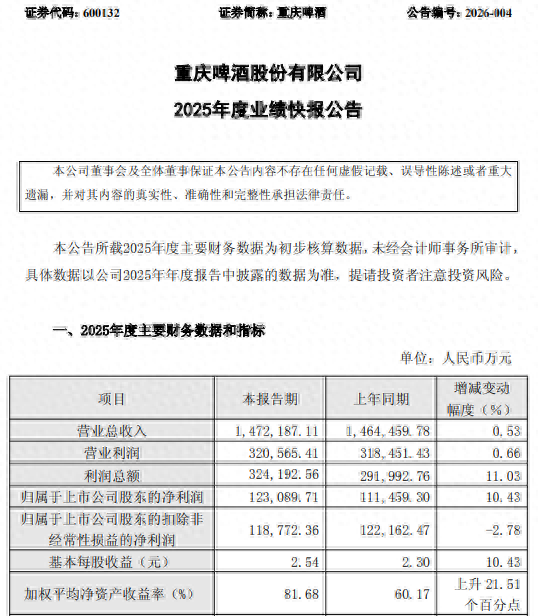
Core Viewpoint - Chongqing Brewery reported comprehensive growth in sales, revenue, and profit for the year 2025, with a notable net profit increase of 10.43%, demonstrating the company's operational resilience and vitality [1][4]. Financial Performance - In 2025, Chongqing Brewery achieved an operating revenue of 14.722 billion yuan, a year-on-year increase of 0.53% [3]. - The net profit attributable to shareholders reached 1.231 billion yuan, reflecting a 10.43% year-on-year growth [3]. - Basic earnings per share were 2.54 yuan, up 10.43% compared to the previous year [3]. - The weighted average return on equity surged to 81.68%, an increase of 21.51 percentage points from the previous year [3]. Market Position - Despite the overall industry pressure, Chongqing Brewery outperformed the market, with a sales growth of 0.68% in 2025, while the beer production of large-scale enterprises in China declined by 1.1% [3][4]. - The company's growth is attributed to its dual strategy of leveraging strong local brands alongside international premium brands, creating a robust brand matrix [4]. Product Strategy - In 2025, Chongqing Brewery launched over 30 new products, including craft beers and flavored beverages, aligning with industry trends and expanding its product line into non-beer categories [4]. - The company has focused on optimizing its product structure to enhance consumer engagement and diversify consumption scenarios [5]. Marketing and Cost Management - Chongqing Brewery has implemented a "big city" marketing strategy, creating distinctive consumption scenarios that resonate with local culture and high-frequency dining experiences [5]. - The company benefited from a decrease in raw material costs and improvements in its supply network, which contributed to an increase in gross margin, supporting profit growth [5]. - Analysts noted that the company's ability to achieve a net profit growth rate that significantly exceeds revenue growth indicates the effectiveness of its premiumization strategy [5].

重庆啤酒(600132):经营展现韧性,分红价值显现:重庆啤酒(600132):2025年业绩快报点评
Huachuang Securities· 2026-02-05 02:47
Investment Rating - The report maintains a "Strong Buy" rating for Chongqing Beer, expecting it to outperform the benchmark index by over 20% in the next six months [2][22]. Core Views - The company demonstrated resilience in its operations, with a slight revenue increase of 0.5% year-on-year to CNY 14.72 billion in 2025, and a net profit growth of 10.4% to CNY 1.23 billion [2][3]. - The report highlights the company's strategic focus on expanding non-traditional sales channels, such as instant retail and e-commerce, which contributed to stable revenue and sales performance despite challenges in the dining sector [2][3]. - The company is expected to continue its high dividend strategy, with a projected dividend yield of 4.7% based on a 100% payout ratio, providing a solid margin of safety for investors [2][3]. Financial Performance Summary - **Revenue and Profitability**: In 2025, the company achieved total revenue of CNY 14.72 billion, with a net profit of CNY 1.23 billion. The earnings per share (EPS) for 2025 is projected at CNY 2.54, with a price-to-earnings (P/E) ratio of 21 [2][3][11]. - **Cost Management**: The gross margin improved due to cost benefits and product mix upgrades, despite increased marketing expenses aimed at consolidating market presence [2][3]. - **Future Projections**: The report adjusts the earnings forecast for 2025-2027 to CNY 1.23 billion, CNY 1.31 billion, and CNY 1.39 billion respectively, reflecting a positive outlook for continued profit growth [2][3][11]. Market Position and Strategy - The company is focusing on high-end product lines, which are expected to drive growth, alongside the recovery of dining scenarios that will support revenue increases [2][3]. - The report emphasizes the importance of new product launches and collaborations with platforms like JD.com to capture additional market share [2][3]. Valuation Metrics - The target price for Chongqing Beer is set at CNY 67, which corresponds to a P/E ratio of approximately 25 times for 2026 earnings [3][11]. - The current market price is CNY 54.40, indicating potential upside for investors [3]. Conclusion - The report concludes that despite challenges, Chongqing Beer is well-positioned for growth with a strong dividend policy and strategic initiatives aimed at expanding its market presence [2][3].
重庆啤酒1亿和解,但山城啤酒的“雷”留到了3年后
Guan Cha Zhe Wang· 2026-01-08 01:20
Core Viewpoint - The long-standing dispute between Chongqing Beer and its affiliate Chongqing Jiawei Beer has reached a resolution through a mediation agreement, halting ongoing litigation and establishing a three-year transitional cooperation period [1][3][29] Financial Summary - Chongqing Beer will make a one-time payment of 100 million yuan (excluding tax) to Jiawei to settle all disputes related to "volume-price difference settlement" before December 31, 2025 [3][5] - The payment will not impose significant financial pressure on Chongqing Beer, which had a cash balance of 2.46 billion yuan as of June 2025 [7] - The agreement is expected to increase Chongqing Beer's total profit by approximately 37.11 million yuan and net profit attributable to shareholders by about 19.08 million yuan for the year 2025 [5][16] Operational Summary - During the three-year transitional period, Chongqing Beer will purchase 142,600 hectoliters of beer annually from Jiawei at an average price of 4,000 yuan per hectoliter [5][20] - If Jiawei's annual sales fall short of the agreed volume, Chongqing Beer has the right to demand compensation based on the shortfall [5][20] - The agreement aims to stabilize Chongqing Beer's production capacity and supply chain, allowing the company to focus on high-end product development and market penetration [16][21] Strategic Summary - The mediation agreement allows Chongqing Beer to regain control over the "Shancheng" brand and Jiawei's production capacity after the contract expires in 2028 [17][20] - The resolution of disputes over brand usage rights and sales agreements is crucial for both companies as they navigate the competitive landscape of the beer industry [12][29] - The agreement does not address the ownership of the "Shancheng" trademark, leaving potential future conflicts unresolved [22][29] Industry Context - The Chinese beer industry has seen a decline in production volume from 50.62 million hectoliters in 2013 to 37.89 million hectoliters in 2023, despite an increase in revenue from 167.8 billion yuan to 203 billion yuan [12] - The shift towards premium products has become a key growth area, with Chongqing Beer successfully increasing its price per ton from 2,700 yuan in 2013 to 4,820 yuan in 2023 [13] - The ongoing competition in the industry highlights the challenges faced by brands like "Shancheng," which struggle to maintain profitability amid rising costs and changing consumer preferences [14][20]

重庆啤酒总裁李志刚:把握消费场景需求 谋划业绩增长新篇
Zhong Guo Zheng Quan Bao· 2025-11-30 22:27
Core Viewpoint - The Chinese beer industry is undergoing structural adjustments and a transformation in consumer logic, with Chongqing Beer exploring a path that balances local culture and global vision through a dual strategy of local and international brands [2][4]. Product and Channel Transformation - Chongqing Beer has focused on continuous upgrades in product structure and strategic reshaping of channel resources, responding to the slowing growth of the beer industry by innovating in product offerings and channel strategies [2][3]. - The company has launched approximately 30 new products this year, including craft beers, tea beers, and low-alcohol options, while also expanding into non-beer categories like fruit drinks and energy drinks [3]. - The shift towards non-on-premise channels has seen over half of the company's sales coming from these channels, with partnerships established with platforms like Meituan and JD Daojia to enhance distribution [3]. Local and International Brand Synergy - The combination of local and international brands is a key competitive advantage for Chongqing Beer, with local brands accounting for over 70% of total sales, particularly in base markets like Chongqing [4][5]. - Local brands are deeply connected to regional culture, while international brands bring a sense of fashion and vitality, allowing for complementary growth and channel synergy [5][6]. Geographic Expansion and Category Diversification - Chongqing Beer plans to continue its "big city strategy" to enhance its presence in high-potential markets, particularly in South China, where local production has been established to reduce logistics costs [6][7]. - The company aims to upgrade its product structure and accelerate its expansion into non-beer categories, focusing on deeper consumer engagement and continuous iteration of new products [7]. Digitalization and Operational Efficiency - The company emphasizes the role of digital tools in enhancing channel efficiency, aiming for better inventory management and market insights through data optimization [7]. - Continuous iteration is highlighted as a crucial strategy for responding to competition from new beverage brands and the entry of liquor companies into the beer market, with a focus on rich product offerings and efficient channels [7].
把握消费场景需求 谋划业绩增长新篇
Zhong Guo Zheng Quan Bao· 2025-11-30 22:22
Core Insights - The Chinese beer industry is undergoing structural adjustments and a transformation in consumer logic, with companies like Chongqing Beer exploring a dual strategy of local and international brand integration to adapt to these changes [1][4] Group 1: Company Performance - Chongqing Beer reported a sales volume of 2.6681 million kiloliters and revenue of 13.059 billion yuan in the first three quarters of 2025, with an operating profit of 3.233 billion yuan [1] - The company's president emphasized that the stable performance is attributed to continuous optimization in product structure, channel focus, and brand combination [1] Group 2: Product and Channel Innovation - The company is focusing on two main areas for innovation: continuous upgrading of product structure and strategic reshaping of channel resources [2] - Chongqing Beer has launched approximately 30 new products this year, including craft beers, tea beers, and low-alcohol beers, while also expanding into non-beer categories like fruit drinks and energy drinks [2][5] - The company is shifting resources towards non-on-premise channels, with over half of its sales now coming from these channels, and has partnered with various instant retail platforms [2] Group 3: Brand Strategy - Chongqing Beer's competitive advantage lies in its combination of local and international brands, with local brands accounting for over 70% of total sales [3] - The local brand "Wusu Beer" has become a representative national brand, while "Chongqing Beer" has established a strong presence in regional markets [3] Group 4: Future Outlook - The company anticipates that the Chinese beer market will continue to grow, shifting from quantity-driven growth to quality-driven growth [4] - Chongqing Beer plans to enhance its geographical presence, upgrade its brands, and optimize its channels to achieve sustainable and quality growth [4][5] - The company is also focusing on digitalization to improve channel efficiency and market responsiveness [5]
重庆啤酒总裁李志刚: 把握消费场景需求 谋划业绩增长新篇
Zhong Guo Zheng Quan Bao· 2025-11-30 20:27
Core Insights - The Chinese beer industry is undergoing structural adjustments and a transformation in consumer logic, with companies like Chongqing Beer exploring a dual strategy of local and international branding to adapt to these changes [1][3] Product and Channel Transformation - Chongqing Beer is focusing on product structure upgrades and strategic channel resource reallocation to address the slowing growth in the beer industry [2] - The company has launched approximately 30 new products this year, including craft beers and non-beer beverages, to capture evolving consumer preferences [2] - Non-on-premise channel sales now account for over half of the company's total sales, with partnerships established with major instant retail platforms [2] Local and International Brand Synergy - The combination of local and international brands is a key competitive advantage for Chongqing Beer, with local brands accounting for over 70% of total sales [3] - The company’s local brands, such as "Wusu Beer" and "Chongqing Beer," dominate the market share in their respective regions, enhancing brand recognition and consumer loyalty [3] Geographic Expansion and Efficiency Improvement - Chongqing Beer plans to continue its "big city strategy" to deepen its market presence in high-potential areas, particularly in South China [4] - The establishment of the Foshan brewery has improved supply chain efficiency and reduced logistics costs, supporting the company's growth in the Greater Bay Area [4] Brand and Category Development - The company aims to upgrade its product structure and expand into non-beer categories to meet diverse consumer demands [5] - Emphasis is placed on continuous iteration and gradual market penetration rather than seeking immediate blockbuster products [5] Digitalization and Operational Efficiency - The company is leveraging digital tools to enhance channel efficiency, optimize inventory management, and improve market responsiveness [5] - Continuous iteration is highlighted as a crucial strategy to navigate competition from new beverage brands and adapt to changing consumer preferences [5]
重庆啤酒(600132):渠道策略得当驱动结构改善,费用及税率拖累短期盈利
Minsheng Securities· 2025-11-02 14:52
Investment Rating - The report maintains a "Recommended" rating for the company [4][6]. Core Insights - The company is actively promoting the high-end non-dining segment, with effective channel strategies driving structural improvements. In Q3 2025, the company achieved a revenue of 41.1 billion yuan, a year-on-year increase of 0.6%, with a slight decline in volume but an increase in price [2][4]. - Cost benefits continue to drive gross margin improvements, although expenses and tax rate adjustments have negatively impacted profitability. In Q3 2025, the company’s gross margin increased by 1.7 percentage points, while the net profit margin decreased by 1.2 percentage points year-on-year [3][4]. - The company aims to expand its market share and embrace the high-end non-dining trend, anticipating a recovery in industry demand. The revenue projections for 2025-2027 are 149.37 billion, 152.06 billion, and 154.57 billion yuan, respectively, with corresponding net profits of 12.36 billion, 12.85 billion, and 13.31 billion yuan [4][5]. Summary by Sections Financial Performance - For the first three quarters of 2025, the company reported total revenue of 130.59 billion yuan, a slight decrease of 0.03% year-on-year, and a net profit of 12.41 billion yuan, down 6.83% year-on-year. In Q3 alone, revenue was 42.20 billion yuan, with a net profit of 3.76 billion yuan, reflecting a year-on-year decline of 12.71% [1][2]. - The company’s beer revenue for the first three quarters reached 127.1 billion yuan, a year-on-year increase of 0.1%, with volume and price changes of +0.4% and -0.4%, respectively [2]. Cost and Margin Analysis - The company’s cost per ton decreased by 2.3% year-on-year in Q3 2025, contributing to a gross margin increase of 1.7 percentage points. However, the increase in sales and management expenses, along with a higher tax rate, led to a decrease in the net profit margin [3][4]. Future Outlook - The company plans to continue expanding its market share and is optimistic about the recovery of the industry, driven by ongoing consumer policy support. The long-term outlook for the beer industry remains positive, with significant upgrade potential [4].