
300mm硅片

Search documents
AI需求暴增!存储芯片板块涨停潮来袭,天奥电子、恒烁股份封板,超级周期已确认!
Jin Rong Jie· 2025-12-25 04:18
Core Viewpoint - The storage chip sector in A-shares is experiencing a strong rally, becoming the leading segment in the semiconductor industry, driven by significant demand from AI applications and a favorable market cycle [1][2] Group 1: Market Performance - The storage chip sector has shown robust performance, with key stocks like Tian'ao Electronics and Hengsuo Co. hitting the daily limit, igniting profit-making sentiment across the sector [1] - There is a notable influx of capital into the market, indicating high recognition of the storage chip industry's cyclical reversal and growth potential [1] Group 2: Industry Dynamics - AI demand is driving a significant increase in high-end storage needs, with Micron Technology reporting a quarterly revenue of $13.6 billion, a 57% year-over-year increase, and a net profit of $5.5 billion, up 169% [1] - The storage requirements for AI servers are eight times that of regular servers, with global AI server shipments expected to grow by 180% in 2025, leading to a 220% surge in high-end storage chip demand [1] Group 3: Price Trends and Inventory Levels - The storage chip industry has seen prices soar, with DDR5 memory prices increasing by 80% from September to December, and HBM2e prices rising nearly 50% [2] - Inventory levels have dropped to a five-year low, with major players like Samsung and Micron reducing production, resulting in inventory levels falling from 12-16 weeks to 2-4 weeks [2] Group 4: Domestic Market Developments - Domestic companies are accelerating their market presence, with Shunming Storage achieving mass production of the first domestic ferroelectric memory, ranking among the top five global suppliers [2] - Changxin Storage's DDR5 memory module has entered the supply chains of major companies like Huawei, with revenue surpassing $1 billion in Q3 2025 [2] Group 5: Benefiting Sectors - The storage chip design and module sector is directly benefiting from the explosion in AI demand and rising prices, with companies like Beijing Junzheng and Jiangbolong positioned to gain from the industry's upward trend [3] - The storage chip materials and equipment sector is also seeing growth due to domestic production expansion and technological advancements, with companies like Shunming Storage achieving full localization of materials and equipment [3] - The AI server and computing equipment sector is experiencing synergistic growth, with a significant increase in demand for AI servers and storage chips [3]




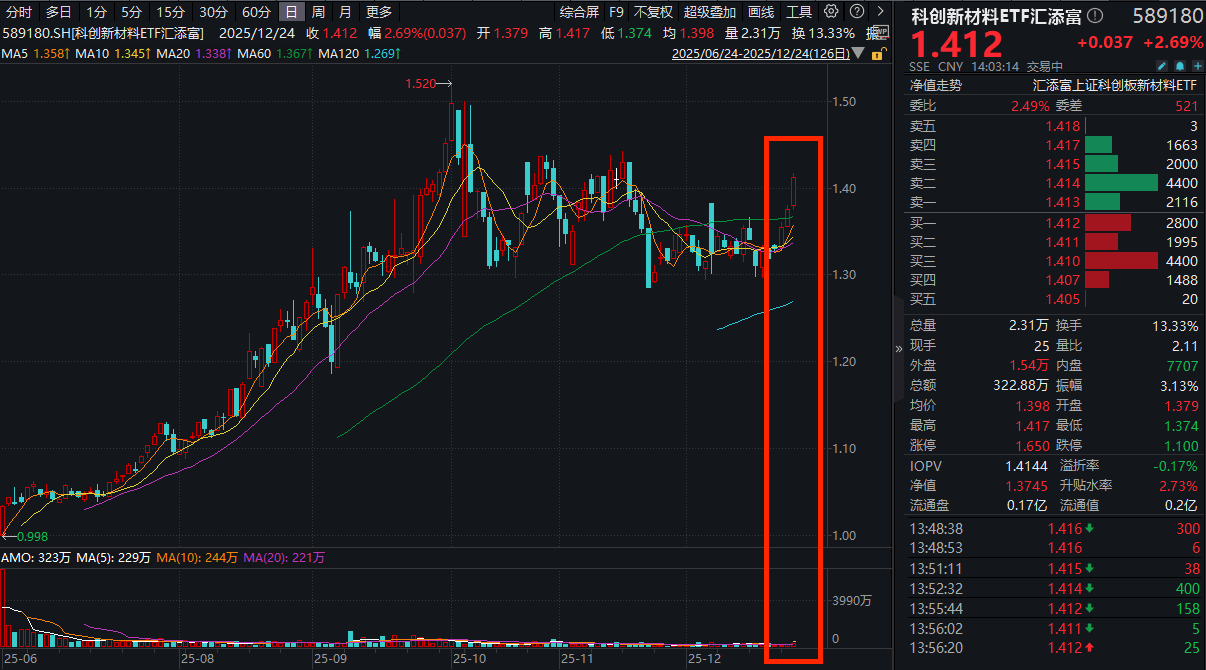
斯瑞新材涨超8%,沪硅产业21亿元配套融资获踊跃认购!科创新材料ETF汇添富(589180)大涨近3%强势冲击三连阳!如何布局硬科技底层?
Sou Hu Cai Jing· 2025-12-24 06:23
Group 1 - The core viewpoint of the news highlights the surge in hard technology concepts, particularly the strong performance of the Science and Innovation Materials ETF, which rose nearly 3% and achieved a three-day winning streak [1][3] - Shenzhen has recently issued measures to attract and utilize foreign investment, focusing on the international development of advanced manufacturing and encouraging foreign investment in key sectors such as high-end equipment manufacturing and new materials [3] - The recent completion of a significant asset restructuring project by Hu Silicon Industry, raising 7.04 billion yuan, marks a pivotal moment for the company as it aims to enhance its focus on 300mm silicon wafer technology and accelerate its R&D projects [3][4] Group 2 - The component stocks of the Science and Innovation Materials ETF showed strong performance, with notable gains including over 9% for Jia Yuan Technology and over 8% for Si Rui New Materials [3][4] - The commercialization of CPO technology is accelerating, reshaping the optical network material structure, with major companies like Nvidia and Broadcom advancing their initiatives in this area [5] - The global non-ferrous metal market is experiencing a collective surge, with copper prices breaking historical records, indicating a strong performance in the commodities market [5][6]


沪硅产业21.05亿元配套融资获踊跃认购
Zheng Quan Ri Bao Wang· 2025-12-22 12:48
Core Viewpoint - Shanghai Silicon Industry Group Co., Ltd. has successfully completed a significant asset restructuring project worth 7.04 billion yuan, marking the end of a nearly one-year process [1] Group 1: Financing and Stock Issuance - The company raised 2.105 billion yuan through a successful stock issuance, with a subscription multiple of 1.95 times, involving 22 professional institutions including national industrial funds and public funds [1] - A total of 11,044,070 shares were issued at a price of 19.06 yuan per share, which is 89.32% of the closing price on the day of the book-building [1] - The raised funds will be used entirely to supplement working capital and pay cash consideration for the transaction [1] Group 2: Acquisition and Control - The company has completed the acquisition of minority stakes in three target companies, achieving 100% control over core processes such as 300mm silicon wafer pulling, cutting, grinding, and epitaxy [1] - The successful financing provides crucial funding support for the company to establish a "closed-loop full industry chain for 300mm semiconductor silicon wafers" [1] Group 3: Future Development Focus - The company will continue to focus on technological breakthroughs in 300mm silicon wafer technology, including single crystal growth and epitaxy processes [2] - The completion of this financing injects strong momentum into the company's efforts in technology advancement, capacity enhancement, and market expansion [2]
硅片,洗牌进行时
Sou Hu Cai Jing· 2025-12-07 10:46
Core Viewpoint - The acquisition of minority stakes in three subsidiaries by Hu Silicon Industry for 7 billion yuan marks a significant move in the domestic silicon wafer industry, aiming for full control over its 300mm silicon wafer business amidst a wave of mergers and acquisitions in the sector [2][3]. Group 1: Acquisition Details - Hu Silicon Industry completed the acquisition of 100% stakes in subsidiaries Shanghai Xinsheng Crystal Investment, Xinsheng Crystal Technology, and Xinsheng Crystal Smart, enhancing its control over the "300mm silicon wafer phase II project" [2][3]. - The acquisition was approved by the Shanghai Stock Exchange's merger and reorganization committee in September 2025 and involved a combination of share issuance and cash payment [3]. - The three subsidiaries have distinct roles: Xinsheng Crystal Technology focuses on cutting and polishing 300mm wafers, Xinsheng Crystal Smart specializes in the crystal pulling process, and Xinsheng Crystal Investment serves as a holding platform [3]. Group 2: Industry Trends - The acquisition reflects a broader trend of consolidation in the Chinese semiconductor silicon wafer industry, driven by policies like the "merger six articles" introduced in September 2024 [3]. - Four major silicon wafer manufacturers have initiated mergers in 2025, indicating a clear trend towards increased industry concentration [3]. - Other leading companies are also pursuing various acquisition strategies, contributing to a comprehensive picture of industry consolidation [4]. Group 3: Market Dynamics - According to SEMI, global silicon wafer shipments are projected to grow by 5.4% in 2025, reaching 12.824 billion square inches, with optimistic forecasts suggesting a record 15.485 billion square inches by 2028 [6][9]. - The third quarter of 2025 saw a 3.1% year-on-year increase in global silicon wafer shipment area, indicating a gradual recovery from the low point in 2024 [6]. - However, the recovery is characterized by structural differentiation, with demand for 12-inch wafers driven by AI and advanced processes remaining strong, while 8-inch and smaller wafers face ongoing pressure [10][11]. Group 4: Domestic Market Developments - The domestic semiconductor silicon wafer market in China reached approximately 15 billion yuan in 2024, with significant growth in 300mm wafer production, where leading companies like Shanghai Xinsheng reported over 70% year-on-year growth [12][14]. - The production capacity of domestic 300mm silicon wafers has increased from less than 1 million pieces per month in 2022 to nearly 3 million pieces per month in the first half of 2025 [14]. - Despite the increase in market share for domestic 300mm wafers, the overall domestic production rate remains low at about 15%-20%, with only around 10% for 300mm wafers, highlighting the challenges faced by local companies in achieving technological breakthroughs [15]. Group 5: Financial Performance - Hu Silicon Industry reported a revenue of 1.697 billion yuan in the first half of 2025, an 8.16% year-on-year increase, but faced a net loss of 519 million yuan due to intense price competition [16]. - Other companies in the sector, such as TCL Zhonghuan and Lian Micro, also reported declines in revenue and profitability, indicating a common struggle with the "increased revenue without increased profit" dilemma [16]. Group 6: Future Outlook - The ongoing consolidation in the silicon wafer industry is not merely a cyclical fluctuation but a necessary evolution driven by the need for technological advancement and market adaptation [17]. - The future leaders in the industry will likely be those who can effectively convert production capacity into stable profits and deeply integrate into the global semiconductor value chain [17].
沪硅产业70亿并购落地:全面整合300mm硅片业务,国产替补加速突围
Xin Lang Cai Jing· 2025-12-02 02:00
Core Viewpoint - The completion of a 7.04 billion yuan acquisition by Hu Silicon Industry marks a significant step in the consolidation of the domestic semiconductor silicon wafer industry, accelerating the expansion of high-end silicon wafer production capacity in China [1][4]. Transaction Structure - Hu Silicon Industry acquired 46.74% of Xinxing Crystal Investment, 49.12% of Xinxing Crystal Technology, and 48.78% of Xinxing Crystal Intelligence through a combination of issuing shares and cash payments, resulting in these companies becoming wholly-owned subsidiaries [2]. - The total transaction price was 7.04 billion yuan, with 6.716 billion yuan paid in shares (4.47 million new shares at 15.01 yuan per share) and 324 million yuan in cash [2]. - The target companies have reported losses, with Xinxing Crystal Technology generating 739 million yuan in revenue and a net loss of 95.22 million yuan in the first three quarters of 2024, while Xinxing Crystal Intelligence reported 196 million yuan in revenue and a net loss of 29.97 million yuan [2]. Strategic Intent - The acquisition aims to integrate resources and overcome technological bottlenecks, enhancing Hu Silicon Industry's capabilities in high-end silicon wafer manufacturing [3]. - The company seeks to create a technological closed loop by integrating the entire process from crystal pulling to cutting, grinding, polishing, and epitaxy, which is expected to shorten the R&D cycle for high-end products [3]. - The acquisition will significantly increase production capacity through the implementation of the "300mm silicon wafer phase II project" and optimize costs by unifying resource allocation [3]. Industry Impact - The acquisition of Hu Silicon Industry is part of a broader trend of mergers and acquisitions in the semiconductor sector, with over 1,000 various transactions reported in the Shanghai market since the release of the "merger six guidelines" in 2025 [4]. - This acquisition is seen as a critical step towards achieving technological self-sufficiency and may serve as a benchmark case for consolidation in the domestic semiconductor materials industry [4].
沪硅产业(688126)季报点评:利润阶段承压 300MM硅片以量补价
Xin Lang Cai Jing· 2025-11-09 12:34
Core Insights - The company reported a revenue of 2.641 billion yuan for the first three quarters of 2025, representing a year-on-year increase of 6.56%, but the net profit attributable to shareholders was -631 million yuan, widening from -536 million yuan in the same period last year [1] - The third quarter of 2025 saw a revenue of 944 million yuan, a year-on-year growth of 3.79%, with a net profit attributable to shareholders of -265 million yuan [1] - The decline in profit levels is attributed to a differentiated revenue structure and increased costs, with 300mm wafer sales growing over 30% but facing price pressure, while 200mm wafer sales declined [1][2] Revenue and Profit Analysis - For the first three quarters of 2025, the company achieved a revenue of 2.641 billion yuan, with a net profit of -631 million yuan, and a non-recurring net profit of -823 million yuan, indicating an increase in losses compared to the previous year [1] - In Q3 2025, the company reported a revenue of 944 million yuan, with a net profit of -265 million yuan and a non-recurring net profit of -342 million yuan [1] Product Performance - The 200mm wafer segment remains under pressure, with slow recovery in capacity utilization due to weak demand in consumer electronics and inventory destocking [2] - In contrast, the 300mm wafer segment is performing strongly, maintaining high capacity utilization and stable yields, with potential for further improvement through process optimization [2] Future Projections - The company forecasts revenues of 3.82 billion yuan, 4.31 billion yuan, and 5.20 billion yuan for 2025-2027, with net profits projected at 30 million yuan, 190 million yuan, and 320 million yuan respectively [3] - Corresponding EPS is expected to be 0.01, 0.07, and 0.12 yuan, with PE ratios of 1914.77, 249.37, and 149.73x [3]
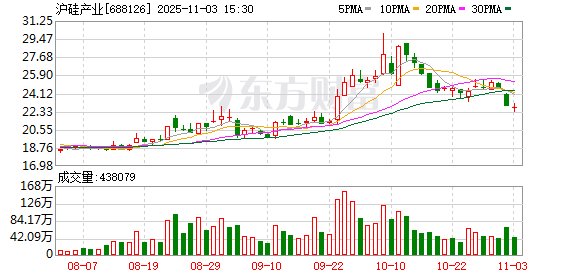
沪硅产业:300mm硅片产能利用率较高
Mei Ri Jing Ji Xin Wen· 2025-11-03 12:20
Group 1 - The core viewpoint is that the 200mm silicon wafer business is experiencing a slow recovery in capacity utilization due to a relatively sluggish application end, while the 300mm silicon wafer segment is performing significantly better with higher capacity utilization [2] - The 300mm silicon wafer volume has increased, but pricing remains under pressure due to domestic competition [2] - The 200mm segment is primarily affected by the overall market environment [2]
从“十五五“规划看新材料领域:从业者/研究者/投资者必抓的10大机遇
材料汇· 2025-10-28 15:32
Core Viewpoint - The article emphasizes the strategic importance of new materials in China's 14th Five-Year Plan, highlighting their role in industrial upgrading, technological breakthroughs, green transformation, national security, agricultural modernization, and new urbanization [2][4][21]. Group 1: Strategic Positioning of New Materials - New materials are identified as the "core support" for modern industrial systems, essential for upgrading key industries like mining, metallurgy, and chemicals [4]. - They are positioned as a key area for technological self-reliance, focusing on breakthroughs in critical technologies such as integrated circuits and advanced materials [4]. - New materials are crucial for green transformation and energy security, supporting the construction of a new energy system and resource conservation [4]. - They serve as a quality assurance for agricultural modernization, with biodegradable materials and soil restoration being key applications [4]. - New materials are seen as an upgrade vehicle for new urbanization, directly linked to the demand for prefabricated buildings and municipal infrastructure [4]. - They act as a protective barrier for national security, ensuring the safety of food, energy resources, and critical supply chains [4]. Group 2: Market and Policy Alignment - New material enterprises should align with the six strategic positions outlined in the plan, focusing on "self-controllable industrial chains, green and intelligent integration, scenario-based applications, and cross-field empowerment" [5][6]. - The article identifies four main lines of development: addressing critical material shortages, adapting to green and intelligent industry needs, expanding scenario-based applications, and leveraging policy tools to mitigate risks [6][8][9][10]. Group 3: Investment Opportunities - The article outlines six key tracks for investment, emphasizing sectors with strong policy support and market demand, such as new energy materials, biomanufacturing materials, aerospace materials, and safety materials [15][16]. - It highlights the importance of focusing on high-certainty tracks driven by both policy and market forces, with specific materials and market data provided for each sector [16]. - The article also discusses forward-looking tracks in quantum technology, brain-computer interfaces, and 6G communication materials, indicating future growth areas [17]. Group 4: Research and Development Focus - The article stresses the need for a comprehensive approach to R&D, targeting foundational research, technological breakthroughs, and the transformation of research outcomes into practical applications [11][12]. - It identifies key research directions, including extreme environment materials, new energy and communication materials, and bio-intelligent materials [12]. - The article emphasizes the importance of collaborative ecosystems involving industry, academia, and research institutions to foster innovation and talent development [14].

沪市并购整合步入快车道 “并购六条”以来新增并购项目近千单
Sou Hu Cai Jing· 2025-10-13 09:04
Group 1 - The core viewpoint of the articles highlights the recent approval of merger and acquisition projects for Hu Silicon Industry and Huahai Chengke by the China Securities Regulatory Commission, indicating a trend of industry consolidation in the Shanghai market [1][2] - Hu Silicon Industry is acquiring stakes in three companies, New Ascend Crystal Investment (46.7354%), New Ascend Crystal Technology (49.1228%), and New Ascend Crystal Intelligence (48.7805%), which will become wholly-owned subsidiaries post-transaction [1] - The acquisition aims to enhance resource integration and synergistic effects, particularly in the context of the 300mm silicon wafer project [1] - Huahai Chengke plans to acquire 70% of Hengsuo Huawai Electronics through a combination of share issuance, convertible bonds, and cash payments, with the goal of solidifying its position in the semiconductor packaging materials sector [1] - Upon completion, Huahai Chengke's annual production capacity for epoxy encapsulants is expected to exceed 25,000 tons, positioning it as a leader in China and the second-largest globally [1] Group 2 - The data indicates that the merger and acquisition activities in the Shanghai market have accelerated, with a total of 996 new projects reported since the release of the "Six Merger and Acquisition Guidelines" [2] - Among these, there are 114 major asset restructurings with a disclosed amount of 308.64 billion yuan, while 882 non-major restructuring projects account for 444.9 billion yuan [2] - Notably, 77 of the major asset restructurings involve mergers within the same industry, totaling over 228.7 billion yuan [2]

“并购六条”发布后新增项目近千单 沪市并购整合步入快车道
Zhong Guo Jing Ying Bao· 2025-10-12 12:37
Core Insights - The article highlights the rapid advancement of mergers and acquisitions (M&A) in the Shanghai market, driven by a focus on quality improvement and industry consolidation [1] Group 1: M&A Activity Overview - Since the release of the "Six M&A Guidelines," there have been a total of 996 new M&A projects in the Shanghai market as of October 12, 2025 [1] - Among these, 114 cases constitute major asset restructurings, with a total value of 308.64 billion yuan, while 882 cases do not constitute major asset restructurings, amounting to 444.9 billion yuan [1] - There are 77 M&A projects involving companies within the same industry, with a total value exceeding 228.7 billion yuan [1] Group 2: Specific M&A Transactions - Hu Silicon Industry (688126.SH) has received regulatory approval for its acquisition of a 46.7354% stake in Xinsheng Jingtou, a 49.1228% stake in Xinsheng Jingke, and a 48.7805% stake in Xinsheng Jingrui, all through a combination of share issuance and cash payment [1] - Following the completion of this transaction, the acquired companies will become wholly-owned subsidiaries of Hu Silicon Industry, enhancing resource integration and synergy [1] - Huahai Chengke (688535.SH) plans to acquire 70% of Hengsu Huawai Electronics through a combination of share issuance, convertible bonds, and cash, while also raising supporting funds [2] - Upon completion of the restructuring, Huahai Chengke's annual production and sales volume in the semiconductor epoxy encapsulation material sector is expected to exceed 25,000 tons, solidifying its position as a domestic leader and elevating it to the second position globally in terms of shipment volume [2]