AI原生游戏

Search documents
宏观政策瞭望|加快培育新增长点 服务消费政策支持料加码
Zhong Guo Zheng Quan Bao· 2026-01-19 00:31
Core Viewpoint - The Chinese government is accelerating the cultivation of new growth points in service consumption, with a focus on various sectors such as the silver economy, green consumption, and cultural and sports consumption, supported by multiple policies at both national and local levels [1][2]. Policy Support - The State Council's meeting on January 16 emphasized the need to foster new growth points in service consumption, encouraging the emergence of new business models and enhancing the quality of service supply [2]. - Eight departments, including the Ministry of Civil Affairs, released measures to support the silver economy, particularly through technology-enabled elderly care services [2]. - The Ministry of Commerce and nine other departments issued a notice to promote green consumption, focusing on areas like green dining and accommodation [2]. Technological Integration - Experts believe that the integration of digital and intelligent technologies into service consumption can enhance supply-demand matching efficiency and expand the scale of service consumption [3]. - Local governments are also prioritizing the use of digital technologies to improve service quality and expand consumption [2]. Sector-Specific Support - The Ministry of Commerce has identified several service consumption sectors with high growth potential, including transportation, housekeeping, online audio-visual services, and experiential services, and is working to refine support policies [4]. - The Ministry of Transport is considering measures to expand yacht consumption, indicating a focus on niche markets within service consumption [5]. Financial Support - Financial support policies for the service consumption sector are expected to broaden, with the People's Bank of China planning to include the health industry in its support for service consumption and elderly care loans [6]. - The Ministry of Civil Affairs is collaborating with relevant departments to develop specialized financial support policies tailored to the characteristics of the elderly care industry [6]. Financial Pathways - Financial development can enhance service consumption through various pathways, including improving residents' income and encouraging investment in consumer-oriented enterprises [7]. - There is a pressing need for long-term funding in service consumption enterprises, which rely heavily on physical stores and supply chains, necessitating the use of loans and innovative financial products [7].
加快培育新增长点 服务消费政策支持料加码
Zhong Guo Zheng Quan Bao· 2026-01-18 21:05
Core Viewpoint - The Chinese government is accelerating the cultivation of new growth points in service consumption, with a focus on various sectors such as the silver economy, green consumption, and cultural and sports consumption, supported by multiple policies and local initiatives [1][2]. Policy Support - The State Council's meeting on January 16 emphasized the need to foster new growth points in service consumption, encouraging the emergence of new business models and enhancing the quality of service supply [2][4]. - Eight departments, including the Ministry of Civil Affairs, released measures to support the silver economy through technology-enabled elderly care services [2]. - The Ministry of Commerce and nine other departments issued a notice to promote green consumption, focusing on areas like green dining and accommodation [2]. Technological Integration - Experts believe that the integration of digital and intelligent technologies into service consumption can enhance supply-demand matching efficiency and expand the scale of service consumption [3]. - Local governments are prioritizing the use of digital technologies to improve service quality and expand consumption, with initiatives in cities like Shanghai and Jiangsu promoting AI and innovative service products [2][4]. Financial Support - Financial support policies for the service consumption sector are expected to expand, with the People's Bank of China indicating plans to include the health industry in support measures for service consumption and elderly care [6]. - The Ministry of Civil Affairs is working on specialized financial support policies to encourage social capital participation in the elderly care sector [6][7]. Market Potential - The potential for service consumption in China is significant, with calls for innovative and diversified consumption scenarios to attract more social capital and meet the diverse needs of high-income groups [5][7]. - The Ministry of Transport is exploring measures to expand yacht consumption, highlighting the broad opportunities within the service consumption market [5].
发布28条政策促进消费和服务业联动发展 上海:优化汽车贷款流程 放宽申请条件
Zhong Guo Zheng Quan Bao· 2026-01-13 21:03
Group 1 - The core viewpoint of the article is the introduction of 28 policy measures by the Shanghai Municipal Government to enhance service quality and boost consumption across six key sectors: finance, information services, transportation, cultural and entertainment services, life services, and inspection and certification [1][3] Group 2 - In the financial sector, the measures encourage innovation in financial products tailored to new consumption trends, such as holiday, night, nostalgic, and anime economies, and include personal consumption loan interest subsidies and optimized auto loan processes [1][2] - In transportation services, the government supports airlines in launching new international routes and developing luxury tourism trains, as well as enhancing airport commercial layouts to create composite consumption scenarios [2] - In the cultural and entertainment sector, there is a focus on promoting the gaming and esports industry, supporting the development of original IP games, and incentivizing quality micro-short film content creation [2] Group 3 - The next steps involve ensuring the effective implementation of the measures by coordinating service supply with consumer demand, promoting digital, green, and intelligent consumption, and enhancing service quality [3] - The government aims to create a favorable environment for sustained consumption growth by implementing fiscal and financial support policies and improving service quality management and brand building [3]
上海发布多项促进服务业和消费发展措施 涉游戏、旅游、养老等多方面
Xin Hua Cai Jing· 2026-01-13 08:37
Group 1: Gaming and E-sports Industry - The Shanghai Municipal Government has issued measures to promote the development of the gaming and e-sports industry, aiming to create a globally influential brand event system and attract top international e-sports events [1] - Support will be provided for projects that meet certain criteria, including the development of proprietary intellectual property (IP) in gaming, original high-quality games, and AI-native games, with rewards for hosting high-level gaming awards and international industry events [1] - The government will also support the incubation of gaming and e-sports startups, providing assistance to qualifying industrial parks and incubators [1] Group 2: Elderly Care and Services - The measures support the construction and renovation of dual-occupancy rooms in elderly care institutions, offering subsidies based on the number of beds [2] - There is encouragement for the conversion of existing commercial buildings into elderly care facilities, with one-time subsidies based on bed count [2] - The government aims to enhance the training of mid-to-senior level elderly care workers and promote the development of specialized day care and home service institutions, with rewards based on service quality monitoring results [2]
世纪华通:满足用户需求并超出预期是AI破局之路
Xin Lang Cai Jing· 2025-12-16 12:34
Core Insights - The AI wave is transitioning from laboratories to industry, with 2025 being positioned as the "year of AI application explosion" [1][4] - Century Huatong has deeply integrated AI into its operations, achieving a 60%-80% increase in production efficiency in art production through AI tools [1][4] - Despite the enthusiasm, there are three major obstacles to the large-scale implementation of AI: the noticeable traces of technology, misaligned industry perceptions, and the dual pressures of cost and compliance [1][5] Industry Trends - AI-native games are still in the early exploration stage, with most applications of AI limited to art, music, and gameplay design, while truly personalized gaming experiences remain rare [2][5] - Users prioritize product quality and intellectual property (IP) over the use of AI, indicating that AI is merely a creative tool that must enhance user experience [2][5] - The next 3-5 years are expected to see a dramatic decrease in creative barriers due to AI, leading to an explosion of user-generated content (UGC) [2][6] Future Outlook - As the UGC ecosystem matures, managing IP will become a significant challenge for the industry, requiring core competencies from practitioners [2][6] - The AI industry's path to breakthrough will ultimately focus on user-centric and value-driven approaches, with Century Huatong committed to long-term engagement in AI application practices [3][6]

ETF基金日报丨动漫游戏相关ETF涨幅居前,机构:预计AI原生游戏渗透率将逐步提升
Sou Hu Cai Jing· 2025-04-29 03:45
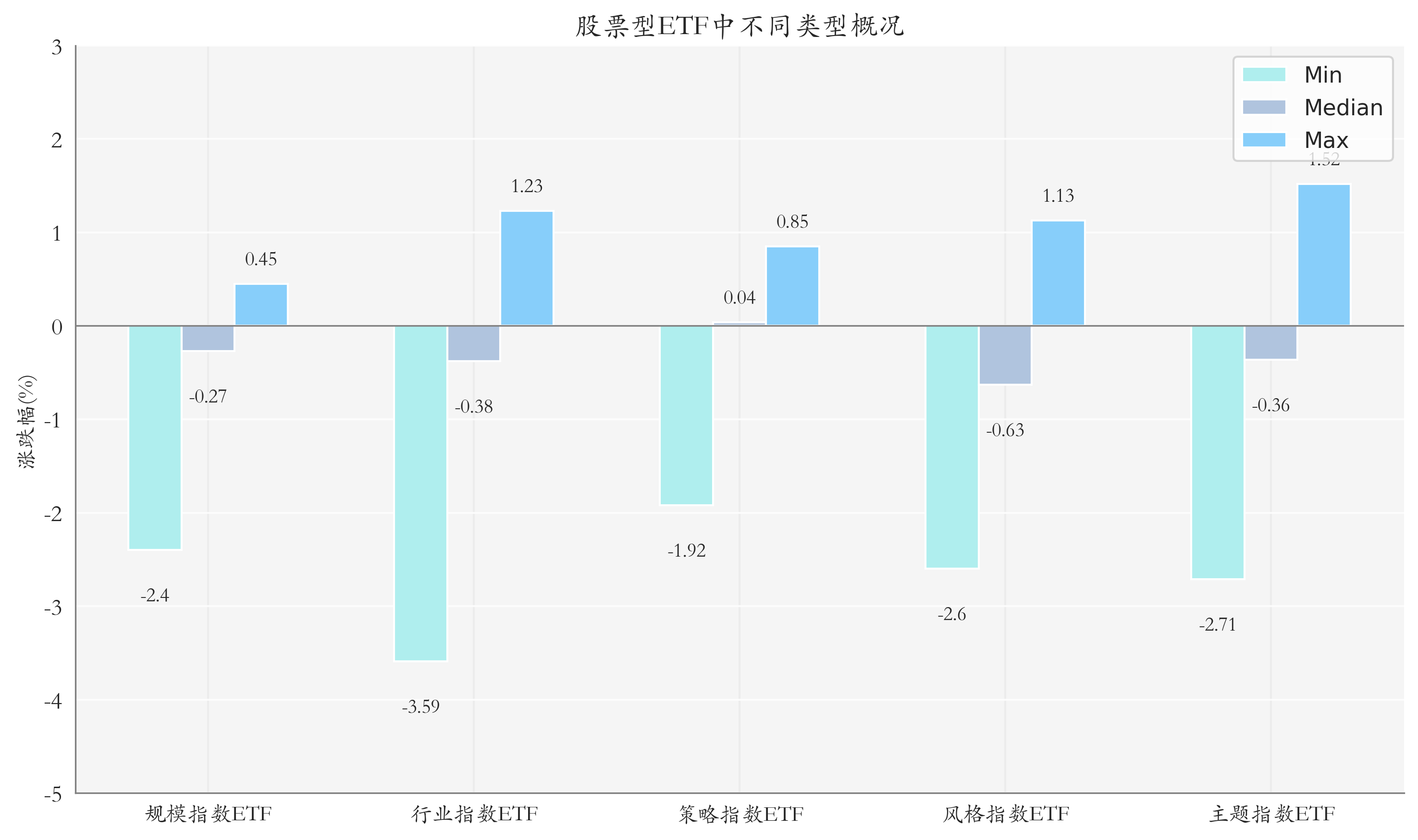
Market Overview - The Shanghai Composite Index fell by 0.2% to close at 3288.41 points, with a high of 3296.93 points during the day [1] - The Shenzhen Component Index decreased by 0.62% to 9855.2 points, reaching a peak of 9926.9 points [1] - The ChiNext Index dropped by 0.65% to 1934.46 points, with a maximum of 1951.16 points [1] ETF Market Performance 1. Overall Performance - The median return of stock ETFs was -0.32% [2] - The highest return among scale index ETFs was 0.45% for E Fund's SSE STAR Market 100 Enhanced Strategy ETF [2] - The highest return in industry index ETFs was 1.23% for Penghua's CSI All Share Public Utilities ETF [2] - The highest return in strategy index ETFs was 0.85% for Southern's S&P China A-share Large Cap Dividend Low Volatility 50 ETF [2] - The highest return in style index ETFs was 1.13% for CMB's CSI Bank AH Price Preferred ETF [2] - The highest return in thematic index ETFs was 1.52% for China Tai's CSI Animation Game ETF [2] 2. Top Gainers and Losers - The top three performing ETFs were: - Guotai's CSI Animation Game ETF (1.52%) - Huatai-PB's CSI Animation Game ETF (1.46%) - Huaxia's CSI Animation Game ETF (1.32%) [5] - The top three declining ETFs were: - Huaxia's CSI All Share Real Estate ETF (-3.59%) - Southern's CSI All Share Real Estate ETF (-3.5%) - Huabao's CSI 800 Real Estate ETF (-2.76%) [6] 3. Fund Flows - The top three ETFs with the highest inflows were: - Huaxia's SSE STAR Market Comprehensive ETF (inflow of 329 million yuan) - Guotai's CSI Steel ETF (inflow of 324 million yuan) - E Fund's ChiNext ETF (inflow of 147 million yuan) [8] - The top three ETFs with the highest outflows were: - Huaxia's SSE 50 ETF (outflow of 763 million yuan) - Southern's CSI A500 ETF (outflow of 487 million yuan) - Southern's CSI 1000 ETF (outflow of 448 million yuan) [10] 4. Margin Trading Overview - The top three ETFs with the highest margin buying were: - Huaxia's SSE STAR Market 50 Component ETF (270 million yuan) - E Fund's ChiNext ETF (166 million yuan) - Huatai-PB's CSI 300 ETF (165 million yuan) [11] - The top three ETFs with the highest margin selling were: - Southern's CSI 1000 ETF (52.1 million yuan) - Southern's CSI 500 ETF (33.8 million yuan) - Huatai-PB's CSI 300 ETF (14.3 million yuan) [12] Institutional Insights - Kaiyuan Securities anticipates that the penetration rate of AI-native games will gradually increase, with ARPU expected to continue rising [13] - The firm notes that AI-native games are likely to enhance user experience and attract a broader user base, potentially leading to a user scale increase [14] - Ping An Securities believes that the gaming sector may enter a new product cycle supported by government policies encouraging cultural and entertainment consumption [15] - The firm also highlights that with the aid of technologies like AIGC, gaming companies are expected to achieve cost reduction and efficiency improvement [15]