AI软硬件

Search documents
安踏进军美国市场;OpenAI首款AI硬件曝光丨Going Global
创业邦· 2026-02-08 11:49
Key Insights - Temu and SHEIN have suspended their cross-border operations in Turkey, shifting towards localized operations due to regulatory changes [5] - Hungarian Post has signed a memorandum of understanding with Temu to enhance cross-border logistics cooperation [6] - TSMC's 2nm production capacity has been fully booked by major tech companies, indicating strong demand for advanced semiconductor technology [7] - Hesai Technology has partnered with Grab to accelerate the deployment of LiDAR technology in Southeast Asia [8] - Anta is set to open its first store in the United States, marking a significant step in its global expansion strategy [10][13] - Baiotai has signed a licensing agreement for its BAT3306 injection in the Middle East and North Africa, with a potential transaction value of up to $7 million [15] - Alibaba Cloud has been recognized as the global leader in cloud service adoption for Chinese enterprises going abroad [16][18] - OpenAI's first AI headset, Dime, has been revealed, although its initial capabilities may be scaled back due to supply chain challenges [20][22] - Tesla plans to increase investments in AI hardware and energy sectors in China, with a projected capital expenditure exceeding $20 billion by 2026 [24]





未知机构:华泰策略港股策略科技周期耗材主线回撤而非反转上周港股市场-20260202
未知机构· 2026-02-02 02:00
Summary of Key Points from the Conference Call Industry Overview - The focus is on the Hong Kong stock market, which recently reached a four-year high before experiencing a global market risk-off adjustment [1][2]. Core Insights and Arguments - The rapid rise in the Hong Kong market in January exceeded general expectations, particularly after a period of low investor interest during Q4 [1][2]. - Two critical questions arose post-adjustment: 1. Whether and when to add to positions 2. Whether the recovery will be led by recently underperforming sectors like technology and cyclical materials or if new leading sectors will emerge [2]. - The response to the first question indicates that adding to positions is advisable, as the adjustment is seen as healthy [2][3]. - External factors causing market adjustments have not fundamentally impacted the market; liquidity concerns regarding the Federal Reserve's hawkish stance are largely priced in [3]. - Active foreign capital has shown consistent net inflows for three weeks, and earnings expectations continue to be revised upwards [3]. - Seasonal trends around the Lunar New Year and catalysts like AI developments are expected to favor the Hong Kong market [3]. Additional Important Insights - The current high congestion in popular sectors, particularly in resource commodities, may lead to continued short-term volatility [4]. - A potential opportunity to build positions may arise if volatility indicators like VIX decrease and congestion levels drop before the Lunar New Year [5]. - The focus on technology and resource sectors is characterized as a technical pullback rather than a reversal, emphasizing the distinction between the "Hang Seng Tech" index and core stocks in AI hardware/software and innovative pharmaceuticals [5]. - The current hawkish stance of the Federal Reserve is not expected to fundamentally disrupt the narrative for technology and resource sectors [5]. - Insurance, local Hong Kong stocks, and high-quality consumer leaders are recommended as stable core holdings due to their robust fundamentals [6]. - The annual outlook emphasizes three major equilibria for the Hong Kong market: earnings valuation rebalancing, internal and external capital rebalancing, and sector rebalancing, advocating for a mid-term investment perspective focused on fundamentals rather than chasing rapid gains [6].
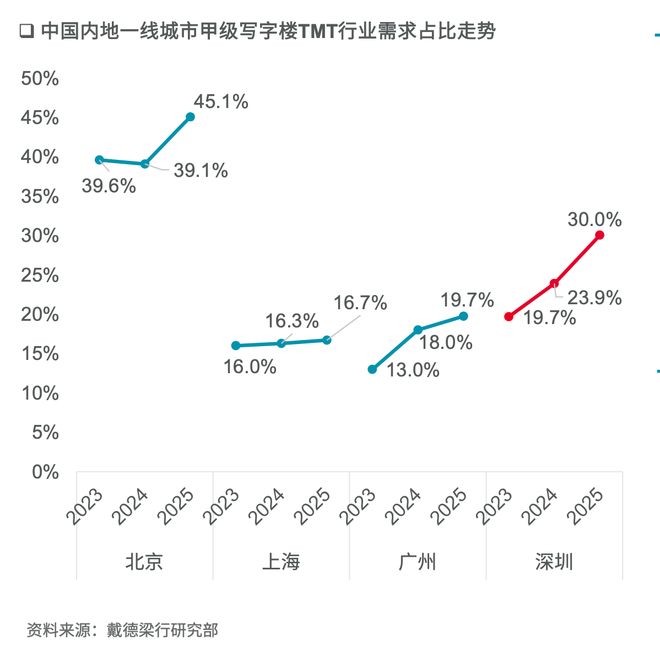
深圳AI产业爆发,TMT的办公租赁占市场总量超三成
Di Yi Cai Jing Zi Xun· 2026-01-16 07:01
2025年,A股市场上最火热的概念莫过于人工智能。在政策加持、资源集聚的持续作用下,人工智能产 业正在以前所未有的速度成长,拉动各相关行业快速发展。目前,深圳人工智能产业规模已突破3600亿 元,在广东省占比近四成,汇聚的企业超2800家,位居全国前列。 伴随着人工智能及其相关产业的快速发展,其办公租赁需求也持续扩张,逐渐成为写字楼市场的一项重 要增长动能。 戴德梁行提供的数据显示,按面积计,2025年,AI相关企业租赁需求在所有办公物业和甲级写字楼中 的占比分别为5.7%以及4.6%;若按宗数计,占比在所有办公物业和甲级写字楼中均有上升,均为 6.5%。 戴德梁行研究院副院长、华南及华中区研究部主管及董事向张晓端第一财经记者分析,"深圳的产业空 间及商办空间当中人工智能相关企业的需求增长,涵盖了龙头企业的持续扩张、中小型企业的快速增 长,以及创业型企业对灵活办公需求等,从具体细分产业来看,包括AI软硬件,以及结合应用场景渗 透到各个行业领域而不断衍生拓展出新的创新应用。" 整体来看,AI行业的租赁需求来源当中包含了大量初创企业及中小企业。"这也印证了当下深圳AI产业 蓬勃的创新创业趋势。"张晓端表示。 深圳 ...
A股结束17连阳,港股接棒后续上涨?
Sou Hu Cai Jing· 2026-01-14 18:01
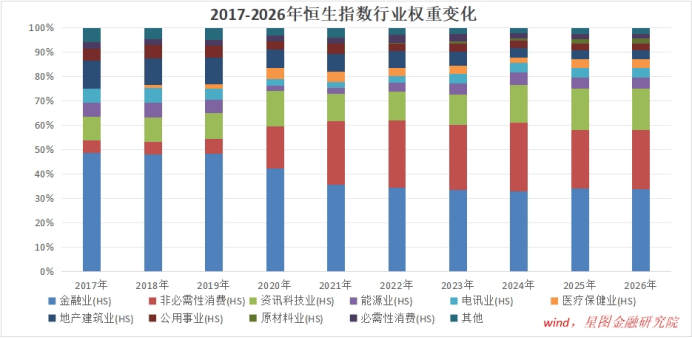
Core Viewpoint - The A-share market is performing strongly, while the Hong Kong stock market is lagging behind due to mismatched market structure and current capital preferences, alongside a weak liquidity environment [1] Group 1: Market Performance - As of January 12, 2026, the Wind All A Index has risen by 6.92%, with the Sci-Tech Innovation Index up by 13.39%, significantly outperforming the Hang Seng Index (3.82%) and Hang Seng Tech Index (6.29%) [1] - The Hang Seng Index saw a 27.77% increase in 2025, driven by global liquidity easing, valuation recovery in the financial sector, and sustained inflows from southbound capital [3] - The Hang Seng Composite Index increased by 30.98%, reflecting higher elasticity in small and mid-cap stocks favored by southbound capital [3] Group 2: Sector Analysis - Resource, technology manufacturing, and consumer services sectors have emerged as leading growth areas, with other metals and mining sectors rising by 198.56% due to global copper supply shortages and strong lithium demand [4] - The semiconductor sector surged by 136.89%, driven by breakthroughs in advanced processes and increased demand for AI servers [4] - The healthcare provider and service sector declined by 17.85% due to policy cost control and intensified industry competition [4] Group 3: Future Outlook - The Hong Kong stock market is expected to continue its recovery in 2026, transitioning from strong broad-based growth in 2025 to a more moderate recovery with structural differentiation [5] - Key drivers for market resilience include improving liquidity, steady recovery of the Chinese economy, and a rebalancing of domestic and foreign capital structures [6] - The Hang Seng Index's earnings per share is projected to grow by 9.64% in 2026, with the Hang Seng Tech Index expected to see a 34.63% increase, supported by a mild recovery in the Chinese macroeconomy [7] Group 4: Structural Changes - The composition of the Hang Seng Index has fundamentally changed from 65.85% in traditional sectors (finance, energy, real estate) to 42.02%, while new economy sectors (consumer discretionary, information technology, healthcare) have increased from 20.83% to 48.87% [8] - This shift aligns with China's "14th Five-Year Plan" focusing on technological self-reliance, indicating a new growth phase with improved visibility and sustainability in profit growth [8] Group 5: Investment Opportunities - The market is expected to be highly structured in 2026, with AI software and hardware as the main themes, driven by breakthroughs in hard technology and the practical application of AI [10] - The cyclical resource theme will benefit from supply-side optimization and demand recovery, with industrial metals likely to see price strength due to ongoing supply constraints [11] - High-dividend assets may still provide absolute returns, but the focus should shift to sectors with strong supply barriers and pricing power, such as infrastructure-related sectors and the insurance industry [12]
报告:2027年AI软硬件整体市场规模将达到7800亿至9900亿美元
Xin Lang Cai Jing· 2025-10-16 09:01
Core Insights - The report by Bain & Company and Amazon Web Services highlights that by 2027, the overall market size for AI software and hardware is expected to reach between $780 billion and $990 billion, with an average growth rate of 40%-55% [1] - The application and transaction platform segments are projected to grow at an average rate of 60%-85%, presenting significant globalization opportunities for Chinese enterprises [1] Market Perspective - North America remains the largest existing market and is a key area of focus for sectors such as SaaS, e-commerce, and social media [1] - Emerging markets in Southeast Asia, the Middle East, Africa, and Latin America are showing strong growth potential [1]
中国资产,闪耀首尔!韩国机构:看好发展潜力!
证券时报· 2025-09-25 15:44
Core Viewpoint - The article highlights the successful roadshow event held by Shenzhen Stock Exchange in Seoul, showcasing the investment potential of five Shenzhen-listed companies in the fields of artificial intelligence, information technology, and new energy, which has enhanced Korean investors' confidence in the Chinese market [2][4][10]. Group 1: Event Overview - On September 25, 2025, Shenzhen Stock Exchange hosted the "Investing in New Opportunities in China" roadshow in Seoul, featuring executives from five companies: iFlytek, Grinmei, Dongshan Precision, Shuanghuan Transmission, and Guangxun Technology [2]. - The event was attended by over 60 Korean investors who engaged in deep discussions with company management about operational performance, investment value, and future development plans [2][4]. Group 2: Investment Value Presentation - The roadshow focused on three cutting-edge sectors: artificial intelligence, information technology, and new energy, with companies presenting their operational data and future strategies to showcase their investment value [4]. - Korean investors expressed that face-to-face communication allowed them to perceive the innovative vitality of Chinese enterprises and gain a more intuitive understanding of the development of new productive forces in China [4][10]. Group 3: Competitive Advantages of Chinese New Productive Forces - The unique competitive advantages of Chinese new productive forces that attract Korean capital include a globally unique supply chain system, vast market space, and the ability to commercialize cutting-edge technologies [5]. - Korean investors noted that Chinese companies are transitioning from "technology followers" to "standard setters," establishing significant positions in the global value chain through high-intensity R&D and patent strategies [5][8]. Group 4: Global Competitiveness of Shenzhen Companies - In the context of global industrial chain restructuring, the development of Chinese new productive forces is expected to promote the globalization of the Chinese economy and attract more foreign investment [7]. - Companies like iFlytek and Grinmei have successfully localized operations and innovated technologies in overseas markets, enhancing their international competitiveness and sustainable development potential [8]. Group 5: Recognition of Chinese Assets by Korean Institutions - The event's positive reception underscores the attractiveness of the Chinese market, with Korean investors increasingly recognizing the rapid technological innovation in China and its potential for long-term investment [10][11]. - Korean institutions are gradually shifting their asset allocation focus towards non-U.S. markets, acknowledging China's advancements in AI and robotics, and forming a consensus on China's leading position in future technological competition [10].