AIP平台

Search documents
道通科技(688208):利润超预期,技术突破与运营周转改善:道通科技(688208):
Shenwan Hongyuan Securities· 2026-03-30 13:08
Investment Rating - The report maintains a "Buy" rating for the company, indicating a strong performance expectation relative to the market [6]. Core Insights - The company's revenue met expectations at 48.3 billion yuan for 2025, while net profit exceeded forecasts at 9.36 billion yuan, driven by a decrease in sales expense ratio [6]. - The company announced a profit distribution plan, proposing a cash dividend of 5 yuan per 10 shares, totaling 333 million yuan, which represents 87.23% of the net profit for the period [6]. - Free cash flow remains robust at approximately 470 million yuan, although operating cash flow saw a decline of 20% year-on-year [6]. - Inventory levels increased significantly, with the balance rising from 783 million yuan to 1.171 billion yuan, impacting cash flow [6]. - The company has made notable advancements in R&D, with significant new product developments in smart vehicle diagnostics and charging solutions [6]. - Operational efficiency has improved, with the net operating cycle decreasing from 383 days to 227 days [6]. - The company is expected to achieve revenues of 59.85 billion yuan and 74.81 billion yuan for 2026 and 2027, respectively, with net profit forecasts of 11.77 billion yuan and 15.69 billion yuan [6]. Financial Data Summary - Total revenue projections for the company are as follows: - 2024: 3,932 million yuan - 2025: 4,833 million yuan - 2026E: 5,985 million yuan - 2027E: 7,481 million yuan - 2028E: 9,143 million yuan - The expected growth rates for revenue are 21.0% for 2024, 22.9% for 2025, and 23.8% for 2026 [5][7]. - The projected net profit for 2026 is 1,177 million yuan, with a growth rate of 25.7% compared to the previous year [5][7]. - The company's return on equity (ROE) is expected to be 24.9% in 2026, with a price-to-earnings (PE) ratio of 18 [5][7].

美伊冲突阴影下,投资者最全避险指南
RockFlow Universe· 2026-03-03 10:33
Core Viewpoint - The article emphasizes that the geopolitical tensions, particularly the US-Iran conflict, are not merely negative for the market but can present significant investment opportunities, as evidenced by past market recoveries following military actions [5]. Group 1: Historical Context and Market Reactions - Historical wars typically follow a pattern where markets rebound after initial panic selling, as seen in the Gulf War and Iraq War [7]. - The 2025 US military action against Iran's nuclear facilities demonstrated a departure from traditional market responses, with the S&P 500 rising 1.0% the day after the event and increasing by 19.1% over three months [8]. Group 2: Energy Sovereignty and Investment Focus - The Strait of Hormuz is crucial for global energy, accounting for about 20% of oil trade, and serves as a catalyst during the US-Iran conflict [10]. - Brent crude oil surged by 75.8% within three months following the 2025 US-Iran tensions, highlighting the importance of focusing on companies with energy sovereignty [11]. - Key investment targets include ExxonMobil (XOM) and Chevron (CVX), which are expected to see explosive growth in free cash flow due to high oil prices [11]. Group 3: Defense Sector Evolution - The article introduces a new era of defense characterized by AI and advanced technology, with companies like Palantir (PLTR) and Northrop Grumman (NOC) leading the way [12][14]. - Palantir's AIP platform is crucial for real-time conflict monitoring and is expected to drive significant stock price increases due to wartime orders [15]. - Northrop Grumman, with its B-21 aircraft, is positioned for high profitability as it transitions from R&D to production, with a stock price exceeding $700 and a revenue growth expectation of over 10% [16]. Group 4: Investment Strategies in Volatile Markets - In a volatile environment, holding cash is risky; diversification and strategic asset allocation are essential [21]. - Historical data suggests that sectors like energy, industrials, materials, and healthcare perform well in the three months following conflicts, making them potential safe havens [22]. - The article concludes that in the face of geopolitical tensions, companies with strong physical assets and technological advantages will likely outperform in the market [23].






Web3 开发者不可不知的四类刑事高危项目模式
Xin Lang Cai Jing· 2026-02-21 16:12
Core Viewpoint - The article emphasizes the importance of compliance in Web3 projects, highlighting that merely registering overseas or deploying servers abroad does not guarantee compliance. The focus should be on the project's business model, funding structure, and operational substance, especially for teams serving Chinese users [2][4]. Group 1: High-Risk Project Identification - Developers should construct a "high-risk project identification radar" to recognize four common criminal risk patterns in Web3 projects: gambling-related crimes, pyramid scheme activities, illegal fundraising, and illegal business operations [4][5]. - The highest risk crime identified is "operating a gambling house," particularly prevalent in GameFi and blockchain gaming projects, where developers can be held liable even if they are not direct operators [5][6][9]. - The most concealed crime is "organizing and leading pyramid schemes," which often disguise themselves as promotional incentives. Developers must be cautious of reward structures that resemble pyramid schemes [11][12]. - The most explicit crime is related to illegal fundraising, where projects that issue tokens without regulatory approval can be prosecuted under laws against illegal fundraising [14][15][18]. - The current hottest crime is "illegal business operations," particularly in the context of virtual currency platforms facilitating illegal currency exchanges, which have seen increased regulatory scrutiny [22][24]. Group 2: Risk Identification Framework - Developers can identify potential legal risks by recognizing key signals in project structures, such as the presence of gambling mechanics, pyramid-like reward systems, illegal fundraising practices, and illegal business operations [28][30][32][34][37]. - Specific characteristics of gambling-related projects include recharge mechanisms, random gameplay, and withdrawal paths that can be interpreted as gambling loops [30][31]. - Pyramid scheme projects often involve user fees, referral rewards, and multi-level commission structures, which can lead to legal repercussions for developers involved in their design [32][33]. - Illegal fundraising projects typically promise returns to the public without financial regulatory approval, making them susceptible to legal action [34][36]. - Illegal business operations are characterized by facilitating currency exchanges without proper licensing, which poses significant legal risks for developers involved in such systems [37][40]. Group 3: Legal Awareness for Developers - Developers must possess a basic understanding of legal risks associated with Web3 projects, as their involvement in system architecture and key functionalities can expose them to criminal liability [41][42]. - Key factors that may indicate a developer's awareness of potential legal risks include their role in the project, involvement in critical modules, and any concerns raised about the project's legality [43][44]. - Developers should conduct self-assessments before engaging in Web3 projects, focusing on identifying high-risk structures, questioning the project's logic, and documenting their role to mitigate potential legal repercussions [45][46].

AI应用巨头回调30%背后:是估值泡沫破裂,还是产业逻辑的“价值错配”?
格隆汇APP· 2026-02-09 11:52
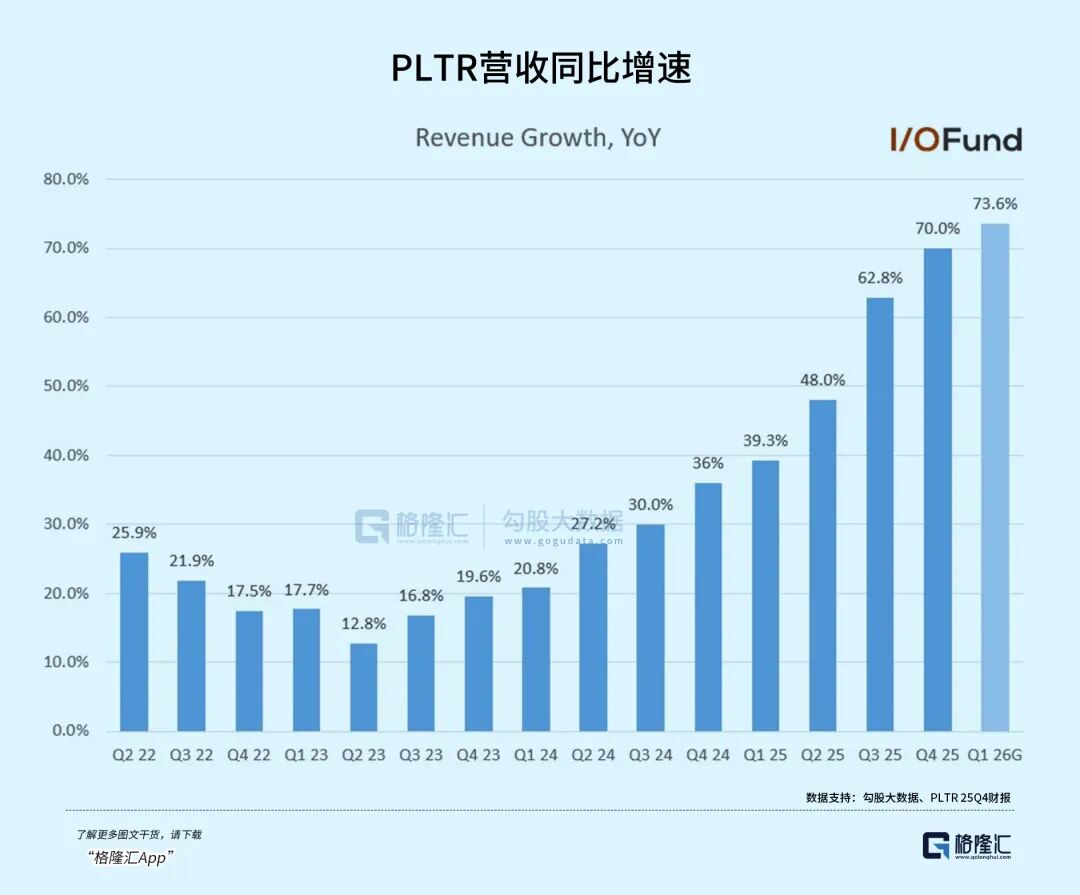
Core Viewpoint - The article discusses the significant divergence between Palantir's strong financial performance and its stock price decline, suggesting that the market may be undergoing a rational correction after a period of extreme optimism or a reallocation of capital by major investors [6][7]. Financial Performance Analysis - Palantir's Q4 2025 revenue reached $1.407 billion, with a year-over-year growth rate accelerating from 63% in Q3 to 70% in Q4 [7][9]. - The adjusted operating profit margin for Q4 was 57%, indicating strong profitability alongside revenue growth [7]. - The "Rule of 40" metric, which combines revenue growth and profit margin, reached 127% in Q4, up from 114% in Q3, challenging the notion that high growth must come with high losses in SaaS companies [12]. Business Growth Drivers - The U.S. Commercial segment's revenue growth accelerated from 121% in Q3 to 137% in Q4, indicating a robust demand for AI decision systems among enterprises [15]. - Palantir's customer base grew to 954, a 34% increase year-over-year, with significant order sizes, including 180 contracts worth over $1 million and 61 contracts over $10 million in Q4 [20]. - The company demonstrated strong customer retention and expansion, with notable increases in contract values across various sectors, such as utilities and healthcare [21][23]. Government and Defense Sector - Palantir's government revenue grew by 66% year-over-year to $570 million in Q4, reflecting a shift from intelligence analysis to comprehensive digital transformation in the defense industry [25]. - The application of technologies like ShipOS and Warp Speed significantly improved supply chain efficiency, reducing planning times from 160 hours to 10 minutes [26]. - The Maven platform's expansion across all U.S. military commands provides stable cash flow due to the long-term nature of defense contracts [27]. Competitive Advantages - Palantir's unique ontology architecture allows its AI systems to understand business logic and execute core decisions, differentiating it from competitors focused on chatbots and content generation [29]. - The company addresses data integration challenges for large enterprises, creating high switching costs and technical barriers for competitors [30]. - Palantir's established credentials in the defense sector provide a competitive edge in sensitive government and large enterprise markets [31]. Market Outlook - The recent stock price decline may present a buying opportunity, as the market has largely absorbed previous over-optimism [32]. - Palantir's business model has been validated through consecutive quarters of strong performance, suggesting potential for long-term growth [33]. - The ongoing AI application boom may represent a significant industrial revolution, positioning Palantir favorably for sustained premium valuations [35].

AI应用巨头回调30%背后:是估值泡沫破裂,还是产业逻辑的“价值错配”?
3 6 Ke· 2026-02-09 11:23
Core Insights - Palantir (PLTR) reported strong earnings in Q4 2025, with revenue growth accelerating to 70% year-over-year, yet its stock price fell over 30% from its peak, raising questions about market valuation and investor sentiment [1][2]. Group 1: Market Review - Palantir's Q4 2025 earnings exceeded expectations, with revenue reaching $1.407 billion, up from 63% growth in Q3 to 70% in Q4 [2]. - Despite strong performance, PLTR's stock price experienced a significant decline post-earnings, suggesting a potential market correction or profit-taking by investors [2][3]. Group 2: Core Data Analysis - PLTR's revenue growth is accelerating, with Q4 showing a 70% year-over-year increase, indicating a rising market penetration rather than a slowdown [3]. - The "Rule of 40" metric, which combines revenue growth and profit margin, reached 127% in Q4, up from 114% in Q3, challenging the notion that high growth must come with high losses [5]. - The US Commercial segment's revenue growth accelerated from 121% in Q3 to 137% in Q4, indicating a strong and ongoing demand for AI decision systems [7]. Group 3: Growth Engine Analysis - PLTR's customer base grew to 954, a 34% increase year-over-year, with significant order sizes, including 180 contracts worth over $1 million each in Q4 [11]. - Existing customers are increasing their spending on PLTR's platform, demonstrating strong product stickiness and expansion potential [13]. Group 4: Business Foundation - PLTR's government and defense business saw a 66% year-over-year revenue increase, reaching $570 million in Q4, reflecting a shift from intelligence analysis to comprehensive defense industry transformation [14]. - The application of technologies like ShipOS and Warp Speed has drastically improved supply chain efficiency, significantly benefiting the US defense sector [15]. Group 5: Competitive Moat - PLTR differentiates itself by focusing on decision-making capabilities rather than just AI chatbots, utilizing an ontology framework that allows for direct business command execution [17]. - The company has developed strong engineering capabilities to address data integration challenges, creating high switching costs for competitors [18]. - PLTR's established presence in the defense sector provides it with unique compliance and security credentials, enhancing its market access [19]. Group 6: Market Outlook - The recent stock price decline may present a buying opportunity, as traditional valuation metrics may not fully capture PLTR's growth potential driven by the "Rule of 40" [20]. - PLTR's business model has been validated through consecutive quarters of strong performance, and the current market correction may have cleared out speculative investors, providing a chance for long-term investors to reassess value [21].
硅谷的“军工新贵”正在改写美国的国家安全体系
Xin Lang Cai Jing· 2025-12-08 21:23
Core Insights - Palantir is collaborating with Exiger to integrate AI platforms and software to enhance the U.S. military's multi-layered supply chain and operational support capabilities [1] - New defense and intelligence contractors like Palantir are breaking the monopoly of traditional military giants, becoming key partners for U.S. defense, intelligence, and technology sectors [1] - The U.S. national security capability is undergoing a profound transformation, leading to a more agile, in-depth, and disruptive model of government-business collaboration [1] Company Overview - Palantir, founded in 2003 by Peter Thiel and Alex Karp, is recognized for its strong data analysis capabilities and advanced AI applications, providing intelligence technology services to the U.S. military and intelligence agencies [3] - The company gained significant support from U.S. intelligence agencies, with the CIA's venture capital arm, IQT, investing $2 million in Palantir shortly after its founding, which helped establish its early customer base [5] - Palantir's "Gotham" platform, adopted by the CIA in 2008, integrates various intelligence data for analysis, solidifying its role as a key intelligence contractor [5] Market Position and Growth - Palantir has built a strong reputation for reliability and effectiveness through extensive service to U.S. intelligence agencies, becoming a crucial tool in counter-terrorism and intelligence operations [6] - The company has seen continuous revenue growth, with approximately half of its income derived from government contracts, including a $368 million contract with the U.S. Special Operations Command [6] - In July 2025, Palantir signed a 10-year agreement with the U.S. Army, with a ceiling of $10 billion, to deploy its software platform comprehensively [6] Industry Trends - A new wave of defense and intelligence contractors, primarily from Silicon Valley, is emerging, with companies like Anduril leading in areas such as AI and robotics for military applications [7] - The U.S. military is increasingly integrating commercial space capabilities, with the Space Force signing around 150 contracts with commercial suppliers, significantly boosting its technological edge [8] - The collaboration model in U.S. national security is evolving from a traditional procurement approach to a more integrated "co-research, co-govern, co-fight" framework [8][11] Structural Changes in National Security - The relationship between government and business in national security is becoming more intertwined, with a focus on continuous feedback and rapid technological iteration [11] - The "revolving door" phenomenon is more pronounced, with former government officials and military leaders taking roles in private companies, enhancing market access for these firms [11][12] - The core of the U.S. national security framework is shifting from a manufacturing-centric model to one that emphasizes technological capabilities alongside manufacturing [14] Implications for Global Security - New defense contractors are increasingly becoming "quasi-state actors," reshaping the military and intelligence landscape and influencing global security dynamics [16] - The integration of technology companies into national security frameworks complicates both tangible and intangible warfare, as algorithms become critical tools in modern conflicts [16]

Wedbush唱多Palantir(PLTR.US):客户口碑强劲、AIP落地提升,有望走向万亿美元市值
Zhi Tong Cai Jing· 2025-12-05 13:57
Core Insights - Wedbush Securities provided a positive evaluation of Palantir (PLTR.US) following a well-received client event, highlighting the company's strong potential in the AI sector [1][2] - Palantir announced a partnership with Teton Ridge, a subsidiary of TWG AI, to integrate real-time AI and computer vision technology into cowboy sports events [2] Group 1 - The majority of potential clients learned about Palantir's technology through word of mouth, and many were impressed by actual use cases presented during demonstrations [1] - New customer agreements for long-term contracts are approaching a 50-50 split with existing clients seeking to increase spending across different products [1] - Palantir showcased over 30 demonstration cases across various industries, emphasizing the application of its AIP platform and other technologies [1] Group 2 - Analysts believe that Palantir has a pathway to a trillion-dollar market capitalization in the coming years, as the company continues to take strategic actions to maintain its leadership in AI [2] - The target stock price for Palantir is set at $230, with an "outperform" rating assigned by analysts [2] - The recent launch of the "Chain Reaction" platform, in collaboration with CenterPoint Energy and NVIDIA, is expected to accelerate the development of AI infrastructure [1]
Palantir Stock Falls 25% as CEO Alex Karp Blames "Market Manipulation." Is It Time to Buy?
The Motley Fool· 2025-11-22 22:52
Core Viewpoint - Palantir Technologies has seen its stock price drop 25% from its record high, but the valuation remains excessively high despite strong financial performance and market presence [1][8] Company Overview - Palantir has established itself as a significant player in the artificial intelligence sector, particularly appealing to retail investors, with shares increasing 1,800% since the launch of its AI platform in April 2023 [1][5] - The company initially developed analytics tools for the U.S. intelligence community and has since expanded its software applications to various industries, including finance, healthcare, manufacturing, and retail [4] Financial Performance - Palantir has reported impressive financial results, with sales growth accelerating for nine consecutive quarters, attributed to investments in unique software architecture and infrastructure [6] - The company currently has a market capitalization of $369 billion, with a gross margin of 80.81% [4] Valuation Concerns - Despite a 25% decline, Palantir shares are trading at 102 times sales, making it the most expensive stock in the S&P 500, significantly higher than the next closest company, AppLovin, which trades at 32 times sales [7] - The valuation metrics suggest that Palantir shares could decline another 66% and still remain the most expensive stock in the index [7] Market Sentiment - Hedge fund manager Michael Burry has taken a substantial short position against Palantir, holding 66% of his $1.4 billion portfolio in put options against the company, which has raised concerns about market manipulation according to Palantir's CEO Alex Karp [2][6] - Karp's comments on short sellers indicate a belief that there is a disconnect between the quality of Palantir's software and its stock valuation [2]

计算机周观察20251109:英伟达对华销售芯片再遭限制,中科曙光发布全球首个单机柜级640卡超节点
CMS· 2025-11-09 12:44
Investment Rating - The report maintains a "Recommendation" rating for the industry, indicating a positive outlook for the sector's fundamentals and expected performance relative to the benchmark index [3]. Core Insights - The report highlights the ongoing restrictions on NVIDIA's chip sales to China, which may impact the competitive landscape in the AI and computing sectors [6][9]. - The launch of the world's first single-cabinet 640-card super node, scaleX640, by Inspur is noted as a significant technological advancement, enhancing performance and efficiency in large-scale computing deployments [6][10]. - The domestic software companies are showing signs of recovery from a low base, with institutional holdings and expectations at low levels, suggesting potential for growth as AI applications evolve [6][17]. Summary by Sections Weekly Highlights - NVIDIA faces new restrictions on chip sales to China, affecting its market presence [9]. - Inspur has introduced the scaleX640 super node, which boasts significant performance improvements and is designed for large-scale deployments [10]. - The performance of overseas SaaS companies has been positively influenced by AI technology applications, with many reporting substantial revenue growth [12]. Market Performance Review - The computer sector experienced a decline of 2.54% in the first week of November 2025, with notable stock performances from companies like Chunzong Technology and Yingfang Software [18][19].


多空双杀?AI应用王者归来!
格隆汇APP· 2025-11-07 10:38
Core Viewpoint - Palantir Technologies (PLTR) is positioned as a leading player in the global AI application sector, demonstrating strong performance despite significant short-selling activity, particularly from notable investors like Michael Burry [2][14]. Financial Performance - In Q3 2025, PLTR reported a revenue of $1.181 billion, exceeding expectations of $1.09 billion, marking a year-over-year increase of 63% and a quarter-over-quarter increase of 18% [5]. - The company provided guidance for Q4 2025, expecting revenue between $1.327 billion and $1.331 billion, which represents a year-over-year growth of 61% [5]. - Adjusted operating income reached $600.5 million, with an operating margin of 51%, setting a historical high [5]. - Free cash flow for the quarter was $539.9 million, a 24% increase year-over-year, with total cash and equivalents amounting to $6.4 billion [5]. Business Segments - PLTR's business model is driven by both government and commercial sectors, with commercial revenue surpassing government revenue for four consecutive quarters [8][9]. - Commercial revenue for Q3 was $548 million, a 73% increase year-over-year, with U.S. commercial revenue growing by 121% [8]. - Government revenue was $633 million, reflecting a 55% year-over-year increase, with international government revenue contributing significantly [9]. Technological Edge - PLTR has developed a robust technological barrier over 20 years, focusing on a comprehensive AI decision-making system that addresses core business challenges [11]. - The company's unique ontology and AIP platform facilitate enterprise-wide AI transformation, enhancing operational efficiency [12]. Market Position and Future Outlook - PLTR's growth is supported by three main drivers: government demand for advanced defense capabilities, expanding commercial client base, and international market penetration [16][17][19]. - The company has a significant opportunity for growth, with a projected revenue growth rate of 53% over the next few years, indicating substantial market potential [20].