Claude Cowork工具

Search documents
高盛谈AI交易:“AI基建”的下半年风险,“AI应用”的“输家”短期难翻身
硬AI· 2026-02-26 10:27
Core Viewpoint - Goldman Sachs warns that the growth rate of AI capital expenditures is expected to slow in the second half of the year, which poses a direct threat to AI infrastructure stocks heavily reliant on capital spending, leading to a potential collapse in their valuation premiums [2][3] Group 1: AI Capital Expenditure Trends - Goldman Sachs highlights that the real risk emerges when the growth rate of capital expenditures begins to slow down, despite strong spending from tech giants [3][10] - The consensus forecast indicates that AI capital expenditures by tech giants will reach $667 billion by 2026, an increase of $127 billion from the beginning of the fourth quarter reporting season, representing a year-on-year growth rate of 62% [12] - The report emphasizes that the capital expenditure of major cloud providers is expected to exceed 90% of their operating cash flow this year, a level even higher than during the internet bubble [13] Group 2: Market Reactions and Valuation Risks - Goldman Sachs warns that once the growth rate of capital expenditures slows, the revenue growth and valuations of some AI infrastructure stocks will appear extremely fragile [19] - The report notes that many AI infrastructure sectors have experienced significant valuation multiple expansions in recent years, and historical experience shows that investors typically assign lower valuation multiples to companies with slowing growth [19][20] - The report identifies memory stocks as a current bottleneck within the infrastructure sector, with major memory stocks having risen approximately 145% since the beginning of Q4 2025, and 55% year-to-date [22] Group 3: Differentiation Among Tech Giants - Goldman Sachs predicts that the differentiation in returns among tech giants will continue in the short term, as the market's focus shifts to whether AI investments yield returns [26][27] - The report provides a comparison showing that the free cash flow yield of tech giants is around 1%, at a historical low, while the rest of the S&P 500 companies is approximately 4% [28] Group 4: AI Application Layer Uncertainties - The report indicates that the conflict at the application layer revolves around which companies will be disrupted and who can capture new revenue [30] - Goldman Sachs emphasizes that the boundary between being seen as an AI revenue "winner" and facing "disruption" concerns is very thin, leading to a lack of high valuations for many public companies [32] - The report highlights that concerns about AI disruption are difficult to be disproven in the short term, and companies labeled as "potentially disrupted" need to stabilize their earnings for their stock prices to stabilize [36][37] Group 5: Catalysts for Market Recovery - Goldman Sachs identifies three catalysts that could help tech giants regain market leadership, likely appearing in the second half of 2026 [48] - The first catalyst is the acceleration of AI revenue growth, as demonstrated by market reactions to earnings seasons [50] - The second catalyst is the visibility of free cash flow bottoming out as capital expenditure growth slows, which could lead to a revaluation based on profitability rather than cash flow [50] - The third catalyst is the fading of macroeconomic tailwinds, which could redirect funds back to these long-term stable tech giants [51]


高盛谈AI交易:“AI基建”的下半年风险,“AI应用”的“输家”短期难翻身
Hua Er Jie Jian Wen· 2026-02-26 03:01
市场首先要消化的,是资本开支预期的"再抬一档"。 根据高盛汇编的共识预期,2026年科技巨头的AI资本开支将达到6670亿美元。这一数字比四季度财报 季开始时高出了整整1270亿美元,同比增速高达62%。 资本开支大幅上修的另一面,是自由现金流被挤压。 报告强调:"超级云厂商资本开支正走向在今年超过经营现金流的90%,这一占比甚至高于互联网泡沫 时期。"在更具体的测算里,高盛指出2026年资本开支预计将占科技巨头经营现金流的92%。 当AI资本开支越冲越猛、估值越来越贵时,高盛提醒市场:真正的风险,往往出现在"增速开始放慢"的 那一刻。 2月24日,高盛全球投资研究在其策略报告《AI交易的拓宽与收窄》中称,近期AI交易波动显著上升, 背后两股力量在拉扯市场:一边是科技巨头资本开支持续"超预期",另一边是投资者对"AI颠覆传统行 业利润池"的担忧快速升温。 受强劲的资本开支指引推动,存储芯片概念股今年迄今平均大涨55%;而受"AI颠覆论"恐慌影响,软件 股则暴跌了24%。同一个"AI主题",在不同环节呈现出几乎相反的行情。 高盛将这场剧烈波动的AI交易划分为四个阶段,而目前这四个阶段的股价走向已经截然相反: 面 ...
“AI+数字广告”霸主Applovin(APP.US)击碎“软件股末日论”! AI红利被烙印进业绩 Q4净利润猛增84%
智通财经网· 2026-02-12 00:13
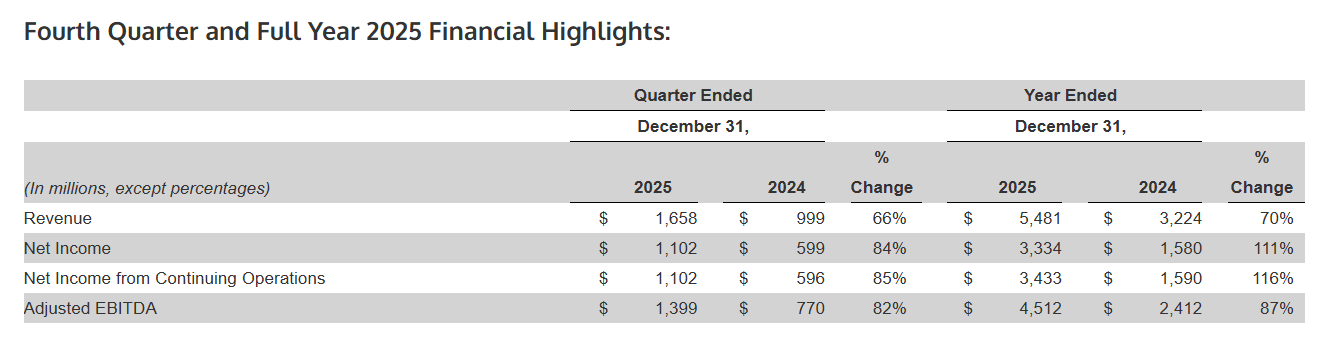
Core Viewpoint - Applovin has demonstrated strong performance and future revenue outlook, surpassing Wall Street analysts' expectations, amidst a market narrative that has exaggerated fears regarding AI's impact on software stocks [1][2][3] Financial Performance - For Q4 2025, Applovin reported total revenue of approximately $1.658 billion, a significant increase of 66% year-over-year, exceeding the analyst expectation of around $1.61 billion [3][4] - The net income for Q4 was approximately $1.102 billion, reflecting an 84% year-over-year growth, with GAAP earnings per share at $3.24, well above the expected $2.96 [3][4] - For the full fiscal year 2025, total revenue reached about $5.481 billion, a 70% increase from 2024, with net income of approximately $3.334 billion, up 111% [4] Future Outlook - Applovin's management anticipates Q1 2026 revenue in the range of $1.745 billion to $1.775 billion, indicating a potential sequential growth and exceeding the average analyst expectation of around $1.7 billion [5] - The adjusted EBITDA forecast for Q1 2026 is projected between $1.465 billion and $1.495 billion, also above analyst expectations [5] Market Context - The software sector has faced significant sell-offs, driven by fears of AI disrupting traditional SaaS models, yet Applovin's results counter this narrative, suggesting that platform software companies may benefit from AI rather than be replaced by it [2][6][8] - The introduction of AI tools by competitors like Anthropic has raised concerns about the viability of traditional software models, but Applovin's performance indicates a different trajectory for companies that integrate AI into their core operations [6][7][10] Strategic Positioning - Applovin has successfully embedded generative AI and deep machine learning into its advertising technology, creating a closed-loop system that enhances revenue and profit growth [5][9] - The company exemplifies how platform software can leverage AI to improve operational efficiency and economic metrics, reinforcing the long-term bullish outlook for such firms [9][10]

科技股疑虑盘旋,AI会否成为软件股的“屠龙刀”
2 1 Shi Ji Jing Ji Bao Dao· 2026-02-11 10:00
南方财经 21世纪经济报道记者赖镇桃 报道 美国软件股上周遭遇血流成河的一周后,抛售潮终告一段落。 当地时间2月10日,周二,美股开盘后,软件股延续前一天的强劲反弹势头,但美国消费数据疲软、谷 歌拟发行天价美元债券消息出来后,多数科技股转跌,软件股走势分化,收盘时,标普500信息科技指 数跌0.58%,微软跌0.08%,甲骨文涨2.11%,Palantir跌2.40%,ServiceNow涨2.51%,iShares北美科技软 件股指数ETF(IGV)涨0.41%。 一些机构已在高喊"现在软件股已经跌至极具吸引力的买入点"。年初至今,甲骨文股价暴跌18.3%, Salesforce回调了23.72%。IGV作为全球最大软件类ETF今年1月已累跌15%,创2008年以来最差单月表 现,近一年内净流出约42亿美元。微软股价较去年10月的最高点,已下挫29.5%,市盈率还一度下探至 23左右,2013年来首次低于IBM。 但近期软件股的超跌,是恐慌带来的过度反应和错杀,还是对AI冲击的提前定价,市场观点已在出现 分化。周二,瑞银下调美国 IT 股评级,理由是软件行业不确定性持续、资本开支大幅增加,花旗上周 五警告软 ...
科技股疑虑盘旋 AI会否成为软件股的“屠龙刀”|美股一线
2 1 Shi Ji Jing Ji Bao Dao· 2026-02-11 09:51
一些机构已在高喊"现在软件股已经跌至极具吸引力的买入点"。年初至今,甲骨文股价暴跌18.3%, Salesforce回调了23.72%。IGV作为全球最大软件类ETF今年1月已累跌15%,创2008年以来最差单月表 现,近一年内净流出约42亿美元。微软股价较去年10月的最高点,已下挫29.5%,市盈率还一度下探至 23左右,2013年来首次低于IBM。 但近期软件股的超跌,是恐慌带来的过度反应和错杀,还是对AI冲击的提前定价,市场观点已在出现 分化。周二,瑞银下调美国 IT 股评级,理由是软件行业不确定性持续、资本开支大幅增加,花旗上周 五警告软件股远未"跌透",微软一周之内还遭遇华尔街两家机构Melius、Stifel下调评级,从"买进"下调 至"持有"。 也有投行持相反观点,"科技多头旗手"Wedbush的分析师坚持"软件末日论"过于悲观,摩根大通认为, 投资者们所担忧的AI替代软件应用的场景并不会大范围发生,建议投资者逢低买入。 美国软件股上周遭遇血流成河的一周后,抛售潮终告一段落。 当地时间2月10日,周二,美股开盘后,软件股延续前一天的强劲反弹势头,但美国消费数据疲软、谷 歌拟发行天价美元债券消息出 ...
美股长牛关键催化震撼来袭!SpaceX与OpenAI等巨头蓄势待发,高盛押注2026年乃IPO大年
Jin Rong Jie· 2026-02-10 02:57
Group 1 - Goldman Sachs strategists predict a strong rebound in the U.S. IPO market, driven by a stable economy, increased board confidence, and expected continued accommodative monetary policy [1][8] - The projected IPO fundraising amount for 2026 is approximately $160 billion, significantly higher than last year's $48 billion, excluding SPACs and other fundraising types [1][8] - The number of IPOs is expected to rise to 120 in 2026, nearly doubling from the previous year, indicating a return to normal levels rather than speculative market exuberance [2][8] Group 2 - Recent IPO activity has been mixed, with notable companies experiencing both significant gains and losses upon their market debut [2] - Key risks for the IPO market include potential market volatility, which could hinder the expansion of actual IPO sizes, as seen in recent global market fluctuations [2] - Major private companies like SpaceX and OpenAI are preparing for IPOs, with SpaceX potentially raising up to $50 billion and OpenAI's valuation expected to approach $1 trillion [5][6] Group 3 - The resurgence of IPO activity is crucial for the bullish trend in the U.S. stock market, as it reflects increased risk appetite and favorable financing conditions [8] - Historical data suggests that significant increases in IPO activity, especially from major companies, are often associated with strong returns in the S&P 500 index [4][8] - Other companies to watch for potential IPOs include Canva, Strava, and Databricks, indicating a broader wave of IPO activity anticipated in the coming years [7]
美股长牛关键催化震撼来袭! SpaceX与OpenAI等巨头蓄势待发 高盛押注2026年乃IPO大年
智通财经网· 2026-02-10 02:36
Core Viewpoint - Goldman Sachs strategists predict a strong rebound in the U.S. IPO market in 2026, driven by a solid economic backdrop, increased board confidence, and expected continued accommodative monetary policy [1][8] Group 1: IPO Market Predictions - The estimated IPO fundraising amount for 2026 is projected to reach approximately $160 billion, significantly higher than last year's $48 billion [1][8] - The number of IPOs is expected to increase to around 120, nearly doubling from the previous year [2][8] - The anticipated growth in IPO size and quantity is viewed as a return to normal levels rather than a speculative market boom [2] Group 2: Market Conditions and Risks - Current IPO activity has been mixed, with some companies facing challenges while others, like Veradermics Inc., have seen significant stock price increases [2] - Key risks for the IPO market include potential market volatility, which could hinder actual IPO expansion [2][8] - The heavy representation of software companies in the potential IPO pipeline poses additional risks, especially following recent declines in software stock valuations [2] Group 3: Notable Companies Preparing for IPO - SpaceX is actively planning for an IPO, with an estimated valuation exceeding $1.5 trillion and potential fundraising of several billion dollars [5] - OpenAI is also expected to prepare for an IPO in 2026, with a projected valuation nearing $1 trillion [6] - Other companies like Canva, Strava, and Databricks are being monitored as potential IPO candidates in the upcoming years [7] Group 4: Importance of IPO Activity - A resurgence in IPO activity is crucial for the bullish trend in the U.S. stock market, often occurring in environments of rising risk appetite and favorable financing conditions [8] - The anticipated increase in IPOs is expected to create a positive feedback loop, enhancing demand for risk assets and improving liquidity in the market [8]
砸崩软件股!Anthropic新工具为什么威力这么大?
凤凰网财经· 2026-02-07 10:57
Core Viewpoint - The introduction of a legal plugin by Anthropic for its Claude Cowork AI has significantly impacted the legal software sector, leading to a sharp decline in stock prices for several companies in this space, indicating increased competition and investor concern about the implications of AI on traditional legal services [4][5][6]. Group 1: Impact on Legal Software Stocks - The release of Anthropic's legal plugin triggered a sell-off in stocks related to legal and data services, with many stocks experiencing declines of over 15% [4][6]. - On the day of the sell-off, the total market value lost in the software, financial services, and asset management sectors was approximately $285 billion [6]. - Companies such as LegalZoom.com saw a nearly 20% drop, while Thomson Reuters and other legal information giants also faced significant declines [6][11]. Group 2: Market Position of Claude AI - Claude has emerged as a preferred tool for legal and financial professionals in conducting analysis, highlighting its competitive position in the AI market [8]. - The legal tools provided by Anthropic claim to automate tasks such as contract review and legal briefs, which are core functions of many legal software products [10]. Group 3: Traditional Legal Information Giants Under Pressure - Companies like LegalZoom, RELX, and Thomson Reuters, which operate in the legal information sector, are facing challenges due to the advancements in AI technology [11][12]. - The introduction of AI tools by startups like Legora and Harvey AI has already begun to disrupt the legal industry, with significant investments flowing into AI products for legal applications [12]. Group 4: Broader Software Industry Concerns - The software sector has been under scrutiny for several months as investors remain cautious about the potential risks posed by AI advancements [13]. - Recent data indicates that only 71% of software companies in the S&P 500 have exceeded revenue expectations this earnings season, compared to 85% for the broader tech industry, suggesting underperformance in the software sector [15].


全球资金流向生变!“Anthropic风暴”重创科技 价值股与债基成“新避风港”
智通财经网· 2026-02-06 11:40
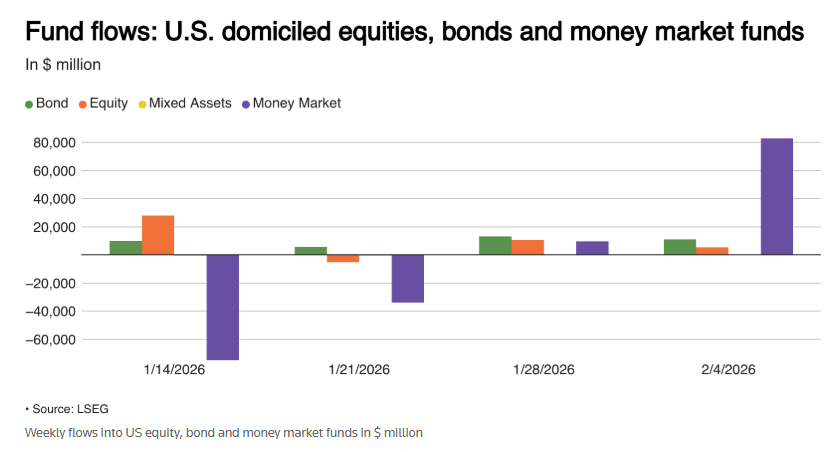
Core Viewpoint - The recent statistics indicate a significant decline in investment demand for U.S. equity funds, attributed to fears surrounding AI's potential to disrupt the software industry, despite strong earnings reports from major companies like Eli Lilly and Super Micro Computer [1] Group 1: Market Trends - U.S. equity funds saw a net inflow of approximately $55.8 billion for the week ending February 4, a sharp decrease of about 48% from the previous week's inflow of $108.2 billion [1] - The introduction of new AI tools by Anthropic has intensified market fears regarding the disruption of the SaaS software industry, leading to a collective crash in software stocks [4] - Major U.S. indices experienced a significant drop following the announcement of advanced AI capabilities that threaten traditional software services [4] Group 2: Fund Flows - Large-cap equity funds recorded a surprising net inflow of about $11 billion, indicating ongoing bullish sentiment towards major tech companies like Google, Nvidia, and Apple [5] - Mid-cap and small-cap equity funds experienced outflows of approximately $15.9 billion and $16.7 billion, respectively, reflecting a shift in investor sentiment [5] - Investors directed $21.1 billion into undervalued industrial sectors and approximately $14.4 billion into metals and mining, while withdrawing about $23.4 billion from the tech sector [5] Group 3: Bond and Cash Market Activity - U.S. bond funds achieved a net inflow of $111.1 billion over the latest week, marking the fifth consecutive week of significant inflows [8] - Short- to medium-term investment-grade bond funds received net investments of about $63.4 billion, the largest weekly inflow since at least 2022 [8] - Money market funds recorded a net inflow of $830.9 billion, the highest since early December, indicating a shift towards cash and bonds amid declining risk appetite [11]
“软件股末日”论调席卷华尔街之际 “AI重塑软件盈利”的增长叙事悄然扩散
智通财经网· 2026-02-05 10:48
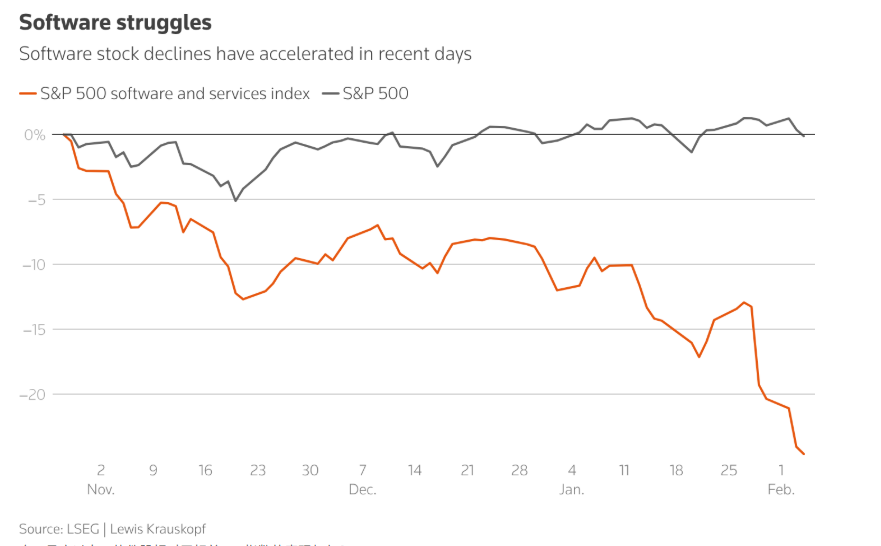
Group 1: Market Overview - The narrative of "Software-mageddon" is gaining traction among global investors, with debates on whether to initiate bullish calls on recently battered software stocks [1] - Large institutional investors are beginning to enter the market to buy the dip in software stocks that have experienced significant declines, with some supporting optimistic views on AI-focused software giants [1][3] - The S&P 500 Software and Services Index has dropped approximately 25% since its recent peak at the end of October, while the overall S&P 500 index has remained relatively stable [3][4] Group 2: Impact of AI Tools - The launch of Anthropic's AI programming tool, Claude Cowork, has intensified fears of AI agents disrupting the SaaS software industry, leading to a collective sell-off in software stocks [2] - The S&P 500 Software and Services Index experienced its worst performance since May 2002, with a significant market cap loss exceeding $800 billion [4] Group 3: Investor Reactions and Divergence - Institutional investors are showing mixed reactions, with some cautiously buying while others remain hesitant, indicating a divide in sentiment regarding the software sector [8] - Some portfolio managers are starting to see long-term value in certain software stocks, while others are waiting for stronger catalysts, such as robust AI-related revenue reports, before making aggressive purchases [8][9] Group 4: Future Outlook and AI Integration - The market is reassessing the value chain in the software industry, with AI potentially redistributing profits rather than completely replacing existing software infrastructure [11][12] - The current sell-off is seen as a response to the question of how much profit pools will be redistributed among SaaS vendors due to AI advancements, with a focus on real deployment and revenue growth from AI-related products [12][13]