Claude for Healthcare

Search documents
AWS launches a new AI agent platform specifically for health care
TechCrunch· 2026-03-05 21:54
Core Insights - Amazon Web Services (AWS) has launched Amazon Connect Health, an AI agent-powered platform aimed at automating administrative tasks in healthcare organizations [1][4] - The platform is HIPAA eligible and integrates with electronic health record (EHR) software, partnering with various EHR providers and patient engagement companies [2] Group 1: Product Features and Offerings - Amazon Connect Health automates tasks such as appointment scheduling, documentation, and patient verification, with features like patient verification and ambient documentation currently available [1][5] - Additional features, including appointment scheduling and medical coding, are set to roll out later, with the software priced at $99 per month per user for up to 600 encounters [5] Group 2: Market Context and Strategy - AWS is targeting the $5 trillion U.S. healthcare industry, building on previous healthcare initiatives like Amazon Comprehend Medical and Amazon HealthLake [3] - The launch of Amazon Connect Health marks AWS's first major product offering that utilizes AI agents within a regulatory compliant framework [4] Group 3: Competitive Landscape - The healthcare administrative burden has attracted attention from startups and larger AI companies, with examples like Regard and Notable focusing on similar automation solutions [8] - Other AI companies, such as OpenAI and Anthropic, have also introduced healthcare-focused products, indicating a competitive environment in the healthcare AI space [10]



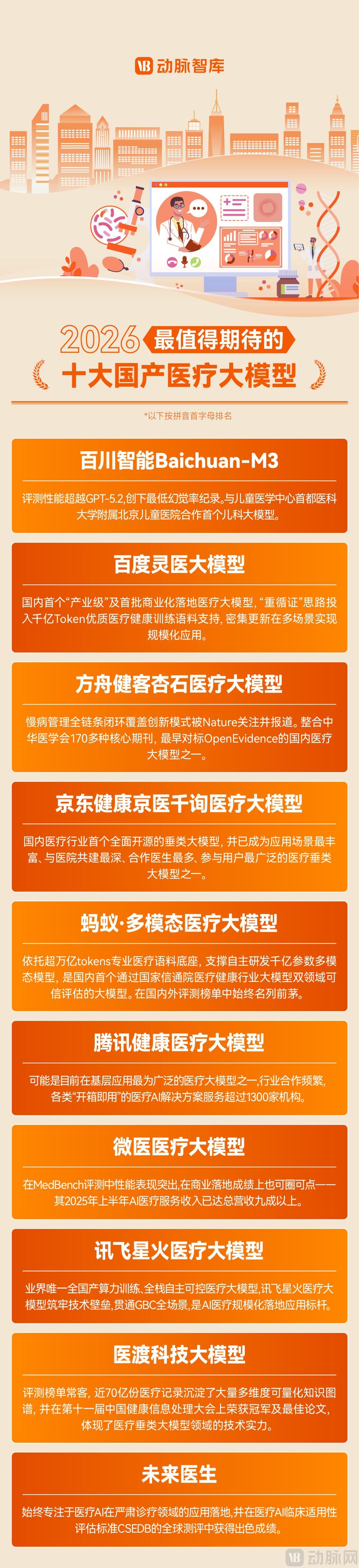
无惧OpenAI,2026年国内最值得期待的十个医疗大模型
3 6 Ke· 2026-02-09 01:31
Core Insights - The medical large model sector is experiencing significant advancements, particularly with the recent launches from OpenAI, Anthropic, and Google, indicating a competitive landscape in healthcare AI [1][3][4] - Domestic companies in China, such as Baichuan Intelligence and Ant Group, are making substantial progress, showcasing their capabilities and innovations in the medical AI field [5][6][10] Group 1: OpenAI's Developments - OpenAI launched ChatGPT Health and OpenAI for Healthcare, which comply with HIPAA regulations and aim to enhance patient care services [2] - ChatGPT Health integrates a new module based on the latest GPT-5 model, allowing users to connect personal health data while ensuring data privacy [2] - OpenAI for Healthcare targets medical institutions, offering enterprise-level solutions for clinical environments, including automated documentation [2] Group 2: Competitors' Responses - Anthropic released Claude for Healthcare, directly competing with OpenAI's offerings, highlighting its commitment to the healthcare sector [3] - Google updated its open-source medical large model, MedGemma 1.5, improving its capabilities in text, medical records, and medical imaging [3] Group 3: Domestic Innovations - Baichuan Intelligence launched Baichuan-M3, surpassing GPT-5.2 in benchmark tests, with a hallucination rate of only 3.5%, which was later improved to 2.6% [4][5] - Ant Group's medical model has gained significant traction, achieving 30 million monthly active users and doubling daily inquiries within a month [5] - JD Health and other domestic firms are also releasing new models and solutions, contributing to a vibrant competitive landscape in China's medical AI sector [5][10] Group 4: Benchmarking and Performance - HealthBench and MedBench are the primary benchmarking systems for evaluating medical large models, assessing safety, clinical applicability, and professional reasoning [7][8] - The performance of medical large models is crucial, with ongoing iterations and resource investments being necessary for advancements [8] Group 5: Industry Trends and Future Outlook - The medical large model sector is expected to grow significantly, with various domestic models emerging as strong contenders in 2026 [6][10] - The integration of local clinical guidelines and data security measures positions domestic models as more suitable for the Chinese market [6] - The increasing support from the government and the focus on localized solutions are likely to enhance the competitiveness of domestic models [6]


Anthropic cofounder Daniela Amodei says trusted enterprise AI will transcend the hype cycle
Yahoo Finance· 2026-01-27 10:00
Core Insights - Anthropic has launched Claude Cowork, an AI capability designed for general knowledge workers, which can autonomously perform multistep tasks on a user's computer, raising concerns about the durability of software-as-a-service businesses in the face of general-purpose AI [1] - The company emphasizes trust and reliability in regulated industries, positioning its AI models as core enterprise infrastructure rather than consumer products [3][4] - Anthropic's revenue has seen significant growth, projected to reach over $9 billion by the end of 2025, reflecting deep integration of its AI tools in enterprise workflows [6] Product Developments - Claude for Healthcare and Life Sciences was launched to support regulated workflows, enhancing earlier tools for clinical trials with HIPAA-ready infrastructure [2] - Claude Code, a tool for writing and managing code, has gained popularity among engineers, enabling the development of various applications [5] - The company has expanded integrations with platforms like Medidata and ClinicalTrials.gov to enhance its capabilities in clinical trial management [9][10] Market Trends - AI spending in healthcare is projected to reach $1.4 billion in 2025, with healthcare organizations adopting AI at a rate 2.2 times faster than the broader economy [7] - The fastest-growing segments in AI spending include patient engagement and prior authorization, with spending increasing 20 times and 10 times year over year, respectively [8] - Competitors like OpenAI are also entering the healthcare sector, but Anthropic's focus on specialized domains requiring structured reasoning gives it a competitive edge [14][15] Strategic Partnerships - Major clients include Novo Nordisk, Banner Health, and Eli Lilly, with reports indicating that over 85% of providers at Banner Health have improved their workflow efficiency using Claude [11] - Travelers is set to deploy Claude AI assistants to nearly 10,000 employees, marking one of the largest enterprise AI rollouts in the insurance sector [16] - Anthropic's capital posture reflects confidence, with a $13 billion Series F funding round at a $183 billion valuation, indicating strong investor interest [17]
在一个不允许犯错的行业:巨头向左、初创公司向右
虎嗅APP· 2026-01-27 09:14
Core Viewpoint - The article discusses the contrasting strategies of tech giants and startups in the healthcare AI sector, emphasizing that while large companies aim for broad applications, startups focus on niche, specialized solutions [2][14]. Group 1: Industry Dynamics - The healthcare industry is characterized by a paradox: it generates a significant amount of data (30% of the world's data) but has low digital penetration in core diagnostic processes [9]. - The healthcare sector is projected to grow from $4.8 trillion in 2023 to $7.7 trillion by 2032, making it an unparalleled market opportunity [9]. - The compound annual growth rate (CAGR) of healthcare data is expected to be 36%, driven by the proliferation of electronic health records and wearable devices [9]. Group 2: Major Players and Strategies - OpenAI has invested $100 million to acquire Torch, a data cleaning company, and launched "ChatGPT Health," which allows users to integrate their health data [3][12]. - Anthropic has introduced Claude for Healthcare, which connects to extensive medical databases, focusing on B2B applications [13]. - The article highlights that OpenAI's ChatGPT sees 230 million weekly health consultations, indicating a high-frequency usage scenario in healthcare [11]. Group 3: Startup Opportunities - Startups like OpenEvidence focus on providing specialized services for healthcare professionals, requiring strict user verification and offering a "professional version" of AI tools [15][16]. - OpenEvidence employs a freemium model, generating revenue through targeted advertising rather than charging healthcare institutions [16]. - The startup's approach includes accumulating data through user interactions and integrating continuing medical education (CME) credits into its platform, enhancing user engagement [17]. Group 4: Challenges and Considerations - The healthcare sector's stringent data quality requirements mean that large companies may not have a definitive advantage over specialized startups [12]. - The article suggests that only industries with substantial scale and rich data resources are suitable for deep AI transformation [8].

策略周报:“春躁”行情分化,聚焦金属科技双主线-20260125
Bank of China Securities· 2026-01-25 09:41
Group 1 - The report highlights a "spring excitement" market entering a phase of high volatility and structural differentiation, focusing on the dual main lines of metals and technology (AI applications and commercial aerospace) [2][12] - The non-ferrous metals industry is expected to benefit from both industrial trends and financial attributes in 2026, driven by Fed rate cut expectations and geopolitical tensions, particularly in rare earths and strategic metals [12][21] - The report notes a significant decline in the allocation of active equity funds to Hong Kong stocks, dropping to 15.9% in Q4 2025 from an average of 19.3% in the previous three quarters, indicating a weakening of overall pricing power [22][28] Group 2 - The AI application market is not finished but is expected to become more differentiated and focused, particularly on clear business models and rapid implementation in AI marketing, healthcare, and programming [33][34] - Major companies are accelerating their entry into the AI healthcare sector, which shows strong commercial potential due to its essential consumption characteristics and high payment willingness from both consumers and enterprises [36] - The report indicates that the global satellite launch and low-orbit constellation construction are accelerating, leading to an upward expectation for space photovoltaics, with potential for customized development in the materials sector [12][38]

AI应用的“妖风”还能吹多久?
投中网· 2026-01-24 07:36
Core Viewpoint - The article discusses the volatility and potential of AI application stocks, highlighting the recent surge and subsequent decline in their prices, emphasizing the need for logical investment rather than speculative trading [4][5][7]. Group 1: AI Application Market Dynamics - The AI application market experienced a significant surge starting January 9, driven by the IPO of MiniMax, which saw a price increase of over 90%, boosting market confidence in AI commercialization [5]. - Following the initial excitement, many AI application companies issued announcements clarifying their limited revenue from AI, leading to a sharp price correction in the sector [7]. - The article suggests that while the AI application sector is currently volatile, it has the potential to create long-term value if investors can identify companies with genuine business models and revenue streams [9]. Group 2: GEO Model in Advertising - The article introduces the GEO (Generative Engine Optimization) model, which allows users to input specific demands and receive optimized product recommendations directly from AI, streamlining the purchasing process [11]. - The GEO market is projected to grow significantly, with estimates of $2.9 billion in China and $11.2 billion globally by 2025, and reaching $24 billion and $100.7 billion by 2030 respectively [13]. - GEO is seen as a transformative force in marketing, shifting the power dynamics towards platforms that can leverage AI models effectively, similar to how Google and Baidu dominated the SEO era [16][17]. Group 3: AI in Healthcare - The AI healthcare sector has shown strong performance, with companies like Hongbo Medicine and Dian Diagnostics seeing stock increases of over 50% year-to-date [28]. - Government policies are increasingly supportive of AI in healthcare, with initiatives aimed at integrating AI into high-end medical equipment and remote healthcare applications [30]. - The article notes that AI healthcare applications are moving from concept to clinical use, with companies like Tempus AI reporting an 83% revenue growth, indicating a positive trend for domestic firms in the sector [31]. Group 4: AI in Financial Technology - The financial technology sector has also seen a rise, with the Financial Technology ETF increasing by over 14% since the beginning of 2026 [46]. - AI is expected to enhance the capabilities of internet financial companies by improving customer engagement and operational efficiency through advanced tools [48]. - However, the article cautions that while AI can improve operational efficiency, it may not fundamentally change the poor business models of many financial IT companies, which face challenges such as high customization costs and fragmented market share [49].

AI医疗爆发,多股年内涨超30%
21世纪经济报道· 2026-01-23 04:53
Core Viewpoint - The AI healthcare sector is experiencing significant growth and interest in 2026, with the AI healthcare index rising over 11% in just 14 trading days, indicating a clear trend in capital market enthusiasm for this sector [1][2]. Market Performance - As of January 22, 2026, the AI healthcare index increased by over 11%, while the CSI Medical Index and Hang Seng Healthcare Index rose by 7.68% and 10.65%, respectively [1]. - Companies like Di'an Diagnostics and Baolait have seen their stock prices surge over 60%, with others like Weining Health and Chengdu Xian Dao also experiencing gains exceeding 30% [1]. Industry Growth Projections - According to Frost & Sullivan, the AI healthcare market in China is projected to grow from 8.8 billion yuan in 2023 to 315.7 billion yuan by 2033, with a compound annual growth rate (CAGR) of 43.1% [1]. Technological Advancements - Major tech companies are actively entering the AI healthcare space, with OpenAI launching a healthcare version of ChatGPT and other firms like Ant Group, Tencent, JD, and ByteDance developing AI healthcare models and applications [5][6]. - AI drug development is identified as the fastest-growing segment within AI healthcare, with companies like Insilico Medicine and WuXi AppTec significantly reducing drug development timelines [6][7]. Commercialization Challenges - Despite the enthusiasm, the commercialization of AI healthcare products is facing challenges, with many companies reporting losses. For instance, 24 out of 47 biomedicine companies forecasted losses or reduced profits for 2025 [10]. - Companies like KingMed Diagnostics and Anbiping are experiencing significant revenue declines, with Anbiping reporting a 28.29% drop in revenue year-on-year [10][11]. Regulatory Developments - Recent government policies are seen as a positive signal for the AI healthcare sector, with initiatives aimed at promoting and standardizing AI applications in healthcare [15][16]. - The National Healthcare Security Administration has clarified pricing for AI-assisted diagnostic services, which is expected to facilitate the integration of AI into routine clinical practice [15][16]. Future Outlook - Industry experts predict that 2026 will be a pivotal year for AI healthcare, with clearer payment structures and stronger financial backing expected to enhance commercialization prospects [16].

2026年最热的板块由蚂蚁阿福和王小川引领
Xin Lang Cai Jing· 2026-01-22 10:08
Group 1 - Major tech companies are accelerating their investments in AI healthcare, with advancements in multimodal AI, agents, and programming expected to evolve significantly by 2025 [2][25] - Ant Group's AI assistant, Aifu, achieved 30 million monthly active users within a month of its new version release [2][38] - OpenAI launched ChatGPT Health, which connects electronic medical records and health applications to provide personalized health responses [2][25] Group 2 - The healthcare market is vast, with over 5% of ChatGPT's total queries related to health, translating to over 40 million daily inquiries [8][33] - AI is increasingly being used for non-urgent health inquiries, with 55% of users checking symptoms, 48% understanding medical terms, and 44% exploring treatment options through AI [8][33] - AI health inquiries often lead to recommendations for offline medical consultations, positioning AI as a preliminary information layer rather than a replacement for medical professionals [7][32] Group 3 - Baichuan Intelligent launched Baichuan-M3, a new generation medical-enhanced language model that outperformed previous models in testing [3][43] - Baichuan-M3 employs the SCAN inquiry principle, allowing it to actively ask about medical history, enhancing the interaction quality [3][45] - The company is focusing its resources on the medical sector, despite initial skepticism regarding the high risks and slow user growth in healthcare [4][46][47] Group 4 - Ant Group's approach integrates AI into existing medical pathways, guiding users on which department to consult and how to make appointments [10][36] - Baichuan's strategy aims to create a "fourth-level medical system" where AI acts as a companion to help patients understand their health data and decide when to seek further medical attention [4][49] - The competition between major players like Ant Group and Baichuan highlights the diverse strategies in leveraging AI for healthcare, with each company targeting different aspects of the market [10][41][49]

2026年最热的板块由蚂蚁阿福和王小川引领
新财富· 2026-01-22 08:47
Core Viewpoint - Major tech companies are accelerating their investments in AI healthcare, leveraging advancements in AI capabilities to enhance medical service supply and transform the healthcare market [2][3][19]. Group 1: AI Healthcare Developments - OpenAI launched ChatGPT Health, which connects electronic medical records and health applications to provide personalized responses based on user health information [5]. - Anthropic introduced Claude for Healthcare, aimed at general users, enhancing data connectivity and allowing secure access to personal medical records [6]. - Baichuan Intelligence released Baichuan-M3, a next-generation medical language model that outperformed previous models in testing [7]. Group 2: Evolution of Internet Healthcare - Prior to the mobile internet era, users relied on Baidu for health information, facing challenges like misleading advertisements and difficulty in assessing medical institutions [10][11]. - The internet healthcare sector transitioned to a platform-based model post-2016, with services like online consultations becoming standard [12][13]. - Despite improvements, the healthcare system still relies heavily on individual doctors, limiting service supply and efficiency [14][15]. Group 3: AI's Role in Healthcare - AI is increasingly used for non-urgent health inquiries, with users often consulting AI before visiting a doctor, although AI's advice is typically a preliminary step rather than a replacement for professional medical advice [16][17]. - The healthcare market is vast, with over 5% of ChatGPT's queries related to health, indicating significant user engagement with AI for health-related questions [17]. Group 4: Company Strategies - Ant Group's Aifu aims to be the largest platform in healthcare, integrating AI into existing medical pathways rather than replacing traditional diagnosis [20][21]. - Aifu's rapid user growth to 30 million monthly active users is attributed to its integration with existing healthcare services and resources [23]. - Baichuan's strategy focuses on developing advanced AI models for healthcare, emphasizing the importance of understanding life sciences as a pinnacle of AI capability [32][33].

巨头竞逐医疗AI赛道 健康160与京东健康等国内龙头打造中国方案
Zheng Quan Ri Bao Wang· 2026-01-21 04:09
Core Insights - Artificial intelligence (AI) is deeply integrated into the healthcare system, driving high-quality development in the industry [1] - The competition in the medical AI sector is intensifying among internet healthcare companies and tech firms [1] - Companies like JD Health and Alibaba Health are advancing from "single-point tools" to "ecosystem competition" [1] Company Developments - JD Health launched the evidence-based medicine AI tool "ZhiYi" aimed at doctors, which is considered a Chinese version of "OpenEvidence" [1] - Alibaba Health's AI product "Hydrogen Ion" has completed internal testing and is designed to be the lowest hallucination rate AI assistant in the medical field [1] - Health 160 has developed a dual-driven model combining public and private WeChat accounts to enhance digital healthcare services [2] Technological Advancements - Health 160 has tested an AI health steward multi-agent system covering pre-diagnosis, diagnosis, and post-diagnosis scenarios [3] - JD Health aims to evolve internet healthcare into a core engine for precise, personalized, and comprehensive health management [3] - OpenAI's ChatGPT for Healthcare has been deployed in various institutions, emphasizing data integration and personalized experiences [2] Industry Trends - The focus of AI healthcare competition has shifted from "usefulness" to "stable, compliant, and sustainable implementation" [3] - Future trends in China's AI healthcare include a complementary relationship between major players' full-chain layouts and precise niche market cultivation [4] - The industry is expected to transition from a "treatment-oriented" approach to "proactive health" as technology matures [4]