Gemini 3模型

Search documents
AI需求、模拟芯片、存储全面升温!瑞银重磅解读美股半导体股
Zhi Tong Cai Jing· 2026-02-10 09:29
Core Viewpoint - UBS highlights the rising demand for AI, simulation chips, and storage, providing a comprehensive analysis of several US semiconductor stocks, including Texas Instruments, SiTime, and Seagate Technology [2] Group 1: Texas Instruments Management Meeting Insights - Texas Instruments announced a $7.5 billion acquisition of Silicon Labs, with shareholders receiving $231 per share in cash, expected to close in the first half of 2027 [3] - The acquisition focuses on enhancing Texas Instruments' core business in various long-term chip markets, including appliances, power, industrial, and medical devices [3] - Management believes investor sentiment is neutral to positive, as the transaction's small scale minimizes its impact on the overall company [4] Group 2: SiTime Acquisition of Renesas Electronics - SiTime is acquiring Renesas Electronics' timing business for $3 billion, aiming to capitalize on the unprecedented AI training and inference demand [5] - UBS forecasts SiTime's earnings per share to exceed $11 by 2028, but acknowledges significant uncertainty due to market share growth and revenue synergies [5][6] - The acquisition is not primarily driven by cost synergies; instead, SiTime plans to invest in R&D for faster growth [6] Group 3: Google and Amazon Financial Reports - Google and Amazon's spending growth exceeded market expectations by approximately $110-120 billion, with Google’s capital expenditure projected to grow by 100% in 2026 [7][8] - Google’s AI model, Gemini 3, is gaining significant market attention, with a notable increase in token generation [7] - Amazon anticipates $200 billion in total capital expenditure by 2026, primarily for AWS, with a 60% year-over-year growth in cloud business capital spending [8] Group 4: Semiconductor Earnings Season Insights - UBS evaluated the performance of analog chip companies, noting a 0.4% revenue increase in Q4 2025 and a 1.3% guidance increase for Q1 2026 [9] - The industrial sector showed positive performance, while the automotive and consumer electronics sectors faced challenges [10] - UBS raised its earnings forecasts for Seagate Technology following Western Digital's earnings call, predicting a gross margin above 50% [11][12] Group 5: Forward-Looking Statements for Analog Devices and Indie Semiconductor - Analog Devices is expected to report strong Q1 2026 earnings, with revenue projected at $3.17 billion, exceeding guidance [13] - UBS anticipates a modest increase in Analog Devices' gross margin and a significant rise in earnings per share [14] - Indie Semiconductor is expected to report revenues close to guidance, with a focus on resolving previous supply chain issues [15]

年终盘点|美股年度牛股出炉!AI热度不减,核电、太空概念强势爆发
Sou Hu Cai Jing· 2025-12-31 10:19
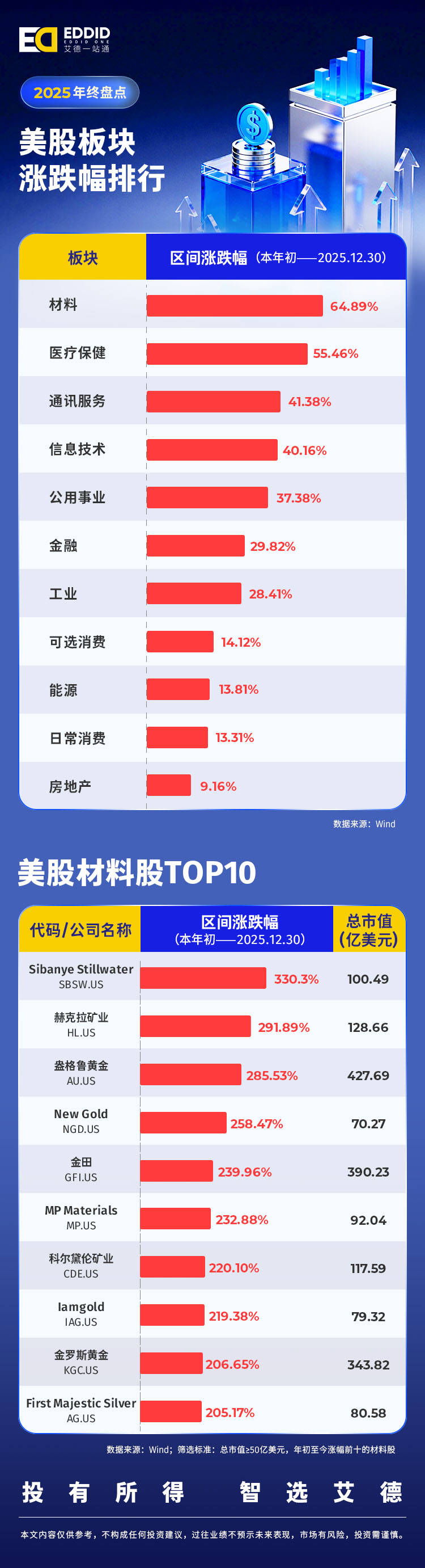
Core Insights - The U.S. stock market experienced a strong performance in 2025, with the S&P 500, NASDAQ, and Dow Jones all achieving double-digit gains for the third consecutive year, closing with increases of 17.25%, 21.28%, and 13.69% respectively [1] - The market was influenced by fluctuating tariff policies and the Federal Reserve's interest rate cuts, leading to a significant rebound in the AI sector and a robust end-of-year rally [1] Sector Performance - All 11 sectors of the U.S. stock market recorded positive growth, with the materials sector leading at a remarkable increase of 64.89%, followed by healthcare at over 55% and communication services at 41.38% [1] - The precious metals and base metals sectors had a standout year, with gold, silver, and copper prices surging, making them core investment choices globally [5] - The top-performing materials stocks included Sibanye Stillwater (SBSW.US) with a 330.3% increase, Hecla Mining (HL.US) at 291.89%, and AngloGold (AU.US) at 285.53% [4][5] AI Sector Developments - The AI narrative remained a focal point, with significant advancements such as OpenAI's Sora and Google's Gemini 3 model driving market interest and stock performance [6][7] - Major tech companies like Google (GOOGL.US) and NVIDIA (NVDA.US) saw substantial gains, with Google rising over 66% and NVIDIA nearly 40% [7] - AI-related stocks in data storage and power supply also performed exceptionally well, with companies like SanDisk (SNDK.US) and Western Digital (WDC.US) achieving increases of 578% and 300% respectively [8][7] Nuclear Energy Sector - The nuclear energy sector gained attention due to new U.S. government policies aimed at increasing nuclear power generation, leading to significant stock price increases for companies like Centrus Energy (LEU.US) and Oklo Inc (OKLO.US), which rose over 230% [10][12] - The government's initiatives included reducing project approval times and prioritizing small modular reactor (SMR) technology, aiming to triple nuclear energy output in the next 25 years [9][10] Space Sector Growth - The space sector saw a surge in interest, particularly after the U.S. government signed an executive order to establish dominance in space, leading to significant stock price increases for companies like Planet Labs (PL.US) and AST SpaceMobile (ASTS.US), which rose nearly 400% and 238.72% respectively [15][13] - The market's enthusiasm for space-related investments was reflected in the performance of various companies, with EchoStar (SATS.US) also achieving a 374% increase [15][13] 2026 Market Outlook - Analysts predict continued growth for the U.S. stock market in 2026, with target levels for the S&P 500 ranging from 7100 to 8100 points, supported by the Federal Reserve's policies and advancements in AI technology [16] - Sectors expected to perform well include non-essential consumer goods, healthcare, finance, and industrials, with a focus on financial stocks as the economy rebounds [16]

中原证券晨会聚焦-20251229
Zhongyuan Securities· 2025-12-29 00:20
Market Performance - The A-share market showed slight fluctuations with the Shanghai Composite Index closing at 3,963.68, up by 0.10%, while the Shenzhen Component Index closed at 13,603.89, up by 0.54% [3] - The average P/E ratios for the Shanghai Composite and ChiNext indices are 16.27 and 50.30 respectively, indicating a suitable environment for medium to long-term investments [8][10] Economic Policies - The National Financial Work Conference emphasized boosting consumption in 2026, with plans to implement special actions to support consumer goods and optimize subsidy standards [4][7] - The introduction of guidelines for commercial rocket enterprises on the Sci-Tech Innovation Board aims to facilitate IPO processes for at least 10 companies in the aerospace sector [5][7] Industry Insights - The photovoltaic industry is experiencing a significant increase in prices for silicon wafers and batteries, with N-type silicon wafers seeing price hikes due to cost pressures and industry self-discipline [15][16] - The domestic photovoltaic installation capacity reached 22.02 GW in November, marking a 74.76% increase month-on-month, with expectations of around 300 GW for the year [14] Animation Film Industry - Animation films accounted for nearly 50% of the total box office in 2025, with significant contributions from titles like "Nezha 2" and "Zootopia 2" [22][23] - The domestic animation film sector has seen a rise in quality and influence, with a notable increase in box office share from 32.28% (2013-2019) to 67.59% (2019-2025) [23][24] Automotive Industry - The automotive sector reported a production and sales increase in November, with total vehicle production reaching 3.53 million units, marking a new high [25][26] - The penetration rate of new energy vehicles reached 53.16%, reflecting a strong growth trend supported by favorable policies [26][27] Communication Industry - The communication sector's index rose by 1.44% in November, outperforming major indices, with a significant increase in telecom business volume [31] - The retail sales of communication equipment saw a year-on-year increase of 23.2%, indicating a recovery in the market [32] Food and Beverage Sector - The food and beverage sector experienced a rebound in November, particularly in pre-prepared foods and alcoholic beverages, with increased trading volumes [35]
2025全球亿万富翁财富激增:AI推动新增340位,马斯克单年增3309亿
Sou Hu Cai Jing· 2025-12-27 05:44
Group 1 - In 2025, the global billionaire population saw unprecedented wealth growth, with over 340 new billionaires added, a 50% increase compared to the average of the past five years [1][2] - The total wealth of billionaires reached $18.7 trillion, an increase of $3.6 trillion from the previous year, and a growth of $10 trillion since 2020 [1][2] - The number of billionaires with a net worth exceeding $100 billion has reached 19, compared to just one six years ago [2] Group 2 - The top ten billionaires collectively saw their wealth increase by over $700 billion in 2025, with Elon Musk's personal wealth growing by $330.9 billion, surpassing the total wealth of the second-ranked Larry Page by over $700 million [2] - Musk's wealth surge is primarily attributed to the significant increase in the value of Tesla and SpaceX, with SpaceX's valuation doubling to $800 billion [2][3] - Larry Ellison of Oracle set a record for the highest single-day wealth increase, gaining nearly $100 billion in one day due to a 36% rise in the company's stock price [2] Group 3 - The technology sector's prosperity has led to significant wealth increases for other entrepreneurs, including Google founders Larry Page and Sergey Brin, who benefited from advancements in artificial intelligence [3] - Nvidia's stock rose by 30.37% in 2025, with the company's market capitalization reaching $4.58 trillion, solidifying its position as the top publicly traded company globally [3] - A notable proportion of new billionaires this year emerged from the artificial intelligence industry, with nearly 70% being self-made, including founders from companies like DeepSeek and former core members of OpenAI [3]




马斯克,今年赚了地球上其他人一生都赚不到的钱
财联社· 2025-12-26 06:03
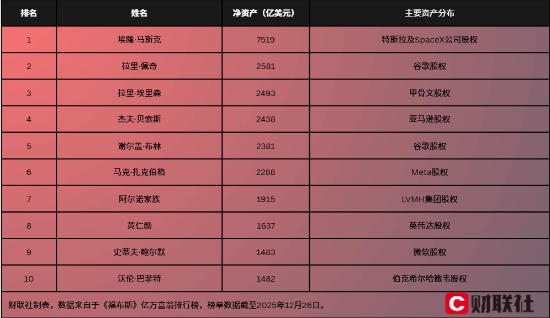
Core Insights - In 2025, the global billionaire population experienced record wealth growth, driven by advancements in artificial intelligence and the technology sector [1] - The total wealth of billionaires reached $18.7 trillion, an increase of $3.6 trillion from the previous year, and up $10 trillion since 2020 [1] - The number of billionaires with a net worth exceeding $100 billion reached a record 19, compared to only one six years ago [1] Billionaire Rankings - Elon Musk leads the billionaire list with a net worth of $751.9 billion, primarily from Tesla and SpaceX [2] - Larry Page and Larry Ellison follow with net worths of $258.1 billion and $249.3 billion, respectively, both benefiting from their stakes in Google [2] - The top ten billionaires collectively saw their wealth increase by over $700 billion in the past year, with Musk alone gaining $330.9 billion [2] Wealth Growth Factors - Musk's significant wealth increase is attributed to the soaring valuations of Tesla and SpaceX, with SpaceX's valuation more than doubling to $800 billion [3] - Larry Ellison experienced a record wealth increase of nearly $100 billion in a single day due to a 36% surge in Oracle's stock price [3] - Google founders Larry Page and Sergey Brin also saw substantial wealth growth due to the release of the Gemini 3 model, which boosted Google's stock [4] - Nvidia's CEO Jensen Huang benefited from a 30.37% increase in Nvidia's stock price, contributing to his rise in the billionaire rankings [4]

马斯克,今年赚了地球上其他人一生都赚不到的钱
Xin Lang Cai Jing· 2025-12-26 05:27
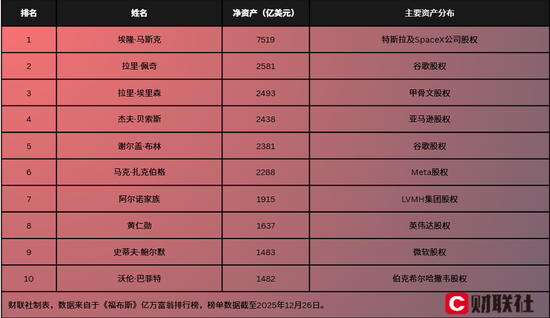
Core Insights - In 2025, the global billionaire population experienced record wealth growth, largely driven by advancements in artificial intelligence and the technology sector [1][5] - According to Forbes, over the past year, more than 340 new billionaires were added, a 50% increase compared to the average of the past five years; total billionaire wealth reached $18.7 trillion, an increase of $3.6 trillion year-on-year, and up $10 trillion since 2020 [1][5] - The number of billionaires with a net worth of $100 billion or more reached a record 19, compared to only one six years ago [1][5] Billionaire Rankings - The top billionaire rankings include Elon Musk at $751.9 billion, Larry Page at $258.1 billion, and Larry Ellison at $249.3 billion, among others [2][6] - The top ten billionaires collectively saw their wealth increase by over $700 billion in the past year, with Musk alone gaining $330.9 billion, surpassing the total wealth of the second-ranked Page by over $70 billion [2][6] Wealth Growth Drivers - Musk's wealth surge is attributed to the significant value increase of Tesla and SpaceX, with SpaceX's valuation more than doubling to $800 billion this year [3][7] - Larry Ellison set a record for single-day wealth increase, gaining nearly $100 billion due to a 36% rise in Oracle's stock price, although it later fell by about 40% [3][7] - Founders of Google, Larry Page and Sergey Brin, also saw substantial wealth increases due to AI advancements, particularly following the release of Google's Gemini 3 model [3][7] New Billionaires - A significant portion of the new billionaires this year emerged from the AI sector, with nearly two-thirds being self-made, including Liang Wenfeng, founder of DeepSeek, and seven key employees who left OpenAI [4][8] Company Performance - Nvidia's CEO, Jensen Huang, benefited from Nvidia's strong performance, with the company's stock rising by 30.37% this year, making it the largest publicly traded company with a market capitalization of $4.58 trillion [3][7]
马斯克今年赚了地球上其他人一生都赚不到的钱
Feng Huang Wang· 2025-12-26 05:10
Core Insights - In 2025, the global billionaire population experienced record wealth growth, largely driven by advancements in artificial intelligence and the technology sector [1] - The total wealth of billionaires reached $18.7 trillion, an increase of $3.6 trillion year-on-year, and up $10 trillion since 2020 [1] - The number of billionaires with a net worth exceeding $100 billion reached a record 19, compared to only one six years ago [1] Billionaire Rankings - Elon Musk leads the list with a net worth of $751.9 billion, primarily from Tesla and SpaceX [2] - Larry Page and Sergey Brin, co-founders of Google, have net worths of $258.1 billion and $238.1 billion, respectively [2] - The top ten billionaires collectively saw their wealth increase by over $700 billion in the past year, with Musk alone gaining $330.9 billion [2][3] Wealth Growth Factors - Musk's wealth surge is attributed to the significant valuation increases of Tesla and SpaceX, with SpaceX's valuation more than doubling to $800 billion [3] - Larry Ellison of Oracle gained nearly $100 billion in a single day due to a 36% rise in Oracle's stock price, although it later fell by about 40% [3] - The wealth of Google's founders increased due to the launch of the Gemini 3 model, which positively impacted Google's stock price [3] New Billionaires - A significant portion of the new billionaires this year emerged from the artificial intelligence sector, with many being self-made [4] - Notable new entrants include Liang Wenfeng, founder of DeepSeek, and seven key employees who left OpenAI [4]
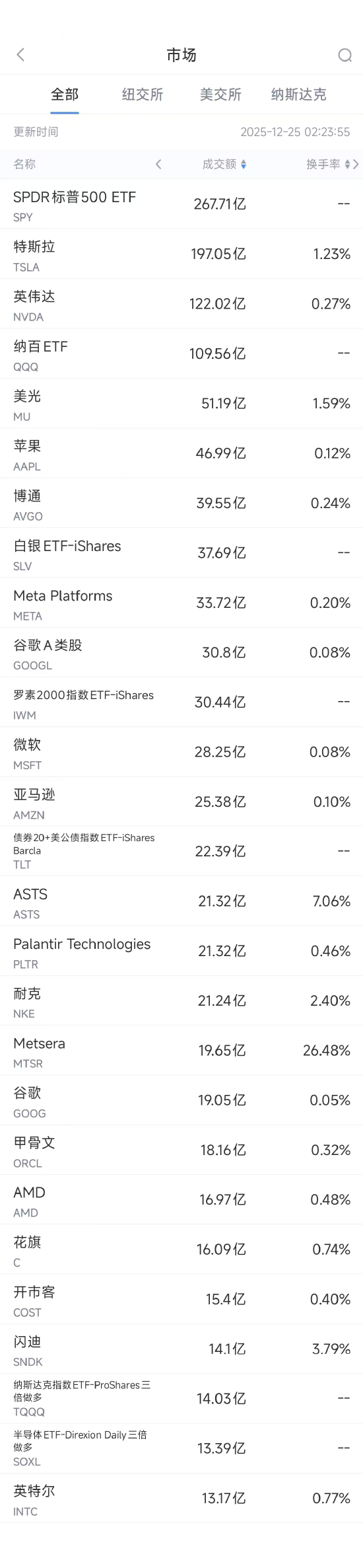
12月25日美股成交额前20:传英伟达暂停测试英特尔18A制程工艺
Xin Lang Cai Jing· 2025-12-24 18:40
Group 1: Tesla - Tesla's stock closed down 0.03% with a trading volume of $1.97 billion. The National Highway Traffic Safety Administration (NHTSA) received a petition on November 24, 2025, requesting an investigation into the mechanical door unlocking mechanism of the 2022 Model 3 due to design issues and difficulty in emergency situations [1][6]. Group 2: Nvidia - Nvidia's stock fell 0.32% with a trading volume of $12.20 billion. Reports indicate that Nvidia has halted testing of high-end chips using Intel's 18A process technology, negatively impacting Intel's stock price. Nvidia has decided not to pursue further collaboration with Intel [1][6][7]. Group 3: Micron Technology - Micron Technology's stock rose 3.77% with a trading volume of $5.12 billion. Argus Research raised Micron's target price from $210 to $320, citing growth driven by artificial intelligence solutions and recovering demand across multiple end markets [1][7]. Group 4: Broadcom - Broadcom's stock increased by 0.26% with a trading volume of $3.96 billion. Citigroup expressed optimism about the AI supercycle extending until 2026, maintaining a positive outlook on Nvidia, Broadcom, and Micron Technology [2][7]. Group 5: Google - Google's Class A shares fell 0.08% with a trading volume of $3.08 billion. Reports suggest that Google has made significant advancements in AI, prompting a "Code Red" alert from OpenAI's CEO in response to the competitive threat posed by Google's Gemini 3 model. Predictions indicate that Google may become one of the strongest performers among the "Magnificent Seven" in 2026 [2][7]. Group 6: Nike - Nike's stock rose 4.64% with a trading volume of $2.12 billion. Apple CEO Tim Cook purchased $2.95 million worth of Nike shares, marking his first personal investment in the company, which is seen as a strong signal of confidence in Nike's future value [3][6][9]. Group 7: Costco - Costco's stock increased by 2% with a trading volume of $1.54 billion. Wells Fargo lowered Costco's target price from $1,000 to $900 while maintaining a "hold" rating [10].


人工智能浏览器还不够智能 无法接管整个互联网
Xin Lang Cai Jing· 2025-12-23 03:33
Core Insights - OpenAI's launch of an AI-based browser has raised concerns among Alphabet Inc. investors regarding its potential impact on Google Chrome, which serves billions of users globally [1] - Current AI browsers, including OpenAI's Atlas and Perplexity's Comet, have not yet reached a level to replace traditional browsers like Chrome, as they still encounter errors and performance issues [1][7] - The integration of AI assistants aims to enhance user experience by allowing more complex tasks to be performed directly within the browser, although these features are primarily available to paid users due to higher operational costs [1][3] Group 1: User Behavior and Market Response - Different types of browsers are leading to distinct user behaviors, prompting developers and publishers to reconsider their tools for human users versus web crawlers [2] - Mozilla's CEO noted a shift in how users interact with the web, emphasizing the continued reliance on traditional search for complex queries [2] - A survey indicated that 60% of respondents prefer using generative AI for low-risk tasks where they can easily verify the output quality [2] Group 2: AI Browser Functionality and Limitations - Generative AI is seen as beneficial for information retrieval, allowing users to save time, but accuracy remains a concern, leading to a combined use of both AI and traditional search methods [3] - AI browsers are popular for summarizing long YouTube videos and handling multiple queries, with Comet users asking questions significantly more than those using standard chatbots [3] - Users are increasingly requesting features that allow for task automation, such as generating reports or filling out forms, indicating a demand for more advanced functionalities [3][4] Group 3: Technical Challenges and Industry Dynamics - The effectiveness of AI assistants is contingent on website design, with a need for clear and structured data to facilitate task execution [6] - Many existing websites are not optimized for AI interaction, which limits the capabilities of AI browsers [6] - The competitive landscape is shifting as Google and Microsoft integrate AI tools into their traditional browsers, potentially leveling the playing field [8] Group 4: Legal and Ethical Considerations - Major companies like Reddit and The New York Times are suing AI firms over content usage, highlighting the tension between traditional content providers and emerging AI technologies [9] - Concerns about the reliability of AI in financial transactions and decision-making processes are prevalent, with calls for improved trustworthiness in AI systems [9]
OpenAI十周年记:从非营利实验室到5000亿美元帝国,马斯克与奥特曼的决裂之路
硬AI· 2025-12-12 09:34
Core Insights - OpenAI has transformed from a non-profit organization founded in 2015 to a commercial giant with a valuation of $500 billion, especially following the release of ChatGPT-5.2 [2][3] - The relationship between co-founders Elon Musk and Sam Altman has deteriorated into fierce competition, with Musk launching xAI, valued at $230 billion, as a direct rival to OpenAI [3][4] Group 1: OpenAI's Evolution - OpenAI was established with a $1 billion commitment from Musk and other tech leaders to create an AI research lab free from commercial pressures [6] - The shift from a non-profit to a commercial entity has significantly altered the competitive landscape in AI, with OpenAI's valuation soaring due to the popularity of ChatGPT, which has over 800 million weekly users [3][4] Group 2: Competitive Landscape - OpenAI faces intense competition from major players like Google, Anthropic, Meta, and Musk's xAI, prompting aggressive investment strategies [4][10] - OpenAI plans to invest over $1 trillion in AI infrastructure, significantly outpacing competitors like Anthropic, which has a commitment of around $100 billion [10][11] Group 3: Financial Projections and Market Impact - OpenAI's aggressive spending is based on the assumption of sustained demand for AI services, with projected annual revenue reaching $20 billion by the end of the year and potentially thousands of billions by 2030 [12] - Major tech companies are benefiting from OpenAI's growth, with Oracle signing a $500 billion deal to provide infrastructure services [12] Group 4: Strategic Adjustments - In response to competitive pressures, OpenAI has initiated a "red code" strategy to reallocate resources towards enhancing ChatGPT's performance while delaying other projects [14][15] - The recent release of ChatGPT-5.2 is part of this strategy, aimed at maintaining a competitive edge against rivals like Google's Gemini [14][15]