Gemini 3系列

Search documents
2025年人工智能发展回顾:开辟AI新场景
Xin Lang Cai Jing· 2026-01-07 01:40
Group 1 - In 2025, Russia's AI development is characterized by policy-driven implementation, parallel advancements in military and civilian sectors, and the initial formation of a self-sufficient technology ecosystem [1][19] - The Russian government emphasizes the importance of mastering autonomous technologies in generative AI, linking it to national and technological sovereignty [1][19] - The AI market in Russia is projected to reach 1 trillion rubles by 2025, with enterprise solutions surpassing consumer solutions for the first time, accounting for 52.3% of the market [1][19] Group 2 - AI technology is being integrated into various sectors including aerospace, healthcare, and finance, with significant investments expected in the financial sector, projected to exceed 120 billion rubles in 2025 [2][20] - The Russian space agency plans to deploy the domestic large model GigaChat to the International Space Station to enhance satellite image resolution [2][20] - The introduction of AI tools in healthcare, such as pediatric MRI analysis tools by Yandex, is expanding access to AI technology across nearly 2,000 institutions in Moscow [2][20] Group 3 - In the U.S., AI technology is experiencing rapid evolution, with significant advancements in AI models and their applications in various fields [3][21] - OpenAI and other tech companies have launched several AI models, including the ChatGPT Agent and GPT-5, showcasing improvements in reasoning and computational capabilities [3][21] - Innovations in chip technology are supporting these advancements, with new designs significantly reducing energy consumption for AI applications [3][21] Group 4 - In the UK, AI research has made breakthroughs in algorithmic reasoning and the integration of AI with the physical world, particularly in healthcare [6][24] - The "DeepMind" company has developed advanced AI models that achieved gold medal-level performance in international mathematics competitions [6][24] - AI applications in embodied intelligence have progressed, with new technologies enhancing robots' tactile perception and adaptability to environments [6][24] Group 5 - France has focused on complex reasoning capabilities in AI, launching models that significantly improve performance in high-stakes fields like law and finance [7][25] - The development of the "Core of Reasoning" platform has enhanced AI's causal analysis abilities, leading to a 30% improvement in reasoning tasks [7][26] - France is also taking a leadership role in global AI governance, hosting international summits to establish ethical standards for AI development [7][27] Group 6 - Germany's AI research emphasizes trustworthiness, embodied intelligence, and industrial applications, aiming to align technological innovation with social responsibility [8][28] - The focus on explainable AI is addressing the challenges posed by the EU's AI regulations, particularly in medical diagnostics [8][28] - AI technologies are being integrated into various industries, enhancing predictive maintenance and personalized healthcare solutions [8][29] Group 7 - South Korea has established a national AI strategy, aiming to become one of the top three AI powers globally, with significant budget increases for AI development [9][30] - The newly formed "Korea National AI Strategy Committee" is responsible for overseeing AI policy and initiatives across 12 strategic areas [9][30] - The government is investing heavily in AI, biotechnology, and energy sectors to drive economic transformation and address growth challenges [9][30] Group 8 - South Africa's AI strategy emphasizes inclusivity and ethical considerations, with initiatives aimed at bridging resource gaps through technology [10][31] - AI diagnostic tools are being deployed in rural healthcare settings to improve disease screening and patient outcomes [10][31] - The country is also focusing on training programs to enhance AI skills among professionals, ensuring respect for cultural norms in AI applications [10][32] Group 9 - Japan is accelerating the institutionalization of AI policies, establishing a central body to oversee AI development and implementation [11][33] - The government is prioritizing the integration of quantum computing with AI to enhance research capabilities in various fields [11][33] - Japan's focus is shifting from technology development to large-scale applications in manufacturing, healthcare, and logistics [11][34]
AI浪潮转向硬科技 专家:2026年大概率成为AI手机元年
Mei Ri Jing Ji Xin Wen· 2025-12-25 14:57
Core Insights - In 2025, DeepSeek emerged, significantly lowering the application cost and threshold of AI technology, leading to a boom in vertical applications and a shift in industry competition from single model comparisons to full-stack ecosystem battles [1] - The AI landscape is transitioning from a dominance of OpenAI to a multi-polar competition, with applications expanding from software to intelligent hardware [1][2] - The "Hundred Mirrors War" in AI hardware is intensifying, with major tech companies investing heavily in AI glasses and smartphones, marking a significant shift in human-computer interaction [6] Group 1: AI Application Market Dynamics - The introduction of DeepSeek in February 2025 has drastically reduced AI inference costs, spurring growth in vertical applications such as AI in health, education, and office settings, leading to a reshuffling of the AI application market [2] - User data shows a concentration effect, with DeepSeek achieving an average monthly download of 34.72 million and ByteDance's Doubao at 31.44 million, dominating the general AI assistant market [2] - Vertical scenarios are becoming crucial for AI applications, evolving from language Q&A and content generation to multi-task intelligent agents across various industries [2][3] Group 2: Hardware Developments and Market Trends - McKinsey predicts a surge in vertical AI intelligent agents by 2025, with over 70% of AI value potential expected to come from these applications [3] - The global smart glasses market saw a shipment of 4.065 million units in the first half of 2025, a 64.2% year-on-year increase, with China accounting for 26.6% of the market share [6] - The global smart glasses market is projected to reach $42 billion by 2030 and $117 billion by 2040, despite facing challenges in technology maturity and privacy compliance [6] Group 3: Future Growth Areas - Key growth points in the AI field for 2026 include large models with continuous learning capabilities, real-time interactive 3D models, and seamless intelligent agents that integrate tools, data, and workflows [4] - The AI smartphone market is expected to see a shipment of 147 million units in China in 2026, a 31.6% year-on-year growth, capturing 53% of the overall market [8] - The "Doubao phone" model is gaining attention, with a focus on a multi-to-multi intelligent connection ecosystem, avoiding a zero-sum game in the internet ecosystem [9]
谷歌挑战英伟达,摩尔线程、沐曦内部人士怎么看?
第一财经· 2025-12-18 14:06
Core Viewpoint - The release of Google's next-generation AI model Gemini 3 series, showcasing the performance and cost advantages of its self-developed TPU, poses a strong challenge to NVIDIA's dominance in the GPU market, leading to a significant market reaction where NVIDIA's market value dropped by over $100 billion [3]. Group 1: Hardware Competition - The core debate centers around the division of labor between general-purpose GPUs and specialized chips like TPUs, rather than a simple replacement relationship [4]. - Google's ability to develop TPUs is attributed to its status as a full-stack integrated company, leveraging its strong infrastructure, foundational models, and cloud services to optimize costs [4]. - The continued advantage of GPUs is attributed to their flexibility, full functionality in a multi-modal era, and the established ecosystem, particularly NVIDIA's CUDA ecosystem, which has created a significant competitive barrier [5]. Group 2: Perspectives on Chip Architecture - The founder of Moex, Sun Guoliang, emphasizes that no chip architecture is inherently superior; the key lies in the application scenarios [6]. - Both GPUs and ASICs like TPUs are expected to coexist due to the diverse and rapidly evolving application scenarios in the industry [6]. - Despite acknowledging the value of general-purpose chips, there is recognition of the potential for specialized chips in specific scenarios, particularly for large cloud service companies once their algorithms stabilize [6]. Group 3: Infrastructure and Performance - In the current AI model competition, the peak computing power of a single card is not the sole determining factor; the ability to construct high-performance networks that connect thousands of cards and deeply integrate with software stacks is crucial [7]. - Moex has multiple production-grade thousand-card clusters operational, indicating a shift from experimental setups to real-world applications supporting training and inference [7]. - The primary challenge in AI infrastructure is to provide a reliable general computing power platform that supports large-scale model training and inference, rather than isolated cards or servers [8].




谷歌挑战英伟达,摩尔线程、沐曦内部人士怎么看?
Di Yi Cai Jing· 2025-12-18 10:48
Core Insights - The release of Google's next-generation AI model Gemini 3 series, featuring its self-developed TPU, poses a significant challenge to NVIDIA's dominance in the GPU market, leading to a market reaction that saw NVIDIA's market value drop by over $100 billion [1] - This shift raises the question of whether the hardware paradigm in the AI era is transitioning from general-purpose GPUs to specialized chips like TPUs, indicating a potential structural change in the industry [1] Group 1: Perspectives on Hardware - Li Feng from Moore Threads emphasizes that the debate is about the division of labor between generalists and specialists rather than a simple replacement, noting that Google's ability to optimize costs with TPUs stems from its full-stack integration capabilities [1][2] - He identifies three reasons for the continued advantage of GPUs: flexibility as a "dessert," full functionality in a multi-modal era, and the ecological moat established by NVIDIA's CUDA ecosystem [2] - Sun Guoliang from Muxi argues that no chip architecture is inherently superior; the key lies in the application scenarios, suggesting that GPUs and ASICs like TPUs will coexist due to diverse customer needs [3] Group 2: Market Dynamics and Infrastructure - The competition in AI models indicates that peak computing power of a single card is no longer the sole determinant of success; the ability to connect thousands of cards into high-performance networks is crucial [4] - Moore Threads is currently operating multiple production-level thousand-card clusters, indicating a shift towards end-to-end solutions rather than focusing solely on individual card performance [4][5] - Muxi has deployed thousands of card-scale clusters nationwide, successfully completing training tasks across various model architectures, highlighting the need for a reliable general computing platform for large-scale model training and inference [5]
每周投资策略-20251208
citic securities· 2025-12-08 06:46
Group 1: US Market Focus - The Federal Reserve is expected to lower interest rates again this week, with a 25 basis point cut anticipated in December [11][19] - Concerns about the "AI bubble" are emerging, with discussions on the sustainability of AI capital expenditures and the pace of AI application deployment [20][21] - Alphabet's Gemini 3 series has gained attention for its significant improvements in reasoning capabilities, potentially impacting its market position against competitors like OpenAI [22] Group 2: Australian Market Focus - Australia's GDP growth for Q3 was below expectations at 2.1% year-on-year, while inflation remains high, leading to a diminished likelihood of interest rate cuts [31][27] - The Reserve Bank of Australia is expected to maintain a hawkish stance, with a potential for only one more rate cut in the future [31][32] - The report recommends focusing on the materials and dividend sectors, highlighting companies like Northern Star and Woodside as key investment opportunities [27][34] Group 3: Indonesian Market Focus - Inflation relief in Indonesia provides a basis for cautious optimism regarding interest rate cuts in 2026, with a focus on banking and telecommunications sectors [3][11] - The VanEck Indonesia Index ETF is suggested as a potential investment vehicle for exposure to the Indonesian market [3] Group 4: Global Market Performance - The MSCI China index showed a 1.1% increase, driven by technology and aerospace stocks, indicating a positive trend in the Chinese market [5] - The Hang Seng Index and other major indices have shown resilience, with the Hang Seng Index up 0.9% and the MSCI China index reflecting a strong year-on-year performance [5][6] Group 5: Commodity and Currency Performance - The US dollar has declined under interest rate cut expectations, while copper prices have surged to historical highs [8] - The report notes significant movements in commodity prices, with WTI crude oil futures up 2.6% and LME copper prices increasing by 3.8% [8]


AI周报 | DeepSeek开源奥数金牌水平模型;前OpenAI 联创称规模扩展时代已终结
Di Yi Cai Jing· 2025-11-30 00:48
Group 1: DeepSeek's New Model - DeepSeek has open-sourced a new model, DeepSeek-Math-V2, which is the first open-source model to reach IMO gold medal level in mathematics [1] - The performance of Math-V2 surpasses that of Google's Gemini DeepThink in certain aspects, as demonstrated in the IMO-ProofBench benchmark and recent math competitions [1] Group 2: AI Scaling Era Conclusion - Ilya Sutskever, CEO of Safe Superintelligence, claims that the era of AI scaling has ended, indicating a shift back to research paradigms rather than mere expansion [2] - He emphasizes that the current computational power cannot continuously yield better scaling, blurring the line between scaling and waste [2] Group 3: Baidu's AI Department Restructuring - Baidu has established two new AI departments: the Basic Model R&D Department and the Application Model R&D Department, both reporting directly to CEO Li Yanhong [3] - The restructuring reflects Baidu's commitment to enhancing its R&D capabilities in large models, with leadership from internally cultivated talents [3] Group 4: Nvidia's Response to Short Selling - Nvidia responded to Michael Burry's claims about the minimal real demand for AI products, clarifying that its strategic investments represent a small portion of its revenue [4] - Following a significant drop in Nvidia's stock price, the company aims to prove the sustained strength of AI demand [4] Group 5: Google's AI Glasses Project - Google is accelerating its new AI glasses project, with hardware manufacturing by Foxconn and chip supply from Qualcomm, expected to enter small-scale production [6] - The project is independent of the previously announced AR glasses and is led by a key figure from Google Labs [6] Group 6: HSBC's Warning on OpenAI's Profitability - HSBC forecasts that OpenAI will face severe financial pressure over the next decade, predicting it will struggle to achieve profitability even with a projected revenue of $213 billion by 2030 [7] - The analysis highlights the significant cash flow deficit OpenAI may encounter, amounting to $207 billion [7] Group 7: Industrial Fulian's Performance Clarification - Industrial Fulian clarified rumors regarding a downward adjustment of its Q4 performance targets, stating that operations are proceeding as planned [8] - The company's stock experienced fluctuations, reflecting market concerns about its relationship with Nvidia [8] Group 8: Denial of Google Order by Tianfu Communication - Tianfu Communication denied rumors of securing a $3 billion order from Google, amidst speculation about its role as a supplier [9] - The stock prices of related companies fluctuated based on market interest in optical module stocks [9] Group 9: Meta's Interest in Google's TPU - Meta is reportedly considering a multi-billion dollar purchase of Google's TPU for its data center development, which could mark the first external sale of Google's TPU [10] - This potential shift could impact Nvidia, as Meta is currently its largest GPU customer [10] Group 10: AI's Water Consumption - A Morgan Stanley report highlights that AI not only consumes significant electricity but also requires substantial water resources for data center operations [11] - The report points out the challenges of water resource allocation for AI data centers, particularly in regions facing water supply issues [12]



DeepSeek上新:开源模型首达IMO金牌水平,AI推理告别“死记硬背”
Guan Cha Zhe Wang· 2025-11-28 07:17
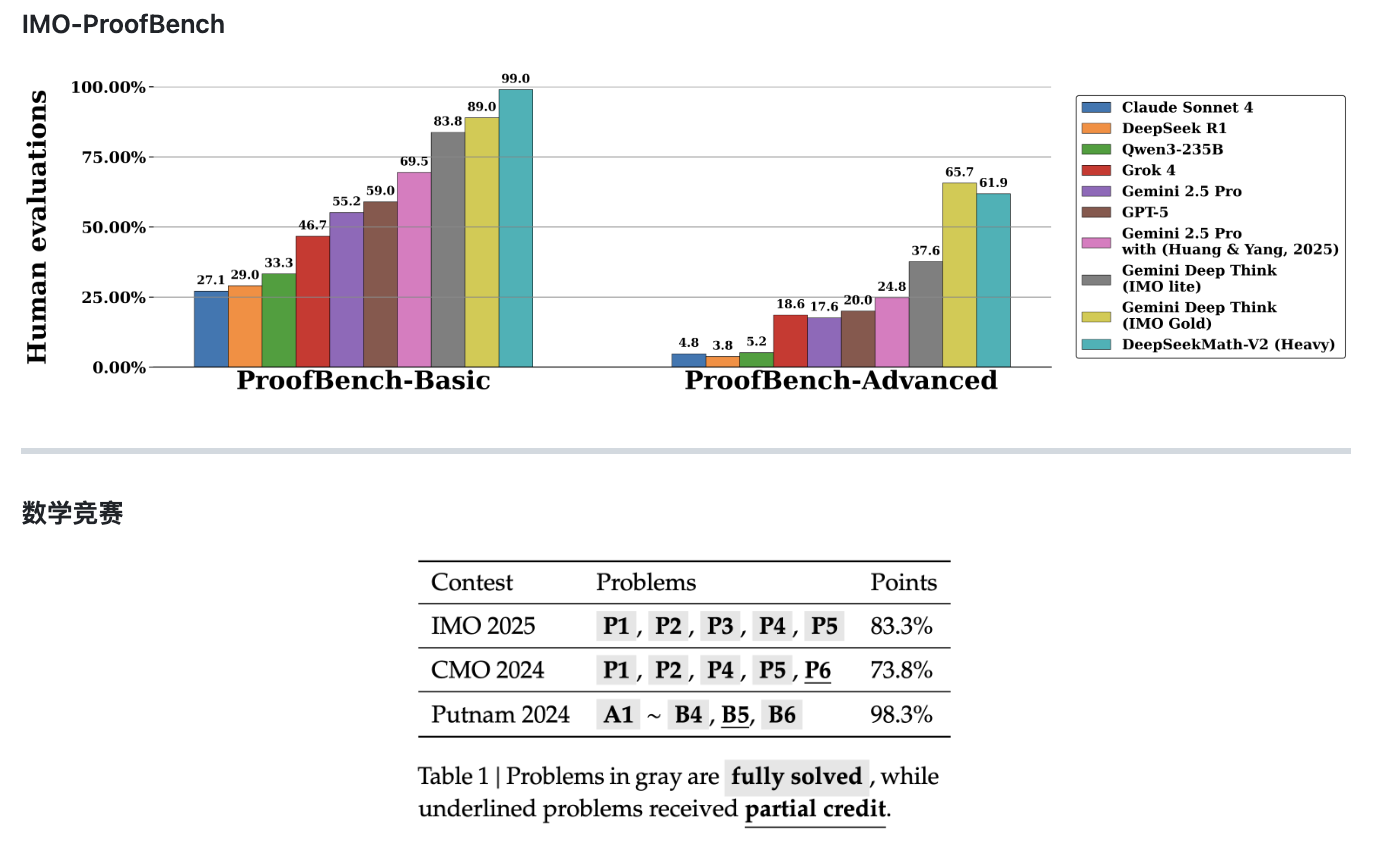
Core Insights - DeepSeek has released its latest technology achievement, DeepSeek-Math-V2, which focuses on enhancing mathematical reasoning and theorem proving capabilities in large language models, boasting 685 billion parameters [1][5] Performance Highlights - DeepSeek-Math-V2 achieved gold medal levels in the 2025 International Mathematical Olympiad (IMO) and the 2024 Chinese Mathematical Olympiad (CMO), and scored 118 out of 120 in the Putnam 2024 competition, surpassing the historical human record of approximately 90 points [1][3] - In the IMO-ProofBench benchmark, Math-V2 scored nearly 99% on the basic set, significantly outperforming Google's Gemini DeepThink, which scored 89%. On the advanced set, Math-V2 scored 61.9%, slightly below Gemini DeepThink's 65.7% [4] Technological Innovations - DeepSeek-Math-V2 addresses the "illusion of reasoning" problem highlighted by former OpenAI chief scientist Ilya Sutskever, moving beyond mere answer correctness to ensure rigorous logical reasoning [5][6] - The model employs a strict "process-focused" strategy, requiring clear and logical step-by-step derivations, and does not reward correct final answers if intermediate steps are flawed [6] - A unique multi-level "Meta-Verification" mechanism enhances the reliability of scoring, increasing the confidence level from 0.85 to 0.96 [9] Industry Impact - The release of DeepSeek-Math-V2 has generated significant buzz in the overseas developer community, marking a strong comeback for DeepSeek and breaking the long-standing dominance of closed-source models in top reasoning capabilities [11] - The model's success in mathematical reasoning is expected to influence the coding model space, potentially disrupting existing code assistance tools [11] - The global AI landscape is transitioning from "text generation" to "logical reasoning," with DeepSeek's approach providing a clear path for technological evolution through rigorous validation mechanisms rather than sheer computational power [11]
DeepSeek上新,“奥数金牌水平”
Di Yi Cai Jing· 2025-11-28 00:40
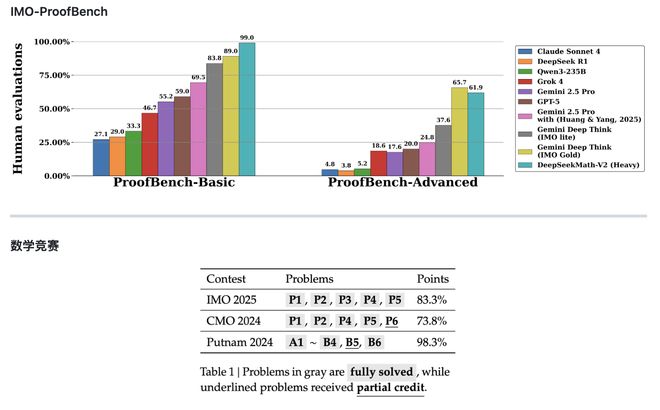
Core Insights - DeepSeek has released a new model, DeepSeek-Math-V2, which is the first open-source model to achieve International Mathematical Olympiad (IMO) gold medal level performance [3][5] - The model outperforms Google's Gemini DeepThink in certain benchmarks, showcasing its capabilities in mathematical reasoning [5][9] Performance Metrics - DeepSeek-Math-V2 achieved 83.3% in IMO 2025 and 73.8% in CMO 2024, while scoring 98.3% in the Putnam 2024 competition [4] - In the Basic benchmark, Math-V2 scored nearly 99%, significantly higher than Gemini DeepThink's 89%, but in the Advanced subset, Math-V2 scored 61.9%, slightly lower than Gemini's 65.7% [5] Research Implications - The paper titled "DeepSeek Math-V2: Towards Self-Validating Mathematical Reasoning" emphasizes the importance of rigorous mathematical proof processes rather than just correct answers [8] - DeepSeek advocates for self-validation in mathematical reasoning to enhance the development of more powerful AI systems [8] Industry Reactions - The release of Math-V2 has generated excitement in the industry, with comments highlighting its unexpected success over Google's model [9] - The competitive landscape is evolving, with other major players like OpenAI and Google releasing new models, raising anticipation for DeepSeek's next moves [10]
DeepSeek上新,“奥数金牌水平”
第一财经· 2025-11-28 00:35
Core Viewpoint - DeepSeek has released an open-source model, DeepSeek-Math-V2, which is the first model to achieve IMO gold medal level in mathematics and outperforms Google's Gemini DeepThink in certain benchmarks [3][5]. Group 1: Model Performance - DeepSeek-Math-V2 achieved nearly 99% on the Basic benchmark, significantly outperforming Gemini DeepThink, which scored 89% [5]. - In the more challenging Advanced subset, Math-V2 scored 61.9%, slightly below Gemini DeepThink's 65.7% [5]. - The model has demonstrated gold medal-level performance in IMO 2025 and CMO 2024, and nearly perfect scores in the Putnam 2024 exam (118/120) [8]. Group 2: Research and Development Insights - DeepSeek emphasizes the importance of verifying mathematical reasoning comprehensively and rigorously, moving from a result-oriented approach to a process-oriented one [8]. - The model is designed to teach AI to review proof processes like a mathematician, enhancing its ability to solve complex mathematical proofs without human intervention [8]. Group 3: Industry Reactions and Expectations - The release of Math-V2 has generated excitement in the industry, with reactions noting that DeepSeek has surpassed expectations by defeating Google's IMO Gold model by a 10% margin [9]. - There is anticipation regarding DeepSeek's next moves, especially concerning updates to its flagship models, as the industry awaits further developments [9].

DeepSeek上新!首个奥数金牌水平的模型来了
Di Yi Cai Jing· 2025-11-28 00:22
Core Insights - DeepSeek has released a new model, DeepSeek-Math-V2, which is the first open-source model to achieve International Mathematical Olympiad (IMO) gold medal level performance [1] - The model outperforms Google's Gemini DeepThink in certain benchmarks, showcasing its capabilities in mathematical reasoning [1][5] Performance Metrics - DeepSeek-Math-V2 achieved 83.3% on IMO 2025 problems and 73.8% on CMO 2024 problems [4] - In the Putnam 2024 competition, it scored 98.3%, demonstrating exceptional performance [4] - On the Basic benchmark, Math-V2 scored nearly 99%, while Gemini DeepThink scored 89% [5] - In the Advanced subset, Math-V2 scored 61.9%, slightly below Gemini DeepThink's 65.7% [5] Research and Development Focus - The model emphasizes self-verification in mathematical reasoning, moving from a result-oriented approach to a process-oriented one [8] - DeepSeek aims to enhance the rigor and completeness of mathematical proofs, which is crucial for solving open problems [8] - The research indicates that self-verifying mathematical reasoning is a viable direction for developing more powerful AI systems [8] Industry Reaction - The release has generated significant interest, with comments highlighting DeepSeek's competitive edge over Google's model [9] - The industry is keenly awaiting further developments from DeepSeek, especially regarding their flagship model updates [10]