
KPRO(肯律轻食)

Search documents
百胜中国(9987.HK):同店销售提速 26年展望积极
Ge Long Hui· 2026-02-12 22:54
Core Viewpoint - The company reported strong financial performance for Q4 2025, with revenue growth accelerating and continued improvement in operating profit margins, indicating a positive trend in both sales and operational efficiency [1][2][3][4]. Financial Performance - In Q4 2025, the company achieved revenue of $2.823 billion, a year-on-year increase of 9%, with operating profit of $187 million, up 25%, and net profit attributable to shareholders of $140 million, up 24% [1]. - For the full year 2025, total revenue reached $11.797 billion, a 4% increase year-on-year, with operating profit of $1.29 billion, up 11%, and net profit of $929 million, up 2% [1]. Same-Store Sales - Same-store sales grew by 3% in Q4 2025, marking the third consecutive quarter of growth, while same-store transaction volume increased by 4%, continuing a twelve-quarter growth streak [2][3][4]. - The average transaction value remained stable, with a decline in customer spending offset by an increase in delivery orders [3]. Store Expansion - The company added 587 new stores in Q4 2025, the highest for the fourth quarter, with a 36% increase in the proportion of franchise stores [1][5]. - For the full year, a total of 1,706 new stores were opened, with franchise stores accounting for 31% of the total [1]. Delivery and Membership Growth - Delivery sales grew by 34% year-on-year in Q4 2025, representing 53% of restaurant revenue, up from 42% the previous year [2][3][4]. - The combined membership for KFC and Pizza Hut exceeded 590 million, a 13% increase year-on-year, with active members surpassing 265 million [2]. Profitability Metrics - The restaurant profit margin for Q4 2025 was 13%, up 70 basis points year-on-year, while the operating profit margin was 6.6%, an increase of 80 basis points [2][3]. - For the full year, the restaurant net profit margin was 16.3%, up 60 basis points, and the operating net profit margin was 10.9%, also up 60 basis points [1][2]. New Business Initiatives - The company is expanding its market reach through new business models, including KFC's coffee and light meal offerings, which have seen significant growth [5]. - Pizza Hut is enhancing its value proposition by reducing capital expenditures and streamlining operations, particularly in lower-tier cities [5]. Future Outlook - The company plans to add 1,900 new stores in 2026, aiming to exceed 20,000 total stores, with a capital expenditure of $600-700 million [6]. - Continued innovation and expansion into new markets are expected to drive future growth, with a focus on operational efficiency and cost management [6].
百胜中国(09987):同店销售提速,26年展望积极
China Post Securities· 2026-02-12 08:55
Investment Rating - The report maintains a "Buy" rating for Yum China (9987.HK) [5][15] Core Insights - The company reported a revenue of $2.823 billion for Q4 2025, a year-on-year increase of 9%, with operating profit rising by 25% to $187 million and net profit increasing by 24% to $140 million [5][6] - For the full year 2025, the company achieved a revenue of $11.797 billion, up 4% year-on-year, with operating profit of $1.29 billion, an 11% increase, and net profit of $929 million, a 2% increase [5][6] Summary by Sections Company Overview - Latest closing price: HKD 445.60 - Total shares: 354 million - Total market capitalization: HKD 1,578.99 billion - 52-week high/low: HKD 450.00 / HKD 363.80 - Debt-to-asset ratio: 42.21% - Price-to-earnings ratio: 22.05 [4] Financial Performance - Q4 2025 saw a same-store sales growth of 3%, marking the third consecutive quarter of growth, with same-store transaction volume increasing for twelve consecutive quarters [6][7] - The company added 587 new stores in Q4 2025, the highest for the quarter, with a 36% increase in franchise store ratio [7] - The restaurant profit margin for Q4 2025 was 13%, up 70 basis points year-on-year, while the operating profit margin was 6.6%, up 80 basis points [7][8] Growth Drivers - The company’s delivery sales grew by 34% year-on-year, accounting for 53% of restaurant revenue, up from 42% the previous year [8][11] - Membership numbers for KFC and Pizza Hut exceeded 590 million, with active members growing by 13% [8] Future Outlook - The company plans to add 1,900 new stores in 2026, aiming for over 20,000 total stores, with capital expenditures projected at $600-700 million [14] - Revenue growth is expected to be 6.3% in 2026, with net profit growth of 10.1% [15][17]
食饮吾见 | 一周消费大事件(2.2-2.6)
Cai Jing Wang· 2026-02-06 08:08
Group 1 - Dongpeng Beverage listed on the Hong Kong Stock Exchange on February 3, 2026, with projected revenue for 2025 expected to be between 20.76 billion to 21.12 billion yuan, representing a year-on-year growth of 31.07% to 33.34% [1] - The company anticipates a net profit attributable to shareholders of 4.34 billion to 4.59 billion yuan, with a year-on-year increase of 30.46% to 37.97% [1] - The expected growth in net profit excluding non-recurring items is projected to be between 26.29% to 33.34% [1] Group 2 - Gaoxin Retail announced that it is currently unable to contact CEO Li Weiping, and the management responsibilities are being overseen by Chairman Hua Yunen [2] - The company confirmed that its operations are proceeding normally, with no impact on the supply of goods or services during the peak sales season [2] Group 3 - Chongqing Beer reported a revenue of 14.722 billion yuan for 2025, a year-on-year increase of 0.53%, and a net profit of 1.231 billion yuan, up 10.43% [3] - The company launched over 30 new products in 2025, including tea beer and fruit-flavored soda, to enhance its product offerings [3] - The company’s strategic initiatives included optimizing product structure and expanding into non-traditional beverage channels, contributing to a resilient business performance [3] Group 4 - Liangpinpuzi announced that its controlling shareholder, Ningbo Hanyi, received execution notices due to overdue debts totaling approximately 280 million yuan [4] - The company stated that the operational impact from this situation is currently minimal, and business activities are proceeding as normal [4] Group 5 - Yum China reported a 4% increase in total revenue to 11.8 billion USD for the fiscal year 2025, with a 9% increase in Q4 revenue to 2.8 billion USD [6] - The company opened 1,706 new stores in 2025, bringing the total to 18,101, with a focus on expanding its KPRO brand [6] - KPRO, which offers healthy food options, has seen significant sales growth, contributing to double-digit sales increases for the parent brand [6] Group 6 - Dabeinong announced the passing of its actual controller and chairman, Shao Genhuo, on February 3, 2026, with Vice Chairman Zhang Lizhong taking over the chairman's responsibilities [7] - The company confirmed that its board and management are functioning normally, and business operations continue without disruption [7] Group 7 - Sam's Club former executive Andrew Miles has joined Metro China as an advisor, effective February 2026, to enhance product competitiveness and long-term user value [8] Group 8 - Langjiu reported record high sales in January 2026, with a single-day sales peak of 270 million yuan [9] - The company noted a slight increase in distributor shipments and significant growth in membership and product launches throughout 2025 [9] Group 9 - Jinshiyuan expressed cautious optimism for the upcoming Spring Festival sales, indicating that while achieving internal expectations is possible, overall performance may decline compared to the previous year [10][11] - The company is actively preparing for the holiday season and managing inventory to balance supply and demand [11]
百胜中国去年收入增长4%至118亿美元,KPRO为肯德基母店带来双位数销售提升
Cai Jing Wang· 2026-02-05 08:27
Core Insights - Yum China reported a 9% year-over-year increase in total revenue for Q4 2025, reaching $2.8 billion, with system sales up 7% and same-store sales up 3% for the third consecutive quarter [1] - The company achieved a 25% increase in operating profit to $187 million, with a core operating profit growth of 23% [1] - The net addition of stores reached a record high in Q4, totaling 587, with 36% being franchise stores [1] Financial Performance - Total revenue for the full year 2025 increased by 4% to $11.8 billion, with system sales also up 4% excluding foreign currency effects [1] - Same-store sales for the year grew by 1%, with a total of 1,706 net new stores added, 31% of which were franchise stores [1] - As of the end of the year, the total number of stores reached 18,101 [1] Operational Highlights - Delivery sales grew by 34% year-over-year, accounting for 53% of restaurant revenue, up from 42% in the previous year [1] - KFC and Pizza Hut's combined membership exceeded 590 million, a 13% increase year-over-year, with active members reaching 265 million [2] - KFC's new coffee concept, KPRO, and the WOW store model have successfully expanded into previously uncovered areas, particularly in lower-tier cities [2][7] Strategic Outlook - The company aims to exceed 20,000 stores by 2026, with plans to reach over 30,000 by 2030, utilizing a combination of self-operated and franchised models [2][10] - The RGM 3.0 strategy will continue to drive innovation and efficiency [2] - The company is focusing on expanding its presence in lower-tier cities and strategic locations, with a significant increase in franchise store contributions [9][10]

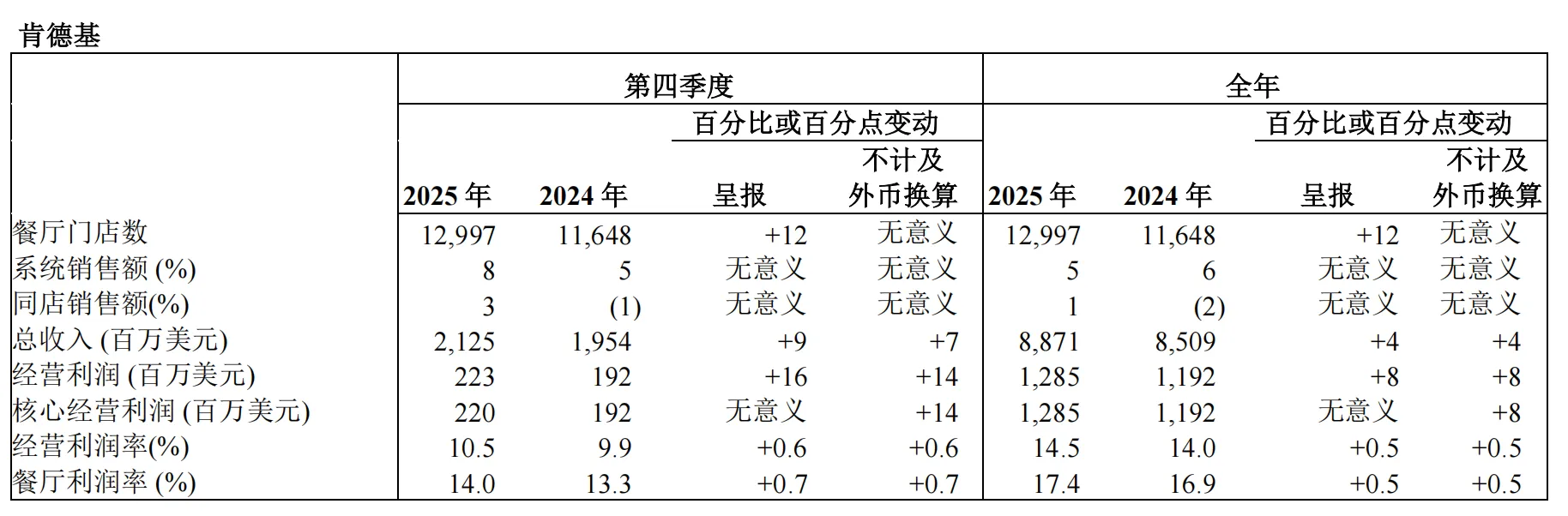
低价、外卖、外部压力环绕下,百胜中国真找准了“最佳平衡点”?
Hua Er Jie Jian Wen· 2026-02-05 07:19
Core Viewpoint - Yum China continues to demonstrate synchronized growth in scale, same-store sales, and profitability, despite increasing pressure from delivery services and competition in the food delivery market [1][2]. Financial Performance - In Q4 2025, Yum China's system sales increased by 7% year-on-year, while same-store sales grew by 3%, marking the third consecutive quarter of positive growth [1]. - The company added 1,706 new stores in 2025, bringing the total to 18,101 stores across over 2,500 towns [1]. - The operating profit margin reached 10.9% for the year, an increase of 60 basis points year-on-year, achieving the highest level since the company's listing in the U.S. after excluding special items [1]. Delivery and Market Trends - Delivery sales grew by 25% year-on-year in 2025, accounting for 48% of restaurant revenue, up 9 percentage points from the previous year [2]. - In Q4, delivery sales for KFC and Pizza Hut reached 53% and 54%, respectively, indicating a consistent upward trend throughout the year [2]. Pricing Strategy - KFC raised delivery product prices by approximately 0.8 yuan starting January 26 to offset rising delivery costs associated with increased delivery sales [3]. - The CEO noted that the growth of delivery services is expected to continue into 2026, and larger brands benefit from the competitive landscape of delivery platform subsidies [3]. Operational Efficiency - Yum China is implementing operational efficiency measures, including product innovation and the use of AI tools to optimize staffing and inventory management [4]. - In Q4 2025, KFC and Pizza Hut's restaurant profit margins increased by 70 and 60 basis points, respectively, due to these efficiency initiatives [4]. Expansion Strategy - The "Shoulder-to-Shoulder" model has proven effective in enhancing store efficiency and growth, with KFC's sub-brand K-Coffee expanding from 700 to 2,200 stores in 2025 [5]. - KPRO (KFC's healthy food brand) surpassed 200 stores and contributed double-digit sales growth to parent stores [7]. - Yum China plans to double KPRO's store count to over 400 in 2026, focusing on high-tier cities [8]. Future Goals - Yum China aims to reach a total of 30,000 stores by 2030, expanding its presence from approximately 2,500 cities to 4,500 [11]. - The company is adjusting its expansion strategy by increasing the proportion of franchise stores, which rose from 25% to 36% of new store openings in 2025, with plans to reach 40%-50% in 2026 [13]. - The company is confident in achieving its goal of 20,000 stores by 2026, with total capital expenditures expected to remain between $600 million and $700 million [18].
百胜中国:2025年经营利润同比增11%,今年将突破2万店
Bei Ke Cai Jing· 2026-02-05 07:09
Core Insights - Yum China reported a 25% year-on-year increase in operating profit for Q4 2025, with same-store sales growth for the third consecutive quarter [1] - For the full year, total revenue grew by 4% to $11.8 billion, and operating profit reached $1.3 billion, an 11% increase year-on-year [1] Expansion Strategy - The company aims to exceed 20,000 stores by 2026 and over 30,000 by 2030, focusing on both self-operated and franchised models [1] - As of December 2025, Yum China had a total of 18,101 stores, covering over 2,500 towns, with a net addition of 1,706 stores in 2025 [1] Brand Performance - KFC added 1,349 new stores in 2025, with system sales increasing by 8% in Q4 and same-store sales showing positive growth for three consecutive quarters [2] - Pizza Hut achieved a record high with 444 new stores in 2025, and same-store sales increased by 6% in Q4, with a 13% rise in same-store transaction volume [2] Membership Growth - By the end of 2025, the combined membership for KFC and Pizza Hut surpassed 590 million, reflecting a 13% year-on-year growth [1] New Market Strategies - The introduction of the WOW model has allowed Pizza Hut to enter over 200 new cities, with about half of these using the new model to penetrate previously uncovered areas, particularly in lower-tier cities [2] - The proportion of franchise stores in new openings increased from 25% in 2024 to 36% in 2025, while self-operated stores remain the core of the business, accounting for over 80% of total stores [2]
三万店“野心”背后,百胜中国如何重塑增长逻辑?
Sou Hu Cai Jing· 2025-12-09 03:32
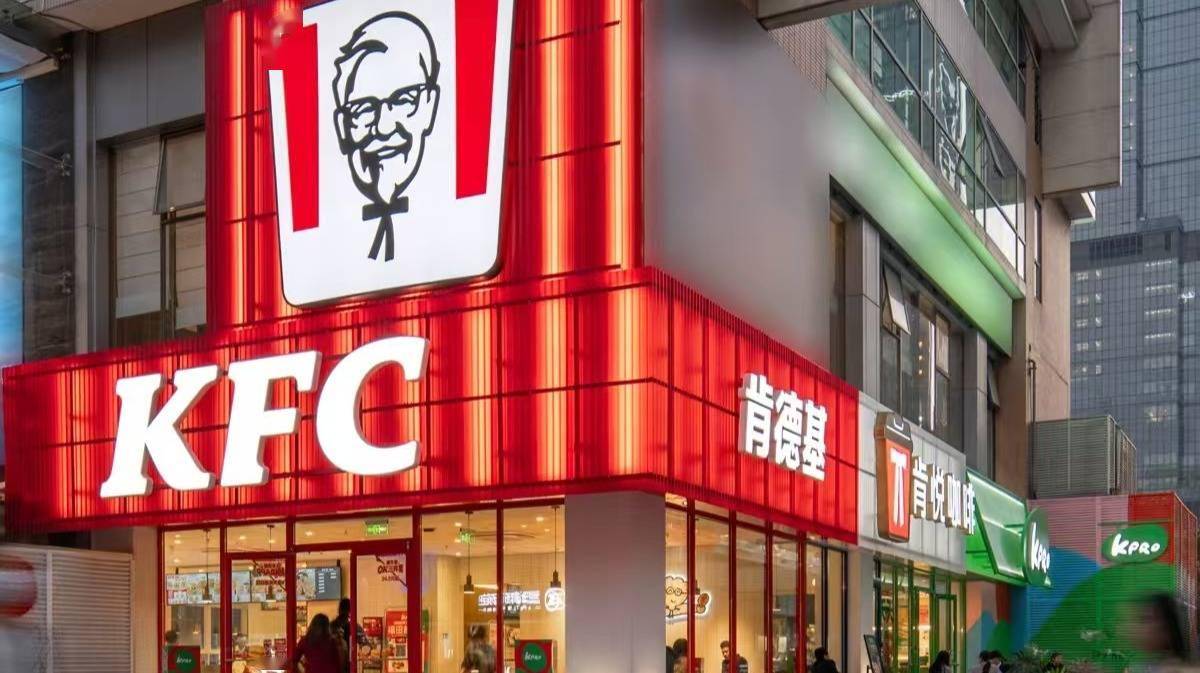
Core Insights - Yum China plans to rapidly expand its store count from 10,000 to 20,000 in less than a decade, aiming for 30,000 by 2030, significantly accelerating its growth trajectory established over the past 33 years [2] - KFC aims to exceed 17,000 stores by 2028 and become the first restaurant brand in China to achieve an operating profit of 10 billion yuan, while Pizza Hut targets over 6,000 stores by 2028 and aims to double its operating profit by 2029 compared to 2024 [2] - The company is also expanding its coffee and light meal brands, with KFC Coffee projected to surpass 5,000 stores by 2029 and KPRO already opening over 100 locations in just one year [2] Expansion Strategy - The "Bamboo Forest Effect" describes Yum China's diverse brand portfolio, supported by a robust supply chain, digitalization, and membership systems developed over nearly 40 years in the Chinese market [3] - The company faces challenges in balancing scale, innovation, and profitability, especially as competitors adjust their strategies in a saturated market [3][4] - Yum China's CEO emphasizes the importance of focusing on internal strengths and adapting to market conditions rather than solely emphasizing localization [4] Digital Transformation - Yum China is integrating AI technology across its operations, from smart ordering to quality control, although challenges remain in unifying different technological platforms [7][8] - The company acknowledges that employee trust in AI will take time to develop, and human decision-making remains crucial in the restaurant management process [8] Financial Performance - Despite rapid expansion, Yum China maintains a strong investment return cycle, with KFC's return period around two years and Pizza Hut's reduced to 2-3 years [9] - The company has consistently added over 1,000 new stores annually, with same-store sales showing positive growth for two consecutive quarters [9] Business Model Innovation - Yum China is focusing on its main brands while incubating new modules and store formats, leveraging KFC's extensive network and infrastructure [11] - The "Shoulder-to-Shoulder" model allows KFC to share space and resources with new brands like KFC Coffee, optimizing costs and enhancing operational efficiency [13] - The company is adopting flexible rental agreements, with 70% of new store leases based on revenue sharing rather than fixed rents, allowing for better adaptability to market conditions [15] Organizational Adaptability - Yum China is learning to balance the advantages of a large corporation with the agility of smaller businesses, aiming to create a resilient and efficient growth model [16] - The company recognizes the importance of maintaining human elements in decision-making processes, even as it embraces technological advancements [16]
三万店“野心”背后,百胜中国如何重塑增长逻辑?
虎嗅APP· 2025-12-08 13:48
Core Viewpoint - Yum China is aggressively expanding its store network, aiming to reach 30,000 stores by 2030, significantly accelerating its growth compared to the past 33 years when it opened 10,000 stores [4][5]. Expansion Plans - KFC plans to exceed 17,000 stores by 2028 and aims to become the first restaurant brand in China to achieve an operating profit of 10 billion [4]. - Pizza Hut targets over 6,000 stores by 2028 and aims to double its operating profit by 2029 compared to 2024 [4]. - New brands like K Coffee and KPRO are also expanding rapidly, with K Coffee expected to surpass 5,000 stores by 2029 [4][5]. "Bamboo Forest Effect" - The "Bamboo Forest Effect" refers to the diverse growth of various brands under Yum China, supported by a robust supply chain, digitalization, and membership systems developed over nearly 40 years in the Chinese market [5][6]. Challenges and Strategies - The company faces challenges from local brands and market saturation, with management emphasizing the importance of maintaining scale while being agile [6][9]. - Yum China's CEO highlighted the need to "do well" and adapt to market demands without overly focusing on localization [6]. Digital Transformation and AI - Yum China is integrating AI across its operations, from smart ordering to quality control, although challenges remain in unifying different technological platforms [11][12]. - The company acknowledges that while AI can enhance operations, human factors and trust in AI are crucial for successful implementation [12]. Financial Performance - Despite rapid expansion, Yum China has maintained a net new store growth of over 1,000 stores annually, with KFC's investment return period remaining around 2 years and Pizza Hut's reduced to 2-3 years [13][14]. - The company’s growth forecasts do not rely on macroeconomic improvements, indicating resilience in its business model [13]. New Business Models - Yum China is focusing on its main brands while incubating new modules and store types, leveraging KFC's infrastructure for new concepts like K Coffee and KPRO [14][16]. - The company is adopting flexible rental agreements for new stores, with 70% of new leases based on revenue sharing rather than fixed rents [18]. Conclusion - Yum China is navigating a transformative phase, balancing scale with agility, and leveraging technology while maintaining a human-centric approach to management and decision-making [20].

发力新模块与多元市场 百胜中国加速扩张
BambooWorks· 2025-11-28 10:52
Core Viewpoint - Yum China aims to significantly expand its store count, targeting over 25,000 stores by the end of 2028 and exceeding 30,000 by 2030, representing a growth of over 70% from the current level of 17,514 stores [1][3]. Store Expansion Plans - Yum China plans to increase its store count by over 40% in the next three years, with a target of more than 25,000 stores by the end of 2028 [2]. - The company intends to enhance restaurant profit margins from approximately 16.2%-16.3% this year to at least 16.7% by 2028 [2][6]. - The expansion strategy includes a focus on high-tier cities and deeper penetration into lower-tier markets through flexible store models [3][5]. Financial Performance and Projections - The company projects a compound annual growth rate (CAGR) for system sales in the mid to high single digits over the next three years, with operating profit also expected to grow at a high single-digit CAGR [6]. - Yum China plans to return approximately 100% of its free cash flow to shareholders starting in 2027, with expected annual shareholder returns of about $900 million to over $1 billion during 2027 and 2028 [6]. Brand-Specific Strategies - Pizza Hut's expansion plan is aggressive, aiming to increase its store count from 4,022 to over 6,000 in the next three years, while KFC will adopt a more conservative growth strategy, increasing its stores from 12,640 to over 17,000 by the end of 2028 [7]. - KFC is promoting a "small town model" to accelerate franchise expansion in lower-tier markets, with investment costs significantly lower than traditional stores [8]. Innovation and Technology - The company is implementing AI projects for store management, delivery operations, and customer service to enhance efficiency [11]. - Yum China is also focusing on resource sharing and integration across its brands to create stronger synergies [5][10]. Recent Financial Results - In the latest financial report, Yum China reported a 4% year-over-year increase in total revenue to $3.2 billion, with operating profit rising 8% to $400 million [12].
