LongCat

Search documents
美团的真正威胁藏在暗处
虎嗅APP· 2026-03-28 03:56
以下文章来源于AGI接口 ,作者苗正卿 AGI接口 . AI卷起的财富风暴。 出品|虎嗅商业消费组 作者|苗正卿 题图|视觉中国 电脑最左侧的"Tab键",正在成为美团内部,工程师日常"最高频敲击键"。 3月中旬,一位美团技术中层告诉虎嗅,2026年开年以来,内部在彻底的"AI化"。虎嗅获悉,截至 2025年底,美团新代码中AI生成率已经接近52%,而到了2026年一季度末,这个数据已经接近 60%。 上述人士透露,他所在的某核心业务线的技术部门,超过95%的代码工作都依托于CatPaw这款工 具。CatPaw是美团自研的一款AI IDE产品( AI Integrated Development Environment ),简单来说 它是AI编程工具,类似Cursor、字节的Trae以及阿里的通义灵码。但和很多其他AI IDE产品不同之 处是,它并没有和自家模型"绑死",CatPaw在美团LongCat模型之外,也支持多种模型混用,其中也 包括了核心竞对公司的模型产品。 该技术人士表示,CatPaw几乎嵌入到了他如今工作的每一步:从代码生成到代码检测。"基本上在写 代码时CatPaw可以做到实时编码提示,自动 ...


腾讯研究院AI每周关键词Top50
腾讯研究院· 2026-03-28 02:33
AI前沿每周关键词Top50 (0323-0327) 每周50关键词 把握全局AI动态 点击 关键词 可查看资讯概述 | 类别 | Top关键词 | 主体 | | --- | --- | --- | | 算力 | Atlas 350 | 华为 | | 算力 | TERAFAB | 马斯克 | | 算力 | AGI CPU | Arm | | 算力 | TurboQuant | 谷歌 | | | 3-bit | | | 算力 | AVO注意力内核 | 英伟达 | | 模型 | Uni-1 | Luma A I | | 模型 | LongCat | 美团 | | | Flash-Prover | | | 模型 | 世界模型简化 | LeCun等 | | 模型 | Ψ₀机器人模型 | 南加州大学 | | 模型 | Hyperagents | Meta | | 应用 | 桌面Agent布局 | OpenAI等 | | 应用 | ClawBot插件 | 腾 讯 | | 应用 | Token Plan | MiniMax | | 应用 | ClawBot接入 | 阶跃星辰等 | | 应用 | Computer Use | ...

美团CEO王兴:力争成为未来本地生活需求的AI入口
Xin Lang Cai Jing· 2026-03-26 14:41
来源:上海证券报·中国证券网 上证报中国证券网讯(记者 杨翔菲)3月26日,在美团财报电话会上,美团CEO王兴表示,在AI革命 中,唯一合理的策略是进攻,而不是防守。但美团不会盲目追求成为"词元工厂",而是将AI视为战略机 遇,用于改进、加强甚至彻底变革本地服务这一核心业务。 王兴透露,自2023年初以来,美团在资本支出和AI人才上进行了大规模投入。"除了有云计算业务的企 业外,美团在AI上的投入规模,大概率是国内企业里领先的,且已经坚持布局三年多了。"王兴说,美 团正继续投入自研基座大模型LongCat,也在和当前行业顶尖的第三方大模型合作,致力于最精准地理 解真实物理世界。 王兴认为,所谓AI"超级入口",关键在于精准理解用户需求,并且高效执行任务,其复杂程度远超"聊 天机器人"。尤其是本地生活领域,消费场景复杂多样、海量商家信息分散,数据和信息未被有效线上 化。同时,本地生活平台还需要对履约交付做深入的管理,这是通用AI所欠缺的能力。 王兴举例说:"我在望京办公,我的朋友在中关村,我们计划一起吃午饭,但只有2个小时的时间,需要 找到一家位于中间地段、味道不错、还要方便停车的川菜馆。"要满足这个常见需求, ...

王兴:美团不会盲目追求成为token工厂,将以AI变革本地服务业务
Xin Lang Cai Jing· 2026-03-26 13:59
王兴认为,AI"超级入口",关键在于精准理解用户需求,并且高效执行任务,其复杂程度远超"聊天机 器人"。 尤其是本地生活领域,消费场景复杂多样、海量商家信息分散,数据和信息未被有效线上化。同时,本 地生活平台还需要对履约交付做深入的管理,这是通用AI所欠缺的能力。 3月26日美团财报电话会上,CEO王兴表示,在AI革命中,唯一合理的策略是进攻,而不是防守。但美 团不会盲目追求成为"词元工厂",而是将AI视为战略机遇,用于改进、加强甚至彻底变革本地服务这一 核心业务。 他透露,自2023年初以来,美团在资本支出和AI人才上进行了大规模投入,"除有云计算业务的企业 外,美团在 AI 上的投入规模,大概率是国内企业里最大的,且已经坚持布局三年多了。"美团正继续投 入自研基座大模型LongCat,也在和当前行业顶尖的第三方大模型合作,致力于最精准地理解真实物理 世界。 王兴举例表示:"我在望京办公,我的朋友在中关村,我们计划一起吃午饭,但只有2个小时的时间,需 要找到一家位于中间地段、味道不错、还要方便停车的川菜馆。"要满足这个常见需求,AI需要掌握地 图信息、POI信息,以及餐厅的实时供给信息,否则很难满足用户真正 ...
美团高管解读Q4财报:仍将坚定推进自研大语言模型LongCat的研发
Xin Lang Ke Ji· 2026-03-26 13:20
另外,从风险的角度来看,这种竞争是否可能削弱公司在应用时代作为主要流量入口的地位?针对这一 潜在风险,管理层有哪些应对策略或规划?此外,能否请管理层介绍一下美团在AI智能体以及大模型 方面的最新进展? 美团发布2025年第四季度及全年业绩。公告显示,美团全年实现收入3649亿元,同比增长8%。受即时 零售行业"内卷式"竞争影响,美团业绩由盈转亏,全年净亏损234亿元,经营亏损170亿元。 详见: 美团2025年财报:收入3649亿元 核心本地商业亏损69亿元 财报发布后,美团董事长兼CEO王兴、高级副总裁兼CFO陈少晖参加了随后举行的分析师电话会议,对 财报进行了解读。 以下为电话会议问答环节实录: 高盛分析师Ronald Keung:我想请教管理层关于人工智能竞争格局的问题。随着新一轮技术浪潮的到 来,我们看到行业内围绕入口和流量的竞争正在加剧。公司是如何看待这一趋势及未来发展的? 王兴:在此前几个季度的业绩电话会上我曾经明确表示,我认为人工智能很可能会对各个领域带来颠覆 性变革。在这场AI革命中,唯一合理、合适的策略是"主动进攻",而不是"被动防守"。但这并不意味着 我们会急于去成为所谓的"词元工厂"(t ...
外卖大战一周年:硝烟和补贴都没了,只剩不够AI的美团
3 6 Ke· 2026-03-13 03:57
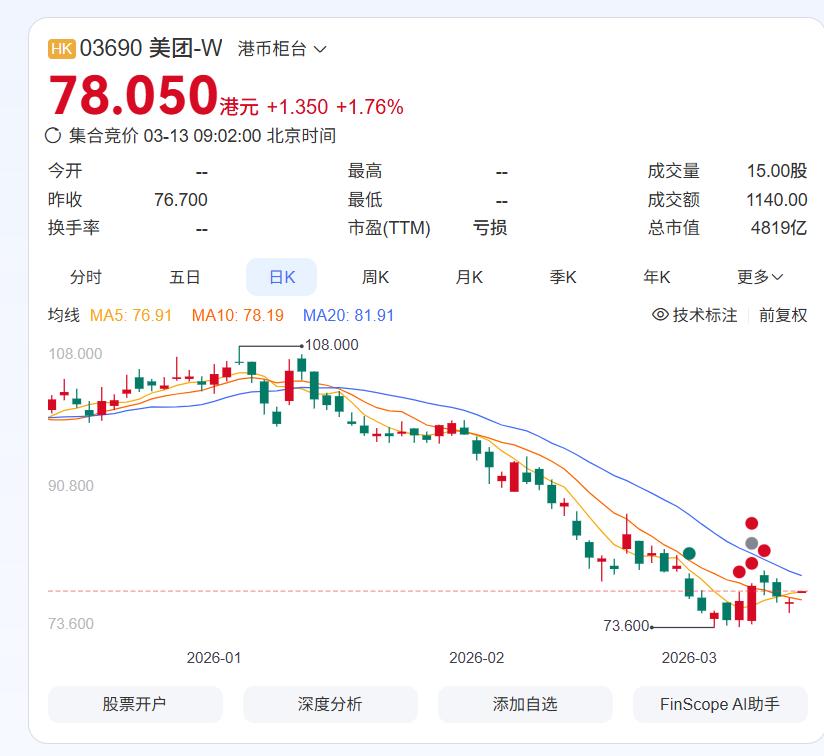
Core Insights - The article discusses the significant changes in the food delivery market in China, particularly the decline in subsidies from major platforms like Meituan and Alibaba, leading to increased prices for consumers [2][3][4] - The competitive landscape has not changed substantially despite the massive subsidies, with Meituan remaining the leader and Alibaba in second place, although the gap has narrowed [3][4] - Both companies have faced substantial financial losses, with Meituan's market value dropping over 600 billion HKD and experiencing a shift from profit to significant losses in its core local business [4][6] Group 1: Market Dynamics - The reduction in subsidies has led to higher prices for consumers, making previously affordable items like coffee and lunch more expensive [1][2] - The intense competition between Meituan and Alibaba, characterized as a "last battle of the internet," has resulted in no clear winner, with both companies suffering financially [3][4] - Meituan's stock price has been on a downward trend since the beginning of the year, reflecting investor concerns over its profitability and market position [6] Group 2: Financial Performance - Meituan's losses for 2025 are projected to be between 25.6 billion to 26.7 billion HKD, a stark contrast to its previous profitability [4][6] - Alibaba's aggressive marketing strategies have led to increased operational costs and a significant drop in operating profits, despite its large scale [6][10] - The financial struggles of both companies highlight the challenges in the food delivery sector, where profitability remains elusive [4][16] Group 3: Strategic Shifts - Alibaba is shifting its focus towards AI and cloud services, indicating a strategic pivot away from the food delivery market [8][10] - Meituan is expanding its instant retail business and investing in AI technologies to enhance operational efficiency and customer service [11][24] - The competition in the food delivery market may evolve into a new phase centered around AI, with both companies needing to adapt to changing consumer behaviors and technological advancements [21][27] Group 4: Future Outlook - The article suggests that the food delivery battle may not resume as expected, with a consensus emerging around more pragmatic approaches to competition [27] - Meituan's future strategies will likely focus on expanding its product offerings and improving AI capabilities to remain competitive [23][24] - The potential for AI to redefine business models in the industry is significant, with implications for how companies engage with consumers and manage operations [21][22]

硅谷不相信忠诚,AI行业玩成NBA,科学家爽拿“转会费”
3 6 Ke· 2026-02-09 01:48
Core Insights - The loyalty of employees in Silicon Valley has diminished, with significant talent poaching events occurring among major tech companies, particularly in the AI sector [1][2] - The trend of "acqui-hire," where companies acquire others primarily for their talent rather than products, has become a common strategy among tech giants [24][27] Group 1: Talent Poaching Events - Major talent poaching incidents include Meta's $14.3 billion investment in Scale AI to acquire co-founder Alexandr Wang in June 2025, Google's $2.4 billion acquisition of Windsurf's technology and team in July 2025, and NVIDIA's $20 billion deal with Groq in December 2025 [1][2][11] - OpenAI has also been active in recruiting talent, bringing back researchers from Thinking Machines Lab and attracting former Google DeepMind employees [1][2] Group 2: Motivations for Job Changes - Employees are motivated to switch jobs for various reasons, including high salaries, access to cutting-edge resources, and the pursuit of more promising technologies and products [2][32] - The phenomenon of "active" and "passive" job changes is noted, with many researchers leaving for better opportunities or being relocated due to company acquisitions [2] Group 3: Acqui-hire Strategy - Acqui-hire has become a popular method for tech giants to quickly acquire skilled teams without facing antitrust scrutiny, allowing them to maintain a competitive edge in AI [24][27] - The case of Google's acquisition of Windsurf illustrates the potential fallout for remaining employees, who may feel abandoned when key talent is poached [27][28] Group 4: Employee Sentiment and Loyalty - Despite high salaries offered by companies like Meta, employee loyalty remains elusive, with some researchers returning to their previous employers shortly after being hired [18][20] - The culture in the tech industry is shifting, with employees increasingly concerned about long-term commitments to a single company, leading to a more fluid job market [32][35] Group 5: Domestic Talent Competition - The talent war is not limited to Silicon Valley, as domestic companies are also aggressively recruiting AI talent from top labs, indicating a global trend in talent mobility [37][39] - High salaries and rapid job changes are characteristic of the AI industry, where top talent is viewed as a strategic asset [40]





美团Q3财报:“外卖大战”致亏,出海提前盈利
Guan Cha Zhe Wang· 2025-11-29 12:32
Core Insights - Meituan reported a revenue of 95.5 billion RMB for Q3 2025, a 2% year-on-year increase, but faced a core local business operating loss of 14.1 billion RMB due to intensified competition [1][2][3] - The company emphasized prioritizing market scale, user engagement, and long-term competitiveness over short-term profits [1][3] Financial Performance - Revenue for Q3 2025 was 95.5 billion RMB, with a breakdown of core local business revenue at 67.4 billion RMB, including delivery service revenue of 23.0 billion RMB, commission revenue of 26.4 billion RMB, and online marketing service revenue of 14.2 billion RMB [2][4] - The operating loss for the core local business was 14.1 billion RMB, attributed to increased direct subsidies in the food delivery sector to counter irrational competition [3][4] User Engagement and Market Position - The number of transaction users on the platform exceeded 800 million in the past 12 months, with daily active users (DAU) growing over 20% year-on-year [1][5] - Meituan maintained a leading position in the mid-to-high price order market, capturing over 70% of orders above 30 RMB [5] New Business Growth - New business segment revenue grew by 15.9% year-on-year to 28 billion RMB, although operating losses increased by 24.5% to 1.3 billion RMB [6] - The company is expanding its international presence, with Keeta achieving profitability in Hong Kong and entering new markets in the Middle East and Brazil [6][7] Technological Advancements - Meituan is advancing its AI initiatives, launching tailored AI tools for restaurant businesses and a smart assistant app for users, aimed at enhancing operational efficiency and user experience [9] - The company plans to continue its "retail + technology" strategy to meet user needs and drive sustainable industry growth [9]

惨烈!美团三年来首度报亏,核心本地商业Q3巨亏141亿元,预计Q4延续经营亏损
美股IPO· 2025-11-28 09:40
Core Viewpoint - Meituan reported its first quarterly loss in nearly three years, with an adjusted net loss of 16 billion RMB in Q3, compared to a profit of 12.8 billion RMB in the same period last year. The core local commerce business shifted from profit to loss, recording an operating loss of 14.1 billion RMB, down from a profit of 14.6 billion RMB year-on-year [1][3][6]. Financial Performance - In Q3, Meituan's revenue reached 95.5 billion RMB, a year-on-year increase of 2.0%, but below the estimated 97.5 billion RMB [6]. - The core local commerce segment's revenue decreased by 2.8% to 67.4 billion RMB, with an operating profit margin plummeting from 21.0% to -20.9% [7][10]. - The adjusted EBITDA for Q3 was a loss of 14.8 billion RMB, reflecting the financial strain on the company [5]. Market Competition - The company attributed its losses to intensified competition in the food delivery sector, leading to a 90.9% increase in sales and marketing expenses to 34.3 billion RMB, which now accounts for 35.9% of total revenue [9]. - Meituan anticipates that the trend of operating losses will continue into Q4 due to ongoing fierce competition with Alibaba and JD.com, both of which are heavily investing in discounts and subsidies [4][9]. New Business Growth - In contrast to the core business struggles, Meituan's new business segment saw a revenue increase of 15.9% to 28 billion RMB, driven by grocery retail and international expansion [10]. - Despite the growth, the new business segment reported an operating loss of 1.3 billion RMB, widening from 1 billion RMB the previous year, but the loss margin improved from 7.1% to 4.6% quarter-on-quarter [10]. Strategic Investments - The company is increasing its investment in artificial intelligence, with R&D expenses rising by 31.0% to 6.9 billion RMB, focusing on AI tools for merchants and user experience enhancements [12]. - Meituan is exploring entry into the Indian market, which is characterized by intense competition, indicating a strategic shift towards international markets [11][14]. Financial Position - As of the end of the quarter, Meituan held approximately 141.3 billion RMB in cash and cash equivalents, indicating a strong capital position despite the operational losses [13].

你的AI越来越蠢?因为它学会见人下菜碟了
创业邦· 2025-09-12 03:14
Core Viewpoint - The article discusses the perceived decline in the performance of AI models, particularly OpenAI's ChatGPT, highlighting a trend where AI models are designed to conserve resources by reducing their computational effort when possible [6][13][18]. Group 1: AI Model Performance - OpenAI's ChatGPT was found to struggle with basic arithmetic, raising concerns about its current capabilities compared to earlier versions [6][7]. - The introduction of models like LongCat and DeepSeek indicates a shift in the industry towards efficiency, with these models employing mechanisms to optimize token usage and processing [10][15][24]. Group 2: Cost Efficiency and Token Management - AI companies are implementing strategies to reduce token consumption, with OpenAI's GPT-5 reportedly saving 50%-80% in output tokens, which translates to significant cost savings for large organizations [13][18]. - The concept of a "perceptual router" has been introduced, allowing models to determine when to engage in complex processing versus simpler tasks, thereby enhancing efficiency [22][24]. Group 3: User Experience and Model Limitations - The new routing mechanisms have led to instances where models fail to engage deeply with user prompts, resulting in a lack of nuanced responses [30][34]. - Users have expressed frustration over the perceived loss of control and depth in interactions with AI models, particularly with the introduction of a one-size-fits-all approach [29][30].