MES

Search documents
中国工业软件行业发展研究报告
艾瑞咨询· 2026-02-17 00:09
Core Insights - The industrial software industry is at a critical juncture, driven by the need for innovation and the urgency of development, particularly in the context of China's economic transformation and the push for self-sufficiency in core technologies [1][4][17] - The market for industrial software in China is projected to approach 300 billion by 2024, indicating robust growth despite challenges such as a hollowing out of core technologies and imbalanced industrial structures [1][17] - The evolution of industrial software is characterized by a shift from tools to systems, platforms, and eventually to a genetic level, focusing on data value and efficiency [2][48] Industry Dynamics - The industrial software market is large, with significant opportunities for companies to target head, mid, and long-tail customers, each with distinct needs and potential for revenue generation [2][50] - The core evolution path of industrial software is from tools to systems, then to platforms, and finally to genetic integration, emphasizing the importance of data flow and value efficiency [48][49] - The industry faces systemic challenges, including a lack of foundational technologies and difficulties in integrating into supply chains, which hinder the development of domestic industrial software [26][17] Product Development Trends - Current industrial software primarily focuses on product sales, but there is a shift towards selling "intelligence" as data assets are accumulated and utilized effectively [3][52] - The integration of AI and large models is expected to enhance the capabilities of industrial software, particularly in areas such as code generation and human-computer interaction [43][52] - Future products are anticipated to evolve into "digital engineers," capable of autonomous task execution and intelligent interaction, moving beyond traditional software tools [52] Market Characteristics - The industrial software market is characterized by a high degree of fragmentation, with varying levels of domestic replacement and integration needs across different customer segments [14][50] - The demand for industrial software is driven by practical applications in enterprises, government initiatives, and the integration of research institutions, each with unique procurement focuses [14][16] - The market is currently experiencing a transition from subsidy-driven growth to a more market-oriented approach, emphasizing the importance of innovation and self-sufficiency [19][12] Challenges and Opportunities - The industry is grappling with significant challenges, including a lack of core technologies in research and design software, which is critical for engineering optimization [23][17] - Companies are encouraged to leverage policy incentives and market opportunities to enhance their technological capabilities and address the "bottleneck" issues in core components [17][26] - The evolution of industrial software is expected to create new revenue streams through data value services, as companies adapt to the changing landscape of technology and market demands [30][52]


为什么越来越多的软件被“用完即弃”?
3 6 Ke· 2026-02-11 03:26
Core Insights - The article discusses a significant shift in the software industry, where software is transitioning from being viewed as a long-term asset to a disposable product, driven by changes in production costs, organizational structures, and business models [1][4][22]. Group 1: Changing Nature of Software - Software is increasingly being developed for short-term use, often created for specific tasks and discarded after completion, rather than being maintained as long-term systems [1][3][4]. - Examples of this trend include applications developed for single events or temporary needs, such as a birthday party app or a family news app, which are deleted after use [2]. Group 2: Structural Changes in Software Production - Four structural changes are occurring simultaneously in the software industry: 1. Software is shifting from system-based to task-based forms, focusing on completing specific tasks rather than long-term operation [5][6]. 2. Business departments are taking the lead in system development, utilizing low-code and no-code platforms to create temporary solutions [7]. 3. AI development tools are making it more cost-effective to rewrite software rather than maintain it, leading to frequent replacements of internal systems [8]. 4. Result-based payment models are emerging, allowing businesses to pay for software based on quantifiable outcomes rather than long-term usage [9]. Group 3: Impacts on the Software Industry - The traditional criteria for evaluating software quality are becoming obsolete, with a shift towards valuing speed of delivery and quantifiable results over long-term maintainability [11][12]. - The focus of development is moving from building long-lasting systems to creating reusable components and workflows that can be quickly adapted for various tasks [14]. - Pricing models are evolving from annual subscriptions to more flexible structures based on results or task completion, reflecting the transient nature of many software applications [15]. - Customer relationships are shifting from long-term partnerships to project-based collaborations, requiring vendors to continuously demonstrate efficiency and results to secure future contracts [16]. Group 4: Boundaries of Software Consumption - Not all software should adopt a disposable model; critical systems related to core business functions, security, and compliance must maintain long-term viability due to their high stakes [17][18]. - The article warns against blindly applying the disposable model in inappropriate contexts, as it may lead to technical debt and a lack of understanding of key processes [20]. Conclusion - The trend of software consumerization is a natural outcome of increased production efficiency in the AI era, leading to a proliferation of software with shorter lifecycles [22][24]. - Companies must develop the ability to distinguish between different software types, determining which should be disposable and which require long-term investment [21][25].
云意电气:已搭建并完善ERP、MES、WMS等核心数字化管理系统
Zheng Quan Ri Bao Wang· 2026-02-08 10:12
Core Viewpoint - The company emphasizes its commitment to digitalization and intelligence development, having established and improved core digital management systems such as ERP, MES, and WMS, which enhance operational efficiency and data traceability throughout the production process [1] Group 1 - The company has implemented end-to-end data traceability and refined operational management from raw material procurement to finished product delivery [1] - The company possesses capabilities and practical applications related to Industry 4.0 [1] - The level of digital operations continues to improve [1]

中国工业软件行业发展研究报告
艾瑞咨询· 2026-02-04 00:08
Core Insights - The industrial software industry is at a critical juncture, driven by the need for innovation and the urgency of development, especially in the context of China's economic transformation and the push for self-sufficiency in core technologies [1][3][17] - The market for industrial software in China is projected to approach 300 billion yuan by 2024, indicating robust growth despite challenges such as a lack of core technologies and imbalanced industrial structure [1][17] - The evolution of industrial software is characterized by a shift from tools to systems, platforms, and eventually to a genetic level, focusing on data value and efficiency [2][48] Industry Dynamics - Industrial software serves as a critical enabler for innovation and transformation in the industrial sector, acting as the "brain" and digital foundation of new industrialization [3][9] - The market is large, with significant opportunities for domestic companies to replace foreign products, particularly in the context of national policies promoting self-reliance [2][50] - The development of industrial software is slow and requires patience, but it also presents opportunities amid ongoing changes and restructuring [1][17] Market Characteristics - The industrial software market is characterized by a significant gap in core technologies, particularly in research and design software, which is crucial for engineering optimization [17][23] - The market structure shows a strong presence of management software while engineering software remains weak, indicating a need for improvement in the latter [17][19] - The demand for industrial software is driven by practical needs from enterprises, government initiatives, and the integration of research and education [14][50] Technological Drivers - The advancement of large models and AI technologies is accelerating the development and application of industrial software, supported by government subsidies aimed at fostering innovation [12][14] - The integration of AI and big models is transforming the capabilities of industrial software, enhancing areas such as code generation and human-computer interaction [43][45] Future Directions - The industrial software industry is expected to transition towards a model that emphasizes selling "intelligence" rather than just software, with products evolving into "digital engineers" capable of autonomous task execution [52][48] - The focus will shift towards platformization and the internalization of industrial knowledge into parameters and codes, enhancing the efficiency of data flow and value extraction [48][52] - Companies are encouraged to leverage head clients and policy support to drive technological breakthroughs while also exploring opportunities in mid-tier and long-tail markets [50][52]

鼎捷数智(300378):自主可控筑基,AI驱动成长新范式
Dongguan Securities· 2026-01-29 09:36
Investment Rating - The report maintains a "Buy" rating for the company [3]. Core Insights - The company is a leading provider of data and intelligent solutions in the industrial software sector, focusing on digital transformation services for manufacturing and distribution industries. It has a comprehensive product matrix covering key industrial software areas, including PLM, MES, and ERP, with a strong emphasis on AI integration [5][12]. - The company has experienced steady revenue growth, with a reported revenue of 1.614 billion yuan for the first three quarters of 2025, representing a year-on-year increase of 2.63%. The net profit attributable to shareholders was 51 million yuan, up 2.40% year-on-year [21][24]. - The company is positioned to benefit from the acceleration of domestic industrial software localization due to external pressures, such as U.S. technology restrictions, which have highlighted the urgency for self-sufficiency in industrial software [42][43]. Summary by Sections 1. Leading Provider of Intelligent Solutions - The company has over 40 years of experience and has become a leading provider of intelligent solutions in China, serving over 50,000 clients across various industries, including equipment manufacturing and automotive parts [5][12]. - The company has expanded its operations to regions such as Taiwan, Vietnam, and Thailand, and has developed a robust product offering that integrates AI and cloud computing technologies [12][15]. 2. Acceleration of Domestic Software Localization - The report highlights significant opportunities for domestic industrial software localization, driven by external disruptions and the need for self-sufficiency in critical software areas [32][42]. - The company has developed a complete product matrix with fully controllable source code and core algorithms, addressing the urgent demand for supply chain security and software autonomy in manufacturing [48]. 3. AI-Driven Demand in Industrial Software - The integration of AI into industrial software is accelerating, with the company actively exploring AI applications and launching innovative AI Agent solutions that enhance operational efficiency for clients [3][5]. - The company's AI-related business revenue grew by 125.91% year-on-year as of mid-2025, indicating successful commercialization of AI applications [5][21]. 4. Investment Strategy - The report suggests that the company is well-positioned to benefit from the ongoing trends in industrial software localization and the integration of AI technologies, with projected earnings per share (EPS) of 0.63, 0.75, and 0.93 yuan for 2025, 2026, and 2027, respectively [5][21].

工业软件为锂电制造引入AI新变量
高工锂电· 2026-01-20 10:42
Core Viewpoint - The article emphasizes the importance of integrating AI, data, and simulation capabilities into the front end of process decision-making in lithium battery manufacturing, highlighting the role of industrial software in reshaping competitive logic [3][4]. Group 1: Industrial Software and AI Integration - The lithium battery manufacturing sector is experiencing intense competition, where the ability to transform process experience into reusable and evolvable system capabilities is crucial for equipment companies [3]. - Liyuanheng's recent advancements in industrial software and AI manufacturing have been recognized with awards for outstanding contributions in engineering practices under the Ministry of Industry and Information Technology's "Modular Resonance" initiative [3][4]. - The company aims to provide a verifiable and replicable AI + manufacturing path for lithium battery production through its proprietary industrial software [4]. Group 2: Challenges in Non-Standard Equipment - The structural challenges of non-standard equipment in lithium battery manufacturing stem from its complexity, diverse machine types, and high precision requirements, leading to reliance on trial-and-error and engineer experience [5]. - The limitations of the traditional approach have become more pronounced in the current environment focused on cost reduction, efficiency improvement, and rapid iteration, resulting in longer R&D cycles and high trial costs [5]. Group 3: Methodology and Engineering Practice - Liyuanheng's industrial software strategy focuses on eliminating problems at the design stage, aiming for "right the first time" as a core objective [6]. - The company's approach involves building a closed-loop system around the entire R&D process, transitioning from experience-driven to data and model-driven methodologies [7]. - By introducing high-fidelity simulations early in the design phase, Liyuanheng has significantly reduced reliance on physical prototypes, thus lowering trial costs [7][8]. Group 4: Dual-Engine Structure - Liyuanheng's "toolchain platform + advanced simulation foundation" dual-engine structure integrates various systems (CAD, CAE, CAM, PLM, ERP) to manage data flow and alleviate issues related to fragmented R&D processes [10]. - The advanced simulation foundation enhances decision-making by upgrading simulations from auxiliary tools to primary decision-making resources, supporting the goal of "design correctness" [10][11]. Group 5: Ecosystem Development - HaiKui Information, a subsidiary of Liyuanheng, plays a crucial role in extending capabilities and connecting ecosystems, having achieved certification as a cloud service partner with Huawei [12]. - The company has developed a comprehensive digital solution system covering design, manufacturing, management, and service, facilitating the construction of an integrated industrial intelligence ecosystem [12]. - Liyuanheng's collaboration with HaiKui Information and other partners aims to create an open scene and shared data assets, transitioning industrial software from internal tools to public capabilities for the lithium battery manufacturing sector [12].


工业AI助力制造业智能化转型升级
China Securities· 2025-12-02 05:45
Investment Rating - The report maintains an "Outperform" rating for the computer sector [4] Core Insights - The industrial software sector is experiencing robust growth driven by policy support and technological advancements, with a projected market size of CNY 354.14 billion in 2024, reflecting an 11.2% year-on-year increase [2][21] - The integration of AI with industrial software is accelerating, enhancing capabilities in design, production control, and operational management, which is crucial for achieving the "Made in China 2035" goals [3][49] - The market structure shows a significant presence of foreign companies in high-end segments, while domestic firms are gaining ground in production control and management software due to localized services and cost advantages [25][38] Summary by Sections Policy Support - The "14th Five-Year Plan" emphasizes the importance of intelligent manufacturing, aiming for over 70% digital penetration in large manufacturing enterprises by 2025 [2][18] - Recent policies indicate a sustained commitment to upgrading industrial software and operating systems as core technologies for high-quality development [19][20] Industrial Software Market Growth - The industrial software market is projected to reach CNY 765 billion by 2029, with a compound annual growth rate (CAGR) of 19.1% [2][21] - The market is characterized by a high share of foreign companies in high-end sectors, while domestic firms are making strides in embedded software and management solutions [25][26] AI Integration - AI is transforming industrial software, enabling generative design in CAD and enhancing simulation capabilities in CAE, which improves efficiency and reduces costs [41][42] - The combination of AI with production control systems like DCS and PLC is creating closed-loop intelligent systems that optimize decision-making and enhance production efficiency [44][47] Future Outlook - The report anticipates that industrial software will be a key focus area in the upcoming "15th Five-Year Plan," with policies likely to support breakthroughs in critical areas of design and production control [20][21] - The integration of physical AI is expected to drive advancements in various industries, enhancing simulation and predictive capabilities [66][69]
为什么企业数字化总“转”不起来?因为分不清这两条流
Sou Hu Cai Jing· 2025-11-03 15:16
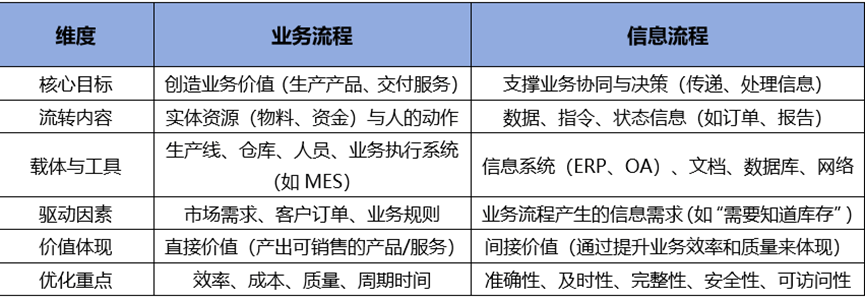
Core Insights - The essence of digital transformation is to utilize data-driven and systematic information flows to drive, optimize, and even reshape business processes [15] - Understanding the differences and symbiotic relationship between business processes and information flows is crucial for enhancing operational efficiency and advancing digital transformation [3] Business Processes - Business processes are the "value streams" that create customer value, focusing on the actual business activities such as production and service delivery [4][5] - A typical example in the e-commerce sector is the sequence of "customer order → review → picking → shipping → receipt," which directly generates transaction value [6] - In manufacturing, the business process includes steps like "raw material procurement → warehouse inspection → production → quality testing → finished goods storage," which directly produces tangible products [12][13] Information Flows - Information flows act as the "nervous system" of enterprise operations, responsible for transmitting, processing, and storing information that supports business operations [7][8] - In the same e-commerce scenario, synchronizing orders, inventory updates, and logistics status tracking exemplifies information flow [9] - In manufacturing, the information flow includes steps like "procurement request → supplier entry → inspection report upload → production instruction issuance → progress feedback → inventory update," ensuring data transmission and business node collaboration [14] Comparative Analysis - Business processes aim to create business value, while information flows support business collaboration and decision-making [11] - Business processes involve the movement of physical resources and human actions, whereas information flows deal with data, instructions, and status information [11] - The optimization focus for business processes is on efficiency, cost, quality, and cycle time, while for information flows, it is on accuracy, timeliness, completeness, security, and accessibility [11] Conclusion - The integration of business processes and information flows is essential for modern management, where competition is based on process efficiency and information response speed [15][16] - Companies must ensure that both elements are highly integrated and mutually supportive to achieve a robust operational framework and agile responsiveness to market demands [15][16]
计算机行业双周报(2025、10、3-2025、10、16):外部环境扰动,信创及工业软件或迎来发展新机遇-20251017
Dongguan Securities· 2025-10-17 07:54
Investment Rating - The report maintains an "Overweight" rating for the computer industry, expecting the industry index to outperform the market index by more than 10% in the next six months [1]. Core Insights - The current external environment is causing disturbances, increasing policy risks and uncertainties, which highlight the urgency for technological self-reliance in China. This situation is expected to accelerate the domestic substitution process, presenting new development opportunities for the domestic software and industrial software sectors [2][27]. - The report suggests focusing on companies with competitive advantages in foundational hardware, foundational software (databases, operating systems, middleware), and application software within the domestic software sector. In the industrial software sector, attention should be directed towards companies excelling in product design, production control, and operational management [2][27]. Summary by Sections 1. Industry Performance Review - The Shenwan computer sector experienced a cumulative decline of 4.21% from October 9 to October 16, 2025, underperforming the CSI 300 index by 3.73 percentage points, ranking 28th among 31 Shenwan primary industries. Year-to-date, the sector has risen by 22.64%, outperforming the CSI 300 index by 5.27 percentage points [9][19]. 2. Valuation Situation - As of October 16, 2025, the Shenwan computer sector's PE TTM (excluding negative values) stands at 57.38 times, placing it in the 91.01 percentile for the past five years and the 84.33 percentile for the past ten years [19][21]. 3. Industry News - Key developments include the U.S. imposing export controls on critical software to China, a 12.6% year-on-year increase in China's software business revenue from January to August 2025, and strategic collaborations in AI technology between OpenAI and Broadcom [20][22]. 4. Company Announcements - Notable announcements include acquisitions and performance forecasts from various companies, indicating growth in sectors such as industrial software and smart logistics [23][24]. 5. Weekly Perspective - The report emphasizes the urgency for technological self-reliance in China, suggesting that the domestic software and industrial software sectors may see new growth opportunities due to increased policy risks and uncertainties [27]. 6. Recommended Companies - The report lists several companies to watch, including: - GuoDianYunTong (002152.SZ) for its stable growth in financial technology - Digital China (000034.SZ) as a core partner in the "Kunpeng + Ascend" industry chain - Inspur Information (000977.SZ) for its leadership in AI server markets [28].
美方拟对关键软件出口管制,国产替代加速突围 | 投研报告
Zhong Guo Neng Yuan Wang· 2025-10-15 01:34
Core Viewpoint - The U.S. government, led by President Trump, announced a 100% tariff on all Chinese goods starting November 1, along with export controls on key software, which will accelerate the domestic software replacement process in China [2][3]. Group 1: U.S. Trade Measures - The U.S. will impose a 100% additional tariff on all Chinese imports and export controls on key software starting November 1 [2]. - The U.S. measures are seen as a strategic move to pressure China ahead of the APEC summit, with potential implications for negotiations [2][3]. Group 2: China's Response and Industry Impact - China's Ministry of Commerce has implemented export controls on various technologies, including chip production equipment and lithium batteries, which are crucial for modern industries [2][3]. - China is expected to dominate the rare earth industry by 2025, holding 49% of global reserves and 69% of production, making it a critical resource for the U.S. [2][3]. Group 3: Domestic Software Development - The export controls on key software will accelerate the domestic replacement process in China, particularly in the fields of EDA, CAD, CAE, MES, and PLM [3][4]. - The shift towards domestic software is seen as essential due to China's heavy reliance on imported industrial software [3][4]. Group 4: Industrial Digital Transformation - The announcement of using WPS format in government documents marks a significant milestone for domestic software, indicating a breakthrough in the software replacement strategy [4]. - "Lighthouse factories," which utilize advanced technologies for efficiency, are expected to be prioritized in national strategic development plans, driving demand for industrial software [4]. Group 5: Investment Opportunities - Companies in the EDA, industrial software, operating systems, databases, network security, and industry IT sectors are highlighted as potential investment opportunities due to the ongoing shift towards domestic solutions [4]. - Specific companies to watch include: - EDA: Huada Jiutian, Guangliwei, Gai Lun Electronics [4] - Industrial Software: Dingjie Zhizhi, Nengke Technology, Suochen Technology, Zhongwang Software, Zhongkong Technology [4] - Operating Systems: China Software, Ruantong Power, Runhe Software, Chengmai Technology [4] - Databases: Dameng Data, Taiji Co. [4] - Network Security: Deepin Technology, Qilin Security, Sanwei Security, Guotou Intelligent, Qimingxing Chen [4] - Industry IT: Keda Xunfei, Hehe Information, Hengsheng Electronics, Kingsoft Office, Foxit Software, Tuolisi, Tax Friend Shares, Caixun Shares, Dingdian Software, Jiuyuan Yinhai, Jiahe Meikang, Guanglian Da, Kingdee International, Yonyou Network, Fanwei Network, Yuxin Technology, Newland [4].