
OpenAI

Search documents
美银:The Flow Show-Short = Long, Long = Short
美银· 2026-03-09 05:18
Investment Rating - The report indicates a bullish sentiment towards commodities, particularly oil, with a rating of 41.1% for oil, 26.9% for commodities overall, and 17.0% for gold [1]. Core Insights - The report highlights the ongoing moral hazard in the market, particularly in Korea, where government intervention has supported a stock market that has doubled in the past year [1]. - It suggests that the political landscape in the US, including Trump's approval ratings, will significantly influence market dynamics, particularly regarding oil prices and inflation [1][4]. - The report anticipates a shift in asset allocation towards beneficiaries of extended geopolitical conflicts, particularly in the context of US-Iran relations [3]. Summary by Sections Market Flows - Weekly flows show $19.7 billion to bonds, $11.5 billion to stocks, and $5.6 billion to cash, indicating a strong preference for fixed income [11]. - There was a significant outflow from gold ($1.8 billion) and bank loans ($0.9 billion), while emerging markets saw inflows of $12.6 billion [19]. Investment Strategies - The report suggests selling oil at $90 per barrel and the US dollar above 100 DXY, while recommending buying 30-year UST at 5% [2]. - It emphasizes that without bear positioning, new equity highs are unlikely, and a policy panic may be necessary to reverse peak liquidity [2]. Economic Indicators - The February US services PMI is consistent with approximately 15% EPS growth, indicating a positive outlook for stocks and credit [15][24]. - The report notes that corrections typically end once oversold conditions are met, particularly in sectors like software and private credit [16]. Geopolitical Context - The report discusses the implications of the Iran-Israel conflict on asset allocation, suggesting that US tech and global defense sectors will benefit at the expense of oil importers [3]. - It draws parallels between the current economic environment and the 1970s, suggesting that the 2020s may experience an inflationary boom rather than a stagflationary bust [20][21].
新春走基层 ·见喜|当爸妈用AI送出春节祝福
Xin Lang Cai Jing· 2026-02-15 23:23
Group 1 - The article highlights the impact of AI on traditional cultural practices, particularly in the context of Chinese New Year greetings and family interactions [1][3] - AI software has been adopted by older generations, such as the author's parents, to enhance their communication and efficiency in their work related to cultural studies [3][5] - The efficiency of AI tools is praised by cultural scholars, who find that they can organize extensive research materials in seconds, thus transforming their workflow [5][10] Group 2 - The integration of AI in cultural research is seen as a positive development, allowing for a more logical and less fragmented approach to historical analysis [5] - The article discusses the cultural significance of the Wu-Yue region and how AI-generated content is being used in tourism and cultural promotion [5] - There is a recognition that AI may reshape traditional cultural narratives, similar to the impact of blogging in the past, suggesting a dual relationship between technology and cultural storytelling [10]


受人工智能相关担忧影响,华尔街股市大幅下挫,随后亚洲股市多数走低
Xin Lang Cai Jing· 2026-02-13 06:26
Core Viewpoint - Asian stock markets mostly declined, following a significant drop in Wall Street tech stocks, as investors are concerned about potential impacts on companies from industry changes driven by artificial intelligence [1][3][9]. Group 1: Market Performance - The Tokyo Nikkei 225 index fell by 0.8% to 57,165.13 points, after previously surpassing 58,000 points [1][7]. - The Hong Kong Hang Seng Index decreased by 1.8% to 26,547.97 points [2][8]. - The Shanghai Composite Index dropped by 0.7% to 4,105.04 points [2][8]. - The Australian S&P/ASX 200 index declined by 1.4% to 8,919.30 points [3][9]. - The South Korean KOSPI index rose by 0.4% to 5,545.49 points, driven by gains in tech stocks, with Samsung Electronics up by 1.2% [1][7]. Group 2: U.S. Market Impact - The S&P 500 index fell by 1.6%, or 108.71 points, to 6,832.76 points, marking the second-largest single-day drop since Thanksgiving, yet remains close to last month's record high [3][9]. - The Dow Jones Industrial Average decreased by 1.3%, or 669.42 points, to 49,451.98 points [3][9]. - The Nasdaq Composite index dropped by 2%, or 469.32 points, to 22,597.15 points [3][9]. - Cisco Systems' stock plummeted by 12.3% despite better-than-expected quarterly results, as investors expressed concerns over its sustained profitability [3][9]. - AppLovin's stock fell by 19.7%, even with quarterly profits exceeding expectations, due to worries about AI's potential impact on its business [3][9]. Group 3: Analyst Perspectives - Some analysts believe that the uncertainty stemming from AI-related transformation risks may persist for some time, affecting investor confidence in related companies, particularly in the software sector [3][9]. - Conversely, some analysts, including those from Capital Economics, remain optimistic about AI-related trends, predicting a "good year" for the S&P 500, led by tech stocks [3][9][10]. - Thomas Matthews from Capital Economics stated that a significant drop in tech stocks is necessary for a sustained reversal in their strong performance, but he expects tech stocks to perform well [10]. Group 4: Other Market Movements - McDonald's reported better-than-expected earnings, leading to a 2.7% increase in its stock price [10]. - Walmart's stock rose by 3.8% following positive earnings results [10]. - Oil prices saw a slight decline, with U.S. benchmark crude down by 0.1% to $62.77 per barrel, and Brent crude down by less than 0.1% to $67.49 per barrel [10]. - Gold prices increased by nearly 1% to $4,995.80 per ounce, while silver rose by 1.4% to $76.72 per ounce [10].
“沾上OpenAI就没吸引力了!”华尔街开始“清算”OpenAI概念股,谷歌大涨36%成赢家
硬AI· 2026-02-05 12:32
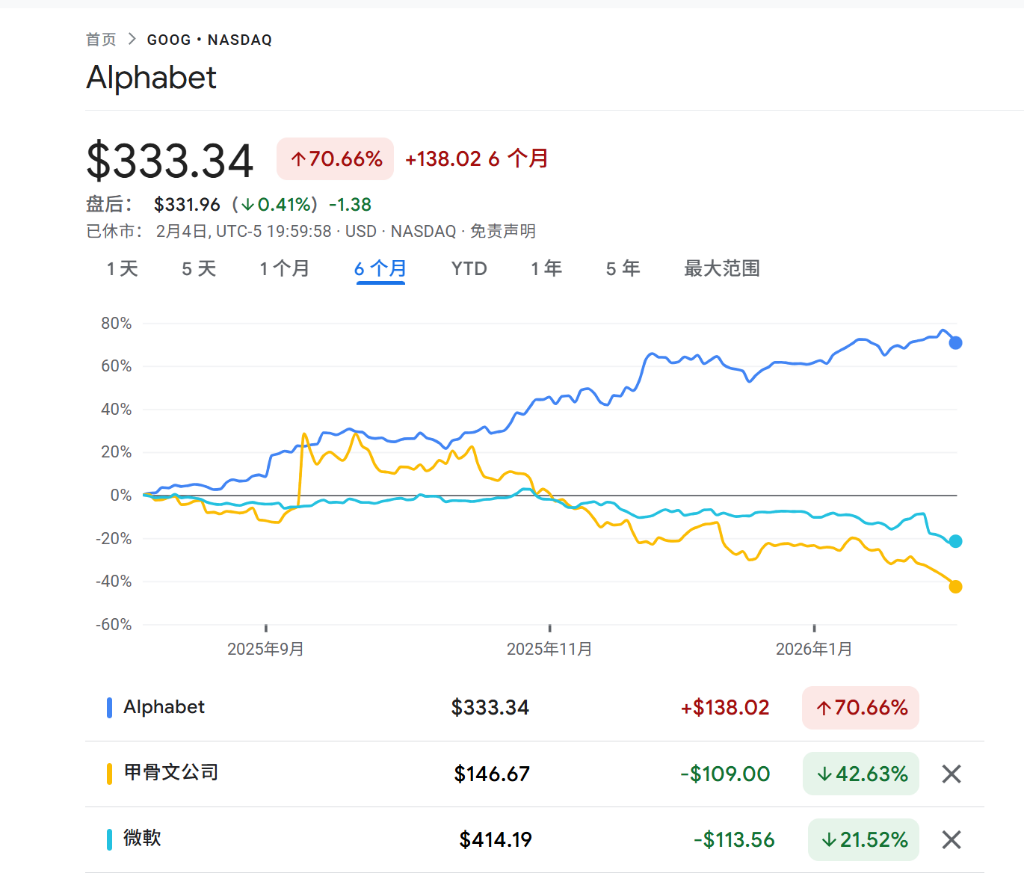
Core Viewpoint - The sentiment on Wall Street towards OpenAI has dramatically reversed, with previously favored stocks now facing sell-offs, while Alphabet has emerged as a major winner due to strong financial returns from its AI business [1][4][12]. Group 1: Market Sentiment Shift - Wall Street analysts indicate a narrative shift favoring Google over OpenAI, as concerns grow over OpenAI's financial sustainability and its impact on closely tied companies like Microsoft and Oracle [1][5][6]. - Oracle's stock has plummeted approximately 49% since last October, heavily reliant on OpenAI contracts, while Microsoft's stock has dropped over 20% during the same period [2][5]. - In contrast, Alphabet's stock has surged about 36% since last October, reflecting a positive market sentiment towards its AI capabilities [2][12]. Group 2: Alphabet's Financial Performance - Alphabet has successfully generated returns from its AI investments, with CEO Sundar Pichai stating that AI infrastructure is driving overall revenue growth [9][10]. - As of the end of December, Google Gemini applications had over 750 million monthly active users, and the enterprise version of Gemini reached 8 million paid licenses, contributing to a 48% increase in Google Cloud revenue [10][12]. - Despite initial concerns over a significant increase in capital expenditures projected to reach $175 billion to $185 billion by 2026, strong cloud performance and AI-driven growth have restored investor confidence [10][12]. Group 3: Market Dynamics and Tech Sector Analysis - A Deutsche Bank report highlights a "cleansing" phase in AI investments, indicating that the S&P 500's performance is largely supported by Google, with many tech stocks experiencing significant declines [4][12][14]. - The report emphasizes a shift from a mindset where all tech stocks were seen as winners to a more brutal reality of clear winners and losers in the market [12][14]. - Alphabet's stock has risen nearly 75% over the past six months, translating to approximately $1.7 trillion in market value growth, while most other companies in the tech sector have seen their market values stagnate [14][15].




软银集团:CSIWM 个股点评:驾驭AI浪潮
citic securities· 2026-02-05 08:37
Investment Rating - The report aligns with the views of CITIC Lyon Research, indicating a positive outlook on SoftBank Group's performance due to the ongoing growth in artificial intelligence (AI) and its impact on capital expenditure and demand [5]. Core Insights - SoftBank Group's stock price has lagged despite the strong performance of AI, with expectations for positive updates from Arm and the SoftBank Vision Fund regarding OpenAI in the upcoming earnings season [5]. - A recent CEO survey revealed that 77% of CEOs have integrated AI into their core products or services, a significant increase from 55% a year ago, highlighting the growing importance of AI across industries [6]. - Key catalysts for SoftBank Group include stock buybacks, new investments, and improvements in the IPO market, which could enhance market sentiment and boost stock prices [9]. Summary by Sections Company Overview - Over the past 30 years, SoftBank has achieved significant growth through investments in mobile communications and internet assets, with a solid market position in Japan's mobile and internet sectors [11]. Financial Performance - Arm's revenue guidance for Q3 FY2026 is between $1.175 billion and $1.275 billion, with a midpoint of $1.225 billion, aligning closely with market expectations [7]. - SoftBank Group's market capitalization is approximately $155.35 billion, with a stock price of 4,207.0 JPY as of February 4, 2026 [12]. Market Consensus - The market consensus target price for SoftBank Group is set at 6,632.40 JPY [13]. Investment Risks - The report notes that the CEO's role is crucial to SoftBank's strategic vision, and any changes in leadership could raise market concerns [10].
“沾上OpenAI就没吸引力了!”华尔街开始“清算”OpenAI概念股,谷歌大涨36%成赢家
Hua Er Jie Jian Wen· 2026-02-05 06:53
Core Viewpoint - Wall Street's attitude towards OpenAI is experiencing a dramatic reversal, with previously favored OpenAI-related stocks facing sell-offs, while Alphabet, Google's parent company, emerges as a major winner with a stock price increase of approximately 36% since last October [1][2]. Group 1: Market Sentiment Shift - Analysts indicate a narrative shift favoring Google over OpenAI, with concerns about OpenAI's financial sustainability leading to a decline in stock prices for companies like Oracle and Microsoft, which are closely tied to OpenAI [2][5]. - Oracle's stock has plummeted about 49% since last October, heavily reliant on its contracts with OpenAI, while Microsoft's stock has dropped over 20% during the same period [2]. - The market's preference for Alphabet is evident, as software companies associated with OpenAI are seeing diminished investor appeal [7]. Group 2: Alphabet's Financial Performance - Alphabet has gained Wall Street's confidence through robust financial returns from its AI investments, marking a turnaround from being perceived as lagging in the AI race [8]. - CEO Sundar Pichai reported that Google Gemini applications have surpassed 750 million monthly active users, up from 650 million in the previous quarter, indicating significant user engagement [8]. - Google Cloud revenue surged by 48% in the December quarter, exceeding Wall Street expectations, contributing to Alphabet's strong financial outlook [8]. Group 3: Market Dynamics and Tech Sector Analysis - Deutsche Bank's report highlights a "cleansing" phase in the AI investment frenzy, suggesting that the S&P 500's performance is largely supported by Alphabet alone [4][10]. - The report notes a decisive shift in market sentiment from a belief that all tech stocks are winners to a more brutal reality of clear winners and losers [10]. - Alphabet's stock has increased nearly 25% in the past three months and 75% over the last six months, translating to approximately $1.7 trillion in market value growth [10][11].
Jensen Huang Speaks on OpenAI investment
Yahoo Finance· 2026-01-31 16:17
Core Insights - Nvidia's CEO Jensen Huang indicated that the company's investment in OpenAI is expected to be the largest investment in its history [1] Company Summary - Nvidia is making a significant investment in OpenAI, which highlights the company's commitment to advancing artificial intelligence technologies [1]
Tesla, Microsoft earnings analysis, what lies ahead for the Fed
Yahoo Finance· 2026-01-29 17:36
Welcome to Market Catalyst. I'm Julie Hyman and we are 30 minutes into US trading day. So, let's get to the three market catalyst we're watching this hour.First up, full earnings coverage on Meta and Microsoft as the tech giants spend big on AI. And speaking of spending, we're going to break down Tesla's results and where the company is looking to unleash $20 billion in capex. Plus, President Trump lashes out at the Fed after keeping rates on pause.We'll have more on the decision, the future of rates, and b ...


真正威胁你的竞品,往往不在你的分析名单里
3 6 Ke· 2026-01-26 06:21
Core Insights - The article emphasizes the importance of correctly identifying competitors before conducting detailed analysis, as selecting the wrong competitors can render the entire report useless [1][2]. Group 1: Definition and Classification of Competitors - Competitors are defined as products that can divert user attention, time, or budget, not just those that offer similar products [2]. - Three categories of competitors are identified: direct competitors, indirect competitors, and potential competitors [2]. Group 2: Direct Competitors - Direct competitors are characterized by operating in the same market, targeting the same user base, and offering similar core functionalities, leading users to choose between them [3][4]. - An example provided is the competition between Doubao and Kimi, both AI dialogue assistants targeting C-end users [4][5]. Group 3: Indirect Competitors - Indirect competitors address similar problems but differ in product form, core functionality, or usage scenarios, potentially diverting users in specific contexts [6][7]. - Midjourney is cited as an indirect competitor to AI dialogue products, as it serves the broader need for AI-assisted creation but through different means [8][9]. Group 4: Potential Competitors - Potential competitors currently differ significantly in product form and functionality but may compete for the same user resources in the future [10]. - Douyin is mentioned as a potential competitor due to its large user base and capability to introduce AI features, which could disrupt the market [11][12]. Group 5: Analysis Directions - When selecting competitors, companies should consider the analysis direction, which can include business strategy, specific functionalities, and user overlap [13]. - Business direction focuses on the competitor's commercial logic and revenue models, while functional direction examines specific features and technical paths [14][15]. - User direction analyzes user overlap and migration costs, which can inform operational strategies [16][17]. Group 6: Sources for Finding Competitors - Companies can identify competitors through various channels, including app stores, industry reports, social media, and direct user feedback [18][19][20][21][22]. - App stores provide a direct source for similar products, while industry reports offer insights into market dynamics and player rankings [19][20]. Group 7: Practical Example - A practical example is provided for selecting competitors for the Deep Research feature, categorizing them into direct, indirect, and potential competitors based on their functionalities and market positioning [23][24]. Group 8: Summary Principle - The core principle for selecting competitors is to first understand who is competing for the same users, which informs the focus of the analysis [25].
计算机ETF(512720)涨超6.5%,AI芯片架构创新或重塑行业逻辑
Mei Ri Jing Ji Xin Wen· 2026-01-12 18:09
Group 1 - The computer industry has reached a turning point in its fundamentals by the second half of 2025, with a year-on-year revenue growth of 1.61% and a staggering 244.56% increase in net profit attributable to the parent company in Q3 2025, validating cost reduction and efficiency improvement results [1] - AI applications are transitioning from technology validation to commercial promotion, with four key areas of focus: 1) Super entrance, where large models have become traffic hubs in the AI era, accelerating the commercialization processes of OpenAI and Google Gemini, establishing a trend of simultaneous increase in volume and price; 2) AI infrastructure, where software infrastructure determines application costs and capability boundaries, with leading companies like Databricks and Snowflake achieving high growth through data governance and computing power scheduling; 3) High-growth scenarios where AI technology drives marketing and the commercialization of comic dramas, with multimodal technology leading to explosive growth in paid traffic for Douyin comic dramas; 4) High-barrier fields such as healthcare and manufacturing, where companies with proprietary data assets and complex process integration capabilities have significant advantages, with AI in healthcare transitioning from auxiliary tools to full lifecycle management, as evidenced by products like Ant Financial's Aifu and ChatGPT Health [1] - The computer ETF (512720) tracks the CS Computer Index (930651), which selects listed company securities involved in computer hardware, software, and services from the Shanghai and Shenzhen markets, covering major sub-sectors of the information technology industry to reflect the overall performance of Chinese listed companies related to computers, exhibiting significant technology growth style characteristics [1]