Ryzen AI 400系列

Search documents
PC CPU市场格局,生变
半导体行业观察· 2026-01-24 02:39
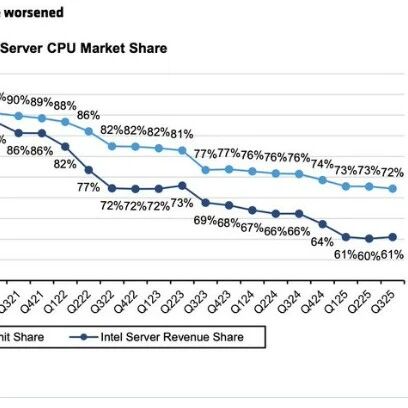
Core Viewpoint - Intel's market share has significantly declined from approximately 90% to 60% over the past eight years, primarily due to competition from AMD and Apple's transition to self-designed Arm architecture processors [1][3]. Market Share Analysis - AMD has steadily been gaining CPU market share, with recent analyses indicating that Apple's notebook CPU sales are now nearly on par with Intel's, each holding about 20% of the market [3]. - Since 2018, AMD and Apple have collectively reduced Intel's market share by over 20% in both the desktop and notebook CPU markets [3]. - Prior to 2018, Intel dominated the desktop CPU market with around 90% share and over 80% in the notebook CPU market; currently, it retains about 60% in both segments [3]. Competitive Landscape - AMD's fourth-generation Zen processors have accelerated its market share growth, while Intel's consumer-grade CPUs have stagnated due to stability issues and a lack of effective response to AMD's 3D V-Cache technology [11]. - AMD's CPUs now account for over 40% of Steam users, indicating strong adoption among gamers [11]. - Apple's M series processors have maintained a stable 10% share in the desktop market since their launch in 2022, reflecting a shift among users favoring Mac computers over Intel models [11]. Future Outlook - Intel's recent launch of the Core Ultra 3 series processors aims to counter the increasing competition from AMD's Ryzen AI 400 series and Apple's M5 processors [12]. - The impact of emerging players like Qualcomm and NVIDIA in the Arm CPU market is anticipated, with Qualcomm set to release a series of Arm-based Windows laptop processors in 2024 [12].


CES2026半导体杀疯了,四大巨头齐出AI王炸,PC、机器人赛道全面开火
3 6 Ke· 2026-01-07 01:59
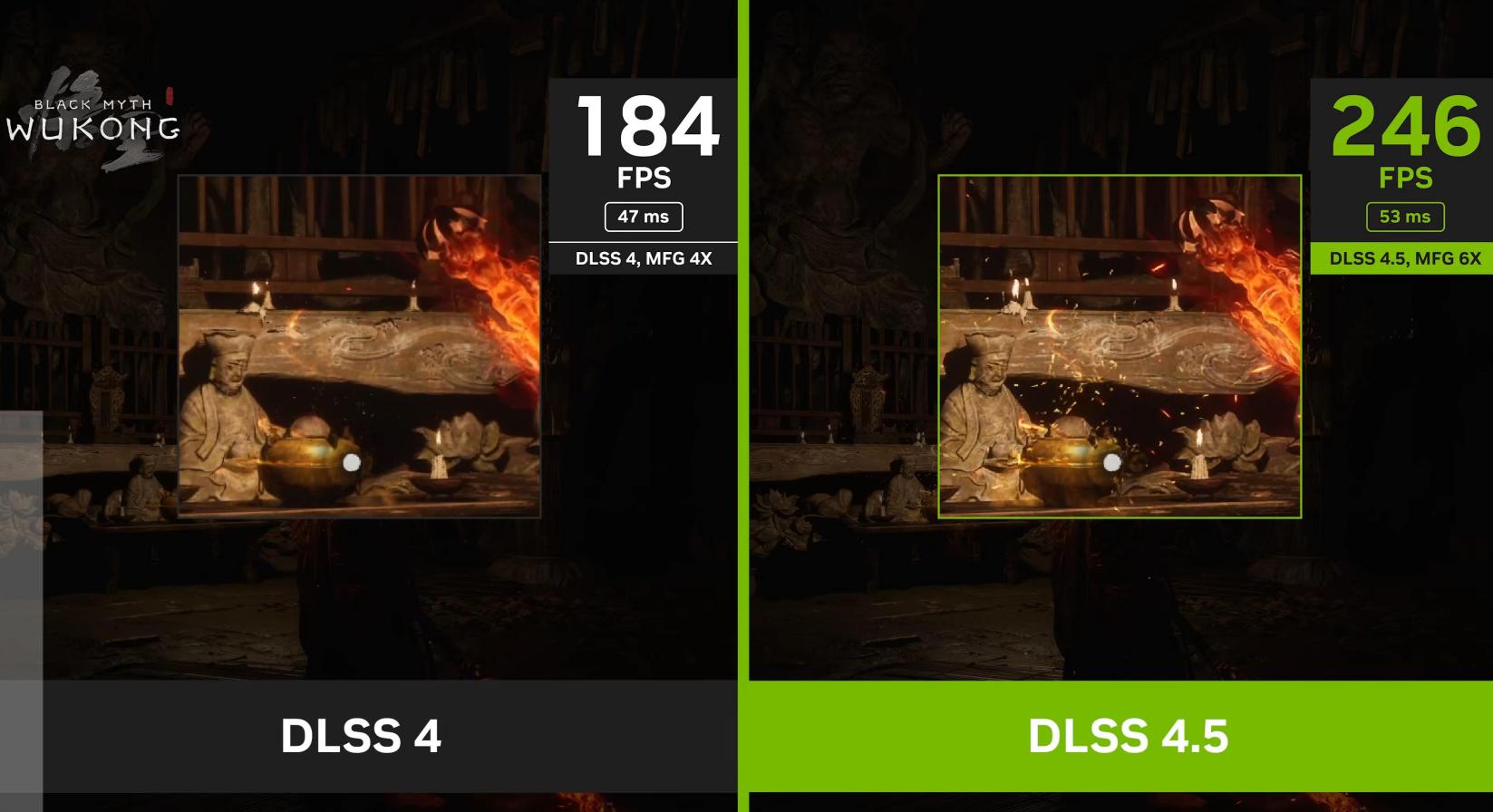
Core Insights - The CES 2026 showcased a shift in focus among semiconductor companies towards AI, with hardware innovations taking a backseat to AI advancements [1][26]. Nvidia - Nvidia's RTX 50 Super series was notably absent from CES 2026, disappointing gamers who had anticipated its release [2]. - The company introduced DLSS 4.5, enhancing frame generation capabilities from 4 to 6 frames, providing a 50% performance boost for RTX 50 series users [2][4]. - The Vera Rubin platform was highlighted as a significant advancement, featuring a CPU with 88 cores and a GPU with 336 billion transistors, achieving a 5x increase in FP4 inference performance [6][4]. - The platform aims to reduce AI inference costs by 90%, making AI applications more accessible [6][4]. Qualcomm - Qualcomm launched the Snapdragon X2 Plus, designed for mid-range markets, featuring a 43% reduction in power consumption and a 35% increase in single-core performance [7][9]. - The Dragonwing IQ10, a new high-performance processor for robotics, was introduced, boasting a 30% improvement in energy efficiency compared to competitors [11][12]. Intel - Intel unveiled the third-generation Core Ultra processors, utilizing the new Intel 18A process technology, which offers a 15% performance increase per watt and a 30% increase in chip density [13][16]. - The new processors demonstrate a 60% performance boost over the previous generation and significantly lower power consumption during 4K video playback [16][20]. - Intel's advancements in AI capabilities allow for the deployment of large AI models directly on devices, enhancing its competitive position in the AI PC market [20][21]. AMD - AMD introduced the Ryzen AI 400 series, featuring seven new processors with AI capabilities up to 60 TOPS, targeting lightweight AI PCs [21][23]. - The Ryzen AI Max+ series was updated to include more GPU cores, enhancing performance for portable AI applications [23][24]. - The Ryzen 7 9850X3D was launched as a gaming-focused processor, offering a balance of performance and efficiency, outperforming competitors in gaming benchmarks [24][25]. Industry Trends - The semiconductor industry is increasingly prioritizing AI capabilities, with a focus on making computing power more efficient and cost-effective [26]. - The CES 2026 highlighted a clear direction towards high-efficiency, long-lasting AI PCs, indicating a significant shift in the PC ecosystem [26].


美国CES展开幕,14句重要论断
吴晓波频道· 2026-01-07 00:30
Core Insights - The article discusses the collaborative evolution of various AI technologies, including Physical AI, Hybrid AI, and Spatial Intelligence, showcased at CES 2026 [3][26]. Group 1: Event Overview - CES 2026 opened with significant participation from over 4,000 exhibitors and tens of thousands of attendees, covering a vast area of over 2.5 million square feet [4]. - Major AI companies, including NVIDIA, AMD, and Intel, presented their visions and technological paths, indicating a shift from consumer-focused products to data center needs and AI advancements [5][9]. Group 2: Key Themes from Presentations - NVIDIA's founder emphasized that AI must understand the physical world to interact effectively, suggesting that the potential of the physical world exceeds that of the online realm [9][11]. - AMD's CEO highlighted the need for a 100-fold increase in computing power in the coming years to address the "computing power shortage" [11][21]. - Intel focused on the importance of edge AI, which is crucial for applications in healthcare, finance, and industry, emphasizing data privacy and low latency [11][23]. Group 3: Future AI Development Insights - The concept of Physical AI is expected to emerge significantly by 2026, with advancements in automation driven by AI and robotics due to global labor shortages [13][18]. - The number of active AI users has surged from 1 million to over 1 billion, with projections suggesting it could exceed 5 billion, indicating AI's integration into daily life [14]. - The article outlines a shift from passive AI systems to proactive AI agents that can assist in various tasks, marking a transition towards more interactive AI applications [17][24]. Group 4: China's Role in AI - Chinese companies are positioned as key players in the AI landscape, with strengths in application innovation, hardware manufacturing, and specific technological breakthroughs [27][28]. - The article notes that China has a significant advantage in the AI application market due to its diverse and large-scale demand across various sectors [27]. - Chinese enterprises are increasingly contributing to the open-source ecosystem, enhancing their influence in the global tech community [28].

CES 2026前瞻:英伟达或重塑物理AI,中美韩机器人齐“秀肌肉”
美股研究社· 2026-01-04 11:22
Core Viewpoint - The 2026 Consumer Electronics Show (CES) is anticipated to showcase significant advancements in technology, particularly in AI, robotics, and consumer electronics, with a focus on cost reduction and efficiency improvements [7][10]. Group 1: Chip Industry Strategies - NVIDIA is shifting its focus away from traditional consumer graphics cards, emphasizing "Physical AI" to extend AI computing capabilities into robotics and industrial applications, with potential delays in the RTX 50 Super series due to high GDDR7 memory prices [8][14]. - AMD is adopting a steady upgrade strategy, planning to launch the Ryzen 9000 series for desktops and Ryzen AI 400 series for mobile devices, targeting workstation users with advanced features [14]. - Intel is set to release the Core Ultra Series 3, which includes approximately 14 SKUs, with the flagship model featuring 16 cores and a maximum frequency of 5.1GHz, aiming to regain market confidence in its advanced manufacturing capabilities [14]. Group 2: Robotics and AI Developments - 2026 is seen as a pivotal year for humanoid robots, with a focus on practical applications and real-world testing [10]. - The competition among countries in robotics is intensifying, with China focusing on cost control and mass production, while the U.S. showcases technological benchmarks through companies like Boston Dynamics [15]. - South Korea is forming alliances to enhance its robotics capabilities, exemplified by the "K-Humanoid" alliance led by Rainbow Robotics, showcasing industrial-grade humanoid robots [15]. Group 3: XR and Consumer Electronics - The XR market is currently in a digestion phase following the release of Apple Vision Pro, with CES 2026 expected to mark the beginning of a counterattack from the Android camp [12]. - Samsung is debuting the Galaxy XR glasses, which integrate advanced AI features and aim to compete with Apple's ecosystem [16]. - Chinese companies are leading the trend of lightweight AI glasses, with products like the Quark AI Glasses S1 and Rokid Glasses focusing on practical applications such as real-time translation and AR navigation [16]. Group 4: Automotive Industry Innovations - The automotive sector is transitioning from "software-defined" to "AI-defined," with a competitive arms race in chip technology [13][21]. - Companies like Geely and Great Wall are showcasing innovations in vehicle architecture, while BMW is presenting its iX3 based on the Neue Klasse architecture, integrating advanced technologies [21]. Group 5: Display and Hardware Innovations - Lenovo is introducing innovative hardware solutions, including AI-driven automatic rotating screens and rollable laptops, addressing the balance between large displays and portability [22]. - Display technology advancements are highlighted by TCL and Hisense, focusing on Mini-LED technology and AI image processing capabilities to enhance picture quality [22].

CES 2026前瞻:英伟达或重塑物理AI,中美韩机器人齐“秀肌肉”
硬AI· 2026-01-04 07:29
Core Insights - The CES 2026 highlights a strategic divergence among chip giants, with NVIDIA shifting focus towards industrial AI and robotics, while AMD and Intel continue to enhance their traditional PC markets [2][4]. Group 1: Chip Giants' Strategies - NVIDIA is expected to delay the launch of the RTX 50 Super series due to high GDDR7 memory prices and supply shortages, with CEO Jensen Huang emphasizing "Physical AI" to extend AI computing power into robotics and industrial applications [4]. - AMD is adopting a steady upgrade strategy, planning to launch the Ryzen 9000 series for desktops, with the flagship Ryzen 9 9950X3D2 featuring dual-chip 3D V-Cache and 192MB L3 cache aimed at workstation users [4]. - Intel is set to release the Intel Core Ultra Series 3 (Panther Lake), which includes approximately 14 SKUs, with the flagship Core Ultra X9 388H featuring 16 cores and a maximum frequency of 5.1GHz, potentially alleviating market concerns about its advanced process execution [5]. Group 2: Robotics and AI Developments - 2026 is seen as a pivotal year for humanoid robots transitioning from demonstration to practical application, focusing on cost reduction and efficiency improvements [7]. - The competition among Chinese, American, and Korean manufacturers is intensifying, with companies like Yushu and Zhiyuan leading cost control efforts, while Boston Dynamics showcases its Atlas robot, and South Korea presents the "K-Humanoid" alliance [10][11]. Group 3: Automotive Industry Transformation - The automotive sector is undergoing a significant technological transformation, with a clearer competitive landscape for intelligent driving chips [13][14]. - NVIDIA leads the high-end L4 market with its Thor chip, while Qualcomm, despite lower AI computing power, successfully penetrates the supply chains of companies like Ideal and Mercedes with its Snapdragon Ride Elite platform [15]. - Chinese automakers like Geely and Great Wall are demonstrating advancements in architecture innovation, while BMW showcases its iX3 based on the Neue Klasse architecture [16]. Group 4: Hardware Innovations - Companies are exploring radical hardware innovations to overcome traditional limitations, with Lenovo presenting prototypes of AI-driven automatic rotating screens and rollable laptops [21]. - TCL and Hisense continue to focus on Mini-LED technology, emphasizing the role of AI image processors in enhancing display quality [21].

AMD 又一颗CPU,曝光
半导体芯闻· 2025-12-05 10:21
Core Insights - AMD's Ryzen AI 5 430 "Gorgon" CPU has leaked specifications showing significant upgrades over the previous Krackan Point series, with performance improvements of up to 19% [2][3] - The Ryzen AI 5 430 features a four-core design based on the Zen 5 architecture, with 8MB L3 cache and 4MB L2 cache, maintaining a TDP of 15-28W [2][3] - The integrated graphics have been notably enhanced, with the Ryzen AI 5 430 equipped with a Radeon 840M iGPU featuring 4 compute units, compared to the 2 compute units in the previous generation [3] Specifications Summary - The Ryzen AI 5 430 is part of the upcoming Gorgon Point series, which is expected to replace the Ryzen AI 300 series [2] - The CPU is tested on a platform with 64GB DDR5-5600 memory, indicating a robust performance environment [3] - The Gorgon and Krackan series share the same product ID, suggesting they are variations of the same architecture [3] Release Information - The Gorgon Ryzen AI 400 series is anticipated to be officially unveiled at CES 2026, with more details expected to emerge soon [4]