SEA浩瀚架构

Search documents
2025年度中国汽车产业盘点——销量篇 车企竞争进入深水区
Zhong Guo Zhi Liang Xin Wen Wang· 2026-02-04 06:51
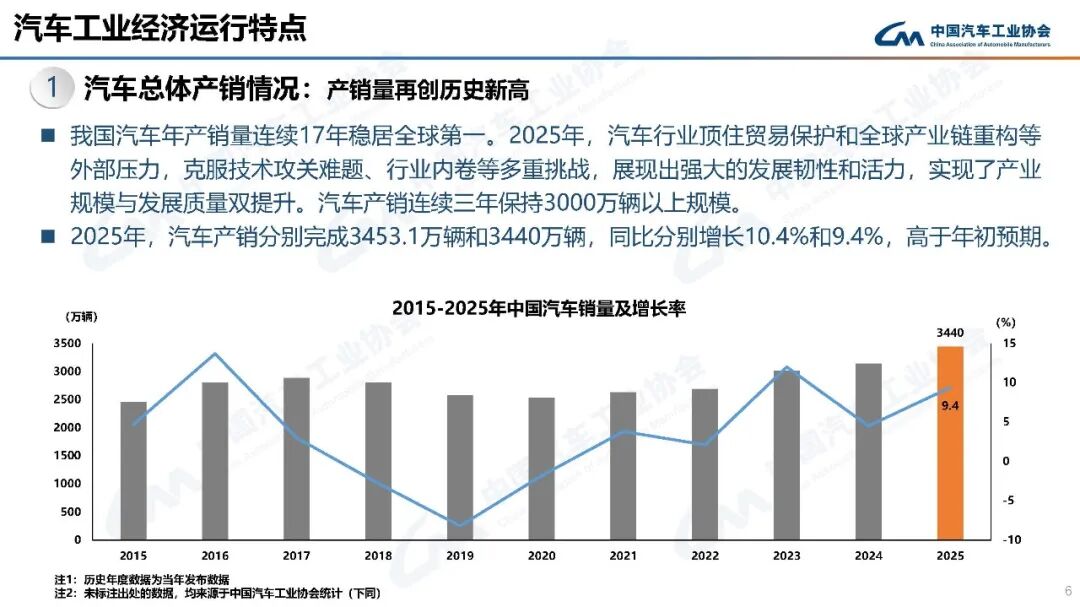
Overall Market - In 2025, China's automotive industry achieved record production and sales, with 34.53 million vehicles produced and 34.40 million sold, marking year-on-year growth of 10.4% and 9.4% respectively, driven by policy support and market dynamics [1][5] - The market demonstrated strong resilience against global trade protectionism, supply chain restructuring, and intensified competition [1] Market Dynamics - The "Two New" policy expanded consumer goods categories and support for equipment upgrades, stimulating vehicle replacement demand, particularly in lower-tier cities [5] - The transition to electric vehicles (EVs) was facilitated by stable tax policies and improved charging infrastructure, lowering barriers for potential EV buyers [5] - Consumer preferences are shifting towards intelligent features and green travel, pushing the market towards higher quality development [5] Segmented Market - In 2025, new energy vehicles (NEVs) became the dominant growth segment, with production and sales reaching 16.63 million and 16.49 million respectively, reflecting year-on-year growth of 29% and 28.2% [6] - NEVs accounted for 47.9% of total new vehicle sales, a 7 percentage point increase from the previous year [6] - The traditional fuel vehicle market is undergoing structural adjustments, with demand for high-displacement, high-fuel-consumption models declining, while smaller, hybrid models remain popular [10] Market Structure - Domestic brands solidified their leading position, with their market share exceeding 60% for the first time, driven by strong performances from companies like BYD, Geely, and Changan [13][15] - BYD led the market with over 4.6 million units sold, benefiting from its technological advancements in NEVs [15] - Joint venture brands faced significant pressure, with declining market shares due to slow adaptation to the NEV market and product homogenization [16] Export Market - In 2025, China's automotive exports exceeded 7 million units, achieving a year-on-year growth of 21.1%, maintaining its position as the world's largest automotive exporter for three consecutive years [18] - Emerging markets in Southeast Asia, the Middle East, and South America remain key destinations for Chinese automotive exports, with NEVs becoming a significant export category [18] Sales Rankings - The top ten automotive brands in 2025 showcased a strong performance from domestic brands, with five spots occupied by them, and a combined market share of 37.3% [21] - BYD, Geely, and Changan maintained their positions through a dual strategy of fuel and NEV offerings [21] - Traditional joint venture brands like FAW-Volkswagen and SAIC Volkswagen continued to experience declines, unable to offset losses from fuel vehicle sales with NEV growth [21] Emerging Brands - New entrants like Leap Motor and Hongmeng Zhixing showed remarkable growth, with Leap Motor doubling its sales through self-developed technology and competitive pricing [23] - Traditional automakers' NEV sub-brands also performed well, rapidly capturing market share through targeted strategies [23] Consumer Trends - Successful models in 2025 aligned with market trends, focusing on price adaptability, user needs, and technological highlights [24] - Family and young consumers emerged as core target groups, with vehicles designed for spaciousness and smart features gaining popularity [26] - The integration of new energy and intelligent technologies became essential for popular models, addressing consumer concerns about range and charging [26] Future Outlook - The strong rise of NEVs indicates China's automotive industry is positioned advantageously in the global transformation of the sector [28] - Continued policy support for NEVs and smart vehicles is expected, alongside growing consumer demand for high-quality, intelligent products [28] - The industry is likely to see further integration across the supply chain, enhancing competitiveness [28]





极氪“回归”吉利体系:一场顺应时势的战略会师
汽车商业评论· 2025-12-25 23:04
Core Viewpoint - The article discusses the strategic evolution of Geely Auto and its subsidiary Zeekr in the context of the rapidly changing electric vehicle (EV) market, highlighting the significance of Zeekr's return to Geely as a proactive move to enhance competitiveness and resource integration in a challenging environment [6][10][20]. Group 1: Zeekr's Journey and Market Context - Zeekr's stock price closed at $26.73 per share, with a total market value of $6.847 billion, marking the end of its journey on the NYSE after over a year [4]. - The return of Zeekr to Geely is seen as a meaningful response to the accelerated industry consolidation and a strategic move to adapt to the current market dynamics [6][10]. - The EV market has shifted from a policy-driven phase to a consumer-driven phase, increasing competition and reducing the marginal benefits of independent operations [10][11]. Group 2: Strategic Integration and Market Positioning - Geely's acquisition of Zeekr fills a gap in its luxury EV segment, creating a comprehensive brand matrix that includes mainstream, mid-range, and luxury markets [16][19]. - The integration allows Geely to enhance its operational efficiency and strengthen its competitive position through resource aggregation [16][19]. - Zeekr's independent brand identity is preserved while leveraging Geely's resources for sustainable growth [16][19]. Group 3: Financial Performance and Market Expectations - Geely's stock price has increased by 96.1% since the release of the "Taizhou Declaration," significantly outperforming the Hang Seng Index [11]. - Institutional investors have shown strong confidence in Geely, with an average target price of HKD 26.95, indicating a potential upside of approximately 59% from recent closing prices [10][11]. - Geely's total sales reached 2.788 million units in the first 11 months of 2025, achieving 93% of its annual target, with a revenue increase of 26% year-on-year [23][24]. Group 4: Technological Integration and Future Outlook - The integration of Zeekr's advanced technologies, such as the SEA architecture and intelligent driving systems, is expected to enhance Geely's technological capabilities and brand image [19][24]. - Geely's strategic shift from opportunistic breakthroughs to systematic capability building reflects a deep understanding of the automotive industry's cyclical nature [26]. - The return of Zeekr marks a significant milestone in Geely's ongoing strategic transformation, positioning the company for future growth in the global EV market [26].
吉利极氪整合完毕的意义和价值
Jin Rong Jie· 2025-12-23 13:25
Core Viewpoint - Geely Automobile has completed the privatization and merger of Zeekr Intelligent Technology Holdings, marking a significant strategic integration and a new phase of development for the company [1][2]. Group 1: Strategic Integration and Market Position - The merger integrates Zeekr's high-end and intelligent assets with Geely, enhancing its market position and providing practical experience for overseas capital market operations [3][4]. - Zeekr's positioning in the luxury electric vehicle market, with an average vehicle price of nearly 300,000 yuan, strengthens Geely's coverage across mainstream, high-end, and luxury segments [3]. - The merger allows Geely to leverage Zeekr's advanced technologies, such as the SEA architecture and AI digital chassis, enhancing its technological profile [4]. Group 2: Financial Performance and Market Expectations - Geely's revenue for the first three quarters of 2025 reached approximately 239.5 billion yuan, a year-on-year increase of 26.35%, with a core net profit of 10.62 billion yuan, up 59% [6]. - The integration is expected to optimize Geely's product structure, increasing average selling prices and gross margins, with Zeekr acting as a profit engine for the group [7][6]. - Capital markets have responded positively, with over 40 investment banks issuing nearly 100 positive ratings for Geely, reflecting confidence in the strategic clarity and growth potential post-merger [8][9]. Group 3: Future Outlook and Valuation - Analysts predict significant upside potential for Geely's stock, with an average target price of 26.9 HKD, indicating a potential increase of 62% from recent trading levels [10]. - The "One Geely" strategy is expected to yield benefits in cost reduction, supply chain optimization, and brand synergy over the next 2-3 years, driving improvements in profitability [12]. - Long-term value will be supported by advancements in smart driving technology and emerging tech fields, positioning Geely closer to a technology company valuation model [12][13].
吉利、极氪合并落地,全面贯彻「一个吉利」
雷峰网· 2025-07-15 12:05
Core Viewpoint - The merger between Geely Automobile and Zeekr aims to enhance Geely's global competitiveness in the smart electric vehicle sector, leveraging Zeekr's strengths in the luxury electric vehicle market [2]. Group 1: Merger Details - Geely Holding Group announced the signing of a merger agreement with Zeekr Intelligent Technology, where Geely will acquire all outstanding shares of Zeekr, allowing shareholders to choose cash or Geely shares as compensation [2]. - The merger is intended to cover various powertrain forms, including fuel, pure electric, plug-in hybrid, and hydrogen electric, thereby achieving a comprehensive market layout across mainstream, mid-to-high-end, and luxury segments [2]. Group 2: Financial Implications - Zeekr has invested a total of 22.7 billion yuan in R&D over the past four years, with an expected investment of nearly 10 billion yuan in 2024, contributing to a cumulative loss of 26.223 billion yuan [2]. - The merger is expected to improve strategic execution efficiency, innovation capability, and profitability by eliminating redundant investments [2]. Group 3: Strategic Direction - The integration with Geely is seen as a way for Zeekr to elevate its brand experience and focus on high-end development, moving away from the pure electric market [3]. - The launch of the Zeekr 9X, which features a hybrid architecture, marks a significant step towards entering the luxury ultra-high-end market [3].
均价 30 万,最高 90 万,极氪如何能卖出 50 万台车?
晚点LatePost· 2025-06-16 15:15
Core Viewpoint - Zeekr is the fastest luxury electric brand to achieve the milestone of 500,000 vehicle deliveries, reaching this target in just 44 months since its inception with the Zeekr 001 model [2][3] Group 1: Market Position and Strategy - Zeekr's average vehicle price is nearly 300,000 yuan, with the highest model priced close to 900,000 yuan, positioning itself in the luxury segment traditionally dominated by brands like BMW, Benz, and Audi (BBA) [3] - The company has launched six models in three years, indicating a commitment to building a sustainable product matrix rather than relying on a single hit model [3][4] - The merger with Lynk & Co has established a new strategic direction, with Zeekr focusing on the high-end luxury market while Lynk & Co targets the 200,000 yuan segment [4] Group 2: Technological Advantages - Zeekr has developed the SEA architecture, a fully proprietary electric vehicle platform, which serves as the foundation for its high-end electric strategy [5] - The company has invested 20 billion yuan over five years to create a robust technological ecosystem, enhancing its competitive edge [5] - Zeekr's integration of an 800V high-voltage architecture allows for ultra-fast charging capabilities, with the V4 charging station being the first of its kind globally [6][8] Group 3: Product Development and Innovation - The Zeekr 001 has successfully combined performance, comfort, and luxury, creating a new category of luxury shooting brake vehicles [12] - Following the success of the Zeekr 001, the company entered the luxury MPV market with the Zeekr 009, which has outperformed traditional fuel MPVs in sales [12][14] - The upcoming Zeekr 7X is designed for global markets, featuring advanced technology and performance characteristics that rival high-end luxury vehicles [14][15] Group 4: Future Outlook and Integration - The completion of the merger with Lynk & Co and potential privatization under Geely's umbrella signifies a strategic consolidation aimed at enhancing resource efficiency and brand positioning [16][18] - Zeekr is evolving its technology strategy to encompass a broader range of energy solutions beyond pure electric, indicating a shift towards a more comprehensive approach to the luxury electric vehicle market [17][18] - The company aims to leverage its accumulated technology and experience to drive innovation and growth within the Geely ecosystem, marking a transition from a startup to a core player in the high-end electric vehicle sector [17][18]

整合领克、极氪营销,极氪科技集团再做高管调整
Guan Cha Zhe Wang· 2025-05-06 08:20
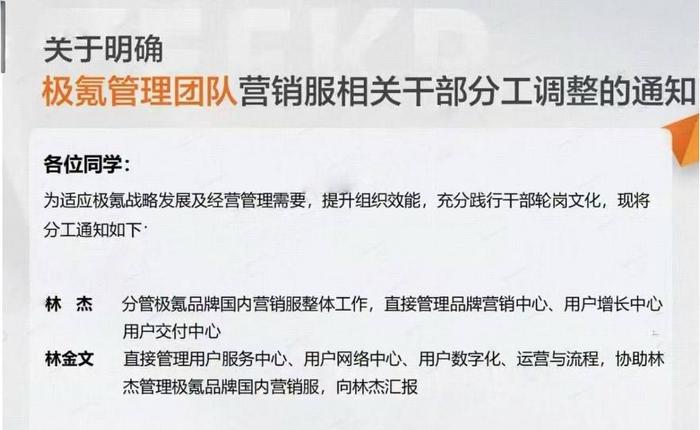
Core Viewpoint - Zeekr Technology Group is undergoing internal management changes to enhance the integration and efficiency of its brands, Zeekr and Lynk & Co, in response to strategic goals outlined in the "Taizhou Declaration" [1][3][4]. Group 1: Management Changes - Zeekr Technology Group announced that Vice President Lin Jie will oversee domestic marketing, sales, and service for the Zeekr brand, while Vice President Lin Jinwen will manage user service and digital operations [1][3]. - The management adjustments reflect a deeper strategic integration between Zeekr and Lynk & Co, aligning with Geely's rotational culture to expand leadership capabilities and perspectives [3][4]. Group 2: Strategic Goals and Sales Targets - The "Taizhou Declaration" emphasizes brand integration and the establishment of a technology platform to achieve strategic transformation, with a sales target of 710,000 units for 2024, including 390,000 for Lynk & Co and 320,000 for Zeekr [4]. - The integration aims to reduce R&D costs by nearly 25% through shared technologies among Geely, Zeekr, and Lynk & Co [4]. Group 3: Sales Performance - From January to April 2023, Zeekr Technology Group achieved sales of 155,000 units, representing a completion rate of 19.6% of its annual target, with Lynk & Co at 100,000 units (25.6% completion) and Zeekr at 55,000 units (17.2% completion) [7]. - The appointment of Lin Jie to oversee Zeekr's marketing indicates a strong internal focus on boosting overall sales performance [9].