
2 1 Shi Ji Jing Ji Bao Dao

Search documents
伊朗局势扰动石油市场:油价100美元/桶是预警还是虚惊?
2 1 Shi Ji Jing Ji Bao Dao· 2026-02-27 16:32
Group 1: Oil Market Dynamics - The ongoing negotiations between the US and Iran are causing fluctuations in the oil market, with reports indicating significant progress in talks, leading to a slight decline in Brent and US crude oil prices on February 26 [1] - The market is currently caught between expectations of a global supply surplus and geopolitical tensions surrounding Iran, which have increased risk premiums [2] - If a deal is reached between the US and Iran, oil prices could see a significant drop due to the current oversupply situation in the global oil market [2][3] Group 2: OPEC+ Production Decisions - OPEC+ is considering increasing oil production by 137,000 barrels per day in April, which could impact market dynamics and allow member countries to regain market share [3] - Despite expectations of a supply surplus, OPEC+ predicts strong oil demand, forecasting a daily average demand of 106.52 million barrels by 2026, which supports the case for production increases [3] Group 3: Price Projections and Risks - In extreme scenarios, if negotiations fail and Iran disrupts the Strait of Hormuz, oil prices could surge, potentially exceeding $100 per barrel due to significant supply disruptions [5][6] - Current oil prices have seen a cumulative increase of nearly 20% this year, driven by geopolitical tensions, while the market also faces concerns of oversupply [4][8] - The International Energy Agency (IEA) and the US Energy Information Administration (EIA) both project significant supply surpluses in the coming years, indicating that without geopolitical disruptions, oil prices may face downward pressure [7][8]
李斌分拆芯片资产,22亿已到账
2 1 Shi Ji Jing Ji Bao Dao· 2026-02-27 16:07
Core Viewpoint - NIO's subsidiary, Shenji, has completed its first round of external financing, raising 2.257 billion yuan, which will help accelerate the development of its self-developed chip technology and reduce financial pressure on the parent company [2][8]. Financing Details - Shenji raised 2.257 billion yuan in its angel round, achieving a post-money valuation of approximately 10 billion yuan [7]. - The financing was led by institutions such as Hefei Guotou and IDG Capital, with investors holding a total of 27.3% equity [7][10]. - NIO will maintain a controlling stake of 62.7% in Shenji and will consolidate its financial statements [10]. Product and Technology - Shenji, established in June 2025, is the core of NIO's self-developed chip system, focusing on the entire process of chip research, production, and technology licensing [4]. - The first product, Shenji NX9031, is the world's first 5nm automotive-grade intelligent driving chip, which is expected to be launched in March 2025 [4]. - The chip's actual computing power is about four times that of NVIDIA's Orin-X, with a memory bandwidth of 546 GB/s, and has already been installed in over 150,000 vehicles [6]. Market Position and Strategy - The commercialization of Shenji chips aims to break the monopoly of international giants in the high-end automotive chip sector, enhancing the competitiveness of domestic chips [6]. - The development cost of the Shenji NX9031 is estimated to be between 2.25 billion and 3 billion yuan, comparable to the cost of building 1,500 battery swap stations [6]. - NIO's self-developed chips are projected to provide a cost advantage of approximately 10,000 yuan per vehicle compared to NVIDIA's Orin-X [7]. Future Prospects - Shenji's business scope is expanding beyond automotive applications to include robotics and AGI-related chip and hardware solutions, indicating a broader market potential [10]. - NIO aims to achieve annual Non-GAAP profitability by 2026 and is implementing a mechanism to operate its chip assets independently [12].


1350亿蜜雪冰城,乐园选址定了!
2 1 Shi Ji Jing Ji Bao Dao· 2026-02-27 16:07
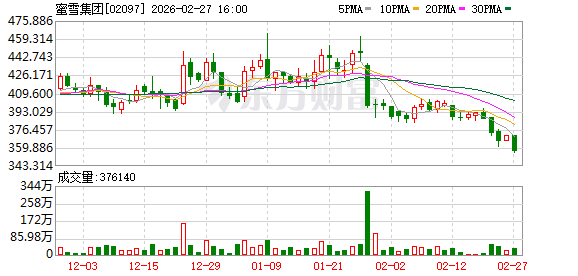
Core Insights - The company, Mixue Ice City, is planning to open its first "Snow King Indoor Paradise" at its flagship store area near Zhengzhou East Railway Station [2] Group 1 - The location for the new indoor amusement park is strategically chosen to be close to the company's headquarters [2]

美股科技、银行股深夜大跌,CoreWeave重挫17%,戴尔狂飙18%,金银原油齐涨,美伊战争风险急剧升高
2 1 Shi Ji Jing Ji Bao Dao· 2026-02-27 15:32
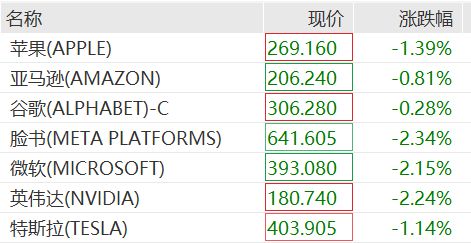
Market Overview - The U.S. stock market indices collectively declined, with all three major indices falling over 1% [1] - Major technology stocks mostly dropped, with Oracle and Salesforce down over 4%, and the "Big Seven" tech stocks, including Nvidia and Microsoft, down over 2% [1] Individual Stock Performance - Apple shares fell by 1.39%, Amazon by 0.81%, Google by 0.28%, Facebook by 2.34%, Microsoft by 2.15%, Nvidia by 2.24%, and Tesla by 1.14% [2] - Semiconductor stocks experienced a significant decline, with the Philadelphia Semiconductor Index leading the market drop, and companies like Bluefin Semiconductor down over 5% and Broadcom and GlobalFoundries down over 2% [2] - Bank stocks also saw a downturn, with Barclays and Citigroup down approximately 4%, and Bank of America and Wells Fargo down over 4% [2] Notable Stock Movements - CoreWeave's stock plummeted over 17%, marking its largest drop since August of the previous year due to concerns over massive capital expenditures [4] - Duolingo's stock fell by 22%, reaching its lowest level since February 2023, as the company's booking outlook for Q1 and the full year fell short of expectations [4] - Dell Technologies saw its stock surge by 18%, the largest intraday increase since April 9, as its revenue guidance for fiscal 2027 exceeded market expectations [4] - Netflix's stock rose by 12%, marking its largest increase since January 2025, following its exit from the Warner Bros. bidding war [4] - Block, the U.S. version of Alipay, increased nearly 20%, achieving its largest intraday gain since February 2024 [4] Commodity Market - Gold and silver prices surged due to escalating tensions in the Middle East, with silver rising approximately 5% and gold exceeding $5,230 [3][5] - International oil prices also spiked, with WTI and ICE Brent crude both increasing over 3% [3][5] - Year-to-date, international oil prices have risen nearly 20%, with potential for significant fluctuations depending on geopolitical developments involving the U.S. and Iran [5] Cryptocurrency Market - The cryptocurrency market experienced a widespread decline, with Bitcoin down 2.5% and Ethereum down over 5%, leading to over 100,000 liquidations globally in the past 24 hours [5]


688480一周大涨超52%!利好驱动,电力板块多股净利高增
2 1 Shi Ji Jing Ji Bao Dao· 2026-02-27 15:06
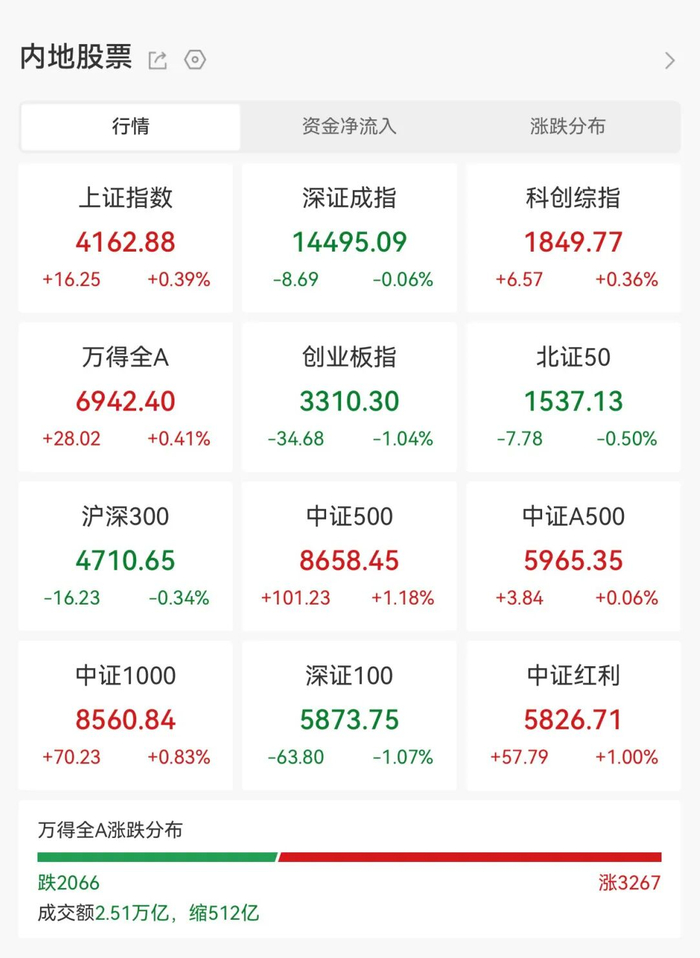
Group 1: Market Overview - The A-share market experienced fluctuations with mixed performance across major indices, where the Shanghai Composite Index rose by 0.39% to close at 4162.88 points, while the Shenzhen Component Index fell by 0.06% and the ChiNext Index dropped by 1.04% [1][2] - The total market turnover reached 25054.8 billion, a decrease of 511.59 billion compared to the previous day [1] Group 2: Small Metals Sector - The small metals sector saw a significant surge, with the Shenwan Small Metals Index increasing by 7.69%, and multiple stocks such as Dongfang Zirconium, Xianglu Tungsten, and Huaxi Nonferrous hitting the daily limit [3][8] - Notable stocks in the small metals sector included Dongfang Zirconium with a price increase of 10.03%, Xianglu Tungsten up by 10.01%, and Huaxi Nonferrous rising by 10.01% [9] Group 3: Power Sector Performance - The power sector experienced a notable afternoon rally, with stocks like Jiawei New Energy, South Network Energy, and Fuling Power reaching their daily limits [4][10] - A total of 46 power stocks have released performance forecasts for 2025, with 24 stocks expected to achieve net profits exceeding 100 million [13] - Changjiang Electric is projected to have the highest net profit of 341.67 billion for 2025, with a year-on-year growth of 5.14% [13][16] Group 4: Future Projections and Trends - The demand for electricity is expected to surge due to the rapid growth of AI data centers, with a compound annual growth rate of approximately 55% in power capacity demand from 2025 to 2028 in the U.S. [12] - The investment in global power grids is projected to reach 390 billion in 2024 and increase to 620 billion by 2030, indicating a strong growth trajectory for the power sector [12]

白银急涨5%,国际油价涨超3%,我驻以使馆紧急提醒:非必要不外出
2 1 Shi Ji Jing Ji Bao Dao· 2026-02-27 14:49
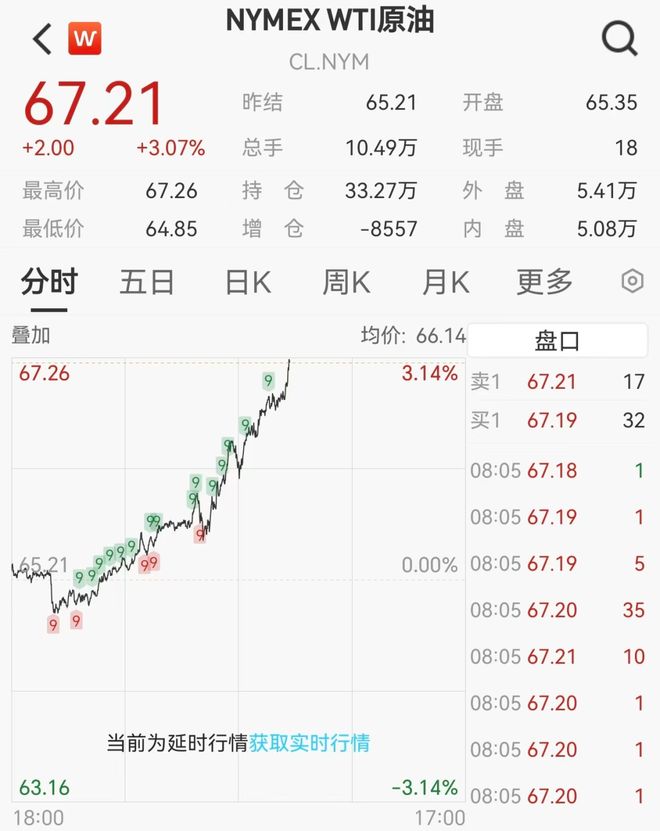
Core Viewpoint - International oil prices have seen a significant increase, with WTI and Brent crude oil rising over 3% as of February 27, indicating a strong market response to geopolitical tensions, particularly between the U.S. and Iran [1][7]. Oil Price Movements - As of February 27, WTI crude oil closed at $65.21, opening at $65.35, with a peak of $67.26 and a low of $64.85, reflecting a 3.07% increase [2]. - Domestic fuel futures also experienced a rise, with the main SC crude oil futures contract increasing by over 4% [1]. Geopolitical Influences - The current rise in oil prices is primarily driven by geopolitical tensions, particularly the escalating situation between the U.S. and Iran, which has led to a cumulative increase of approximately $10 per barrel for Brent crude [7]. - Analysts suggest that if a diplomatic agreement is reached between the U.S. and Iran, oil prices could see a significant decline [7]. Supply and Demand Dynamics - The oil market is facing a potential oversupply situation, with the International Energy Agency (IEA) projecting a surplus of 3.73 million barrels per day by 2026, which is about 4% of global demand [12]. - The U.S. Energy Information Administration (EIA) estimates a daily global supply surplus of 3.04 million barrels this year [12]. OPEC+ Production Decisions - OPEC+ is considering increasing oil production by 137,000 barrels per day in April, which could impact market dynamics and pricing as demand peaks in summer [8]. - The potential for increased production is linked to the recent rise in oil prices, which have surpassed the psychological thresholds for OPEC+ member countries [8]. Extreme Scenarios - In extreme scenarios, if tensions escalate and Iran disrupts the Strait of Hormuz, oil prices could surge, potentially exceeding $100 per barrel [10]. - However, global strategic oil reserves may mitigate the impact of supply disruptions, suggesting that a sustained price spike would require significant and prolonged supply interruptions [10].
贝莱德建信理财换帅在即:总经理张鹏军将离任
2 1 Shi Ji Jing Ji Bao Dao· 2026-02-27 13:46
Core Insights - The general manager of BlackRock China Wealth Management, Zhang Pengjun, is leaving the company for personal reasons, with the business temporarily led by Fan Hua, the head of BlackRock China [1] - BlackRock emphasizes that its strategic focus, partnerships, and long-term commitment to the Chinese market remain unchanged despite the leadership transition [1] Group 1: Company Leadership and Structure - Zhang Pengjun has been with BlackRock for 30 years and joined the group in 2016, becoming a core member of the leadership team in China [1] - BlackRock China Wealth Management was established in 2021 as a joint venture between BlackRock, China Construction Bank, and Temasek, making it the second foreign-controlled wealth management company in China [1][2] - Other key executives at BlackRock China Wealth Management include Deputy General Manager and Chief Investment Officer Liu Rui [2] Group 2: Product Offerings and Market Strategy - BlackRock China Wealth Management has launched eight product series, including fixed income, equity, mixed, pension, and QDII, covering risk levels from R1 to R5 [2] - The company is actively utilizing cross-border investment mechanisms such as QDLP, mutual recognition funds, and QDII to provide domestic investors with quality overseas products [2][3] - BlackRock employs AI and advanced machine learning technologies to enhance stock selection and investment performance in equity investments [3] Group 3: Investment Solutions and Customization - BlackRock's investment philosophy emphasizes diversified asset allocation, with products like fixed income+ and multi-asset reflecting this approach [3] - The company aims to provide customized solutions for both outbound funds and domestic asset allocation needs, leveraging a strengthened team with talent from large institutions [3]



从“分数第一”到“健康第一”:有多难,怎么做
2 1 Shi Ji Jing Ji Bao Dao· 2026-02-27 13:46
Core Viewpoint - The core focus of the article is the promotion of a "health first" approach in schools, as outlined in the Ministry of Education's recent guidelines, which aim to shift the educational emphasis from academic scores to student health [10][12][16]. Group 1: Health School Construction - The Ministry of Education has issued guidelines to promote the construction of health schools, with a goal to cover every school by 2030, currently having over 540 pilot health schools [10][11]. - The guidelines include eight key tasks that focus on various aspects of student health, such as physical education, mental health, and nutrition [10][11]. - The electronic science and technology university's affiliated primary school has successfully implemented a daily physical activity program, achieving an average of 3 hours of exercise per day for students [5][10]. Group 2: Implementation Challenges - There is a contradiction between the "health first" philosophy and the existing exam-oriented education system, necessitating a shift in educational performance evaluation by local governments and educational departments [3][12][16]. - Parents often express concerns that increased physical activity may detract from academic performance, highlighting the need for a cultural shift towards valuing health in education [13][14]. Group 3: Collaborative Efforts - The construction of health schools requires a collaborative approach involving government, educational institutions, families, and society to effectively address health issues among students [16][17]. - Local governments, such as in Shandong Province, are integrating student health metrics into their educational performance evaluations to ensure accountability and promote health initiatives [17].

总额2.9亿元,广州南沙再下场收购商品房用作安置房
2 1 Shi Ji Jing Ji Bao Dao· 2026-02-27 13:37
Core Viewpoint - Guangzhou's Nansha District is actively acquiring commercial housing for use as resettlement housing, with a planned investment of 290 million yuan to purchase 20,000 square meters of residential property, addressing local housing supply issues and promoting urban renewal [1]. Group 1: Acquisition Details - The acquisition targets newly built, fully decorated residential properties that have passed inspection and are unsold, with a price cap of 14,500 yuan per square meter [2]. - Each unit must have at least one bedroom, one bathroom, and one kitchen, with sizes ranging from 60 to 180 square meters [2]. - The properties must have clear ownership, free from disputes or illegal constructions, and the land must be state-owned for residential or mixed-use [2]. Group 2: Market Context - Nansha's approach to acquiring commercial housing for resettlement is seen as a model for urban renewal, with a significant number of projects already identified for government resettlement [1][3]. - The local housing market remains stable, with the government's intervention in purchasing existing properties helping to reduce inventory while accelerating the resettlement process [1]. Group 3: Broader Implications - Other cities in China, such as Suzhou, Wuhan, and Haikou, are also beginning to adopt similar models for acquiring existing housing to address local housing needs [1][6]. - The trend of acquiring existing housing for public welfare is expected to continue, creating a positive cycle of inventory reduction and market stabilization [1][4]. - Experts suggest that the focus on acquiring existing properties for affordable housing can effectively address urgent housing needs while alleviating financial pressures on local governments [7].

AI越火经济越惨?一篇推演让华尔街恐慌,我们该如何自处
2 1 Shi Ji Jing Ji Bao Dao· 2026-02-27 13:35
Group 1 - The article titled "2028 Global Intelligence Crisis" predicts a future where the unemployment rate in the U.S. could soar to 10.2% and the S&P 500 could drop by 38% from its peak, suggesting that as AI becomes more advanced, economic conditions worsen [1][2] - A negative feedback loop is proposed where increased AI capabilities lead to more layoffs, which in turn allows companies to invest in more AI tools, further enhancing AI capabilities and resulting in more job losses [1][3] - The article highlights that AI could dismantle traditional business models and industries, leading to a potential collapse of the $13 trillion mortgage market as even high-credit borrowers may struggle to meet loan obligations after being replaced by AI [1][3] Group 2 - Several Wall Street institutions, including Castle Securities and Deutsche Bank, have criticized the article's extreme assumptions, arguing that the savings from layoffs cannot sustain continuous AI advancements and that the premise of "frictionless" AI adoption is unrealistic [2] - Critics assert that the report lacks data support and resembles an emotionally driven apocalyptic narrative rather than a grounded analysis [2][3] - The core issue raised by the article touches on the economic system's reliance on the assumption that human intelligence is a scarce resource, which may be challenged by rapid AI development [3] Group 3 - The article concludes by emphasizing that the negative feedback loop has not yet begun and that there is still time to adapt before 2028 [4] - Recommendations for the future include critically assessing income sources based on the assumption of being better than machines, leveraging AI to become decision-makers rather than easily replaceable workers, and recognizing the revaluation of "human traits" that cannot be easily replicated by AI [5][6][7]