Guan Cha Zhe Wang

Search documents
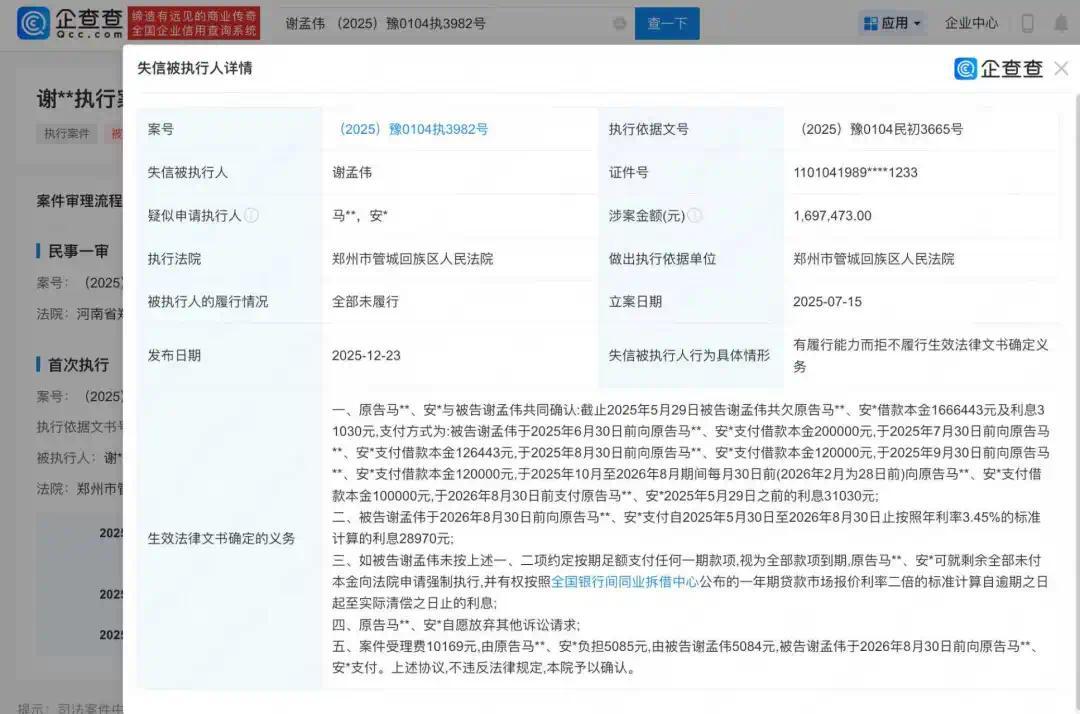
拒还169万欠款,“嘎子哥”谢孟伟成老赖
Guan Cha Zhe Wang· 2025-12-26 14:02
| 正百百 缔造有远见的商业传奇 全国企业信用查询系统 | | | 谢孟伟 | | | 网 查一下 | | 음 | | --- | --- | --- | --- | --- | --- | --- | --- | --- | | 企业 人员 风险 | SVIP | 全球企业 | 商标 专利 招投标 | | 新闻 创投库 | | | | | 风险类型 全部 | | 失信被执行人(1) | 限制高消费(2) | 被执行人(4) | 裁判文书(63) | 开庭公告(29) | 法院公告(6) 送达公告(1) | | | 省份地区 天歌 | | 北京(2) | 河南(1) 湖南(1) | | | | | | | 风险年份 老部 | | 2025 (4) | | | | | | | | | | | | | > | | | | | 为您找到 4 条风险信息 | | | | | | | | | | 谢孟伟 被执行人 | | | | | | | | | | 案号: (2025) 京0105执45970号 | | | 执行标的(元):797501.00 | | 执行法院:北京市朝阳区人民法院 | | 立案日期:2025-11 ...

realme被曝年底启动大规模裁员
Guan Cha Zhe Wang· 2025-12-26 12:47
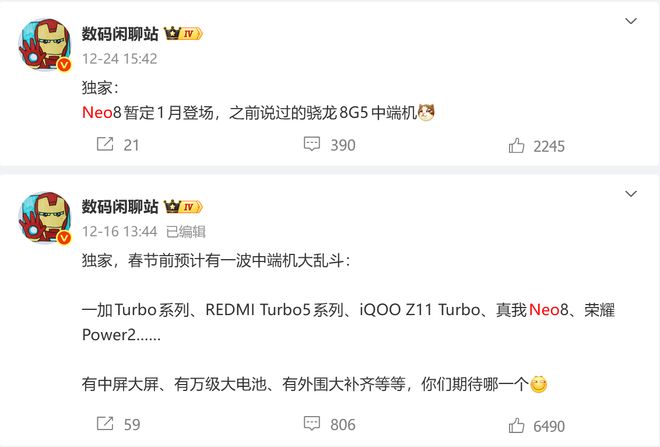
Group 1 - Recent rumors suggest that Realme is initiating a large-scale layoff plan, affecting outsourced, on-site, and formal employees, with claims that some departments may retain only one new graduate and that senior employees may be relocated to India [1] - A spokesperson from Realme responded to the rumors, stating that the company's business is operating normally and that a new product, Neo, will be launched in January, characterizing the layoffs as "normal year-end personnel changes" [1] - Realme was founded in May 2018 by former OPPO Vice President Li Bingzhong and focuses on a cost-effective strategy with the slogan "Dare to Leap" [1] Group 2 - Realme's Neo series targets gamers with high performance, fast charging, and strong heat dissipation, while the Digital series is positioned in the mid-range market, often featuring highlights in imaging and design [1] - Upcoming products include the Neo8, expected to launch in January with a Snapdragon 8 Gen5 processor and a large battery of over 8000mAh, along with a 6.78-inch 1.5K LTPS display supporting a refresh rate of up to 165Hz [1] - The Digital series, including the 16 Pro and Pro+, is set to be released on January 6, featuring a 200-megapixel main camera [1] Group 3 - Last year, Realme's Vice President Xu Qi announced a plan to break into the top five global smartphone brands by focusing on channels, marketing, and products to capture market share [2] - According to IDC's Q3 global smartphone data, the top five brands by shipment volume and market share are Samsung, Apple, Xiaomi, Transsion, and Vivo, with Realme categorized under "Others" [2] - In the Chinese market, Realme is not listed among the top five brands, and data from a digital blogger indicates that Realme's cumulative market share in China for the period from January to October 2025 is 1.26%, ranking seventh [2]
75岁中国人寿原总裁杨超被开除党籍:系投资领域腐败典型
Guan Cha Zhe Wang· 2025-12-26 10:21
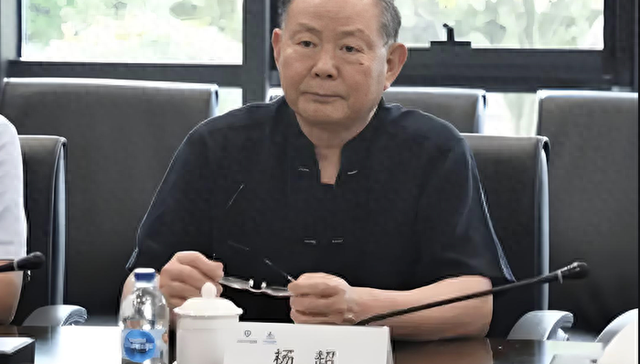
Core Points - The Central Commission for Discipline Inspection and the Jiangxi Provincial Supervisory Commission are investigating Yang Chao, the former Party Secretary and President of China Life Insurance (Group) Company, for serious violations of discipline and law [1][2] - Yang Chao is accused of losing his ideals and beliefs, being disloyal to the Party, and violating various regulations, including accepting gifts and banquets, misusing public vehicles, and engaging in corrupt practices [1][2] Summary by Sections Investigation Findings - Yang Chao, as a senior leader in a financial state-owned enterprise, has been found to have serious political and organizational discipline violations, including accepting bribes and abusing his power for personal gain [2] - His actions have been characterized as typical corruption in the investment sector, involving illegal acceptance of substantial financial benefits [1][2] Disciplinary Actions - The Party has decided to expel Yang Chao from the Party and cancel his benefits, while also confiscating his illegal gains [2] - His case has been referred to the Jiangxi Provincial Supervisory Commission for criminal prosecution, along with the related assets [2] Background Information - Yang Chao was born in 1950 and has an extensive career in the insurance and banking sectors, having held various leadership positions before becoming the President of China Life Insurance in 2005 [4] - He retired in 2011 and was under investigation 14 years later, highlighting the long-term implications of his actions [4]

当市场给智谱定价时,中国大模型正在被一并评估
Guan Cha Zhe Wang· 2025-12-26 09:51
Core Insights - The article discusses the evolving identity of Zhipu AI as it transitions from a traditional ToB service provider to a significant player in the global AI model competition, particularly in the context of its IPO and the rapid advancements in its model capabilities [2][3][16]. Group 1: Company Overview - Zhipu AI's revenue from localized deployment accounts for 85%, which has led to a narrative of being an AI outsourcing company focused on delivery rather than API services [3]. - The company has shifted its commercialization strategy from "model delivery" to "model invocation," aiming for a balanced revenue stream between localized deployment and model-as-a-service (MaaS) [2][8]. - CEO Zhang Peng indicated that the future revenue split between localized deployment and MaaS will be 50-50, reflecting a strategic pivot in their business model [2]. Group 2: Market Position and Competitiveness - Zhipu AI has been compared to OpenAI, not just in product form but in its foundational technology, positioning it within a global competitive framework for large models [2][16]. - The company has released multiple iterations of its GLM model (GLM-4.5, 4.6, and 4.7) in rapid succession, establishing itself as a key player in the developer ecosystem [3][5]. - Zhipu AI's models have gained traction among global developers, with significant adoption and integration into mainstream AI platforms, indicating its transition from a domestic alternative to a global competitor [8][10]. Group 3: Financial Performance and Growth - The company reported a significant increase in paid developer subscriptions, surpassing 150,000 within two months of launching its GLM Coding plan, leading to an annual recurring revenue exceeding 100 million [8]. - In November, Zhipu AI achieved a daily token invocation volume of 4.2 trillion, countering the narrative of being merely a delivery-focused company [9]. - The overall gross margin has shown improvement as model invocation scales up, indicating a positive trend in financial performance despite initial losses [13]. Group 4: Industry Context and Future Outlook - The AI market is expected to grow significantly, with estimates suggesting that the Chinese B-end AI market could reach 100 billion RMB by 2030, highlighting the potential for Zhipu AI's growth [13]. - The article emphasizes that the valuation of Zhipu AI should not be based solely on past financial data but rather on its potential as a foundational model provider in the evolving AI landscape [16][17]. - Zhipu AI's strategic focus on building trust with enterprise clients through localized deployments and its independent model development is seen as a competitive advantage in the global market [15][20].

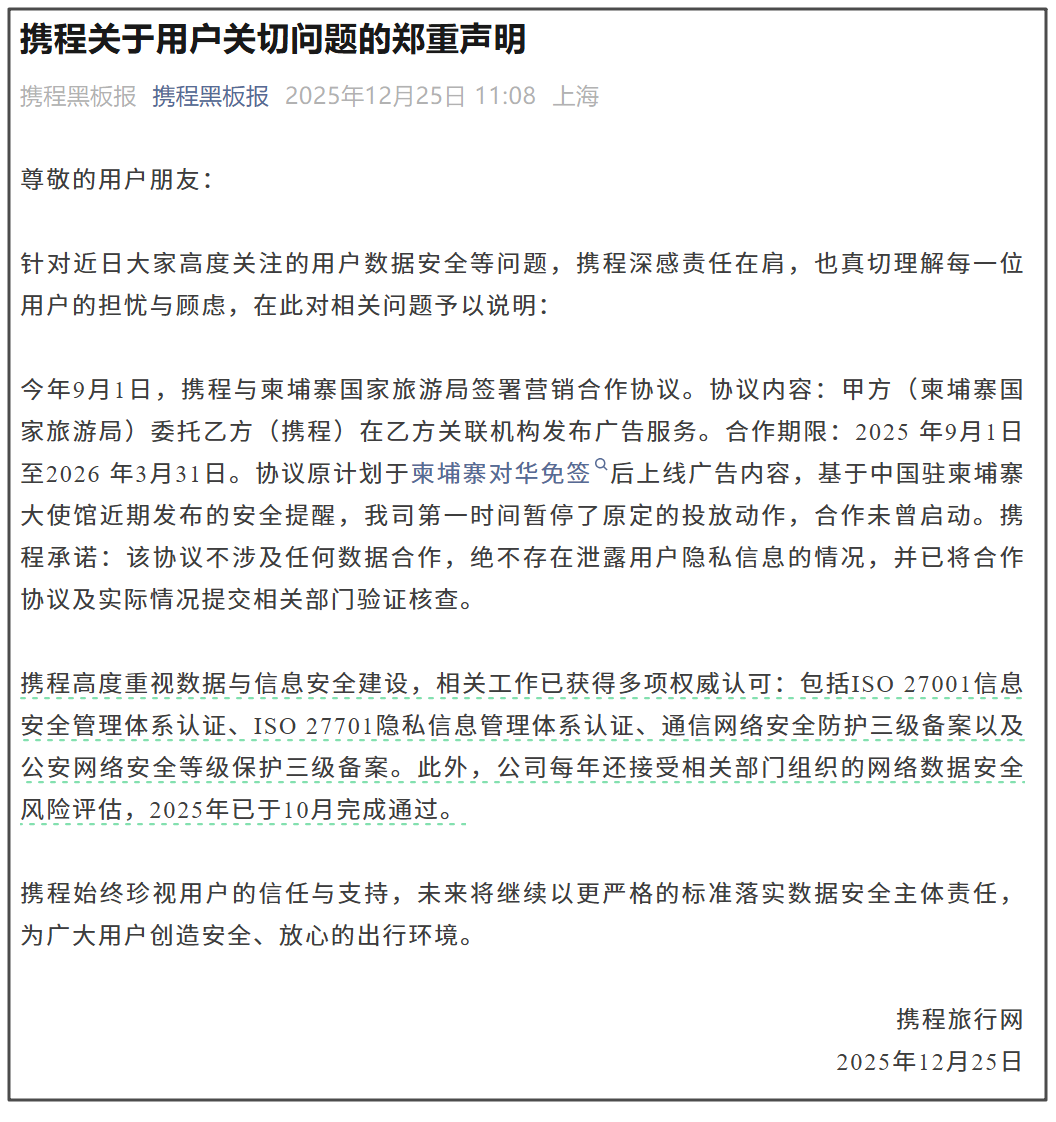
携程:与柬埔寨国家旅游局签署的营销合作未曾启动
Guan Cha Zhe Wang· 2025-12-26 09:01
Core Viewpoint - Ctrip's partnership with the Cambodian National Tourism Board has sparked significant public concern regarding user data privacy, leading to a wave of account cancellations among users [1][5]. Group 1: Partnership Details - On September 1, Ctrip signed a marketing cooperation agreement with the Cambodian National Tourism Board, which is set to run from September 1, 2025, to March 31, 2026 [2][5]. - The agreement was intended to launch advertising content following Cambodia's visa exemption for Chinese citizens, but was suspended due to safety warnings issued by the Chinese Embassy in Cambodia [2]. Group 2: User Concerns and Reactions - Following the announcement of the partnership, many users expressed their concerns on social media, leading to a significant number of account deletions, including from high-tier users [5]. - The Chinese Embassy in Cambodia has issued multiple safety alerts due to recent armed conflicts between Thailand and Cambodia, further heightening user anxiety regarding travel safety [5]. Group 3: Data Security Assurance - Ctrip has emphasized that the partnership does not involve any data sharing and has committed to user privacy, submitting the agreement for verification by relevant authorities [2]. - The company has received multiple certifications for its data and information security practices, including ISO 27001 and ISO 27701, and undergoes annual security risk assessments [2].

台积电高管:中国大陆客户可获全球先进制程支持
Guan Cha Zhe Wang· 2025-12-26 07:28
Core Viewpoint - TSMC's China head clarified that mainland Chinese customers can access advanced manufacturing processes globally, not limited to the Nanjing facility [1] Group 1: TSMC's Operations and Capacity - TSMC's Nanjing plant currently produces approximately 20,000 wafers of 16/12nm and 40,000 wafers of 28/22nm monthly, accounting for about 3% of TSMC's overall capacity [2] - The Nanjing facility primarily serves special demands such as automotive chips [2] Group 2: Regulatory and Market Clarifications - TSMC's capacity allocation is based on customer technology requirements, product positioning, and compliance considerations, rather than the customer's location or a single wafer fab [1] - TSMC is actively working to resolve issues related to the VEU (Vendor Eligibility for Use) qualification, aiming to meet regulatory requirements and fulfill customer commitments [1] - The U.S. announced the termination of TSMC's Nanjing plant's VEU qualification effective September 2025, transitioning to a case-by-case application process [1]

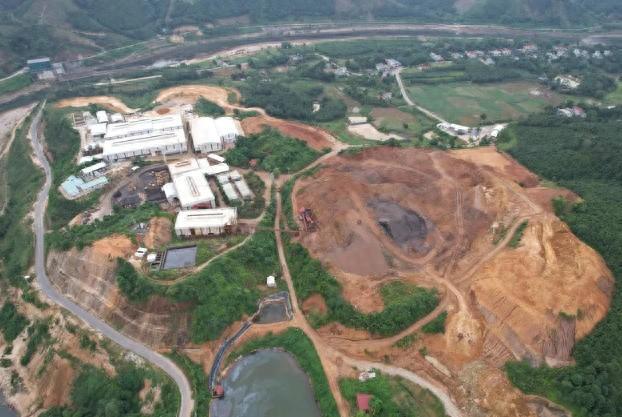
韩国想挖稀土“抗衡中国”,但越南想要更多
Guan Cha Zhe Wang· 2025-12-26 04:06
Core Viewpoint - Countries are increasingly looking to Vietnam to reduce dependence on Chinese rare earths, with South Korean company LS Eco Energy announcing a nearly $20 million investment in a rare earth processing plant in Ho Chi Minh City [1][3]. Group 1: Investment and Market Dynamics - LS Eco Energy's investment of $19.4 million aims to supply raw materials for its planned magnet factory in the U.S., as multinational companies seek to establish a "de-China" supply chain for critical materials [1][3]. - Vietnam's National Assembly has passed legislation tightening export controls, emphasizing that mineral extraction must align with the development of a closed-loop value chain, avoiding mere raw material exports [1][4]. - Other South Korean companies, such as Trident and POSCO, are also entering the Vietnamese rare earth market, indicating a broader trend of investment in the region [3][4]. Group 2: Regulatory Environment - Vietnam's government has implemented stricter controls on strategic materials, including a new law that prohibits the export of rare earth raw materials, requiring companies to obtain government approval for extraction and processing [4][5]. - The revised law encourages international cooperation in the research and development of rare earth extraction and processing technologies, aiming to enhance the local value chain and ensure self-sufficiency in the rare earth sector [5]. Group 3: Competitive Landscape - Despite efforts from the U.S. and Europe to create a "de-China" supply chain, challenges remain for companies seeking stable supplies of critical materials in Vietnam [6]. - China's dominance in the rare earth industry, controlling over 80% of global processing capacity and 90% of magnet production, presents significant competition for Western companies attempting to rebuild their supply chains [7].
小米卢伟冰:一万多的手机放到下一代
Guan Cha Zhe Wang· 2025-12-26 03:35
Group 1 - Xiaomi launched its flagship smartphone, the Xiaomi 17 Ultra, with a price range of 6,999 to 8,499 yuan, and a Leica version priced between 7,999 and 8,999 yuan [1] - The price increase for the Xiaomi 17 Ultra was anticipated, with a 500 yuan increase compared to the previous generation, the Xiaomi 15 Ultra [1][3] - Xiaomi's president, Lu Weibing, indicated plans to target the high-end smartphone market with models priced above 6,000 yuan in the future [1] Group 2 - The Xiaomi 17 Ultra features significant imaging capabilities, including a 1-inch main camera and a 200-megapixel telephoto lens, with advanced hardware and technology for enhanced dynamic range and optical zoom [3] - Other specifications include a 6.9-inch display, Snapdragon 8 Gen 2 processor, 6,800 mAh battery, and fast charging capabilities, making it the lightest Ultra model at 8.29 mm thick [3] - The Leica version of the Xiaomi 17 Ultra includes upgrades in lens zoom, UI interaction, and ergonomic design [3] Group 3 - Xiaomi and Leica have upgraded their strategic partnership, focusing on integrating Leica's optical expertise and design aesthetics into their products [5] - In the third quarter, Xiaomi ranked fourth in the Chinese smartphone market with a shipment of 10 million units, while Vivo, Apple, and Huawei led the market [5]

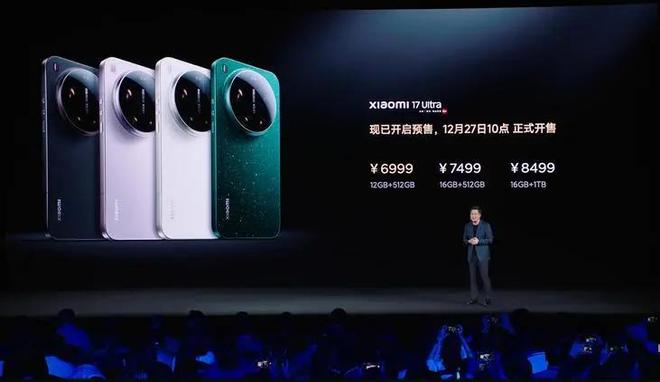
小米17Ultra起售价上调500元,卢伟冰:一万多放到下一代
Guan Cha Zhe Wang· 2025-12-26 03:33
Group 1 - Xiaomi launched its flagship smartphone, Xiaomi 17 Ultra, with a price range of 6,999 to 8,499 yuan, and a Leica version priced between 7,999 and 8,999 yuan [1] - The price increase for the Xiaomi 17 Ultra was anticipated, with a 500 yuan increase compared to the previous generation, Xiaomi 15 Ultra [1] - The company aims to target the high-end smartphone market with plans for a 6,000+ yuan segment in the future [1] Group 2 - The Xiaomi 17 Ultra features a 6.9-inch screen, Snapdragon 8 Gen 2 processor, 6,800 mAh battery, and 90W wired charging, making it the lightest Ultra model at 8.29 mm thick [2] - The collaboration with Leica has been upgraded to a strategic co-creation model, enhancing the camera's optical and design features [2] - Xiaomi also introduced several other products, including smart home devices and accessories, expanding its ecosystem [2] Group 3 - The Xiaomi 17 series saw price adjustments, with the standard version remaining at 4,499 yuan, while the Pro Max series increased to 5,999 yuan, reflecting a 500 yuan rise compared to the previous generation [3] - In Q3, Xiaomi ranked fourth in the Chinese smartphone market with a shipment of 10 million units, while Vivo led with 11.8 million units [3]
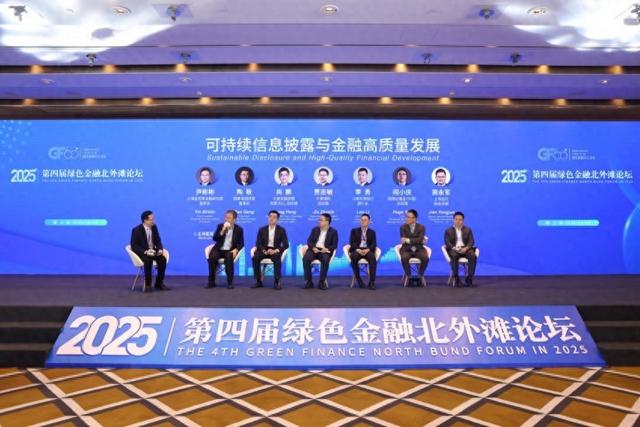
迈向“十五五”:以高质量信息披露驱动绿色金融提质增效
Guan Cha Zhe Wang· 2025-12-26 02:49
Core Viewpoint - The article emphasizes that green finance has become a core strategy for financial institutions, driven by sustainable information disclosure, which guides funds towards low-carbon sectors and promotes high-quality development in the industry [1]. Group 1: Sustainable Information Disclosure - Sustainable information disclosure is effectively driving financial institutions to integrate green development concepts and implement green innovation practices [1]. - There is a need for a systematic and mandatory information disclosure system to enhance transparency and comparability in ESG disclosures, which are currently mostly voluntary [5]. - The future focus of ESG work should revolve around institutionalizing information disclosure, integrating international standards, and leveraging technology to address data quality issues [5]. Group 2: Green Investment Practices - Companies like Guotai Junan Asset Management have integrated ESG indicators into their investment research systems across various financing businesses, achieving recognition in green financial innovation [5]. - ICBC-AXA Asset Management has seen significant growth in green investment, focusing on sectors like energy storage and renewable energy, while also expanding their green product offerings [7]. - Huaxia Wealth Management has incorporated ESG principles into their product design, ensuring that at least 80% of the underlying assets in green financial products are genuinely green [10]. Group 3: Risk Management and Innovation - Roadmap for risk assessment frameworks is crucial, as identifying and managing risks associated with ESG and climate transition is a key challenge for fund management companies [13]. - Jiangnan Rural Commercial Bank has developed a green finance risk management system to support business expansion and enhance risk control through innovative credit products [16]. - Shanghai Trust emphasizes the flexibility of trust systems in supporting green industries, with a focus on long-term capital and sustainable returns [19]. Group 4: Industry Collaboration and Future Directions - The forum highlighted the need for continuous breakthroughs in information disclosure, standard integration, risk management, and technological empowerment to direct financial resources efficiently towards green low-carbon sectors [21]. - Collaboration with various organizations, including NRDC and WBCSD, indicates a collective effort to advance sustainable finance practices [21].