Guan Cha Zhe Wang

Search documents
华为云城市峰会落地十堰,当地算力规模突破1万P
Guan Cha Zhe Wang· 2025-12-25 12:24
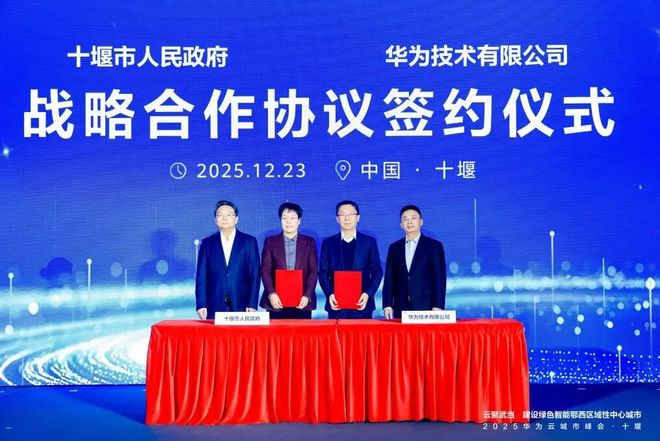
碧水映云,数潮奔涌。12月23日,2025华为云城市峰会落地十堰。政企学研界嘉宾齐聚一堂,以"云聚 武当·建设绿色智能鄂西区域性中心城市"为主题,共商数字经济发展路径,共绘绿色算力产业蓝图。 十堰依托生态禀赋构筑算力高地 数字经济的腾飞,离不开开放协同、互利共赢的产业生态。华为与十堰战略携手,并积极培育创新力 量,共同绘制"技术+产业+应用"的生态图谱。 政企合作迈向新阶段。峰会现场,十堰市政府与华为公司签署战略合作协议,并联合多家企业启动产业 生态联合创新行动。 十堰市政府与华为正式签署战略合作协议 "加快城市数字化转型,是十堰的战略选择,也是推动产业升级、优化营商环境、提升治理效能、增进 民生福祉的重要举措。"十堰市委常委、常务副市长周智勇表示,十堰将数字经济作为十大千亿级产业 集群重点培育,加快推动数字技术与实体经济深度融合,已成功入选全省首批中小企业数字化转型试点 城市,被纳入全省三大算力集群。 湖北省数据局党组成员、副局长艾青松在致辞中强调,十堰要依托武当云谷独特优势,积极融入全 省"武宜襄十"算力圈布局,既能承接武汉的算力辐射,又能辐射带动周边地区。 "十堰的算力,生而绿色,源于天然。"十堰市数据 ...

同仁堂:责令李声义辞职,其他相关管理人员全部停职
Guan Cha Zhe Wang· 2025-12-25 12:18
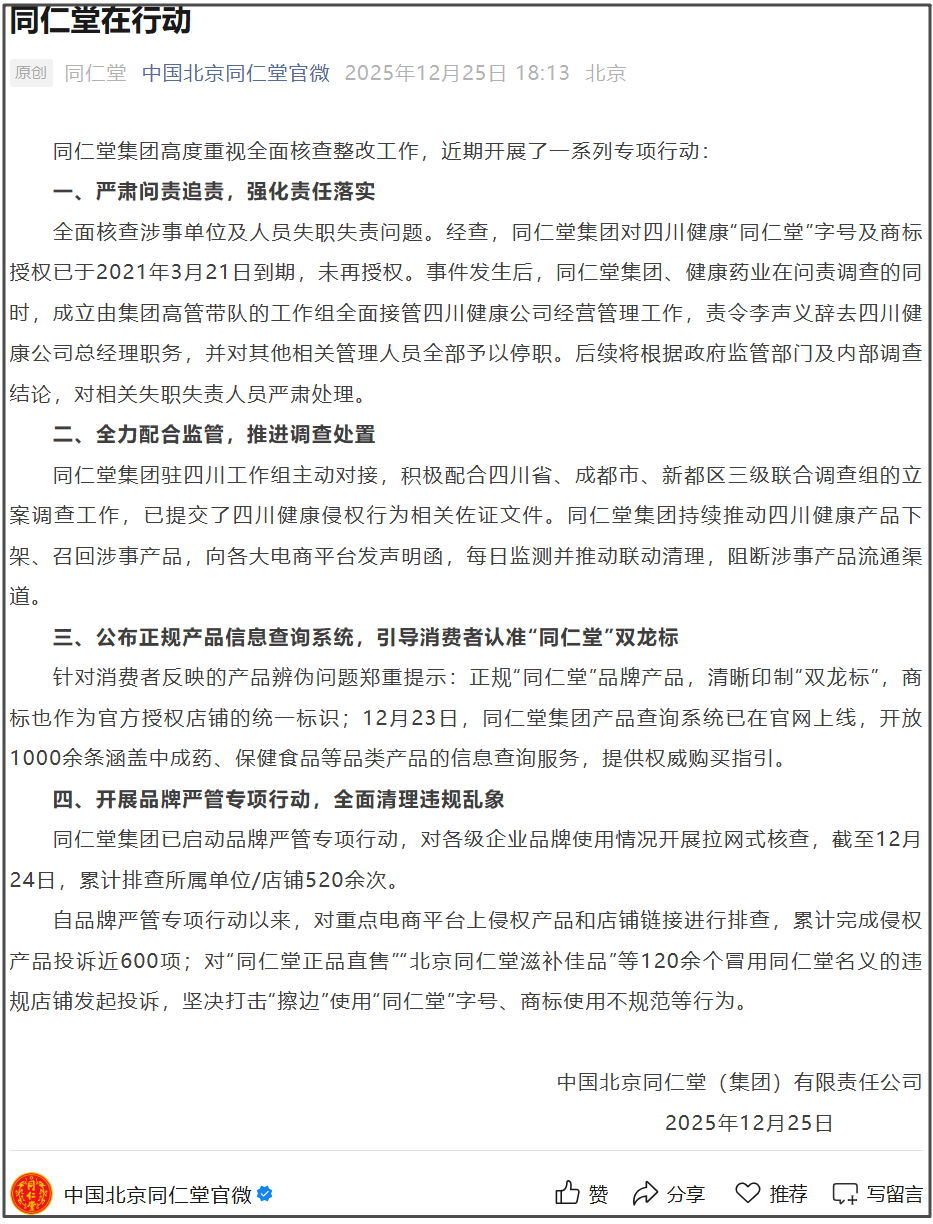
Group 1 - The core message of the news is that Tongrentang Group is taking significant actions to address the issues related to the unauthorized use of its brand and products, particularly in response to the controversy surrounding a product claiming to contain Antarctic krill oil [1][7][9] Group 2 - Tongrentang Group has initiated a comprehensive investigation and accountability measures, including the dismissal of the general manager of Sichuan Health Company and the suspension of other responsible personnel [1] - The company is actively cooperating with regulatory authorities in a joint investigation and has taken steps to recall the problematic products while monitoring their distribution channels [2] - A product information query system has been launched to help consumers identify genuine Tongrentang products, emphasizing the importance of the "Double Dragon Mark" for authenticity [3] - A special action for strict brand management has been initiated, resulting in the inspection of over 520 units and the filing of nearly 600 complaints against infringing products and stores [4] Group 3 - The Shanghai Consumer Protection Committee has identified serious discrepancies in the marketing of a product claiming to contain 43% phospholipids, which was found to contain none, leading to a formal investigation [7][8] - The company has acknowledged unauthorized use of its brand by Sichuan Health Company and has initiated legal proceedings against the involved parties [8] - Regulatory bodies are planning to implement stricter oversight on commissioned production practices to ensure product quality and consumer protection [9]

美团做起酒外卖,年营收或超60亿
Guan Cha Zhe Wang· 2025-12-25 10:49
Core Insights - The article highlights the rapid growth of Yima Songjiu, a liquor instant retail platform, which is projected to achieve a GMV of over 6 billion yuan in 2023, doubling from 3 billion yuan in 2022 [2][24] - Yima Songjiu has quickly become a leading player in the industry, reflecting the strong demand for instant home delivery of alcoholic beverages [3][28] Company Overview - Established in 2021 as a supplementary project for Meituan's flash purchase service in Huizhou, Yima Songjiu has expanded to over 2,000 warehouses across more than 200 cities, serving nearly 30 million users [3][11] - The platform offers over 800 SKUs, covering major categories such as beer, white liquor, red wine, and foreign liquor, with an average delivery time of 15 minutes [3][4] Competitive Advantages - Yima Songjiu promotes three main advantages: speed, price, and a light-asset model [4] - The platform's self-operated delivery model allows for faster delivery times, achieving a 50% on-time rate within 15 minutes and 95% within 25 minutes, significantly quicker than competitors [4][21] - Pricing strategies include using self-branded products to maintain high margins and leveraging Meituan's subsidies to offer competitive prices on well-known brands [4][5] Market Dynamics - The instant retail sector for alcoholic beverages is still in its early stages, with a projected market size of 100 billion yuan by 2027, indicating a compound annual growth rate of approximately 30% [24][27] - The industry faces challenges such as high delivery costs, low margins, and fluctuating demand, which complicate the balance between operational efficiency and profitability [21][29] Strategic Collaborations - Yima Songjiu has partnered with China Resources Beer to launch exclusive products based on real-time consumer data, showcasing the potential of instant retail platforms to influence product development [9][10] Future Outlook - The article suggests that the next phase of competition in the liquor instant retail market will focus on enhancing customer experience through specialized services and personalized recommendations [22][30] - The industry's growth is expected to be driven by changing consumer habits, particularly among younger generations who favor instant delivery services [27][28]


本田将推纯电K-Car,迎战比亚迪
Guan Cha Zhe Wang· 2025-12-25 10:38
Core Viewpoint - Honda plans to launch a pure electric version of its K-Car model by 2027 to compete with BYD, which has recently entered the K-Car market with its model Racco [2][3]. Group 1: Honda's K-Car Strategy - Honda's N-BOX model achieved impressive sales, reaching 200,000 units in 2024, making it the best-selling new car in Japan for three consecutive years [2]. - The N-BOX has a spacious interior and a price starting from 1.7 million yen, which has garnered strong consumer support [2]. - Since its launch in 2011, the cumulative sales of the N-BOX have reached approximately 3 million units [2]. Group 2: Market Context and Competition - The K-Car segment accounts for about 35%-40% of new car sales in Japan, with 1,202,100 units sold in 2024 [3]. - Currently, the K-Car market in Japan is dominated by local brands, with Suzuki holding a 38.8% market share, followed by Honda at 21.4% and Daihatsu at 18.3% [4]. - The introduction of BYD's Racco, which is designed specifically for the Japanese market and complies with local regulations, poses a significant threat to Japanese automakers [4]. Group 3: Electric K-Car Market Potential - The Japanese government offers subsidies for purchasing pure electric K-Cars, along with tax reductions in the second year of ownership, which could accelerate the adoption of electric vehicles if prices become comparable to gasoline cars [5].


110亿,强生爽身粉致癌案判了
Guan Cha Zhe Wang· 2025-12-25 09:45
Core Viewpoint - Johnson & Johnson faces significant legal challenges and financial liabilities due to claims that its baby powder products contain asbestos, leading to cancer diagnoses among users, with a recent jury awarding $1.56 billion in damages to a plaintiff [1][4]. Group 1: Legal Challenges and Financial Liabilities - A Maryland jury ruled that Johnson & Johnson must pay approximately $1.56 billion to a woman who developed mesothelioma after using its baby powder, marking the highest compensation awarded to a single plaintiff in the company's history [1]. - The company has faced multiple lawsuits over the years, with previous rulings including $72 million in 2016 for an ovarian cancer patient and $417 million in 2017 for another plaintiff [2]. - Johnson & Johnson's subsidiary, Red River Talc, filed for prepackaged bankruptcy in 2024 to address ongoing litigation related to talc claims, proposing a settlement plan worth approximately $8 billion over 25 years [4]. Group 2: Product Safety and Corporate Actions - Johnson & Johnson has historically denied that its products contain asbestos, asserting that extensive testing confirms their safety [2]. - In response to declining sales due to the cancer allegations, the company ceased production of talc-based baby powder in the U.S. and Canada in 2020, later expanding this decision globally in 2023 [3]. - The company has attempted to mitigate litigation risks through settlements, including a $8.9 billion agreement to resolve claims over 25 years and a $700 million settlement with 42 states in 2024 [4]. Group 3: Industry Implications - The ongoing legal battles and substantial financial penalties serve as a warning to global companies about the consequences of prioritizing commercial interests over public health [5]. - The situation highlights the potential risks associated with product safety and the importance of transparency in corporate practices [5].


朱孝天举报“勾结黄牛”,大麦客服回应
Guan Cha Zhe Wang· 2025-12-25 09:45
Core Viewpoint - Artist Zhu Xiaotian has reported multiple violations by the management company "Believe Music," which represents the band Mayday, including collusion with scalpers, tax evasion through cross-border fund transfers, and coercing artists into lip-syncing [1][9] Group 1: Allegations and Background - Zhu Xiaotian's allegations stem from conflicts during the F4 reunion concert collaboration, where he claims he was unilaterally "withdrawn" from the event without a contract after refusing three demands from Believe Music [1] - The report includes serious accusations such as collusion with scalpers to inflate ticket prices and forced lip-syncing of artists, which raises significant concerns about the integrity of the concert industry [4][9] - Believe Music has faced scrutiny before, particularly during a "lip-sync controversy" in late 2023, which, despite an official investigation finding no wrongdoing, has continued to affect public trust [3][11] Group 2: Ticketing Market Issues - The ticketing market in China is highlighted as problematic, with scalpers profiting significantly from concert tickets, as evidenced by the recent F★FOREVER concert where tickets sold out in seconds but scalper tickets were available at inflated prices [5][7] - A report indicates that 56.94% of complaints in the online ticketing market in 2024 were related to refunds, with a total of 14.79 million complaints and over 158 million yuan in disputed amounts from 2019 to 2025 [7] - The distribution of concert tickets involves a complex structure, with approximately 70% allocated to primary ticketing platforms, leaving a 30% "gray area" that scalpers exploit [7] Group 3: Financial Performance and Industry Trends - Believe Music's parent company, Alibaba's Damai, reported a revenue of 2.057 billion yuan for the fiscal year 2025, a 236% increase, driven by a booming concert market that saw ticket sales exceed 26 billion yuan in 2024, up 78.1% year-on-year [8] - Despite the financial success, consumer protection issues persist, with Damai receiving the highest number of complaints among ticketing platforms, raising questions about the balance between consumer rights and commercial interests [8] - The overall economic scale of China's performing arts industry is projected to reach 79.629 billion yuan in 2024, reflecting a 7.62% growth, indicating a robust market but also highlighting ongoing challenges [13]
19薪起!全网都被京东这份年终奖公告酸到了
Guan Cha Zhe Wang· 2025-12-25 09:27
Core Viewpoint - JD Group announced a significant increase in year-end bonuses for 2025, with total investment expected to rise over 70% year-on-year, marking the largest annual increase in the industry [1][10]. Group 1: Year-End Bonus Announcement - 92% of employees across the group are eligible to receive full or above-standard year-end bonuses, with all business lines upgrading their compensation incentives [1][6]. - The company has initiated a tradition of distributing year-end bonuses to frontline employees before the Spring Festival [9]. Group 2: Compensation Structure - The new year-end bonus structure includes performance-based multipliers, with employees rated A+ receiving up to 12 times their monthly salary as a bonus, while B+ rated employees receive 7 times [7][8]. - The sales and procurement teams are projected to achieve an average of 25 salaries, with no upper limit, and are expected to reach an average of 26 salaries in 2026 [7][8]. Group 3: Employee Welfare Enhancements - Over 20,000 customer service employees will receive an average salary increase equivalent to 2 months, following a previous 30% increase in February 2025 [8]. - Additional benefits for customer service staff include enhanced medical insurance, upgraded health check standards, and increased housing subsidies [8]. Group 4: Historical Context and Industry Comparison - Since its establishment, JD has invested over 30 billion in its customer service team, with a consistent trend of increasing employee compensation [9]. - Compared to other internet companies, JD's year-end bonus structure is significantly more generous, with many competitors offering bonuses equivalent to only 6 months of salary or none at all for underperforming employees [10].

19薪起!京东2025年终奖投入同比涨幅超70%
Guan Cha Zhe Wang· 2025-12-25 09:26
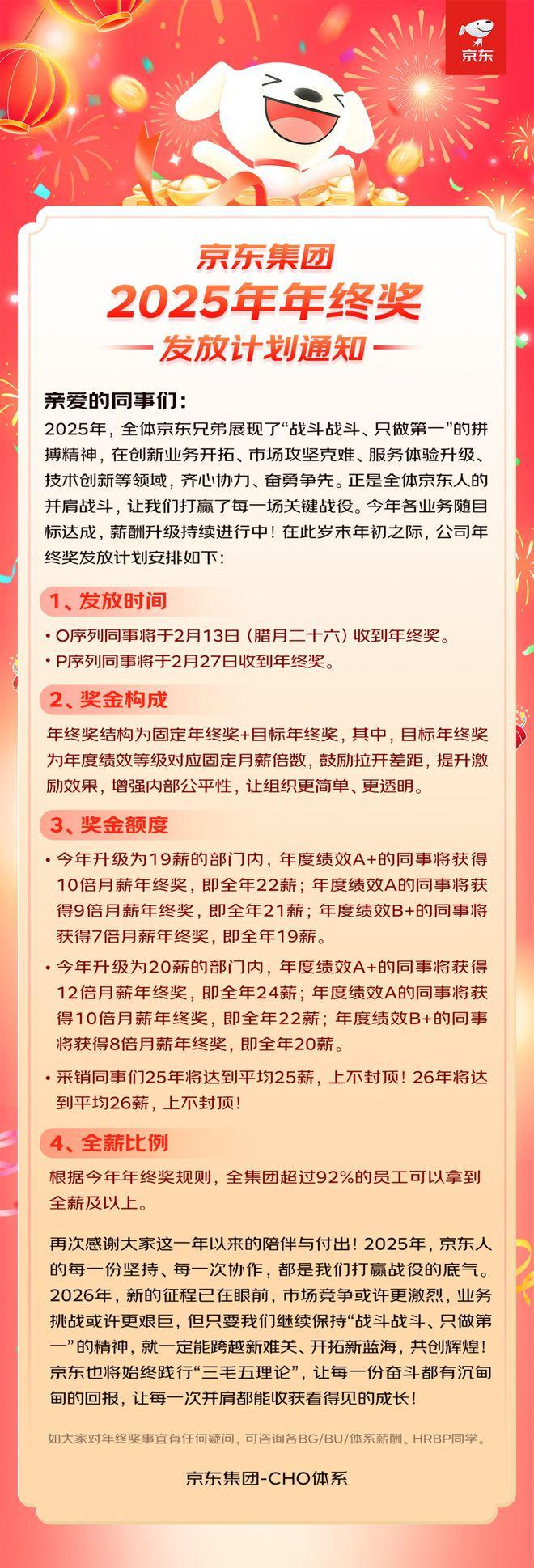
Core Viewpoint - JD Group announced a significant increase in year-end bonuses for 2025, with total investment expected to rise over 70% year-on-year, marking the largest annual increase in the industry [1][10]. Bonus Structure - The year-end bonus consists of a fixed bonus and a target bonus, where the target bonus is a multiple of the fixed monthly salary based on annual performance ratings, aimed at enhancing internal equity and transparency [4]. Bonus Amounts - Employees in departments upgraded to 19 salaries will receive bonuses ranging from 7 to 10 times their monthly salary, while those in departments upgraded to 20 salaries can receive bonuses up to 12 times their monthly salary [7][8]. Full Salary Proportion - Over 92% of employees across the group are eligible to receive full salary bonuses or more, reflecting the company's commitment to rewarding employee contributions [6][9]. Salary Upgrades - JD has been steadily implementing its 20-salary upgrade plan, with some business units achieving this goal ahead of schedule. The company has also significantly increased salaries for customer service personnel, with an average raise of 2 months for over 20,000 employees [8][9]. Historical Investment in Employee Compensation - Since its establishment, JD has invested over 30 billion in its customer service team, with a consistent trend of increasing employee compensation. The average annual salary has risen from 14 salaries to 16 salaries over the past two years [9]. Financial Performance - JD's financial performance supports its ongoing salary and bonus increases, with a reported revenue of 2,604 billion and a net profit growth of 5.1% year-on-year, driven by supply chain efficiency and an increase in third-party platform business [10]. Industry Comparison - Compared to other internet companies, JD's year-end bonus structure is notably more generous, with many competitors offering bonuses equivalent to only 6 months of salary or none at all for underperforming employees [10].

“避雷帖”造成百万损失,丽江旅拍业称将集体诉讼小红书
Guan Cha Zhe Wang· 2025-12-25 08:51
Core Viewpoint - The dispute between the Lijiang Wedding Photography Industry Association and the Xiaohongshu platform has escalated into a legal confrontation, with the association seeking a public apology and improved content moderation from the platform [1] Group 1: Association's Demands - The association's core demands include a public apology from Xiaohongshu for regulatory shortcomings, timely content moderation to remove false posts, and direct communication channels with company executives to prevent future issues [1] - As of December, the financial impact of false "avoidance posts" has exceeded 1 million yuan in cancellations, with indirect economic losses surpassing 5 million yuan [1] Group 2: Platform Responsibility - The central issue of the dispute revolves around the extent of the content platform's responsibility for content moderation, with the local cultural and tourism bureau stating that Xiaohongshu has failed to fulfill its monitoring and management obligations [2] - Businesses often find it difficult to address false content, leading to significant damage to their reputation [2] Group 3: Consumer Behavior and Industry Standards - The association highlighted that some consumers post false avoidance posts to pressure businesses for refunds, even when the businesses have fulfilled their contractual obligations [4] - Experts suggest that the issue arises from both businesses potentially over-marketing and consumers misusing avoidance posts as bargaining tools, indicating a lack of integrity among some consumers [5] Group 4: Platform's Position and Industry Impact - Xiaohongshu has stated that businesses can report posts that infringe on their rights, and the platform has a review process in place [7] - Despite the controversy, Xiaohongshu also hosts numerous positive reviews of Lijiang wedding photography services, contributing to the area's popularity as a wedding photography destination [7] Group 5: Regulatory Developments - The Lijiang local government is actively promoting industry standardization, with new regulations requiring businesses to clearly state service items and pricing, and to sign contracts with consumers [10] - The association has also issued guidelines to encourage rational consumer behavior and discourage misleading pricing practices [10] Group 6: Broader Implications - The dispute reflects deeper challenges in content platform governance in the digital economy, highlighting the need to balance consumer expression freedom with preventing platform misuse [10]
“科兴”分家30年:疫苗王者陨落美股,干扰素老兵转战医美
Guan Cha Zhe Wang· 2025-12-25 08:34
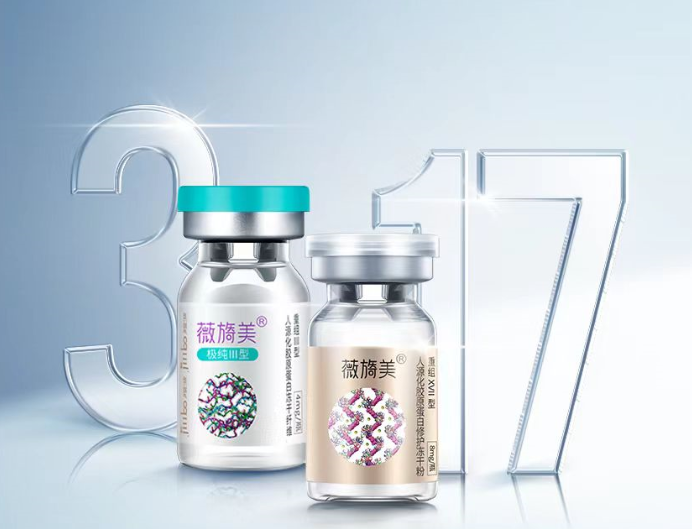
Group 1: Core Insights - Kexing Pharmaceutical is entering the rapidly growing recombinant collagen market, with a clinical trial for its type III humanized collagen product officially launched [1][2] - The recombinant collagen market in China is projected to reach 108.3 billion yuan by 2027, with a compound annual growth rate of 44.93% [1][2] - Kexing Pharmaceutical's revenue has stagnated around 1.2 billion yuan for several years, making this strategic shift a necessary move for growth [1][6] Group 2: Industry Trends - The recombinant collagen is becoming a new favorite in the medical aesthetics sector, with its market share expected to grow significantly, while hyaluronic acid's market share is declining [2][4] - Currently, only Jinbo Biotech has received approval for two type III medical devices in this space, indicating a competitive landscape that is likely to change as more companies enter [2][4] Group 3: Company Challenges - Kexing Pharmaceutical faces challenges in cash flow, with net cash flow being negative from 2022 to mid-2025, and cash reserves decreasing from 784 million yuan to 446 million yuan [4][11] - The company is also under pressure from increasing competition, with several firms, including major beauty brands, entering the recombinant collagen market [4][11] Group 4: Historical Context - Kexing Pharmaceutical and Kexing Biology share a common origin, having been established from the same foundational institutions, but have diverged significantly in their paths over the past 30 years [7][8] - Kexing Biology has faced governance issues and financial struggles, while Kexing Pharmaceutical has been criticized for its stagnant revenue and reliance on legacy products [8][11]