
Zhong Guo Hua Gong Bao

Search documents
创新技术路径与实施机制,推进“能源—水—物料”协同 以系统工程思维驱动园区绿色转型
Zhong Guo Hua Gong Bao· 2026-02-25 05:09
Core Viewpoint - The chemical industry parks play a crucial role in achieving China's "dual carbon" goals, necessitating high-quality engineering construction for green development [1] Group 1: Challenges in Current Practices - Many parks exhibit an "engineering island" phenomenon, where energy efficiency, wastewater treatment, and resource recovery projects are planned and implemented independently, leading to missed optimization opportunities [2] - This fragmented approach neglects the inherent coupling of materials and energy in chemical processes, resulting in cascading waste of energy and materials within the park ecosystem [2] Group 2: Key Pathways for Optimization - Energy cascading utilization and deep coupling of water resource regeneration are essential for carbon reduction and water conservation, exemplified by integrating low-grade waste heat recovery with seawater desalination [3] - Closed-loop design for material metabolism and resource recovery treats waste as "misplaced resources," focusing on green design and establishing park-level waste energy and resource recovery centers [3] Group 3: Digital Empowerment for Optimization - The development of a smart energy-environment management system is underway, utilizing IoT for real-time data collection and digital twin technology for simulation modeling, enabling proactive and dynamic optimization of resources [4] Group 4: Mechanisms for Sustainable Transformation - A unified planning mechanism is recommended to incorporate "energy-water-material" collaborative networks into the park's overall planning and long-term green development [6] - A shared data and service platform should be established to facilitate resource management and reduce transaction costs among enterprises [6] - A market-based incentive and constraint mechanism is proposed, focusing on differentiated resource pricing and exploring internal carbon and water rights trading [6] - A collaborative招商 mechanism should prioritize attracting enterprises that can utilize by-products and provide clean energy or key recycling technologies [6] Group 5: Conclusion on Transformation - The transformation of chemical parks under the "dual carbon" goals represents a systemic and epochal challenge, with a belief that systematic engineering thinking, innovative technology, and collaborative management mechanisms will lead to a more efficient, safe, and sustainable development path [7]

锦州石化光伏发电项目稳定运行
Zhong Guo Hua Gong Bao· 2026-02-25 04:58
Core Insights - The project by Jinzhou Petrochemical Company has successfully achieved stable operation of a distributed photovoltaic power generation system, covering all electricity loads of the company's public engineering office building and supplying excess power to an air separation unit [1] Group 1: Project Overview - The total installed capacity of the photovoltaic project is 200 kilowatts peak, with a peak power generation capacity of 170 kilowatts [1] - The project is expected to generate an annual electricity output of 200,000 kilowatt-hours [1] Group 2: Project Implementation - The project was completed in just two months, significantly shorter than the expected timeline, while also optimizing resource use and saving over 300,000 yuan in labor and material costs [1] - The system consists of 324 solar panels divided into 18 groups, ensuring stability and continuity in power generation through a well-designed layout [1] Group 3: Performance Testing - A two-day grid connection test was conducted under various weather conditions, confirming stable power generation between 150 to 170 kilowatts during sunny afternoons [1] - Professional testing indicated that the power quality meets national standards, demonstrating the project's reliable power supply capability [1]
陕煤加氢装置“黑屏操作”稳运500小时
Zhong Guo Hua Gong Bao· 2026-02-25 04:28
Core Insights - The Shaanxi Coal and Chemical Group's Shendong Coal Chemical Fuels Company has achieved a significant milestone with its 1120 naphtha hydrogenation unit operating continuously for over 500 hours in "black screen operation" mode, indicating progress in the construction of "black light factories" in the chemical sector [1] Group 1: Operational Achievements - The 1120 naphtha hydrogenation unit is responsible for naphtha refining and product quality enhancement, featuring a complex process flow and high operational precision requirements [1] - The company has implemented a systematic technological upgrade centered on an "awareness-decision-execution" intelligent closed-loop system to overcome the limitations of traditional "human monitoring" methods in terms of efficiency and safety [1] Group 2: Automation and Efficiency - An automated control system has been established that covers the entire process from raw material pretreatment to reaction control and product separation, achieving real-time monitoring and dynamic adjustment of process parameters [1] - The unit's automation rate has reached 100%, with a stable process rate exceeding 90%, and the fluctuation range of key parameters has been reduced by approximately 30% [1] - The amount of manual intervention has decreased by 95% compared to traditional methods, enhancing safety levels and operational efficiency while optimizing product yield and reducing energy consumption [1]
让井口盘根不再“闹心”
Zhong Guo Hua Gong Bao· 2026-02-25 04:26
Core Viewpoint - The article highlights an innovative solution developed by a technician to address the issue of oil well sealing during the busy Spring Festival period, which enhances operational efficiency and safety while reducing costs [1][2]. Group 1: Innovation and Problem-Solving - The technician Zhang Xianli proposed a solution by repurposing discarded oil pump belts into durable sealing components, addressing the common issue of traditional rubber seals that wear out quickly under harsh conditions [1][2]. - This innovation not only resolves the sealing problem but also minimizes the need for frequent repairs during the holiday season, allowing for a more stable production environment [1][2]. Group 2: Operational Efficiency - The new sealing technology is projected to reduce maintenance needs for over 220 wells annually and decrease downtime by more than 200 hours, thereby improving production efficiency [2]. - The implementation of this solution contributes to lower operational costs and enhances safety and environmental protection by addressing potential risks at the source [2].
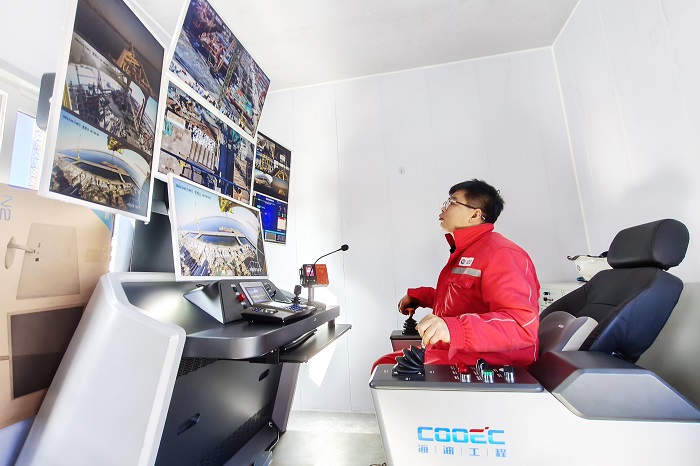
海油装备领域首套智能塔机系统投用
Zhong Guo Hua Gong Bao· 2026-02-25 03:02
Core Insights - The first intelligent tower crane control system in China's offshore oil and gas equipment manufacturing sector has been put into operation at CNOOC Engineering's Tianjin Intelligent Manufacturing Base [1][2] - The intelligent crane system integrates 5G communication, millimeter-wave radar, and dynamic obstacle avoidance, transitioning from traditional operation to intelligent remote control, thereby reducing labor intensity and safety risks [1][2] Group 1 - The tower crane is essential for vertical and horizontal material transportation and structural component installation during construction, featuring a large operational space and high lifting height [1] - Traditional tower crane operations require operators to climb to the top of the crane, increasing climbing time and exposure to high-altitude risks [1] - The new intelligent crane system has a maximum lifting capacity of 12 tons and improves operational efficiency by approximately 20% compared to traditional methods, with control latency maintained within 40 milliseconds [1][2] Group 2 - The development of the intelligent crane control system involved interdisciplinary technologies, including mechanical engineering, data transmission, and sensor positioning, requiring high standards for engineering applications, data interaction, environmental perception, and path planning [2] - The project team overcame multiple technical challenges over two years, achieving 100% domestic production of both software and hardware, providing a replicable solution for the intelligent upgrade of China's marine engineering equipment [2] - CNOOC Engineering plans to continue promoting the intelligent innovation and scenario expansion of large lifting equipment, accelerating the "R&D—Verification—Promotion" mechanism to advance the transition from traditional to intelligent models in the offshore oil and gas manufacturing sector [2]


聚乙烯:步入深度调整期
Zhong Guo Hua Gong Bao· 2026-02-25 02:44
Core Viewpoint - The domestic polyethylene market in China is expected to reach a significant milestone in 2026, with total production capacity surpassing 45 million tons, leading to a shift from scale expansion competition to value enhancement competition, indicating a structural adjustment in the industry [1] Group 1: Capacity Growth and Structure - New polyethylene production capacity in China is projected to reach between 6.15 million to 7.29 million tons in 2026, with a growth rate of 15% to 18.5% [2] - The production capacity will be primarily driven by oil-based facilities, with major contributions from large refining and chemical enterprises like Huajin Amoco and Zhongsha Gulei, alongside a significant increase in coal-based production [2] - The product structure is showing an optimization trend, with the planned production capacity for high-density polyethylene (HDPE) at 2.05 million tons and linear low-density polyethylene (LLDPE) growth slowing to an estimated 4% in 2026, down from 24% in 2025 [2] Group 2: Supply and Demand Dynamics - The polyethylene industry is expected to experience ongoing adjustments in supply and demand, characterized by a phase of seeking balance and rapid price fluctuations [3] - The first half of 2026 will see limited new capacity release, while the second half will face market pressure as capacity expansion comes online [3] Group 3: Cost Trends and Profitability - There will be significant differentiation in cost structures, leading to widening profitability gaps among companies based on their production processes [4] - Oil-based polyethylene, which constitutes nearly two-thirds of total capacity, will face profit pressures due to high crude oil prices and declining polyethylene spot prices [4] - Coal-based polyethylene, accounting for about 20% of total capacity, is expected to benefit from a moderate decline in coal prices, maintaining a specific profitability level [4] Group 4: Domestic Demand and Export Challenges - Domestic apparent consumption of polyethylene is projected to reach approximately 41.5 million tons in 2026, reflecting a year-on-year growth of 7.8%, which is still lower than the growth rate of production capacity [5] - Traditional demand sectors such as packaging films and pipes are experiencing slow growth, while new industries like photovoltaic backsheet films and lithium battery separators are expanding, albeit still representing a small portion of overall consumption [6] - The export of polyethylene from China has seen a compound annual growth rate of 34.5% over the past five years, with expectations for steady growth in 2026, particularly in Southeast Asia [6]
杉杉股份2025年业绩预盈
Zhong Guo Hua Gong Bao· 2026-02-25 02:44
Core Viewpoint - The company Shanshan Co., Ltd. is expected to achieve a net profit of 400 million to 600 million yuan for the fiscal year 2025, marking a turnaround from previous losses, primarily driven by the robust growth and profitability of its core businesses in anode materials and polarizers [1] Group 1: Financial Performance - The projected net profit attributable to shareholders is estimated to be between 400 million and 600 million yuan, with a net profit excluding non-recurring gains and losses expected to range from 300 million to 450 million yuan [1] - The two core businesses are anticipated to generate a combined net profit of 900 million to 1.1 billion yuan in 2025 [1] Group 2: Business Growth Drivers - The anode materials business is benefiting significantly from strong demand in the downstream electric vehicle and energy storage markets, leading to a notable increase in sales and overall profit [1] - The polarizer business is experiencing growth through product high-endization and operational refinement, which enhances both scale and profitability, while cost reduction and product structure upgrades contribute to improved gross margins [1]

新宙邦2025年营收净利双增
Zhong Guo Hua Gong Bao· 2026-02-25 02:44
Core Viewpoint - The company Xinzhou Bang reported steady growth in revenue and net profit for 2025, driven by increased demand in the lithium battery market and opportunities in the semiconductor industry [1] Financial Performance - Revenue reached 9.639 billion yuan, an increase of 22.84% compared to the previous year [1] - Net profit amounted to 1.098 billion yuan, reflecting a growth of 16.56% year-on-year [1] - Deducted non-recurring profit, net profit was 1.089 billion yuan, up by 14.54% from the previous year [1] Growth Drivers - The growth is attributed to three main factors: 1. Increased demand in the lithium battery market and semiconductor industry, leading to significant growth in the production and sales of battery chemicals and semiconductor chemicals [1] 2. Rapid capacity release from newly launched projects, along with process improvements and cost reduction measures, enhancing cost competitiveness and operational efficiency [1] 3. Substantial profit growth from the joint venture Jiangxi Shilei Fluorine Materials Co., Ltd., which significantly boosted investment income and further increased the company's profits [1]

中国橡胶工业协会副秘书长朱红建言橡胶行业——破卡点 疏堵点
Zhong Guo Hua Gong Bao· 2026-02-25 02:44
Core Viewpoint - The article emphasizes the need to eliminate obstacles in the domestic rubber industry to enhance the internal circulation of the economy, as highlighted by the "14th Five-Year Plan" suggestions [1] Group 1: Industry Challenges - The rubber industry faces significant bottlenecks across the entire supply chain, with high dependence on foreign raw materials and insufficient domestic supply [2] - Key synthetic rubber materials like butadiene and isoprene have over 60% reliance on imports, while high-end products have a self-sufficiency rate below 60% [2] - The processing capacity is imbalanced, with 70% concentrated in East China, and there are pressing issues related to technological bottlenecks and green transformation [2] - The demand for high-performance rubber products is increasing due to the rise of electric vehicles, while traditional fuel vehicle markets are shrinking, leading to a mismatch in supply and demand [2] Group 2: Impact on Industry Development - The industry's challenges increase operational costs and compress profit margins due to reliance on imported raw materials and structural contradictions [3] - Supply chain security is compromised, affecting the upgrade of midstream industries, with geopolitical and natural risks impacting natural rubber supply [3] - Inefficiencies in logistics and resource allocation hinder the smooth operation of domestic circulation, leading to increased costs and energy consumption [3] - The industry's international competitiveness is weakened, resulting in missed opportunities in emerging markets due to technological barriers [4] Group 3: Proposed Solutions - To enhance domestic circulation, the industry should focus on improving self-supply capabilities for raw materials, optimizing midstream technology and capacity, and exploring downstream demand [5] - Specific measures include expanding domestic natural rubber cultivation, promoting cooperation with Southeast Asian countries, and developing sustainable materials [5] - Midstream improvements should involve smart upgrades in processing, establishing collaborative centers in industrial clusters, and promoting low-pollution production processes [6] - Downstream strategies should focus on integrated R&D for new materials, customized services, and tapping into rural markets for rubber products [6] - A comprehensive collaboration system should be established to enhance efficiency and resilience across the supply chain [6] - Strengthening policy support through dedicated R&D funds, tax incentives, and talent development is crucial for the industry's advancement [7]
14家企业共建全球可再生塑料供应链
Zhong Guo Hua Gong Bao· 2026-02-25 02:41
Core Viewpoint - Sony and Mitsubishi Corporation, along with 14 companies from five countries, have successfully established the world's first supply chain for producing renewable plastics, aiming to eliminate the use of fossil-based virgin plastics in high-performance audio-visual products [1] Group 1: Supply Chain Development - The supply chain utilizes biomass resources to produce various types of renewable plastics through a quality balance method [1] - This initiative is part of the "Creating New Value with Renewable Materials" project, co-initiated by Sony and Mitsubishi Corporation [1] - The collaboration aims to visualize Sony's existing product supply chain and create a new supply chain system that allows for the procurement of materials equivalent in quality and performance to fossil-based virgin plastics [1] Group 2: Challenges and Solutions - High-performance audio-visual equipment requires a wide variety of plastics, making the supply chain complex and difficult to visualize and manage [1] - The need for flame retardancy and optical performance in plastic components has hindered the reduction of fossil-based virgin plastic usage, as recycled plastics cannot fully replace these requirements [1] - The clear supply chain established by the 14 companies will help track and record greenhouse gas emissions data in a verifiable manner, promoting future carbon reduction efforts [1]
