
Zhong Guo Chan Ye Jing Ji Xin Xi Wang

Search documents
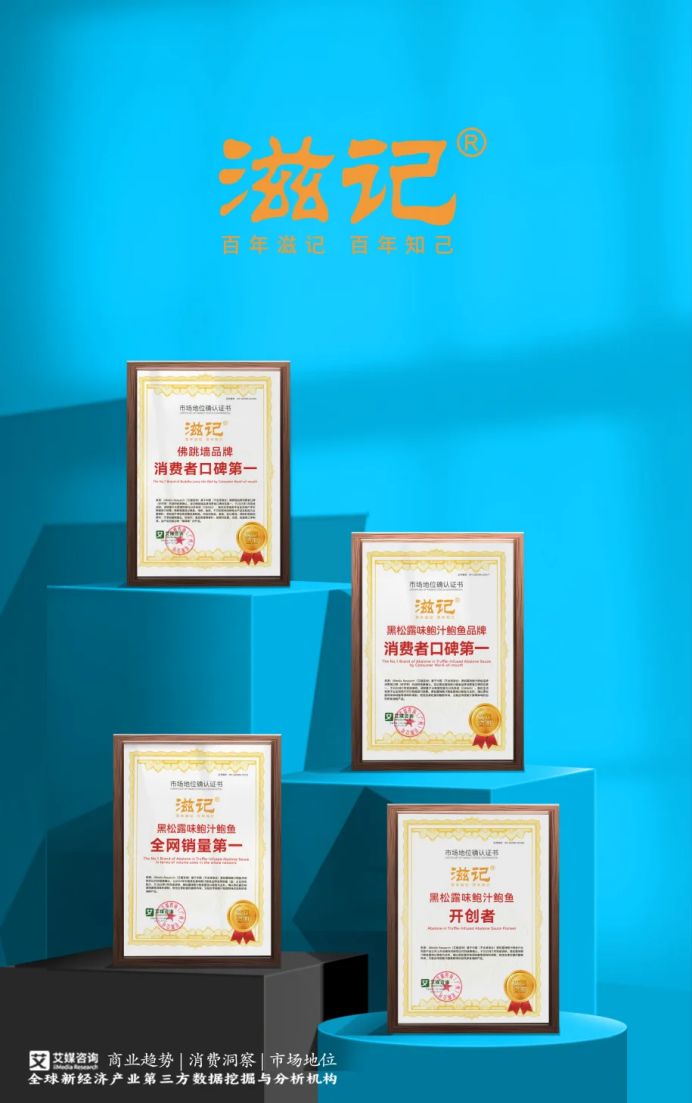
鲍鱼新升级!滋记携黑松露打造鲍鱼界“爱马仕”
Zhong Guo Chan Ye Jing Ji Xin Xi Wang· 2025-08-20 11:27
Core Insights - The company Zhi Ji has been recognized by iiMedia Research for its market leadership in black truffle flavored abalone products, achieving four significant accolades [1][8] - The shift in consumer behavior in China has transitioned high-end nourishing ingredients from being festive gifts to everyday dining options, with a notable increase in demand for convenience and flavor [3][12] Industry Trends - Over the past decade, the supply chain for high-end nourishing ingredients has evolved from a complex structure to a more streamlined process, reducing costs and making products more accessible to consumers [3][12] - The black truffle flavor has emerged as a key differentiator in the high-end abalone market, enhancing consumer experience and driving repeat purchases [5][6] Market Data - iiMedia Research forecasts that the market size for black truffle concept foods in China will grow from 655.7 billion yuan in 2024 to 1,056.4 billion yuan by 2029 [6] - In 2025, flavor will be a primary consideration for 34.69% of consumers when purchasing abalone products, highlighting the importance of taste in consumer decision-making [3] Product Development - Zhi Ji's black truffle abalone product exemplifies the integration of high-quality ingredients and innovative cooking techniques, appealing to both traditional and modern consumer preferences [10][11] - The company emphasizes quality through rigorous ingredient selection and standardized processes, ensuring a premium experience for consumers [11][12]

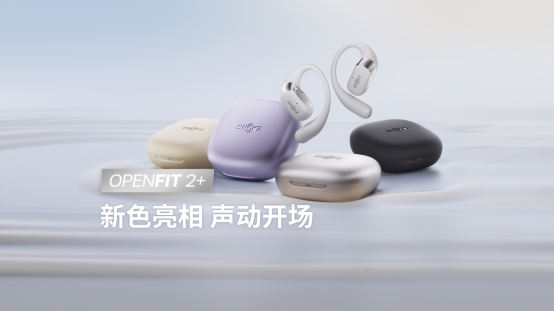
体验更进阶!OpenFit 2+声动登场,韶音多款产品配色上新
Zhong Guo Chan Ye Jing Ji Xin Xi Wang· 2025-08-20 11:19
Core Insights - Shokz has launched its flagship product OpenFit2+, along with new color variants for existing products, enhancing its open-ear headphone lineup and offering personalized audio solutions for users [1][12] Product Launch and Features - The OpenFit2+ emphasizes user comfort, which is a primary demand in the wireless headphone market, and builds on the success of the previous model, OpenFit2, which topped sales in the ear-hook market in H1 2025 [2][12] - OpenFit2+ introduces Dolby audio, wireless charging, and new color options, enhancing sound detail and user convenience [2][5] - The ergonomic design of OpenFit2+ adapts to different ear shapes, ensuring comfort during prolonged use, and features advanced materials for a soft touch [4][5] Sound Quality and Technology - OpenFit2+ incorporates Dolby audio for an immersive listening experience and utilizes Shokz DualBoost technology to enhance soundstage and clarity [5][6] - The product addresses common issues in open-ear headphones, such as sound leakage, with new sound isolation technology [5][6] Battery Life and Usability - OpenFit2+ boasts a remarkable battery life of 48 hours, with 11 hours of continuous playback and quick charging capabilities [6] - The product includes physical buttons for precise control and an app for customizable touch features, enhancing user experience [6][12] Market Positioning and Trends - Shokz recognizes the trend of consumers seeking headphones that reflect personal style, leading to the introduction of diverse color options [7][12] - The company has successfully established a comprehensive product range across four headphone types, positioning itself as a leader in the open-ear headphone market [12]
开放式耳机成消费新风口,韶音凭全场景创新领跑赛道
Zhong Guo Chan Ye Jing Ji Xin Xi Wang· 2025-08-20 10:41
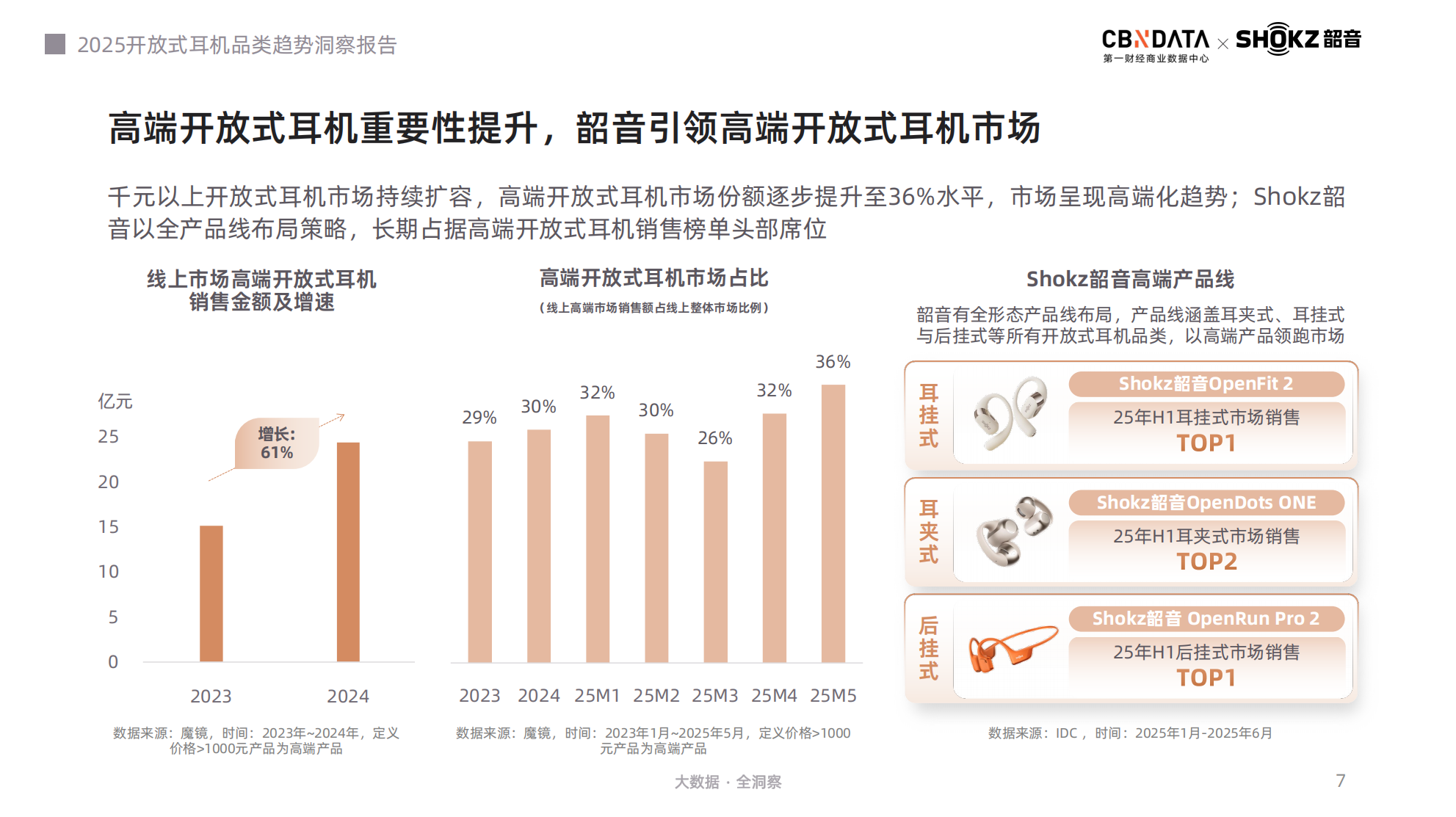
Core Insights - The report indicates that open-ear headphones have entered a growth phase, with shipments expected to reach 24.92 million units in 2024, representing a year-on-year increase of 212.0% [1] - The demand for comfort and multi-scenario adaptability has made open-ear headphones a mainstream necessity rather than a niche choice [2] Market Position - The company has established a dominant position in the open-ear headphone market, achieving the highest sales in China for 2024 and ranking first globally in sports headphone sales for the second consecutive year [2] - The high-end open-ear headphone market is expanding, with the market share for products priced above 1,000 yuan increasing to 50%, indicating a clear trend towards premiumization [5] Product Strategy - The company has effectively captured user needs for multi-scenario usage, with users switching between an average of 2.8 scenarios daily, which is significantly higher than other headphone types [6] - The product lineup includes specialized models for various activities, such as OpenRun Pro2 for high-intensity sports and OpenSwim Pro for underwater listening, demonstrating a comprehensive approach to user needs [9] Technological Innovation - The company holds 1,408 patents, establishing a strong technological moat in the open listening space, with innovations in sound quality and comfort being key drivers of its market leadership [10][13] - Recent advancements include the DirectPitch directional sound technology and the Shokz DualBoost technology, which enhance audio performance and user experience [10] Future Outlook - The company aims to continue its focus on acoustic technology, wearing comfort, and sports technology, with plans to further refine its offerings based on user needs and experiences [17]
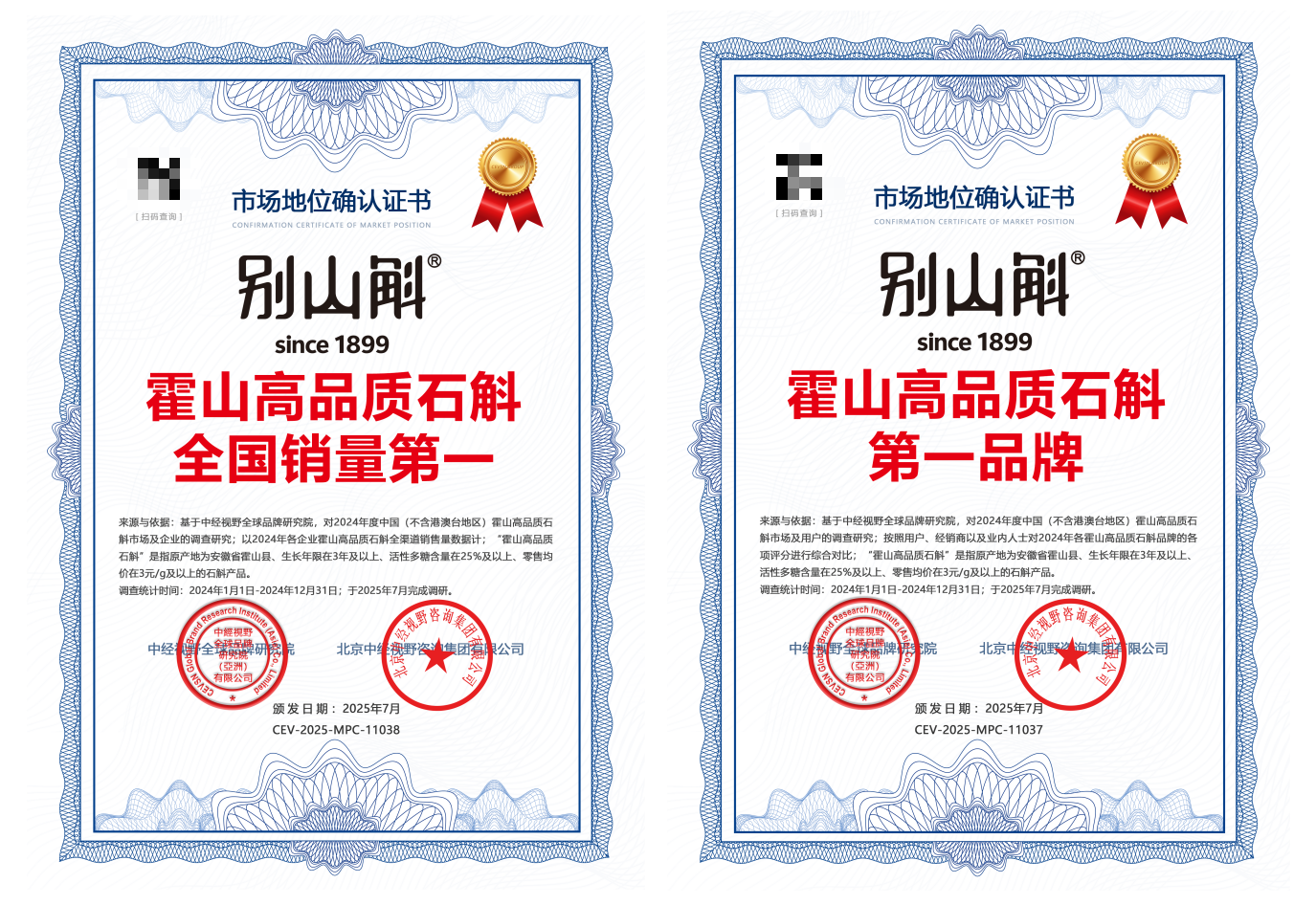
别山斛荣获中视野全球品牌研究院双认证,助力霍山高品质石斛蓬勃发展
Zhong Guo Chan Ye Jing Ji Xin Xi Wang· 2025-08-20 08:24
Core Insights - Bieshan Dendrobium has been awarded two authoritative certifications as the "National Sales Champion of High-Quality Dendrobium" and "First Brand of High-Quality Dendrobium" by the China Economic Vision Global Brand Research Institute, highlighting its leading position in the industry and boosting the market for high-quality Dendrobium from Hushan [1][3][13] Company Overview - Bieshan Dendrobium is rooted in the Dabie Mountain region, known as the "Hometown of Dendrobium" in Anhui, where the unique climate and soil conditions contribute to the high quality of its products [7] - The company has a rich history dating back to 1886, when He Qingcai began using local medicinal herbs, leading to the establishment of "Dabie Mountain Chinese Medicine Hall" in 1899, which laid the foundation for Bieshan Dendrobium's brand [4] Product Quality and Production Techniques - Bieshan Dendrobium emphasizes traditional craftsmanship, utilizing 18 non-heritage processes to ensure the quality of its products, with a significant focus on the meticulous production of Dendrobium [8] - The company maintains a commitment to high-quality standards, with a production ratio of 10:1 for fresh Dendrobium to finished product, showcasing its dedication to quality [8] Market Position and Strategy - The demand for high-quality health supplements is increasing, and Bieshan Dendrobium has positioned itself as a leader in the Hushan high-quality Dendrobium market, leveraging its brand reputation and product quality [3][10] - The company employs a "company + base + cooperative + farmer" model, creating a community of shared interests that addresses the challenges faced by farmers and contributes to local economic development [10] Brand Development and Marketing - Bieshan Dendrobium focuses on brand building as a core strategy, integrating traditional craftsmanship with modern technology to enhance product value and consumer trust [12] - The company utilizes innovative online platforms to expand its sales channels, combining e-commerce with physical retail to enhance market reach [12]

茉酸奶以不含植脂末的坚守,筑牢健康饮品品质防线
Zhong Guo Chan Ye Jing Ji Xin Xi Wang· 2025-08-20 08:04
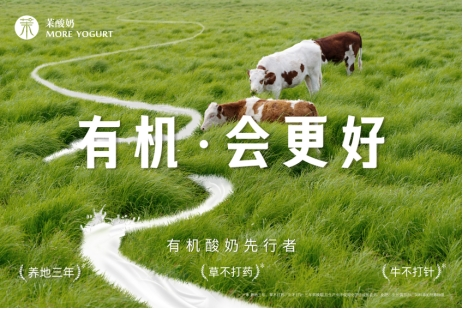
Core Viewpoint - The company, Mo Yogurt, has established a strong brand identity in the competitive tea beverage market by adhering to the principle of "no vegetable fat powder," emphasizing health as a core value since its inception [1][3]. Group 1: Brand Commitment to Quality - Mo Yogurt's commitment to "no vegetable fat powder" is reflected in its comprehensive quality control throughout the supply chain [3]. - The brand sources milk from certified organic farms located in unpolluted, ecologically balanced environments, ensuring the purity and nutrition of every drop of milk [3]. - An efficient cold chain logistics system is in place to maintain the freshness and vitality of the yogurt, allowing consumers to enjoy the authentic flavor of the product [3]. Group 2: Production Practices - The production process strictly avoids the use of vegetable fat powder and hydrogenation, thereby preventing the formation of artificial trans fats [3]. - This rigorous approach not only meets consumer demands for health but also conveys the message that "true quality does not rely on additives" [3]. - The brand views health as a fundamental principle rather than a temporary marketing slogan, ensuring that every product can withstand ingredient scrutiny [3]. Group 3: Market Influence - Mo Yogurt's commitment to health has not only redefined its own brand value but has also positively influenced the fresh yogurt industry [3]. - By continuously offering diverse and high-quality yogurt options, Mo Yogurt is guiding market perceptions towards "healthy beverages," making "no vegetable fat powder" a quality consensus within the industry [3]. - Consumer recognition serves as the best feedback for the brand's steadfast commitment to health [3]. Group 4: Future Strategy - Moving forward, Mo Yogurt plans to deepen its organic strategy, focusing on health in product development and market promotion [4]. - The brand will prioritize consumer health needs in both raw material selection and process optimization, continuing to provide trustworthy beverage options to the market [4].
问界M8夏测完美通关 赛力斯智能安全树立行业技术标杆
Zhong Guo Chan Ye Jing Ji Xin Xi Wang· 2025-08-20 06:45
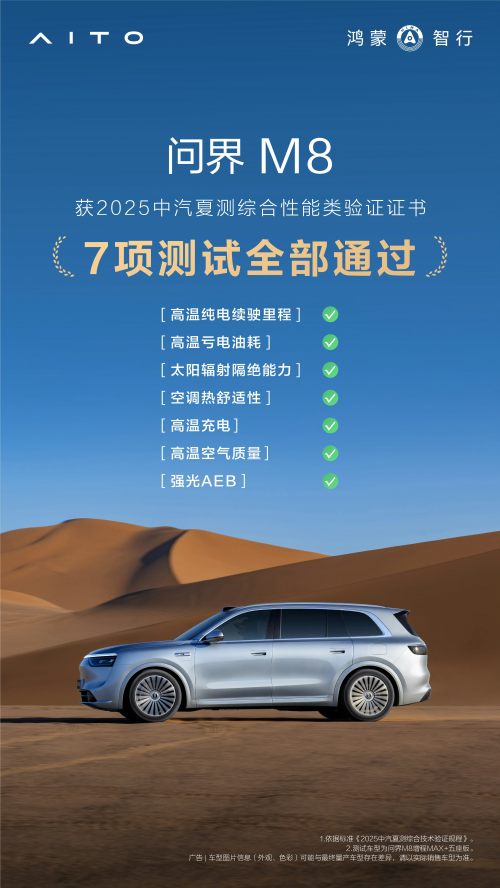
Core Viewpoint - The AITO M8 has demonstrated exceptional performance by passing seven tests under extreme temperatures exceeding 60°C in Turpan, showcasing the confidence of the company in its product and intelligent safety capabilities [1][4]. Group 1: Product Performance - The AITO M8 successfully completed the 2025 China Automotive Summer Test, highlighting its robust performance in extreme conditions [1]. - The vehicle's cabin maintained low levels of harmful substances, with formaldehyde at 0.017 mg/m³ and TVOC at 0.042 mg/m³, while achieving a UV isolation rate of 99.9% [4]. Group 2: Intelligent Safety System - The company has developed an intelligent safety system based on four key areas: "Life Protection," "Body Protection," "Health Care," and "Privacy Protection" [3]. - The AITO M8 features a 720° safety protection framework and the world's largest integrated die-cast magnesium alloy rear body, along with a five-layer battery defense system and a 24/7 cloud safety service [6]. Group 3: User Engagement and Future Outlook - The launch of the "2025 User Co-Creation Summer Test Journey" invites car owners to experience the product firsthand, reinforcing the company's commitment to user engagement [1]. - The company aims to continuously upgrade its intelligent safety features, setting a new benchmark for safety in the electric vehicle industry [6].

青海农产品质检体系实现涉农区域全覆盖
Zhong Guo Chan Ye Jing Ji Xin Xi Wang· 2025-08-20 06:28
Group 1 - The core viewpoint of the articles highlights the comprehensive efforts made by the provincial agricultural and rural department to enhance the quality and safety of agricultural products through a three-year action plan focused on building county-level testing institutions [1][2] - Since 2022, the province has supported the construction or expansion of laboratories in 8 municipal and 18 county-level institutions, resulting in the establishment of 48 quality inspection institutions across the province [1] - The total area of laboratories has reached 15,700 square meters, with a total equipment value of 106 million yuan, covering eight categories of highland specialty products [1] Group 2 - A dual certification mechanism (CMA and CATL) has been established to enhance testing capabilities, with 18 new institutions achieving this certification, leading to a ninefold increase in the total number of certified institutions [2] - The detection capabilities have significantly improved, covering six major risk factors, and the detection rate of high-risk agricultural products has increased by 25 percentage points [2] - A tiered training system has been implemented to address the weak technical capacity at the grassroots level, resulting in the selection of 43 technical backbones and a 70% improvement in detection parameters for supported institutions [2]

福建推动新型信息基础设施高质量发展 到2027年5G个人用户普及率突破80%
Zhong Guo Chan Ye Jing Ji Xin Xi Wang· 2025-08-20 06:28
Core Viewpoint - The Fujian Provincial Communication Administration has issued the "Action Plan for Promoting High-Quality Development of New Information Infrastructure in the Information and Communication Industry (2025-2027)", outlining a blueprint for the development of new information infrastructure in the province over the next three years [1] Group 1: Overall Goals - By 2027, Fujian aims to promote the widespread adoption of "dual-gigabit" networks, enhance network coverage in rural and remote areas, and expand the scale of communication network terminal connections [1] - The plan emphasizes the steady growth of computing power, the active evolution of 5G, and innovation in 10G optical networks, while significantly improving the resilience and modernization of the information and communication industry chain [1] Group 2: Key Tasks - **Network Infrastructure Upgrade**: Enhance 5G network supply capacity to achieve 43 5G base stations per 10,000 people, with a personal user penetration rate exceeding 80% and 5G traffic accounting for over 75%. The goal is to establish over 35,000 5G-A base stations and achieve 80% of ports being 10G PON or above, with 45% of users being gigabit users [2] - **Computing Network Coordination**: Develop a comprehensive computing power supply system, targeting a total computing power scale of 9 EFlops across provincial data centers, with 100% disaster recovery coverage for core and important data in key industries [2] - **Integrated Infrastructure Deployment**: Promote deep interconnection between 5G, edge computing, and industrial control systems, advancing the integration of the industrial internet into the entire lifecycle of manufacturing [2] - **Innovation in the Communication Industry**: Increase innovation in communication technology, business models, and management systems, accelerating the large-scale application of 5G [2] - **Application Empowerment**: Focus on four key scenarios: digital transformation of social governance, upgrading life service experiences, smart ocean initiatives, and low-altitude economy, aiming for dual breakthroughs in governance efficiency and service experience [2]
内蒙古2025年度第二批重点事项清单发布
Zhong Guo Chan Ye Jing Ji Xin Xi Wang· 2025-08-20 06:28
国务院部署的"高效办成一件事"2025年度第二批重点事项清单涵盖了经营主体和个人的9个重点事项。 其中,属于经营主体办事有4项,包括员工录用、企业融资服务(以制造业企业为例)、对外承包工程 一般项目备案、建设项目联合验收的"一件事";属于个人办事有5项,包括登记失业人员就业帮扶、境 外旅客购物离境退税、进出境邮件通关、公安交管服务和社会救助的"一件事"。自治区还创新推出5 个"高效办成一件事"2025年度第二批重点事项,分别为草原植被恢复费征缴、森林植被恢复费征缴、水 资源税智能预填、工伤待遇申领和大学生参保缴费。 据了解,自2024年以来,自治区已分4批推出54项"一件事"服务,目前已有40项建设完成,累计办理 1261万件。2025年第二批14项"一件事"正在加快推进建设。(记者?杨柳) 8月16日,记者从内蒙古自治区政务服务与数据管理局获悉:自治区全力推进国务院"高效办成一件 事"2025年度第二批9个重点事项实施工作,同时创新推出5个自治区"高效办成一件事"重点事项。 ...
踏准脑机接口政策 喜临门AI睡眠弯道超车
Zhong Guo Chan Ye Jing Ji Xin Xi Wang· 2025-08-20 05:39
Group 1 - The Ministry of Industry and Information Technology and six other departments have jointly issued implementation opinions to promote the innovation and development of the brain-computer interface (BCI) industry, aiming for breakthroughs in key technologies by 2027 and establishing an advanced technical, industrial, and standard system [1] - The introduction of this policy is seen as a significant milestone, officially recognizing BCI as an independent strategic emerging industry, which will accelerate the practical application and promotion of BCI technology in core areas such as medical rehabilitation and intelligent interaction [1][4] - The BCI technology in China is developing along two parallel paths: invasive (requiring surgical implantation) and non-invasive (collecting signals from the scalp), with sleep health emerging as a key application area for non-invasive technology [1] Group 2 - A strategic partnership has been formed between sleep technology company Xilinmen and non-invasive BCI technology firm Qiangnao Technology to explore multi-space sleep solutions based on BCI technology, creating an intelligent sleep ecosystem centered around "AI companionship" [1][2] - The world's first AI mattress incorporating BCI technology, "Baobao·BrainCo," has been launched, which monitors and analyzes users' brainwave signals in real-time to provide personalized sleep optimization solutions, marking a significant innovation in technology application [2] Group 3 - Despite the industry excitement, BCI development faces significant challenges, including the need for improved accuracy and reliability in brain signal decoding and the integration of multi-modal information from the brain, body, and environment [3] - The global BCI market is projected to reach $400 billion, but actual revenue for the industry may not exceed $1.5 billion by 2035, indicating that the BCI industry is still in its early development stage and far from commercial maturity [3] - The core competition in the BCI field lies not in market speculation but in the continuous technical challenges in laboratories and the ability to translate technology into affordable, safe, and user-centric products [4]
