Feng Huang Wang

Search documents
美科技巨头扩大海外AI算力:谷歌微软在欧洲投资超1000亿
Feng Huang Wang· 2025-11-12 00:02
Core Insights - Google and Microsoft are set to invest over $16 billion (approximately 113.9 billion RMB) in AI infrastructure in Europe, marking a significant commitment from U.S. tech giants to enhance overseas AI capabilities [1][2] Group 1: Microsoft Investment - Microsoft plans to invest over $10 billion to build a data center hub in Sintra, Portugal, starting early next year [1] - The project will involve collaboration with NVIDIA, Nscale Global Holdings, and Start Campus, deploying around 12,600 NVIDIA GB300 GPUs [1] - This investment is noted as Microsoft's largest in Portugal and one of the biggest in Europe's AI computing sector [1] Group 2: Google Investment - Google intends to invest €5.5 billion (approximately $6.36 billion) in Germany by 2029 to expand its AI infrastructure and office spaces [1] - The investment will include a new data center in Ditzingen, enhancements to existing facilities in Hanau, and office expansions in Berlin, Frankfurt, and Munich [1] Group 3: Industry Context - These investments reflect U.S. companies' efforts to meet the growing demand for AI services and expand their operations abroad [2] - Since the launch of ChatGPT by OpenAI in late 2022, there has been a surge in AI investments in Europe, with tech giants committing billions to strengthen data centers, cloud services, and AI infrastructure [2] - Recent collaborations include NVIDIA and Deutsche Telekom's €1 billion partnership to establish one of Europe's largest AI factories in Germany, and Amazon's announcement of over €1.4 billion investment in the Netherlands over the next three years [2]


美股指数涨跌不一,道指创历史新高,市场押注美国政府停摆将结束
Feng Huang Wang· 2025-11-11 22:40
Market Overview - The U.S. stock market showed mixed results with the Dow Jones reaching a historical high, driven by expectations of an end to the government shutdown [1] - The Senate passed a budget bill to end the government shutdown, which is now under consideration by the House of Representatives [1] - Concerns over high valuations in AI stocks led to a decline in companies like Nvidia, which saw a sell-off after SoftBank liquidated its Nvidia shares for $5.8 billion [1][2] Employment and Economic Data - Recent ADP data indicated a loss of an average of 11,250 jobs per week in the U.S. private sector over the last four weeks, contributing to negative market sentiment [2] Stock Performance - The Dow Jones increased by 559.33 points (1.18%) to close at 47,927.96, while the Nasdaq fell by 58.87 points (0.25%) to 23,468.30 [3] - The S&P 500 rose by 14.18 points (0.21%) to 6,846.61, with healthcare and energy sectors performing well, while the technology sector declined by 0.72% [3] Notable Company Movements - Nvidia's stock dropped by 2.96%, reflecting broader concerns in the AI sector [4] - CoreWeave, an Nvidia-invested cloud computing company, lowered its revenue guidance for the year, further pressuring AI stocks [2][4] - AMD's CEO stated that the AI data center market is expected to exceed $1 trillion by 2030, with significant growth anticipated in their data center business [6] - Google announced a $6.4 billion investment in Germany for data center construction, marking a significant commitment to European infrastructure [7] - Microsoft plans to invest $10 billion in Portugal for AI infrastructure, collaborating with Nvidia and other partners [8]


“双十一”全网控价,为什么应该被叫停?
Feng Huang Wang· 2025-11-11 14:31
Core Viewpoint - The article discusses the implications of price constraints imposed by e-commerce platforms on their merchants, particularly in the context of the upcoming "Double Eleven" shopping festival, emphasizing the need for legal compliance and fair treatment of all parties involved in the platform ecosystem [2][8]. Group 1: Price Constraints and Legal Implications - E-commerce platforms, such as JD.com, have reportedly enforced price constraints on brands, requiring them to maintain the lowest prices on their platform compared to other sales channels [2][3]. - This practice has sparked controversy and raises legal questions regarding its classification as "two-choice" behavior, which restricts merchants' ability to sell on other platforms [3][4]. - Platforms with market dominance face severe penalties under China's Anti-Monopoly Law for such practices, with past cases resulting in fines exceeding 18 billion [3][4]. Group 2: Economic and Competitive Concerns - Price constraints can lead to reduced competition and potentially harm consumer welfare by creating a scenario where prices are universally high rather than competitive [7][8]. - The article argues that even platforms without market dominance must adhere to the Electronic Commerce Law, which prohibits unreasonable restrictions on merchants, regardless of the platform's size [7][8]. Group 3: Fair Treatment and Sustainable Development - The article emphasizes the importance of respecting the interests of all parties in the platform ecosystem, including platforms, merchants, and consumers, to ensure sustainable development [1][8]. - The upcoming "Double Eleven" event should not compromise legal and ethical standards, as compliance is essential for maximizing social welfare and maintaining a healthy competitive environment [8].

软银回应为何清仓英伟达
Feng Huang Wang· 2025-11-11 14:28
Group 1 - SoftBank disclosed in its latest financial report that it has "liquidated its position in NVIDIA," generating $5.83 billion in funds [1] - The company also reduced its stake in T-Mobile, raising $9.17 billion [1] - SoftBank's last liquidation of NVIDIA shares occurred in 2019, where it invested $4 billion and made a net profit of $3 billion; however, if the shares had been held until now, the value would exceed $240 billion [1] Group 2 - SoftBank's CFO, Yoshimasa Goto, stated that the large investment in OpenAI necessitated the sale of shares to raise funds for further investment [1] - Following a financing agreement, SoftBank plans to invest an additional $22.5 billion in OpenAI upon its restructuring completion in December [1] - From April to September this year, SoftBank recorded investment gains of 3.92 trillion yen, with 2.15 trillion yen (approximately 99.2 billion yuan) attributed to the increase in OpenAI's valuation [1] Group 3 - Goto mentioned that it is currently impossible to determine whether AI investments are "bubble-like," emphasizing the importance of maintaining financial stability while seizing investment opportunities [1] - When asked if the decision to liquidate NVIDIA shares was based on valuation judgments, Goto refrained from commenting, stating that asset allocation adjustments are an inherent part of investment companies' operations [1]

华为公布2024年“技术账单”:研发投入1797亿,专利许可收入6.3亿美元
Feng Huang Wang· 2025-11-11 14:15
Core Insights - Huawei disclosed its latest data in technology openness and intellectual property for 2024, highlighting a strong output in patent contributions and commercial returns [1][2] Group 1: Patent Contributions - Huawei's patent disclosure volume reached over 37,000 in 2024, with more than 10,000 proposals contributed to domestic and international standard organizations [1] - The company published over 1,000 academic papers in the same year [1] Group 2: Commercial Returns - Huawei achieved approximately $630 million in patent licensing revenue in 2024 [1] - Over 2.7 billion 5G devices globally have received patent licenses from Huawei, along with over 1.2 billion consumer electronic devices in the Wi-Fi sector, and more than 3.2 billion devices in the multimedia field [1] Group 3: R&D Investment - Huawei's cumulative R&D investment over the past decade has reached 1.249 trillion RMB, with R&D expenses for 2024 amounting to 179.7 billion RMB, representing 20.8% of total revenue [1] - The company maintains a leading position in the industry regarding R&D investment intensity [1] Group 4: Patent Holdings and Rankings - Huawei holds over 150,000 valid authorized patents globally [2] - According to the World Intellectual Property Organization (WIPO), Huawei ranked first in the 2024 PCT international patent application with 6,600 applications, followed by Samsung, Qualcomm, LG, and CATL [2]
Meta据称再现人事震荡,首席AI科学家杨立昆计划离职
Feng Huang Wang· 2025-11-11 13:42
Core Insights - Meta's Chief AI Scientist Yann LeCun plans to leave the company to start his own venture, impacting Meta's stock price which fell over 1% in pre-market trading [1] - LeCun's departure coincides with CEO Mark Zuckerberg's strategic shift in AI, moving focus from long-term research to faster deployment of AI models and products [1][2] - LeCun, a Turing Award winner, has led Meta's Fundamental AI Research lab (FAIR) since 2013 and is known for his foundational contributions to modern AI [1] Company Developments - Zuckerberg has established a new elite group called "TBD Lab" to focus on next-generation large language models, attracting top talent from competitors with salaries up to $100 million [2] - LeCun's reporting structure changed to report to Alexandr Wang, CEO of Scale AI, instead of directly to Chief Product Officer Chris Cox [2] - Meta's recent AI model, Llama 4, underperformed compared to competitors, leading to a strategic pivot in AI development [2] Financial Implications - Meta's significant investment in AI, including a $14.3 billion investment in Scale AI, has raised concerns among investors, especially with projected AI spending exceeding $100 billion next year [3] - Following the announcement of high AI expenditures, Meta's stock price has dropped nearly 15% [3] - The company has also faced internal dissatisfaction from existing employees due to high salaries offered to new AI talent [3]

重心转向OpenAI,软银清仓英伟达套现58亿美元:无法判断是否处于AI泡沫中
Feng Huang Wang· 2025-11-11 13:42
Group 1 - SoftBank Group has sold all of its shares in Nvidia, totaling 32.1 million shares for $5.8 billion, shifting focus towards OpenAI [1][2] - The company reported a profit of 2.5 trillion yen for the second quarter of the fiscal year 2025, exceeding market expectations [1] - SoftBank's Vision Fund recorded a quarterly profit of 2.38 trillion yen, primarily due to investments in OpenAI and PayPay [1] Group 2 - SoftBank's CEO Masayoshi Son is actively seeking profit opportunities in AI and embodied intelligence, reducing investments in other areas [2] - The company has significant stakes in Arm and OpenAI, and recently acquired ABB's robotics business for $5.375 billion [2] - Analysts suggest that the sale of Nvidia shares does not indicate a fundamental strategic shift, but rather a reallocation of funds towards AI-related investments [2]
旺季不旺:10月猪企“增量不增价”,高成本猪企亏损加剧
Feng Huang Wang· 2025-11-11 12:45
Core Insights - The pig farming industry is facing significant challenges as many companies are experiencing losses despite increased output during the traditional peak season for pig sales [1][2][3] - The average selling prices of pigs have dropped to their lowest levels of the year, leading to a situation where companies are selling pigs at a loss [3][5] - Companies with lower breeding costs are better positioned to withstand price declines, while those with higher costs are under severe financial pressure [5][6] Industry Performance - In October, major pig farming companies reported substantial increases in the number of pigs sold, with Muyuan Foods selling 7.076 million pigs (up 13.17% year-on-year) and Wens Foodstuffs selling 3.8928 million pigs (up 45.69% year-on-year) [2][3] - Despite the increase in sales volume, the average selling prices for major companies like Muyuan and Wens fell by approximately 32.73% and 34.41% year-on-year, respectively [3][4] Cost Dynamics - The cost of pig farming varies significantly among companies, with leading firms like Muyuan and Wens reporting costs below 12.5 yuan/kg, while others like Huazhong and Jinxinnong have costs exceeding 13.5 yuan/kg [5][6] - The industry is currently experiencing an overall loss, with average breeding costs maintained between 12.5 and 13 yuan/kg, and losses per pig reaching 161.69 yuan for self-breeding and 283.92 yuan for piglets [5][6] Future Outlook - The demand for pork is expected to increase as the southern regions begin their seasonal consumption, which may provide some support for prices in the coming months [4] - However, the overall price trend is expected to remain weak due to the cyclical nature of the pig market [4]


央行:拓展丰富中央银行宏观审慎与金融稳定功能 创新金融工具
Feng Huang Wang· 2025-11-11 09:23
Core Viewpoint - The People's Bank of China emphasizes the need for proactive and prudent measures to prevent and resolve financial risks in the upcoming phase, focusing on a comprehensive macro-prudential management system and mechanisms for systemic financial risk prevention and resolution [1] Group 1: Macro-Prudential Management - A comprehensive macro-prudential management system will be constructed to monitor, assess, and warn against systemic financial risks from macro, counter-cyclical, and contagion perspectives [1] - The toolbox for macro-prudential policies will be enriched, and the coverage of macro-prudential measures will be continuously expanded [1] Group 2: Financial Stability - The central bank will enhance its macro-prudential management functions and innovate financial tools to maintain stable financial market operations [1] - Systemically important financial institutions will undergo strengthened macro-prudential management, with a focus on advancing the additional regulatory framework [1] Group 3: Risk Management and Cooperation - The additional regulatory framework for systemically important banks will be further solidified, guiding selected banks to continuously improve their recovery and resolution plans [1] - A cross-border crisis management group mechanism for globally systemically important banks will be established to enhance cross-border regulatory cooperation and information sharing [1] Group 4: Non-Bank Financial Institutions - The coverage of additional regulation will be gradually expanded to the non-bank sector [1] - The reform of small and medium-sized financial institutions will be cautiously advanced under market-oriented and rule-of-law principles, with a focus on improving risk disposal responsibility mechanisms [1] Group 5: Risk Disposal Resources - Resources for risk disposal will be enriched, including the continued expansion of the deposit insurance fund and financial stability guarantee fund [1] - Exploration of establishing a backup financing mechanism will be undertaken [1]
构建算力基础设施,OpenAI挖来英特尔CTO,陈立武临时接管AI业务
Feng Huang Wang· 2025-11-11 07:26
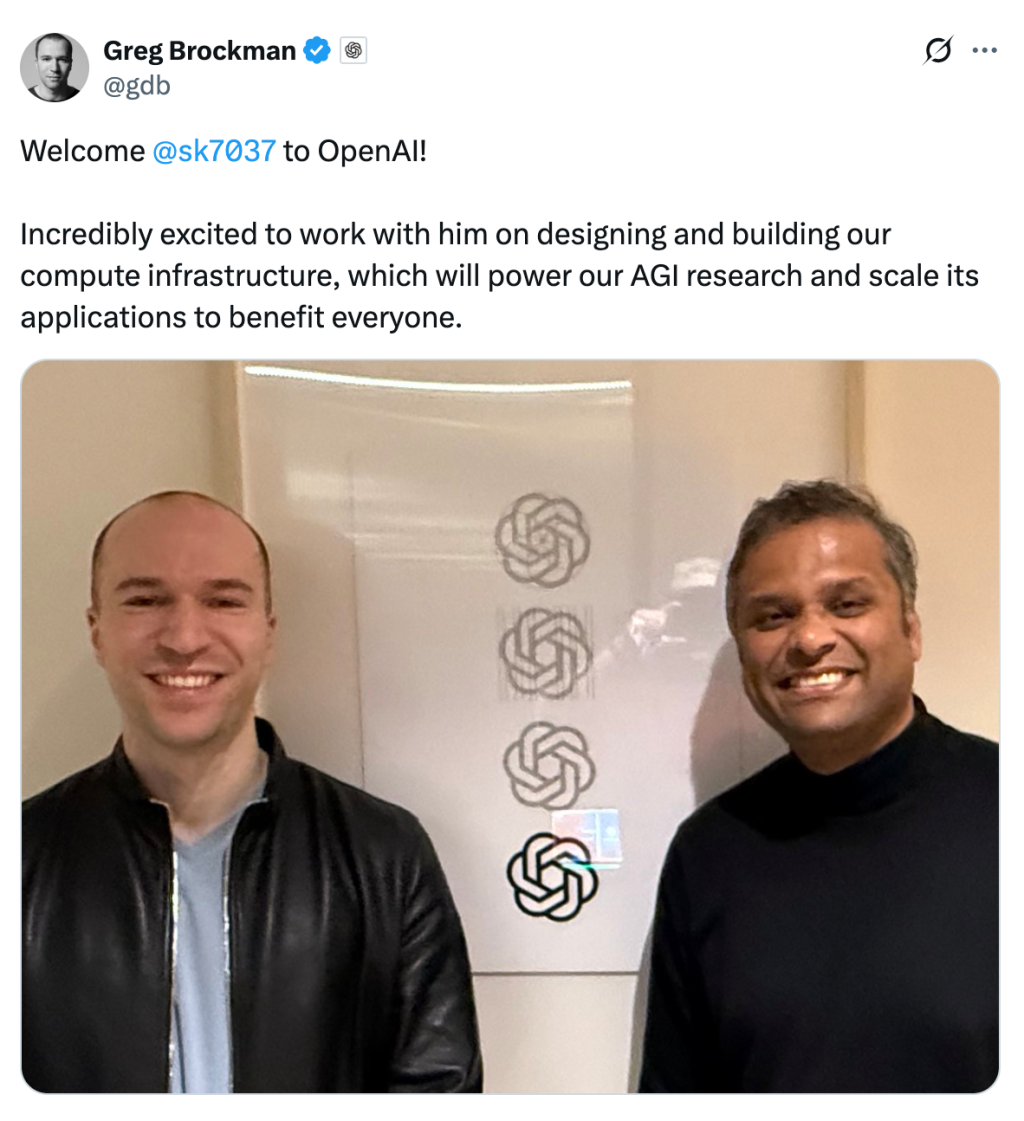
Core Insights - Intel's CTO Sachin Katti has officially joined OpenAI to design and build computational infrastructure for AGI research, aiming to scale its applications [1][3] - Katti previously led Intel's AI strategy and product roadmap, and has a strong academic and entrepreneurial background in wireless communication and AI technologies [3] - Intel's CEO Pat Gelsinger will temporarily take over the AI business, emphasizing that AI remains a top strategic priority for the company [4] Company Developments - OpenAI is actively expanding its infrastructure, having signed agreements worth over $1 trillion with major companies like Oracle, NVIDIA, AMD, Microsoft, and Amazon [4] - OpenAI's CEO Sam Altman stated that significant investment in infrastructure is a strategic gamble, with expectations of exponential growth in AI usage [4] - OpenAI is considering an IPO by 2027, with a potential valuation of around $1 trillion [4]