
Jin Rong Shi Bao

Search documents
从“冰碴水”到“幸福泉” 高原水房蜕变记
Jin Rong Shi Bao· 2026-01-12 01:44
Core Viewpoint - The successful completion of the water supply project in Dongcuo Village, Tibet, significantly improves the living conditions of the villagers by providing reliable access to clean drinking water, showcasing the effectiveness of targeted community support initiatives [1][4]. Group 1: Project Background - Dongcuo Village, located at an altitude of 4,700 meters, faced severe winter water supply challenges due to extreme cold temperatures causing pipes to freeze [1][2]. - The previous water supply relied on a 15-meter deep solar-powered well, which was inadequate during harsh winters, leading to health risks from contaminated water [2][3]. Group 2: Implementation Process - The project was initiated by the 14th batch of the village work team from the Bank of China, which conducted thorough community surveys to identify "water scarcity" as a primary concern [2][3]. - A total of 310,000 yuan was secured for the water supply project after multiple discussions with the Bank of China, addressing the urgent needs of the villagers [2][3]. Group 3: Technical Solutions - A tailored solution was developed, incorporating solar-assisted insulation, automatic multi-media deep filtration, and special anti-freeze pressure pipes to adapt to the harsh environmental conditions [3][4]. - The new system effectively removes impurities, ensuring that the water quality meets national drinking water standards, thus enhancing the overall health and safety of the villagers [3][4]. Group 4: Community Impact - The renovated water supply system now meets the needs of over 400 residents in 83 households, fostering a sense of community and encouraging villagers to engage in local governance [4][8]. - The project aligns with the "14th Five-Year Plan" which emphasizes improving rural infrastructure and public services, reflecting a broader commitment to enhancing living conditions in rural areas [4].


碳排放大户的绿色突围 山西省钢铁焦化行业低碳转型的金融实践
Jin Rong Shi Bao· 2026-01-12 01:20
Group 1 - The core viewpoint of the articles highlights the transformation of traditional high-carbon industries, particularly steel and coking, in Shanxi Province towards greener practices, supported by innovative financial products [1][2][3] - The Jin Ding Steel Group is implementing a project that converts by-products like coke oven gas into high-purity hydrogen and liquid ammonia, with an annual production capacity of 36 million cubic meters of hydrogen and 48,000 tons of ammonia, generating an estimated annual revenue of 110 million yuan from ammonia alone [1] - Shanxi Province faces significant emission reduction pressures, with projected transformation funding needs of 148.3 billion yuan for the steel industry and 120 billion yuan for the coking industry over the next decade [2] Group 2 - A specialized transformation financial system is deemed necessary to meet the funding demands of large enterprises undergoing transformation, as traditional financing models are insufficient [4] - The People's Bank of China and other local authorities have issued guidelines to support financial institutions in providing targeted loans for companies with clear transformation goals, enhancing the financial support framework [4] - The "Shanxi Steel and Coking Enterprise Transformation Financial Operation Manual" aims to guide enterprises in their transformation and assist financial institutions in identifying quality projects, thereby improving funding allocation efficiency [5] Group 3 - Market competition and regulatory pressures are driving companies to adopt low-carbon production lines, with financial incentives playing a crucial role in facilitating this transition [6] - Financial institutions are developing diverse products tailored to the long transformation cycles and substantial funding needs of steel and coking enterprises, such as sustainable development-linked loans that adjust interest rates based on energy consumption levels [6] - The case of Shanxi Yuwang Coal Gasification Co., which received tailored financial support for its transformation plan, exemplifies the effective implementation of transformation finance [7] Group 4 - Despite the progress, challenges remain in the implementation of transformation finance, including rapid technological changes and the need for improved risk assessment capabilities among financial institutions [8] - Experts suggest enhancing policy incentives and establishing technology-sharing platforms to lower costs for enterprises, while also emphasizing the importance of clear standards for identifying genuinely transformative companies [8] - Accurate carbon emission accounting and disclosure are essential for the effective use of transformation financial tools, with current practices needing improvement to ensure transparency and reliability [8] Group 5 - The essence of transformation finance is to provide the necessary financial support for the transition of traditional energy provinces towards low-carbon futures, with ongoing practices in Shanxi expected to reshape the industrial landscape and offer replicable pathways for high-carbon regions across China [9]

财政金融协同发力 为提振内需注入强劲动能
Jin Rong Shi Bao· 2026-01-12 01:10
Group 1 - The State Council, led by Premier Li Qiang, has initiated a package of policies to promote domestic demand through coordinated fiscal and financial measures, emphasizing the importance of these policies in driving effective demand and macroeconomic regulation [1] - The collaboration between fiscal and monetary policies is seen as essential for addressing the complexities of economic transformation and external shocks, with experts noting that traditional policy models are insufficient for the current economic landscape [1][2] - In 2025, the proactive fiscal policy is expected to accelerate government bond issuance, with net financing of government bonds reaching 11 trillion yuan in 2024 and anticipated increases in 2025, including 1.3 trillion yuan in special long-term bonds [2] Group 2 - The People's Bank of China (PBOC) has implemented a buyout reverse repurchase tool to support local government bond financing, which has positively impacted infrastructure investment growth in the first half of 2025 [3] - The collaboration between fiscal and monetary policies has led to effective communication and practice, enhancing the stability of market expectations and reducing government debt costs [3] - Policies aimed at boosting consumption and expanding domestic demand are being executed through coordinated efforts from both fiscal and monetary sides, with a focus on increasing the supply of high-quality services [4][5] Group 3 - The government is implementing measures to support private investment, including loan interest subsidies for small and micro enterprises and establishing risk-sharing mechanisms for private enterprise bonds [6] - The shift in credit allocation towards key sectors of the national economy is being guided by the PBOC, reflecting the ongoing economic transition away from reliance on real estate and infrastructure [6] - Structural monetary policy tools are being combined with fiscal subsidies to facilitate easier access to loans for quality enterprises, promoting credit market prosperity in targeted areas [6]

金融高水平开放稳步拓展
Jin Rong Shi Bao· 2026-01-12 01:10
Core Viewpoint - The People's Bank of China (PBOC) is advancing high-level financial openness and enhancing the interconnectivity of financial markets, with a focus on supporting foreign financial institutions and optimizing cross-border use of the Renminbi (RMB) [2][5][6]. Group 1: Financial Market Openness - The PBOC is implementing multiple measures to promote financial openness, including eight initiatives announced by Governor Pan Gongsheng, covering areas such as financial infrastructure and cross-border investment [2]. - By 2025, the PBOC aims to enhance the mechanisms of Bond Connect and Swap Connect, facilitating more foreign investors' participation in China's financial markets [3][4]. Group 2: Cross-Border Payment Systems - The launch of the cross-border payment system between the mainland and Hong Kong in June 2025 has significantly improved the efficiency of cross-border transactions, processing over 700,000 remittances by July 2025 [4]. - The PBOC has allowed foreign institutions to use bonds from Bond Connect as collateral for Swap Connect, extending the duration of interest rate swap contracts to 30 years [4]. Group 3: Renminbi Internationalization - The RMB has become the largest currency for cross-border payments in China and ranks among the top three global payment currencies, with a significant increase in cross-border RMB transactions [5][6]. - As of June 2025, the PBOC has signed bilateral currency swap agreements with 32 countries, with the total value of these agreements exceeding 4.5 trillion yuan [6]. Group 4: Cross-Border QR Code Payment - A unified gateway for cross-border QR code payments was launched in July 2025, facilitating over 1.98 million transactions worth 427 million yuan by September 2025 [7]. - This initiative is expected to accelerate the process of cross-border payment interconnectivity and enhance the use of RMB in international trade [7].

朱鹤新会见加拿大前总理克雷蒂安
Jin Rong Shi Bao· 2026-01-12 01:07
责任编辑:袁浩 本报讯 记者马玲报道 1月8日,中国人民银行副行长、国家外汇管理局局长朱鹤新会见了来访的加 拿大前总理克雷蒂安一行。双方就当前国际政治经济形势、推动中加金融合作等议题进行了交流。国家 外汇管理局副局长李红燕陪同会见。 ...
开年这个大集,谁更“开卷”?
Jin Rong Shi Bao· 2026-01-11 22:57
Core Insights - The 2026 Beijing Book Fair showcased a significant rise in cultural and creative products, with "Lu Xun" themed merchandise becoming a highlight, particularly the purple knitted vest that gained popularity at the 2025 Shanghai Book Fair [1][2] - The event attracted over 711 exhibitors and featured more than 400,000 book titles, with attendance exceeding 100,000, indicating a strong interest in literature and cultural products [1][4] Industry Trends - Publishers are increasingly focusing on creative products, with many offering unique items such as postcards and handmade prints inspired by cultural artifacts, which have proven to attract younger audiences [2][3] - The introduction of the "National Reading Promotion Regulations" set to take effect on February 1, 2026, is expected to enhance the reading culture in China, promoting a "book fragrance society" and encouraging publishers to boost confidence in the industry [4] Market Analysis - The 2025 book retail market in China reached a scale of 110.4 billion yuan, with segments like health, skills, and current affairs showing positive growth [5] - E-commerce channels have become dominant, with content e-commerce (including live streaming and short videos) accounting for 40.53% of the retail market, surpassing traditional platforms [5]
证监会最新公布!提供这类线索最高奖励100万元→
Jin Rong Shi Bao· 2026-01-10 04:08
Core Viewpoint - The China Securities Regulatory Commission (CSRC) has announced the "Whistleblower" reward regulations to enhance the reporting of securities and futures violations, reflecting a commitment to protect investors' rights and improve market integrity [1][2]. Group 1: Regulation Changes - The name of the regulation has been changed from "Interim Provisions on Reporting Violations in Securities and Futures" to "Whistleblower Reward Regulations for Securities and Futures Violations" to better reflect the spirit of justice and professional characteristics [2]. - The revised regulations include improved reward conditions, significantly increased reward standards, and enhanced protection mechanisms for whistleblowers [2][3]. Group 2: Reward Standards - The conditions for rewarding whistleblowers have been expanded, with the threshold for serious cases raised from 100,000 yuan to 1 million yuan [3]. - The reward percentage has increased from 1% to 3% of the penalties imposed, with the maximum reward for providing significant leads raised from 100,000 yuan to 500,000 yuan [3]. - For cases with nationwide significance or involving substantial amounts, the maximum reward has been unified and increased to 1 million yuan [3]. Group 3: Protection Mechanisms - The regulations emphasize strict confidentiality and protection of whistleblower identities, requiring registration for any contact that involves personal information [4][5]. - There are strict rules against retaliation, including violence, coercion, or any form of harassment against whistleblowers [6][7]. - Companies that retaliate against whistleblowers will face legal consequences, and there are mechanisms in place to hold accountable those who fail to act on the leads provided by whistleblowers [7].

特朗普:不惜以“艰难”方式得到格陵兰岛
Jin Rong Shi Bao· 2026-01-10 02:26
Core Viewpoint - The article discusses President Trump's insistence on acquiring Greenland, indicating a willingness to pursue both diplomatic and potentially aggressive means to achieve this goal [1] Group 1: U.S. Government Actions - President Trump expressed the need for Greenland and mentioned that if a simple agreement cannot be reached, he may resort to more difficult methods [1] - Trump has previously stated that he does not rule out the use of force to obtain Greenland [1] - The White House is reportedly discussing various options to acquire Greenland, including the possibility of purchase and military action [1] Group 2: International Reactions - The U.S. statements regarding Greenland have sparked strong opposition and concern from Denmark and other European nations [1] - Danish diplomats and representatives from Greenland met with White House officials to address U.S. claims [1] - U.S. Secretary of State Rubio plans to meet with Danish officials to discuss the U.S. demands regarding Greenland [1] Group 3: Geographic and Political Context - Greenland is the world's largest island and is an autonomous territory of Denmark, with defense and foreign affairs managed by the Danish government [1] - The U.S. currently operates a military base in Greenland [1] - Danish Prime Minister Frederiksen stated that the U.S. has no right to annex Greenland [1]
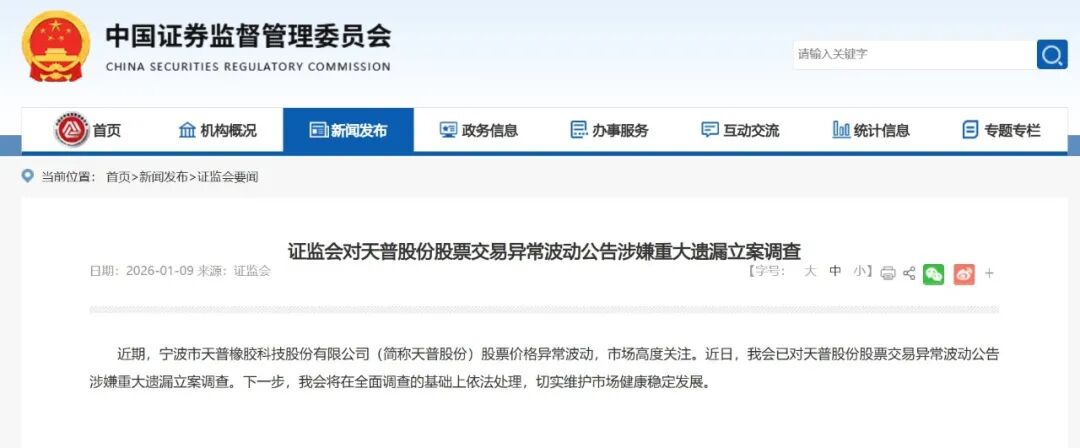
一年涨16倍,这只股票被证监会立案→
Jin Rong Shi Bao· 2026-01-09 14:55
Group 1 - The China Securities Regulatory Commission (CSRC) has initiated an investigation into Ningbo Tianpu Rubber Technology Co., Ltd. (Tianpu Co., 605255) for significant omissions in its announcement regarding abnormal stock trading fluctuations [1] - Tianpu Co.'s stock price has experienced abnormal fluctuations, attracting significant market attention [1] - The Shanghai Stock Exchange has also started a regulatory process regarding the related matters and will handle them according to laws and regulations [1] Group 2 - Tianpu Co. has been suspended from trading since December 31, 2025, marking its fifth trading suspension for verification in nearly four months [1] - The company's stock price surged from 12.59 yuan per share at the beginning of the year to 218.02 yuan per share by the end of the year, resulting in a cumulative increase of 1631.7% [1]

国务院会议重磅部署!
Jin Rong Shi Bao· 2026-01-09 13:22
Core Viewpoint - The State Council of China is implementing a package of policies to promote domestic demand through coordinated fiscal and financial measures, emphasizing the importance of collaboration between fiscal and monetary policies to stimulate effective demand and support economic transformation [1][2]. Group 1: Policy Coordination - The collaboration between fiscal and monetary policies is seen as essential for achieving greater governance effectiveness, with the goal of creating a synergistic effect that exceeds the sum of individual efforts [2]. - In 2025, the issuance of government bonds demonstrated accelerated coordination between fiscal and monetary policies, with the central bank's flexible operations ensuring smooth bond issuance and reduced government debt costs [2][3]. - The central bank's reverse repurchase operations have been crucial in maintaining liquidity, supporting local government bond financing, and stabilizing market expectations [2][3]. Group 2: Stimulating Domestic Demand - Policies are being implemented to activate consumer spending and expand domestic demand, with a focus on enhancing the supply of high-quality services as consumer income levels rise [4][5]. - The People's Bank of China has introduced measures to encourage banks to increase credit for high-quality consumption, while the Ministry of Finance has supported consumer subsidies through long-term special bonds [4]. - A series of targeted subsidy policies have been established to directly benefit consumers and business entities, enhancing their purchasing power and stimulating consumption [4][5]. Group 3: Structural Adjustment and Transformation - The coordinated efforts of fiscal and monetary policies are aimed at guiding economic transformation, particularly by supporting private investment and reducing financing costs for small and medium-sized enterprises [6]. - The focus is on directing funds towards key areas of the national economy, with an emphasis on transitioning away from reliance on real estate and infrastructure towards new productive forces [6]. - Structural monetary policy tools are being utilized to provide low-cost funding, which, when combined with fiscal subsidies, can facilitate better loan pricing for quality enterprises and encourage banks to lend more [6].