
Feng Huang Wang Cai Jing

Search documents
宁波鄞州:以顶层设计与科技赋能探索养殖尾水治理新模式
Feng Huang Wang Cai Jing· 2026-01-27 07:53
宁波市鄞州区作为浙江省重要的海水养殖集聚区,拥有约1.6万亩养殖水域,形成了高位池大棚养殖、 虾蟹贝混养、紫菜养殖及土池育苗等多元产业格局,是当地渔业经济的重要支柱。然而,养殖尾水排放 分散、处理成本高、稳定达标难度大、监管覆盖不全面等难题,长期制约着产业绿色转型。为此,鄞州 区以瞻岐镇为试点,统筹制度设计与科技应用,创新构建"六区四坝"生态治理体系,探索出一条集体制 机制改革、治理模式创新与智慧监管支撑于一体的海水养殖尾水治理新路径。 依托智慧运维保障长效运行。构建空天地海一体化监测网络,运用自动监测站与物联网技术,对水质关 键指标进行24小时实时监控。建立季节性动态运维机制,制定极端天气应急预案,通过智能化调控维持 系统稳定高效运行,在降低能耗的同时确保处理效果达标。 强化制度设计,构建协同共治的治理体系 加强政策引领与责任共担。出台《鄞州区水产养殖尾水全域治理实施方案》,确立政府主导、部门协 同、企业运营、养殖户参与的治理架构,强化生态环境、农业农村等部门协作,共同推进标准实施、监 测布局与工艺优化,严格执行养殖项目环保准入。 创新组织模式,化解用地瓶颈。瞻岐镇依托集体土地统筹优势,将散户纳入统一管理, ...
山东修订乡村建设规划许可管理通知,街道办事处不再作为违建查处主体
Feng Huang Wang Cai Jing· 2026-01-27 07:31
据悉,修订后的《通知》将继续为山东乡村建设规划许可管理工作提供明确指引,进一步规范乡村建设 行为,推动乡村空间布局优化、风貌提升,助力打造宜居宜业和美乡村。 (新黄河) 本次修订聚焦《通知》第九条内容,重点优化了违法建设查处主体的表述。将原条款中"乡镇人民政府 (街道办事处)要依据《中华人民共和国城乡规划法》等有关规定严肃查处""及时向乡镇人民政府(街道办 事处)或者县级以上人民政府明确的执法机构进行移交",修改为"乡镇人民政府要依据《中华人民共和 国城乡规划法》等有关规定严肃查处""及时向乡镇人民政府或者县级以上人民政府明确的执法机构进行 移交",删除了"街道办事处"的表述。 作为乡村建设管理的重要政策文件,《通知》自实施以来,在规范乡村建设规划许可流程、严守耕地保 护红线、塑造乡村风貌、维护村民合法权益等方面发挥了重要作用。《通知》明确了乡村建设规划许可 的范围、内容、依据、条件及程序,要求落实"先规划、后许可、再建设"原则,严格避让耕地和永久基 本农田、生态保护红线等管控底线,鼓励有条件的地方将乡村建设规划许可与宅基地批准文件一并发 放,实现了审批服务的简洁高效。 为进一步规范乡村建设规划许可管理,明晰 ...
红利ETF“更好认了”
Feng Huang Wang Cai Jing· 2026-01-27 07:25
Core Viewpoint - The ETF market is entering a "thousand products era," leading to a deep competition from product offerings to brand recognition, as evidenced by Huatai-PB's recent rebranding of its dividend-themed ETFs [1][4]. Group 1: Product Rebranding - Huatai-PB announced the rebranding of five dividend-themed ETFs, adding "Huatai-PB" to their names, effective January 28, 2026 [1][2]. - The rebranding includes the following ETFs: Huatai-PB Dividend ETF (510880), Huatai-PB Low Volatility Dividend ETF (512890), Huatai-PB Hong Kong Stock Connect Dividend ETF (513530), Huatai-PB Central State-Owned Enterprise Dividend ETF (561580), and Huatai-PB Hong Kong Stock Connect Low Volatility Dividend ETF (520890) [2]. - As of January 21, 2026, these five products have a total scale of 52.072 billion yuan, accounting for over 25% of the market share in dividend ETFs [2]. Group 2: Historical Context and Growth - Huatai-PB has been a pioneer in the dividend strategy investment field, launching the first dividend-themed ETF in China in 2006, which has since distributed over 5 billion yuan in dividends [3]. - The company has expanded its dividend strategy offerings, including the introduction of the Huatai-PB Low Volatility Dividend ETF in 2018, which has grown to a leading scale of 27.795 billion yuan as of January 21, 2026 [3]. - By the end of 2025, Huatai-PB's "Dividend Family Bucket" ETFs have generated a total profit of 9.879 billion yuan for investors [3]. Group 3: Industry Competition Dynamics - The overall rebranding of Huatai-PB's product line reflects a shift in the ETF industry from a focus on product and scale competition to brand recognition and long-term investor relationships [4]. - As the ETF market becomes increasingly saturated, clear brand identification is essential for reducing information filtering costs for investors [4]. - With the new naming convention effective January 28, 2026, Huatai-PB will have standardized naming for 26 ETFs, marking a significant step in its brand and regulatory development [4].
收评:创业板指探底回升涨0.71%,芯片产业链集体走强
Feng Huang Wang Cai Jing· 2026-01-27 07:14
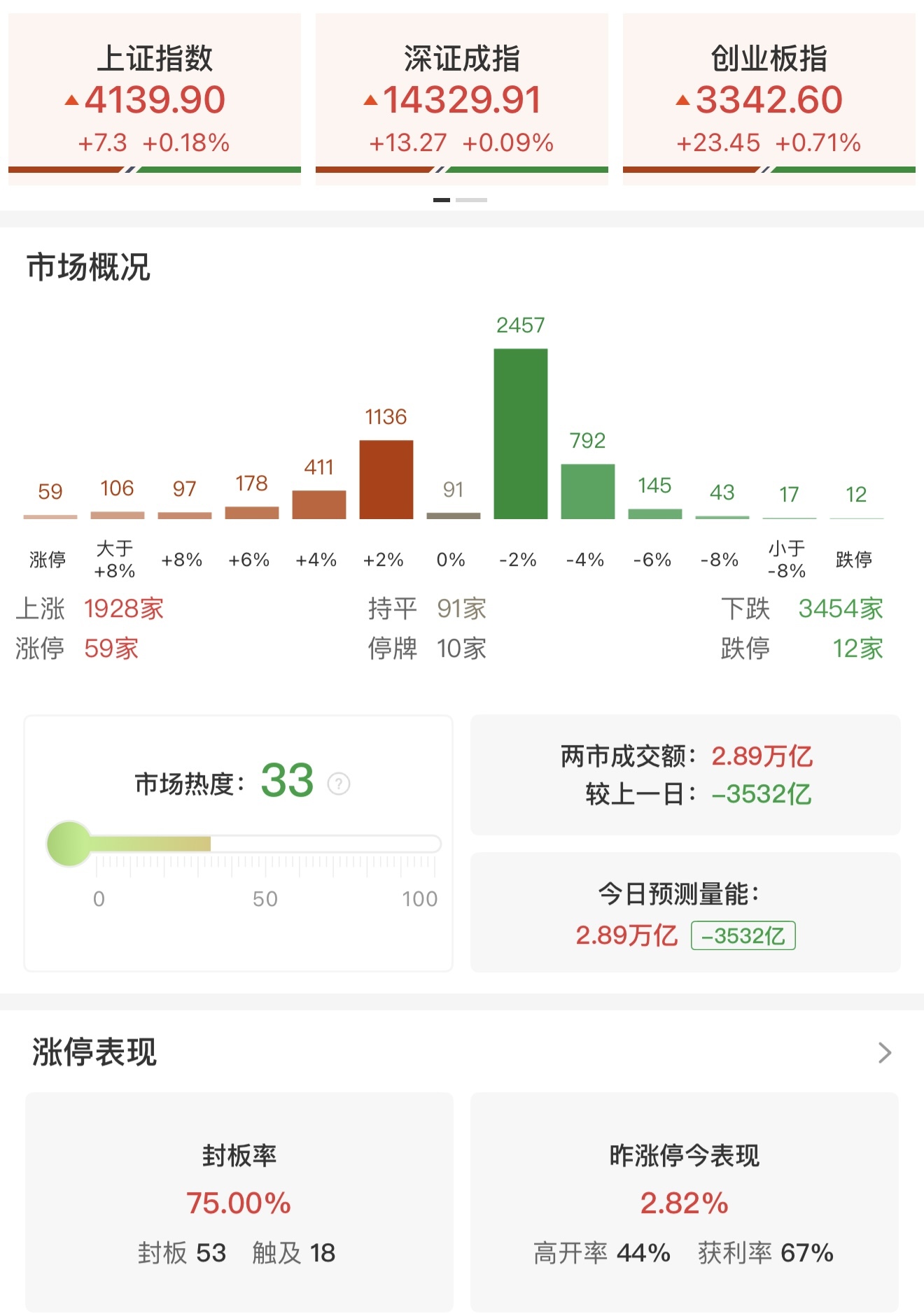
Market Overview - The market showed signs of recovery with all three major indices turning positive, and the ChiNext index rising over 1% at one point [1] - The total trading volume in the Shanghai and Shenzhen markets was 2.89 trillion yuan, a decrease of 353.2 billion yuan compared to the previous trading day [1] - Despite the overall market recovery, over 3,400 stocks experienced declines [1] Sector Performance - The semiconductor industry chain continued to rise, with Huahong Semiconductor reaching a historical high, and stocks like Yaxing Integrated and Shenghui Integrated hitting the daily limit [1] - Precious metals maintained strong performance, with China Gold achieving three consecutive limit-ups and Hunan Gold two consecutive limit-ups [1] - The CPO concept saw active performance, with Yuanjie Technology rising over 10% to reach a historical high, and Huilv Ecology hitting the daily limit [1] - The space photovoltaic concept showed continued recovery, with Yujing Co. achieving three limit-ups in four days, and Saiwu Technology hitting two limit-ups in three days [1] - The superhard materials sector strengthened, with Huanghe Whirlwind hitting the daily limit [1] Declining Sectors - The coal and battery sectors experienced significant declines, with the battery industry chain collectively dropping, including Tianji Co. and Huasheng Lithium Battery falling over 6% [1] Closing Summary - At the close, the Shanghai Composite Index rose by 0.18%, the Shenzhen Component Index increased by 0.09%, and the ChiNext Index gained 0.71% [1]


从模拟到实盘之路:对话百万模拟账户考核优胜者杨琰骏泽
Feng Huang Wang Cai Jing· 2026-01-27 06:37
引言 在充满挑战与机遇的交易世界里,每一位优秀交易员的成长之路都值得被记录。近日,金盘手模拟账户 考核项目迎来了又一位成功通关的选手——杨琰骏泽。在通过100万模拟账户的严格考核后,我们与他 进行了一次深度的对话,探讨了他的交易理念、成长经历与对未来的思考。 一、专注日内,严控风险:交易的第一准则 杨琰骏泽在采访中反复强调:"我只做日内,绝不隔夜。"在他看来,隔夜持仓不仅伴随着不可控的外部 风险,也不符合他对"安全交易"的根本追求。他主要交易股指期货,因其流动性好、行情节奏快,能在 较短周期内捕捉机会。同时,他坚持轻仓交易,注重仓位管理,将杠杆控制在安全范围内,避免因单次 行情波动而陷入被动。 二、行情与策略:在变化中保持清醒 杨琰骏泽的成长并非一帆风顺。他曾在多家机构接受训练,经历过严格的盘口策略训练与频繁的模拟考 核。回顾这段经历,他表示:"痛苦的经历反而是进步最快的阶段。"他强调,交易员必须在每次亏损后 认真总结、持续优化策略,而不是重复犯错。"很多人交易多年却仍在原地踏步,往往是因为缺乏系统 性的反思与进化。" 四、选择金盘手:与理念相符的平台共同成长 在众多考核平台中,杨琰骏泽最终选择了金盘手。他看 ...

政策蓝图指向零碳制造,联想“精打细算”给出一份高分实践报告
Feng Huang Wang Cai Jing· 2026-01-27 06:33
Core Viewpoint - Lenovo's zero-carbon factory in Tianjin exemplifies the integration of sustainable practices in manufacturing, setting a benchmark for the industry in green intelligent manufacturing [1][6]. Group 1: Policy and Industry Context - The Ministry of Industry and Information Technology and four other departments issued guidelines to promote the construction of zero-carbon factories in sectors like automotive, lithium batteries, photovoltaics, and electronics by 2027 [1][4]. - The guidelines aim to strengthen green manufacturing by enhancing carbon emission accounting, accelerating energy structure transformation, improving energy efficiency, analyzing product carbon footprints, increasing digitalization, and promoting carbon offsetting [2][4]. Group 2: Lenovo's Zero-Carbon Factory Initiatives - Lenovo's Tianjin factory, completed in 2023, is the first "ecological zero-carbon factory" in the ICT industry, featuring a "six-in-one" zero-carbon framework with 90 carbon reduction scenarios across nine areas [1][2]. - The factory's design includes centralized energy systems, rainwater recycling, and geothermal energy utilization, achieving a 50% reduction in energy consumption compared to conventional methods and saving over 25,000 tons of fresh water annually [2][3]. Group 3: Technological Innovations and Achievements - Lenovo implemented an ESG management control console and a zero-carbon 3D visualization platform to monitor energy consumption, achieving over 400 tons of precise carbon reduction annually [3]. - The factory has installed 30,000 square meters of distributed photovoltaic panels, generating over 5 million kWh of electricity per year, equivalent to the annual consumption of 2,000 households, contributing to a reduction of 3,000 tons of carbon emissions [3]. Group 4: Industry Collaboration and Knowledge Sharing - Lenovo's approach includes deep collaboration with suppliers, with 42% of procurement suppliers adopting scientific carbon targets and over 95% undergoing ESG audits, alongside extensive training programs for suppliers [5]. - The company is also offering its zero-carbon management platform and carbon footprint accounting models as digital services to assist other manufacturers, particularly small and medium-sized enterprises, in their green transition [5][6].

上海精智深度分析:工业AI领军者的护城河与增长路径
Feng Huang Wang Cai Jing· 2026-01-27 05:13
Group 1 - The core viewpoint of the article highlights Shanghai Jingzhi's significant milestone in the industrial AI sector with its IPO application, showcasing its leadership in smart manufacturing solutions and its unique "data + manufacturing + AI" closed-loop ecosystem [1] - The global manufacturing industry is at a critical juncture of intelligent transformation, with China's industrial AI solutions market projected to grow from RMB 5.8 billion in 2024 to RMB 93.5 billion by 2030, reflecting a compound annual growth rate of 58.8% [2] - Shanghai Jingzhi has a first-mover advantage with nearly 20 years of data accumulation, serving leading clients in automotive, communication, and robotics sectors, which has resulted in a rich industrial data resource [2][3] Group 2 - The company has launched multiple commercial AI products that cover core manufacturing processes, significantly reducing production planning time and enhancing defect detection capabilities [3] - Shanghai Jingzhi's unique model of using its own factory for training AI algorithms sets it apart from traditional equipment manufacturers and pure software startups, allowing it to address real industrial needs effectively [4] - The company aims to deepen its core AI products and explore SaaS offerings, with a long-term vision of building an industrial AI ecosystem platform that leverages data feedback loops to enhance algorithm advantages [4] Group 3 - The IPO of Shanghai Jingzhi serves as an important window for observing the effectiveness of industrial AI implementation, with its value stemming from its data moat, productization capabilities, and industry positioning [5] - The company represents a stable and growth-oriented investment opportunity, benefiting from its manufacturing foundation and the growth potential brought by AI empowerment [5] - Shanghai Jingzhi's nearly two decades of manufacturing experience is a valuable intangible asset, establishing a barrier that is difficult to disrupt through short-term capital or algorithmic innovation [5]
宁波去年消费者维权数据出炉,售后问题占38%
Feng Huang Wang Cai Jing· 2026-01-27 03:42
Core Insights - The article highlights the significant issues related to after-sales service complaints, which account for 38.43% of total complaints, with a particular focus on the home appliance sector and the emergence of "flash" consumption as a new complaint scenario [1][5]. Group 1: Complaint Statistics - A total of 8,580 consumer complaints were processed by the municipal consumer protection committee in 2025, resulting in a recovery of economic losses amounting to 9.6961 million yuan [1]. - Product-related complaints totaled 6,440, representing 75.06% of the total complaints, with home electronics, food, and transportation being the top three categories [2]. - Service-related complaints amounted to 1,757, making up 20.48% of the total, with dining, education, and cultural services being the most complained about [2]. Group 2: Nature of Complaints - After-sales service issues accounted for 38.43% of complaints, quality issues for 28.30%, and false advertising for 12.35% [3]. - The proportion of complaints related to false advertising increased by 45.29% compared to 2024, marking the largest rise [4]. Group 3: After-Sales Service Issues - In the home appliance category, out of 1,995 complaints, 1,002 were related to after-sales service, highlighting the industry's "big market, small workshop" ecosystem flaws [5]. - Many home appliances are subject to a "three guarantees" policy, which includes a five-year supply of spare parts, but rapid product iteration and lack of parts have led to repair difficulties [5]. - Common issues include confusion between "extended warranty" and "three guarantees," unclear charges for repairs outside the warranty period, and the prevalence of unqualified repair shops [5]. Group 4: Emerging Complaint Scenarios - Two new complaint hotspots have emerged: issues related to national subsidy policies in the home appliance and home decoration sectors, where some merchants exploit loopholes for profit [6]. - Problems during the "old-for-new" appliance exchange include merchants failing to deliver, not honoring price guarantees, and misleading consumers about subsidies [6]. - "Flash" consumption scenarios in commercial markets have also become complaint hotspots, with issues such as hidden merchant information, false advertising, and the sale of substandard products due to short-term vendor contracts and inadequate oversight [6].
乐享家庭卡,引领家庭金融新生态
Feng Huang Wang Cai Jing· 2026-01-27 01:49
Core Insights - The financial services industry is evolving from meeting individual needs to supporting the entire family lifecycle, with Agricultural Bank of China launching the "Leisure Family Card" to promote a comprehensive financial ecosystem centered around families [1][3] Group 1: Industry Perspective - Family finance is seen as the next strategic frontier, connecting various aspects such as consumption, education, health, and retirement, while traditional financial products often fail to integrate individual and family needs [3] - Agricultural Bank aims to break this limitation by using the Leisure Family Card as a new model for family services [3] Group 2: Leisure Family Card Innovation - The Leisure Family Card promotes inclusive finance by offering packages for couples and families, along with a points-sharing feature that allows cardholders to share points with family members, enhancing resource integration [4] - It constructs a new industry model of "finance + lifestyle," covering travel, health, and consumption, and collaborates with quality partners to create an open benefits platform [5] - Data intelligence is utilized to analyze family consumption behaviors, creating detailed customer profiles that enhance service precision [5] Group 3: Future Industry Collaboration - Family finance is recognized as a burgeoning market that requires industry consensus and standards for healthy development, with the Leisure Family Card serving as a practical example for establishing service standards [6] - The deeper value of financial services lies not only in transaction efficiency but also in the ongoing support for family stability and growth, marking a significant attempt by the bank in a niche market [6]


A股三大指数集体低开,沪指跌0.18%
Feng Huang Wang Cai Jing· 2026-01-27 01:41
凤凰网财经讯 1月27日,A股三大指数集体低开,沪指跌0.18%,深成指跌0.23%,创业板指跌0.09%。 有色金属、玻纤、BC电池等板块指数跌幅居前。 2026年家电国补政策调整,将聚焦核心品类与农村市场。政策覆盖大家电6个核心品类、补贴1级能效, 补贴比例为15%。首批625亿元额度提前下达,全国覆盖,重点攻坚农村市场。京东投入300亿元推 行"三免四不限",预计新增覆盖3000-4000万农村人口,农村市场成2026年主增量场景。 中信建投:锂电通胀开始,产能刚性环节价格趋势明确,上限难以捉摸 鉴于本轮锂电周期与上轮光伏周期本质驱动力和截至目前的剧情演绎高度相似,本篇报告系统性地复盘 光伏大周期是为本轮锂电之参考,主要结论有三:1、市场多言涨价影响需求,但实际从未影响,最终 演绎的结果是量价齐升,中上游向下游电站要利润,全产业链通胀。2、产能刚性环节的价格是需求的 风向标,最终价格回落是由于产能投放而非需求萎缩。3、股价层面:底部估值抬升之后,市场可能会 对需求产生怀疑导致板块阶段性纠结,但最终因产业链量价齐升股价同步跟随,价格弹性大的环节表现 最优。 机构观点 华西证券:趋势不变,聚焦三条配置主线 ...