港股互联网

Search documents
策略周报:3月第3周全球外资周观察:长线外资回流港股互联网-20260320
Guoxin Securities· 2026-03-20 13:40
Group 1 - The core conclusion indicates that northbound capital may experience a slight net outflow recently, with flexible foreign capital likely seeing a small net outflow [1] - In the Hong Kong stock market, stable foreign capital inflow amounted to 8.3 billion HKD, while flexible foreign capital outflow reached 32.1 billion HKD, with a total inflow through the Stock Connect of 19.1 billion HKD [2] - In the A-share market, the estimated net outflow of northbound capital was 8 billion CNY during the recent week, compared to a net outflow of 2 billion CNY in the previous week [10] Group 2 - In the Asia-Pacific market, there was a net outflow of foreign capital from the Japanese stock market, amounting to 472.9 billion JPY, while the Indian stock market saw an inflow of 2.5 billion USD [15][17] - In the US and European markets, global mutual fund inflows into the US equity market totaled 32.2 billion USD in January, while inflows into European equity markets were 3.67 billion USD, 3.59 billion USD, and 4.27 billion USD for the UK, Germany, and France respectively [20][21] Group 3 - The report highlights that various sectors in the Hong Kong market saw significant foreign capital inflows, particularly in transportation, electrical equipment, and non-ferrous metals, while the Stock Connect saw inflows in banking, oil and petrochemicals, and automotive sectors [12] - The report also notes the performance of the ChiNext and SME boards, with the ChiNext showing a monthly increase of 2.32% while the SME board decreased by 2.06% [4]
兴业中证港股通互联网 ETF(520790):AI 主题多点开花,港股互联网迎配置良机
Changjiang Securities· 2026-02-27 05:10
1. Report Industry Investment Rating No information provided in the document. 2. Core Viewpoints of the Report - In the context of the expected Fed rate cuts, the Hong Kong stock market may attract more capital inflows and become active again due to its relatively moderate valuation [6][16][18]. - The media industry continues its recovery trend, with improved profitability in 2025. Mobile internet traffic is growing steadily, and the usage time of online videos is increasing [7][24][35]. - The computer industry's revenue showed a weak recovery in 2025, with profit growth mainly driven by cost - reduction. However, the overall effective demand is insufficient, and the infrastructure is a bottleneck for the full implementation of AI applications [48][53][60]. - The CSI Hong Kong Stock Connect Internet Index has investment value, with its components having a combination of leading and balanced attributes, high elasticity, growth, and profitability. The index has a relatively low valuation recently [8][92][96][110][114]. - The Industrial Securities CSI Hong Kong Stock Connect Internet ETF (520790) closely tracks the underlying index, aiming to minimize tracking deviation and tracking error [3][9][116]. 3. Summary by Relevant Catalogs 3.1 Fed Rate Cut Expectations and Hong Kong Stocks - As of February 14, 2026, the market expects the Fed to gradually lower the target rate in FOMC meetings starting from June, based on the 30 - day federal funds futures pricing data [16][17]. - With the expected increase in global liquidity due to potential Fed rate cuts, the Hong Kong stock market, with its moderate valuation, may attract more global investors and see more capital inflows, promoting market activity [6][18]. 3.2 Media Industry - In the first three quarters of 2025, the media industry's revenue increased year - on - year. The Yangtze River Media Internet sector achieved a revenue of 404.8 billion yuan, a 5.72% year - on - year increase. In Q3 2025, the revenue was 139 billion yuan, an 8.81% year - on - year increase and a 2.91% quarter - on - quarter increase [24]. - The industry's profitability improved. In the first three quarters of 2025, the Yangtze River Media Internet sector's net profit attributable to the parent company was 32.6 billion yuan, a 43.87% year - on - year increase. In Q3 2025, it was 10.5 billion yuan, a 53.79% year - on - year increase [27]. - In the first three quarters of 2025, the media industry's gross profit margin and net profit margin attributable to the parent company increased year - on - year, while the expense ratio was generally stable, with a slight increase in the sales expense ratio [30][32]. 3.3 Internet Sector - Mobile internet traffic is growing steadily, and the usage time of online videos is increasing. In August 2025, the number of mobile internet users reached 1.267 billion, and in April 2025, the monthly per - capita usage time was 171 hours. In June 2025, the usage time of online videos increased by 22.1% year - on - year [35]. - Affected by macro - factors, advertising investment became more cautious, which impacted the internet sector's revenue. In Q3 2025, the internet sector's revenue was 9.1 billion yuan, a 0.8% year - on - year decline, and the net profit attributable to the parent company was 660 million yuan, a 15.3% year - on - year decline [42]. - In Q3 2025, the internet sector's gross profit margin increased year - on - year, and the sales expense ratio increased slightly [45]. 3.4 Computer Industry - After three years of suppressed demand, the computer industry's revenue showed a weak recovery in 2025. From Q1 to Q3 2025, the total revenue was 482.3 billion yuan, a 5.1% year - on - year increase. As of Q3 2025, the contract liability reached 95.57 billion yuan, a 9.6% year - on - year increase [48]. - The apparent profit growth was mainly driven by cost - control. From Q1 to Q3 2025, the net profit attributable to the parent company was 12.41 billion yuan, a 184.0% year - on - year increase. The gross profit margin was stable, and the three - fee ratio decreased [53]. - The sector's valuation is at a relatively high level. As of December 15, 2025, the Yangtze River Computer's latest PE - TTM (non - negative) was 65.31 times, at the 86th percentile since 2016 [58]. - There are structural effects in the sub - industries, and the overall effective demand is insufficient. AI demand shows growth in revenue, with hardware profits performing better than software. G - end demand has some changes in individual targets, and B - end demand in most sub - sectors is recovering, but the profit inflection point is not clear [60]. 3.5 CSI Hong Kong Stock Connect Internet Index - The index selects 30 listed company securities related to internet business from the Hong Kong Stock Connect scope to reflect the overall performance of internet - themed listed company securities in the Hong Kong Stock Connect. It is calculated based on the adjusted market value of the corresponding component stocks according to the index compilation rules [3][8][83]. - As of February 13, 2026, the index's component stocks are mainly concentrated in five industries: media, commerce and retail, social services, computer, and electronics, with a total weight of 86.26%. The media industry has a relatively high proportion, with a weight of 30.85% [8][87]. - The component stocks have a combination of leading and balanced attributes. There are 7 component stocks with a market value of over HK$150 billion, accounting for about 65.75% of the weight, and 20 component stocks with a market value of less than HK$60 billion, accounting for about 22.89% of the weight [92]. - The index has high elasticity, growth, and profitability. The top ten component stocks have a total market value of about HK$1,017.7793 billion, accounting for about 77.36% of the weight. The weighted average expected net profit growth rate in the next two years is 72.21% [96]. - The component stocks have a high repurchase amount, indicating strong corporate confidence. From January 1, 2021, to June 30, 2025, more than half of the component stocks had non - zero repurchase amounts, and 3 of them had repurchase amounts exceeding HK$10 billion [103]. - The index has excellent long - term performance and a relatively low recent valuation. Compared with the Hang Seng Composite Index and the Hang Seng Index in the past seven years, it has greater elasticity in some market conditions and certain excess returns. As of February 13, 2026, the PE (TTM) value is 23.45, lower than 82.46% of the time points since the index was released [110][114]. 3.6 Industrial Securities CSI Hong Kong Stock Connect Internet ETF - The Industrial Securities CSI Hong Kong Stock Connect Internet ETF (520790) closely tracks the underlying index, aiming to minimize tracking deviation and tracking error [3][9][116]. - The fund is a stock - type, passive index - type fund, with the CSI Hong Kong Stock Connect Internet Index (adjusted by valuation exchange rate) as the performance benchmark. The subscription period is from March 2, 2026, to March 13, 2026 [119]. - The management fee rate is 0.45%, the custody fee rate is 0.10%, and the subscription fee rate for the front - end (ordinary investment group) is 0.30% for an amount less than HK$1 million and HK$1,000 per transaction for an amount of HK$1 million or more [120].
千亿资金 流入
Shang Hai Zheng Quan Bao· 2026-02-25 14:48
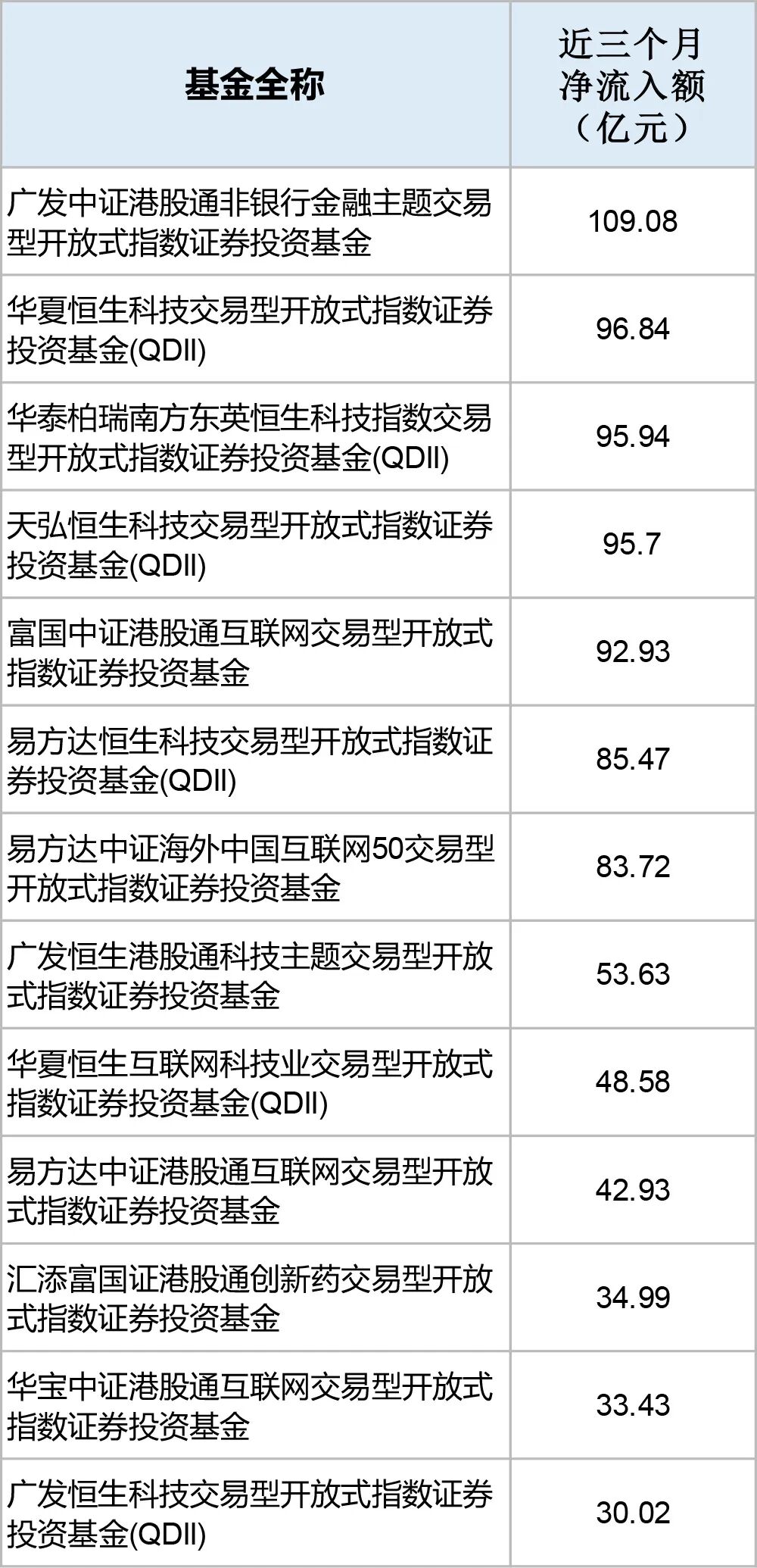
Group 1 - Significant capital inflow into Hong Kong thematic ETFs, with nearly 10 billion yuan net inflow on February 24, focusing on technology ETFs [1][2] - Over the past three months, net inflow into Hong Kong thematic ETFs exceeded 100 billion yuan [1] - Multiple Hong Kong technology thematic ETFs reached historical highs in terms of shares, with notable inflows into various funds [2] Group 2 - Specific funds with substantial net inflows over the past three months include: - GF CSI Hong Kong Stock Connect Non-Bank Financial Theme ETF: 10.91 billion yuan - Huaxia Hang Seng Technology ETF: 9.68 billion yuan - Haitong Southbound Hang Seng Technology ETF: 9.59 billion yuan - Tianhong Hang Seng Technology ETF: 9.57 billion yuan - Fortune CSI Hong Kong Stock Connect Internet ETF: 9.29 billion yuan [3][4] - New products focused on Hong Kong thematic ETFs are being launched, primarily targeting the technology sector [5] - Analysts suggest that the current valuation of the Hang Seng Technology Index is at a historically low level, indicating potential for recovery [5][6]

今天A股三大指数集体上涨!分析人士称市场依然存在三大变数→
Sou Hu Cai Jing· 2026-01-27 08:39
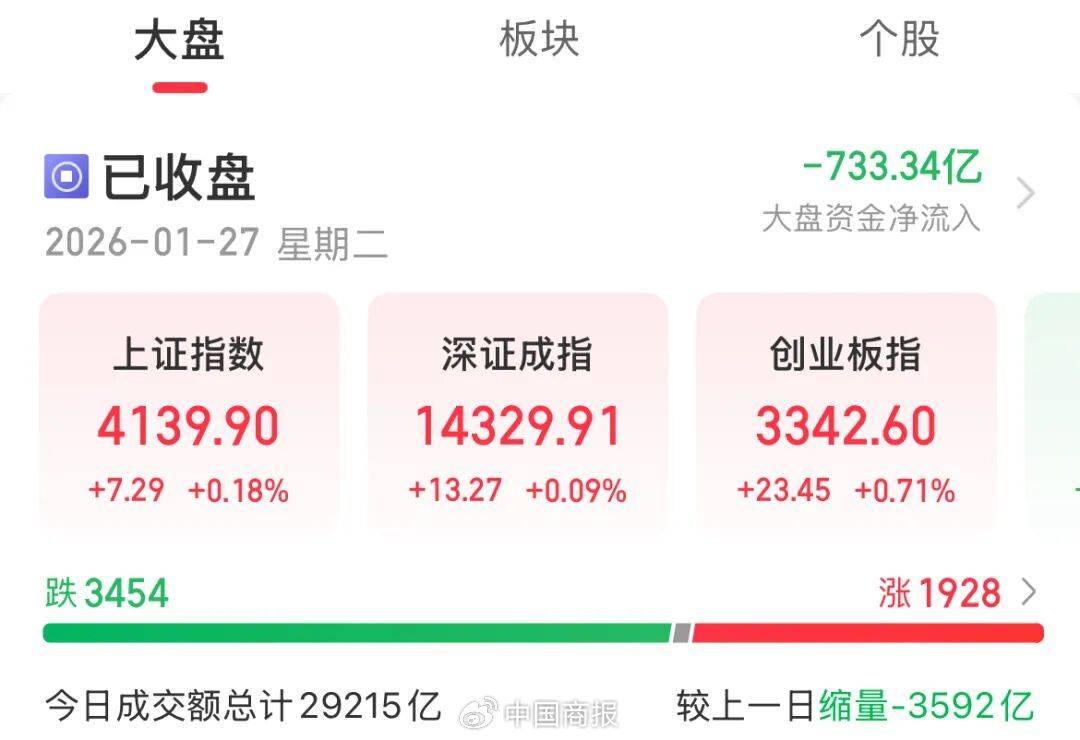
Market Overview - The A-share market saw all three major indices rise, with the Shanghai Composite Index up 0.18%, the Shenzhen Component Index up 0.09%, and the ChiNext Index up 0.71% [1] - The total trading volume in the Shanghai and Shenzhen markets was 29,215 billion yuan, a decrease of 3,592 billion yuan from the previous day, with over 1,900 stocks in the three markets showing gains [1] Employment Support Measures - The Ministry of Human Resources and Social Security announced the implementation of measures to stabilize and expand employment, focusing on key industries and addressing the impact of artificial intelligence on job opportunities [3] - Initiatives include support for key groups in employment, issuance of employment documents for college graduates, and the establishment of a regular mechanism to prevent poverty through employment assistance [3] Market Trends and Analysis - Analysts noted a rapid change in market style, with funds rotating between technology, cyclical, and dividend sectors, as well as between large and small-cap stocks [4] - Three major uncertainties were identified: the impact of deleveraging on bullish sentiment, the adjustment of large-cap stocks affecting market profitability, and the potential for "performance bombs" as earnings reports are released [4] - Huaxi Securities suggested that the current market is in the mid-stage of a "slow bull" trend, recommending focus on sectors such as AI, chemicals, and high-growth industries like electronics and pharmaceuticals [4] Precious Metals Performance - The precious metals sector continued its strong performance, with notable gains in stocks such as Xiaocheng Technology, Hunan Gold, and Sichuan Gold, which saw significant price increases [4] - Spot gold rebounded to $5,086.77 per ounce, marking a 1.5% increase and maintaining a positive trend for seven consecutive trading days, driven by heightened global risk demand and a weakening dollar [5] Semiconductor Industry Growth - The semiconductor industry showed active performance, particularly in the semiconductor and memory chip sectors [6] - Companies in the memory chip sector reported significant profit growth forecasts for 2025, with expected increases in net profits ranging from 81.77% to 167.31% [6] - Global memory prices are expected to rise due to tight supply conditions and increasing AI demand, benefiting the domestic memory supply chain [6] Cultivated Diamonds Sector - The cultivated diamond sector led gains, with recent advancements in high-performance single crystal diamond radiation detectors enhancing reliability and performance in extreme conditions [7] - The market for cultivated diamonds is experiencing a recovery in demand due to price advantages, with increasing penetration in semiconductor, military, and optical fields [7]
A股低开高走,三大股指收涨:黄金股再度上涨,两市成交近2.9万亿元
Xin Lang Cai Jing· 2026-01-27 07:32
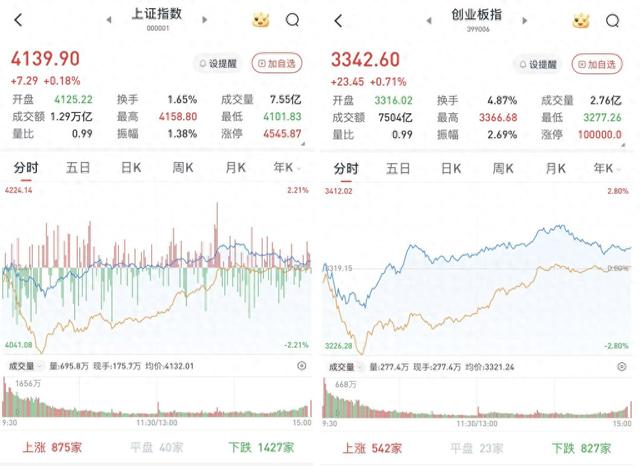
Market Overview - The three major A-share indices opened lower on January 27, with the Shanghai Composite Index closing at 4139.9 points, up 0.18% [2] - The ChiNext Index rose by 0.71% to 3342.6 points, while the Sci-Tech 50 Index increased by 1.51% to 1555.98 points [2] Trading Activity - A total of 1928 stocks rose, while 3450 stocks fell, with 91 stocks remaining flat [3] - The total trading volume was 28.949 billion yuan, a decrease of 3.533 billion yuan from the previous trading day [3] Sector Performance - Semiconductor stocks saw significant gains, with over 20 stocks hitting the daily limit or rising more than 10% [5] - Gold stocks also performed well, with several stocks reaching the daily limit or increasing by over 10% [5] - Coal and basic metal sectors experienced notable declines, with major coal stocks dropping over 4% [6] Market Sentiment and Predictions - Financial analysts suggest that the A-share market may continue to experience fluctuations in the short term due to increased overseas uncertainties and pressure at previous high levels [7] - The current market is viewed as a short-term adjustment risk, with expectations for continued upward movement in the medium term [7] - Long-term perspectives indicate that the current market trend is still in its mid-stage, with potential for a "slow bull" market to continue [8][9] Investment Recommendations - Analysts recommend focusing on sectors such as technology, particularly AI and robotics, as well as industries benefiting from price increases like chemicals and non-ferrous metals [8][9] - Short-term investment opportunities are suggested in power equipment and photovoltaic sectors, which are supported by market demand and policies [10]





A股三大指数集体低开,沪指跌0.18%
Feng Huang Wang Cai Jing· 2026-01-27 01:41
Market Overview - A-shares opened lower with all three major indices declining: Shanghai Composite Index down 0.18%, Shenzhen Component Index down 0.23%, and ChiNext Index down 0.09% [1] Institutional Insights - Huaxi Securities suggests that the current market is in the mid-stage of a "slow bull" trend, with the Shanghai and Shenzhen 300 Index currently at mid-levels compared to previous bull markets in 2007, 2015, and 2021 [2] - The risk premium for the Shanghai and Shenzhen 300 Index is at 5.27%, indicating potential for further market growth as historical lows were around 2.5% [2] - Recommended sectors for investment include technology (AI computing, applications, robotics, space photovoltaics), industries benefiting from "de-involution" and price increases (chemicals, non-ferrous metals), and sectors with high growth in annual performance forecasts (electronics, machinery, pharmaceuticals) [2] Sector Analysis - CITIC Securities reports that the home appliance sector will face pressure in Q4, with a focus on the national subsidy policy adjustment in 2026 targeting core categories and rural markets [3] - The subsidy will cover six major home appliance categories with a 15% subsidy for first-level energy efficiency, with an initial allocation of 62.5 billion yuan aimed at rural markets [3] - JD.com is investing 30 billion yuan to implement a program expected to reach 30-40 million rural residents, positioning the rural market as a key growth area for 2026 [3] Lithium Battery Sector - CITIC Jinpu indicates that lithium battery inflation is beginning, with clear price trends in rigid capacity segments, although upper limits remain uncertain [4] - The current lithium cycle is compared to the previous photovoltaic cycle, suggesting that price increases have not negatively impacted demand, leading to simultaneous volume and price growth across the industry [4] - Price adjustments are expected to be driven by capacity expansion rather than demand contraction, with stock prices likely to follow the trend of volume and price increases in the industry [4]
华西证券:A股“慢牛”趋势有望延续
Di Yi Cai Jing· 2026-01-27 00:16
Group 1 - The core viewpoint is that the current market is in the mid-stage of a "slow bull" trend, which is expected to continue based on comparisons with previous bull markets in A-shares [1] Group 2 - Industry allocation recommendations include focusing on sectors where the technology industry is expanding, such as AI computing power, AI applications, robotics, space photovoltaics, storage, and Hong Kong internet [1] - Sectors benefiting from "de-involution" and price increases, such as chemicals and non-ferrous metals, are also highlighted [1] - Industries with high growth forecasts for annual report performance, including electronics, machinery, and pharmaceuticals, are suggested for attention [1]

投资策略周报:保持慢牛上涨的趋势不变,聚焦三条配置主线-20260125
HUAXI Securities· 2026-01-25 09:14
Market Review - Global stock indices experienced more declines than gains this week, with Hong Kong, US, and European markets all showing downturns. In contrast, the A-share market saw slight increases, with the Shanghai Composite Index and Shenzhen Component Index rising by 0.8% and 1.1% respectively. Small-cap stocks outperformed large-cap stocks, with indices such as the Micro-cap Index, CSI 500, and CSI 2000 leading gains, while the SSE 50 and CSI 300 lagged behind. In terms of sectors, cyclical and technology growth sectors performed well, with construction materials, oil and petrochemicals, steel, and chemicals leading the gains, while large financials, telecommunications, and food and beverage sectors faced declines. In the commodities market, precious metals continued to strengthen, with COMEX silver and gold prices reaching new historical highs, while domestic black commodities remained weak. The US dollar index fell below 98, and the RMB appreciated against the US dollar [1][2][3]. Market Outlook - The report maintains a "slow bull" market trend and focuses on three main investment lines. In the past two weeks, under "counter-cyclical adjustment" measures, net outflows from major A-share ETFs and a slight decline in financing balances have effectively controlled trading momentum. Market turnover remains relatively high, with strong support for small-cap growth stocks, indicating a shift into a phase of accelerated sector rotation. Looking ahead, the current period coincides with a dense disclosure of annual report forecasts, with high-growth sectors becoming the focal point of market attention. The report suggests focusing on the expansion of technology trends, price increase themes, and sectors with high growth in annual report forecasts [2][3]. Sector Allocation - The report recommends focusing on the following sectors: 1) Technology industry expansion, including AI computing, AI applications, robotics, space photovoltaics, storage, and Hong Kong internet sectors 2) Sectors benefiting from "anti-involution" and price increases, such as chemicals and non-ferrous metals 3) Industries with high growth in annual report forecasts, including electronics, machinery, and pharmaceuticals [2][3]. Structural Analysis - Currently, the market is in a window of dense annual report forecast disclosures, with high growth or improving sectors becoming the focus. As of January 24, over 900 listed companies have disclosed their 2025 performance forecasts, with an overall positive forecast rate of 38%. In specific sectors, those with high growth in annual reports (with a median year-on-year growth rate of over 100% in net profit after deducting non-recurring gains) include PCB, storage, optical modules, lithium batteries, non-ferrous metals, and pharmaceuticals. Since the beginning of the year, the Wind pre-increase index has risen by 18%, indicating that outstanding performance sectors have become one of the market's focal points [3][4]. Long-term Perspective - From a medium to long-term perspective, comparing the current A-share market to previous bull markets, this round of market activity is still in the middle stage, with a "slow bull" trend expected to continue. Compared to the peaks of the bull markets in 2007, 2015, and 2021, the CSI 300 index has only reached the mid-stage, with current index levels significantly lower than previous highs. The current risk premium of the CSI 300 is 5.27%, which is higher than the 2.5% level seen in previous bull markets. Additionally, the ratios of total A-share market capitalization to M2 and free float market capitalization to household deposits are both near historical averages, indicating that there is still ample space and opportunity for the market [3][4].
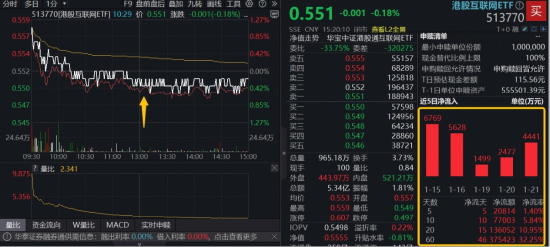
大厂AI应用高频催化,增量资金持续进场,港股互联网ETF(513770)密集吸金13.6亿元
Xin Lang Cai Jing· 2026-01-22 12:17
Market Overview - On January 22, Hong Kong stocks opened high but closed lower, continuing to fluctuate, with the Hang Seng Index and Hang Seng Tech Index slightly up [1][8] - The Hong Kong Internet ETF (513770) experienced a slight decline of 0.18% despite showing a wide premium throughout the day, indicating positive buying sentiment [1][8] - Over the past 20 days, the Hong Kong Internet ETF has seen a net inflow of 1.361 billion yuan, suggesting ongoing capital entry [1][8] AI Sector Developments - The commercialization of AI applications is accelerating, with Hong Kong Internet stocks as key beneficiaries [3][10] - Alibaba's Qianwen has integrated into the Taobao ecosystem to create a one-stop AI service application [3][10] - Kuaishou's AI model has achieved over 12 million monthly active users, while Meituan has upgraded its app to enhance local search functionalities [3][10] Capital Inflows and Stock Performance - Southbound funds are actively buying leading internet stocks, with Alibaba-W receiving a significant net purchase of 1.078 billion HKD on the latest trading day, marking its eighth consecutive day of increased holdings [3][10] - In the past week, Alibaba-W topped the net purchase list with 5.63 billion HKD, followed by Tencent Holdings, Xiaomi Group-W, and Kuaishou-W among the top ten [3][10] ETF Composition and Strategy - The Hong Kong Internet ETF (513770) tracks the CSI Hong Kong Internet Index, with Alibaba-W as the largest weight at 14.71%, and the top ten stocks collectively accounting for nearly 77% of the index [4][11] - For investors seeking to reduce volatility while maintaining exposure to technology, the Hong Kong Large Cap 30 ETF (520560) is recommended, combining high-growth tech stocks with stable dividend-paying companies [12]
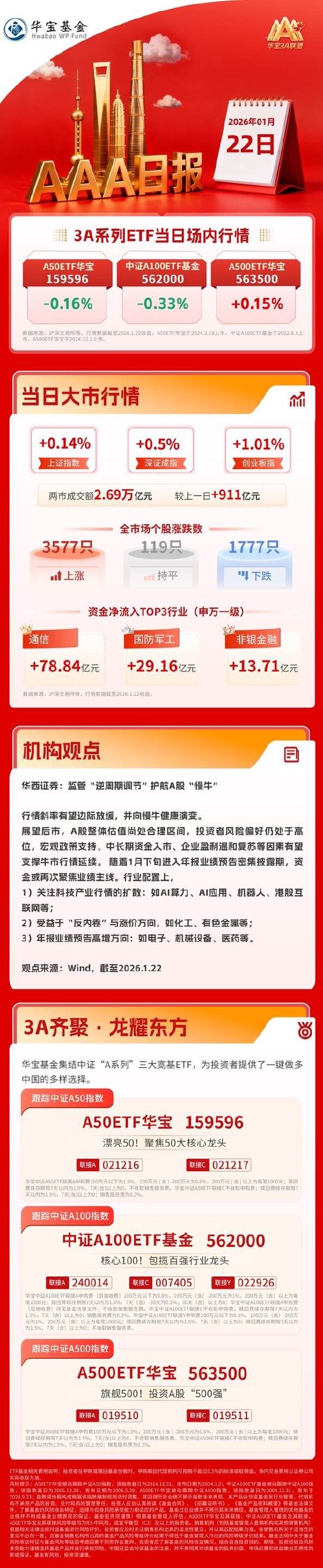
商业航天概念再度爆发,华西证券:“逆周期调节”护航A股“慢牛” | 华宝3A日报(2026.1.22)
Xin Lang Cai Jing· 2026-01-22 11:36
Market Overview - The A-share market is experiencing a "slow bull" trend supported by macro policies, moderate recovery in corporate earnings, and high investor risk appetite [2][6] - The overall valuation of A-shares remains within a reasonable range, with a market turnover of 2.69 trillion yuan, an increase of 911 billion yuan from the previous day [6][2] Industry Insights - Key sectors attracting capital inflow include defense and military, non-bank financials, and telecommunications, with net inflows of 29.16 billion yuan, 13.71 billion yuan, and 78.84 billion yuan respectively [6][2] - Investment focus is shifting towards technology sectors such as AI computing, AI applications, and robotics, as well as industries benefiting from "anti-involution" and price increases like chemicals and non-ferrous metals [2][7] ETF Products - The company offers a range of ETFs tracking major indices, including the A50 ETF, A100 ETF, and A500 ETF, providing investors with diverse options to invest in China's market [2][7] - The A50 ETF focuses on 50 leading companies, while the A100 ETF encompasses the top 100 industry leaders, and the A500 ETF targets the top 500 companies in A-shares [7][2]