
Bei Jing Qing Nian Bao

Search documents
本周六,本市多条公交线路将采取甩站、区间、停运等临时措施
Bei Jing Qing Nian Bao· 2025-08-20 21:33
Summary - The article discusses temporary traffic management measures in Beijing from August 22 to 24 to ensure the safety and smooth operation of a special event [1][94] - During this period, 170 bus routes will implement detours, skip stops, and other temporary measures [1][94] Group 1 - The traffic management measures will be in effect on specific roads during the event [1] - The measures include specific time frames for various bus routes, detailing when they will operate and which segments will be affected [2][3][4][5][6][7][8][9][10][11][12][13][14][15][16][17][18][19][20][21][22][23][24][25][26][27][28][29][30][31][32][33][34][35][36][37][38][39][40][41][42][43][44][45][46][47][48][49][50][51][52][53][54][55][56][57][58][59][60][61][62][63][64][65][66][67][68][69][70][71][72][73][74][75][76][77][78][79][80][81][82][83][84][85][86][87][88][89][90][91][92][93][94] - The article emphasizes the importance of public cooperation and suggests that passengers plan their travel accordingly [94]
重点展示近30项超大城市治理成果和场景
Bei Jing Qing Nian Bao· 2025-08-20 20:41
Group 1 - The 2025 China International Service Trade Fair will be held from September 10 to 14 at Shougang Park, focusing on environmental services as a core topic [1] - The environmental services exhibition will showcase cutting-edge achievements in three main areas: new energy and low-carbon services, ecological environment services, and green low-carbon digital technologies [1] - The exhibition area will cover 6,600 square meters, with over 50 companies participating, including 16 Fortune 500 and industry-leading enterprises [1] Group 2 - The "Urban Operation Guarantee Industry Enterprise Cluster," led by the Municipal Urban Management Committee, focuses on refined urban management, smart upgrades, and sustainable development [2] - This cluster will present smart solutions in urban lighting, smart pipelines, clean energy, and ecological sanitation, highlighting Beijing's commitment to urban governance and development [2] - The water technology cluster, organized by the Municipal Water Authority, will showcase innovations in smart water management, including an integrated perception system and AI applications in water services [2] Group 3 - Major companies such as PetroChina, Sinopec, CNOOC, and Beijing Energy Group will participate in the trade fair, focusing on green energy, circular economy, and new materials [3]
王楚钦、孙颖莎领衔出战WTT中国大满贯
Bei Jing Qing Nian Bao· 2025-08-20 20:35
Core Points - The WTT China Grand Slam will take place from September 25 to October 5 in Beijing's Shijingshan Shougang Park, with the champion earning 2000 world ranking points [1] - The first batch of participants from the Chinese national team has been announced, with men's singles featuring Lin Shidong, Wang Chuqin, and Liang Jingkun, while women's singles includes Sun Yingsha, Wang Manyu, and Chen Xingtong [1] Event Details - Last year's WTT China Grand Slam attracted 241 athletes from 50 countries and regions, with nearly 73,000 spectators attending, showcasing a successful blend of sports and economic development [1] - The event venue has been transformed from former coal handling facilities into modern sports arenas, highlighting the legacy of the Winter Olympics and industrial heritage [1] Participant Breakdown - In men's singles, besides the top five ranked players, additional participants include Xiang Peng, Chen Yuanyu, Lin Gaoyuan, and Wen Ruibo [1] - The women's singles lineup features all top five ranked players, along with Chen Yi, Shi Xunyao, and Qian Tianyi [1]
拓宽赛道 国际邀请赛助推足球青训
Bei Jing Qing Nian Bao· 2025-08-20 01:00
Core Insights - The 2025 Great Wall Cup International Youth Football Invitation Tournament is currently taking place, featuring U16 teams from renowned clubs such as Real Madrid, Auxerre, Sporting Lisbon, and Red Star Belgrade, alongside the host team from Beijing [1][2] - The event serves as a significant platform for youth football training in China, enhancing the quality and visibility of youth football competitions domestically [1][3] Group 1: Event Overview - The Great Wall Cup has attracted seven foreign teams, including top clubs from Europe and Asia, providing a valuable opportunity for local U16 players to compete against high-caliber international peers [2][4] - The tournament is part of a broader trend of increasing high-level youth football events in China, which are seen as essential for the development of young talent [3][4] Group 2: Development and Impact - The Chinese government has prioritized youth football development, aiming to establish a comprehensive training system and increase participation in football at the grassroots level by 2025 [3][4] - The presence of international teams and the quality of competition are viewed as critical for the growth of football talent in China, with events like the Great Wall Cup acting as a selection ground for future national team players [6][7] Group 3: Cultural Exchange - The tournaments not only focus on football skills but also emphasize cultural exchange, with participating teams engaging in activities that showcase Chinese culture, such as visiting the Great Wall and enjoying traditional performances [7]
主题宣讲用小案例阐释大道理
Bei Jing Qing Nian Bao· 2025-08-19 18:39
Core Points - The "Vivid Practice in Jinghua" theoretical micro-presentation city-level demonstration team was launched to promote the study and implementation of Xi Jinping's Thought on Socialism with Chinese Characteristics for a New Era [1][2] - The demonstration team consists of 15 presenters, including young teachers from capital universities, teaching backbones from district party schools, and young researchers from the municipal social science academy [2] - The presentations focus on various themes such as the "Three Musts," rural revitalization, the "Two Mountains" theory, community governance, cultural and technological integration, and the concept of a people-centered city [2] Summary by Sections - **Launch and Structure**: The theoretical micro-presentation team was initiated to enhance the understanding of Xi Jinping's Thought, with activities taking place across multiple districts in Beijing [1][2] - **Content and Themes**: Presenters utilize small case studies to reflect larger themes, aiming to make the party's innovative theories more accessible to the public [2] - **Upcoming Activities**: The team will conduct a series of presentations from August 19 to 21, covering 17 sessions across 16 districts, and will later expand its reach through online platforms [3]
北京发布音乐地图 下半年演出将超300场
Bei Jing Qing Nian Bao· 2025-08-19 18:39
Group 1 - The Beijing Municipal Bureau of Culture and Tourism, in collaboration with Baidu Maps, has launched a "Music Map" featuring the first batch of 20 outdoor concert locations across 11 districts in Beijing, with over 300 performances scheduled from August to the end of the year [1] - The concert venues include diverse settings such as parks, industrial parks, commercial areas, and natural riversides, catering to various audience needs [1] - Notable locations for the concerts include Longtan Zhonghu Park, Chaoyang Park, and Olympic Water Park, which will provide a blend of ecology and art [1] Group 2 - This summer, outdoor music performances in Beijing are experiencing a surge, with events like the Ferris Wheel Night Concert, Starry Performance Season, Tree Summer Music Festival, and Shougang Music Festival showcasing a variety of music genres including folk, pop, ballad, and rock [2] - Future collaborations are planned with local cultural and artistic groups, including university art societies and orchestras, to enhance the outdoor concert experience for the public [2]
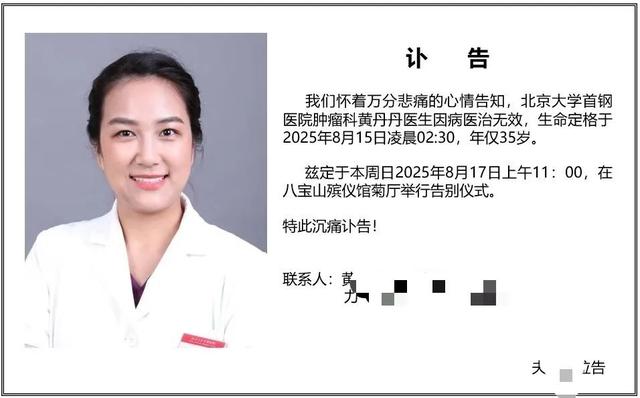
黄丹丹医生不幸离世,年仅35岁
Bei Jing Qing Nian Bao· 2025-08-19 02:00
Core Points - Dr. Huang Dandan, a prominent oncologist at Peking University Shougang Hospital, passed away on August 15, 2025, at the age of 35 due to illness [9] - She was known for her positive attitude and efforts to share her cancer journey with others through social media [7][6] - Huang was diagnosed with diffuse large B-cell lymphoma in December 2023, which progressed to stage IV and metastasized to the brain and bone marrow [7][6] Summary by Sections Personal Background - Huang Dandan was born in a poor village in Henan and excelled academically, eventually earning a PhD and becoming a chief physician in the oncology department at Peking University Shougang Hospital [8][7] - She married a fellow PhD and had a son, establishing a family while pursuing her medical career [8] Medical Journey - Huang's cancer diagnosis came after a routine check-up in December 2023, leading to a challenging treatment journey that included six rounds of intensive chemotherapy and a stem cell transplant [7][6] - Despite her struggles, she maintained a positive outlook and aimed to educate others about cancer treatment through her social media account "Dandan's Cancer Diary" [7][6] Community Impact - Huang's social media presence was focused on providing support and information to cancer patients and their families, emphasizing that cancer should not be feared but approached with understanding [7][6] - Her passing has prompted an outpouring of grief and tributes from colleagues, patients, and the online community, highlighting her impact as both a physician and a patient [6][9]

拒绝暑假胖一圈 开心享瘦很简单
Bei Jing Qing Nian Bao· 2025-08-19 01:22
Group 1 - The core issue of childhood obesity during summer vacations is influenced by irregular eating habits, lack of physical activity, and misconceptions about healthy weight gain [2][3]. - Experts emphasize that summer is a critical period for managing children's weight and suggest establishing a regular routine, ensuring outdoor activities, and replacing snacks with fruits [2][3]. - Proper dietary choices are essential, including fresh fruits and vegetables, quality proteins, and balanced meals to avoid excessive weight gain [3][6]. Group 2 - Regular health check-ups are crucial for monitoring children's growth indicators, including height and weight, to assess their development accurately [4]. - The Body Mass Index (BMI) is a key metric for diagnosing overweight and obesity in children, with specific thresholds indicating potential weight issues [4]. - It is advised that children should not rely on dieting for weight loss, as it can lead to nutritional deficiencies and other health issues [5][6].
生育杀手出没!男士请自查冰箱
Bei Jing Qing Nian Bao· 2025-08-19 01:22
Group 1: Impact of Diet on Male Fertility - A 28-year-old programmer's semen analysis revealed concerning results: sperm concentration at 5 million/ml (normal should be ≥15 million) and vitality at 20% (normal should be ≥40%) [1] - Long-term excessive alcohol consumption significantly harms male fertility, with studies showing a 20%-30% decrease in sperm vitality and a 50% increase in sperm head deformity [2] - Consumption of instant foods, such as instant noodles and self-heating hot pots, introduces preservatives and chemical additives that generate free radicals, leading to decreased sperm quality [3] Group 2: Specific Food Types and Their Effects - Storing leftover food improperly can lead to high levels of bacteria and nitrites, which may damage testicular function and reduce male fertility [4] - Pre-packaged meals and frozen foods often contain high levels of additives and preservatives, which can lead to obesity and negatively impact testosterone levels [5] - Pickled foods and strong-flavored condiments can act as chronic androgen blockers, affecting sperm production and development [6] Group 3: Recommendations for Male Fertility - Dietary adjustments are recommended, including the consumption of black beans, walnuts, and sea cucumbers to support reproductive health [7] - Regular physical activity and a balanced lifestyle are essential to maintain kidney health and overall well-being [8] - Regular health check-ups and the elimination of harmful habits can enhance sperm quality and protect health [9]
寒凉伤脾胃?吃瓜群众看过来
Bei Jing Qing Nian Bao· 2025-08-19 01:22
Core Points - Watermelon is a popular fruit during summer and autumn, but excessive consumption can lead to health issues due to its high sugar content and potential metabolic burden [1] - The sweetness of watermelon primarily comes from fructose, which can increase the risk of high uric acid levels and gout if consumed in excess [1] - Watermelon has a glycemic index (GI) of approximately 72, making it a medium-high GI food, which can cause rapid blood sugar spikes, particularly concerning for diabetics [1] Consumption Guidelines - General population should limit fruit intake to 200-350 grams daily, with watermelon consumption adjusted to 300-500 grams due to its high water content [2] - Weight loss individuals should be cautious, as consuming 500 grams of watermelon can equate to about 40 grams of sugar and the caloric content of a small bowl of rice [2] - Diabetics should limit intake to 100-150 grams per day, monitoring blood sugar levels, and should avoid watermelon if blood sugar is unstable [2] - Patients with renal insufficiency should limit watermelon to less than 100 grams daily due to its potassium content [2] Special Considerations - Pregnant women and children can consume watermelon normally but should avoid refrigerated watermelon to prevent gastrointestinal irritation [3] - Watermelon is considered a cold food; those with cold stomach conditions should avoid excessive consumption to prevent abdominal discomfort [4] - Cut watermelon should be stored in low temperatures and consumed within 12 hours, and it is advisable to avoid eating it on an empty stomach [5]