QYResearch

Search documents
行业聚焦:全球行星式扫描仪市场头部企业份额调研(附Top10 厂商名单)
QYResearch· 2025-10-09 09:06
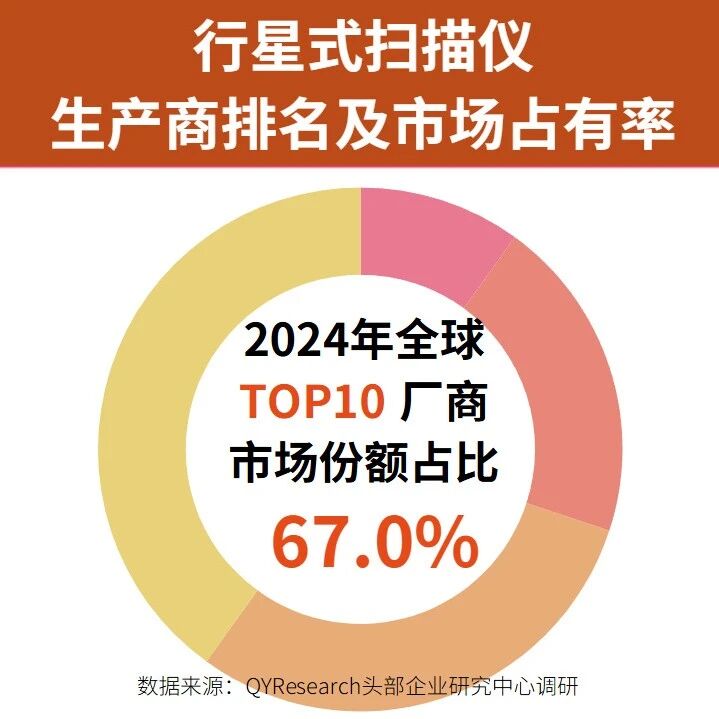
行星式扫描仪是一种专为珍贵图书、档案和大幅面资料数字化而设计的专业设备。其核心特点是 "非接触式扫描",通过顶置高分辨率相机从上 方拍摄原件,无需对文献进行压平或切割,避免对脆弱纸张和装订书籍造成损伤。该类扫描仪常配备可调节书托、冷光源照明及自动图像校正 功能,能实现快速、高精度的图像采集,适用于图书馆、档案馆、博物馆及科研机构的数字化项目。 据 QYResearch 调研团队最新报告"全球行星式扫描仪市场报告 2025-2031 "显示, 预计 2031 年全球行星式扫描仪市场规模将达到 1.9 亿美元 , 未来几年年复合增长率 CAGR 为 5.4% 。 行星式扫描仪 ,全球市场总体规模 行星式扫描仪 ,全球市场规模,按产品类型细分, A3 幅面于主导地位 就产品类型而言,目前 A3 幅面是最主要的细分产品,占据大约 45.5% 的份额。 行星式扫描仪,全球市场规模,按应用细分,图书馆是最大的下游市场 就产品应用而言,目前图书馆是最主要的需求来源,占据大约 28.0% 的份额。 行星式扫描仪行业的发展呈现出几个明显趋势: 技术演进强调高清、快速与无损,设备在图像处理算法、光学成像及操作流畅度方面不断优化, ...

全球气体绝缘金属封闭开关设备行业总体规模、主要企业国内外市场占有率及排名
QYResearch· 2025-09-30 03:34
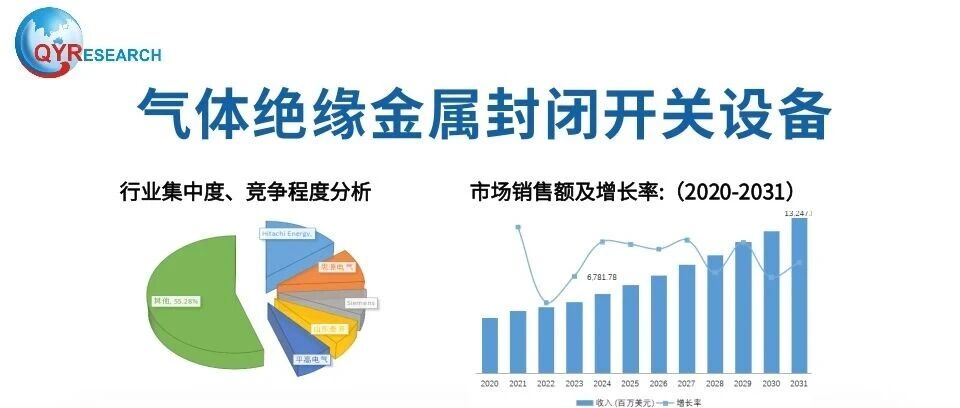
Core Viewpoint - The Gas Insulated Switchgear (GIS) market is experiencing steady growth, driven by urbanization, industrial demand, renewable energy integration, and modernization of distribution networks, with a projected global market size of approximately $6.782 billion in 2024 and a compound annual growth rate (CAGR) of about 9.88% until 2031 [3][7]. Market Size - The global GIS market is expected to reach approximately $13.274 billion by 2031, with a CAGR of 9.88% from 2025 to 2031. The demand for compact and reliable power systems in urban areas is a significant driver of this growth [7]. Competitive Landscape - Major GIS manufacturers are concentrated in Europe and China, with leading companies including Hitachi Energy, Siemens, and others. The top five companies are projected to hold about 44.72% of the market share by revenue in 2024 [8]. Regional Market - China and Europe are the largest consumers of GIS, accounting for approximately 75% of the revenue market share in 2024 [11]. Product Types - GIS products are categorized by voltage ratings, with 110kV and 220kV products holding significant market shares, together accounting for about 56% of revenue in 2024 [12]. Downstream Market - GIS is widely used in urban power grids, renewable energy generation, hydropower, thermal power, and other applications, with urban power grids representing a market share of 18.05% by revenue in 2024 [13]. Favorable Industry Development Factors - Increased government investment in power infrastructure and support for smart grids and green energy initiatives provide long-term policy and capital backing for the GIS market [14]. Challenges in Industry Development - High initial investment costs compared to traditional air-insulated switchgear (AIS) may limit the widespread adoption of GIS, particularly in medium and low voltage applications. Additionally, the environmental regulations regarding SF₆ gas emissions pose challenges for manufacturers [16]. Barriers to Entry - The GIS industry has significant technical barriers due to the need for high precision in design and engineering capabilities. New entrants without substantial technical expertise may struggle to ensure product reliability and safety [17]. Industry Policies - Various policies, such as the "14th Five-Year Plan for Modern Energy System" and "Made in China 2025," emphasize the development of high-voltage transmission projects and the adoption of domestically produced GIS equipment [20][22].
以数据见证专业:QYResearch 2025年9月行业数据引用案例精选
QYResearch· 2025-09-30 03:34
Group 1 - QYResearch is recognized for its authoritative industry analysis and customized reports, widely cited by numerous well-known domestic and international companies, securities firms, and media [1] - The ASIC design service market in China is projected to generate sales revenue of $1.503 billion in 2023, with expectations to reach $3.416 billion by 2030 [2] - The global servo system market is estimated to be $15.611 billion in 2023, with a compound annual growth rate (CAGR) of 4.73%, reaching $20.604 billion by 2029 [5] Group 2 - The global vehicle dashboard market is dominated by a leading domestic company, ranked first in China and eighth globally, according to QYResearch [7] - The global humidifier market is expected to grow at a CAGR of over 10% in the next five years, with integrated and smart products taking a leading position [10] - The market for osmotic laxatives in China is projected to exceed 7.313 billion yuan by 2029, capturing 33.65% of the total constipation medication market [12] Group 3 - The global high-speed connector market is anticipated to reach $21.6 billion by 2030, providing significant expansion opportunities for suppliers [15] - The directional drilling tools market is expected to exceed $9.42 billion in 2024 and surpass $26.88 billion by 2037, with a CAGR of over 8.4% [17] - The global optical switch market is projected to reach $2.02 billion by 2031, with a CAGR of 16.3% [20] Group 4 - The global semiconductor robot market is currently dominated by foreign manufacturers, holding over 90% of the market share in China [22] - The global automatic wafer testing probe market is estimated to be around $1.156 billion in 2024, characterized by high market concentration [24] - The global emergency kit market is expected to reach $1.061 billion by 2031, with a CAGR of approximately 7.3% [27] Group 5 - The global home wireless router market is projected to grow at a CAGR of 5.8% from 2025 to 2031 [29] - The global medical device market is expected to reach $635.8 billion by 2024 [32] - The global SD-WAN market is estimated to reach $51.8 billion by 2031, with a CAGR of 32.6% [35] Group 6 - The global organ-on-a-chip market is expected to grow at a CAGR of 31.2% from 2024 to 2030 [69] - The global automotive drive motor core market is projected to reach $4.678 billion by 2030, with a CAGR of 11.85% [62] - The global eSIM card market is entering a rapid expansion phase, particularly in the IoT and consumer electronics sectors [65]

行业聚焦:全球特种环保增塑剂市场头部企业份额调研(附Top10 厂商名单)
QYResearch· 2025-09-30 03:34
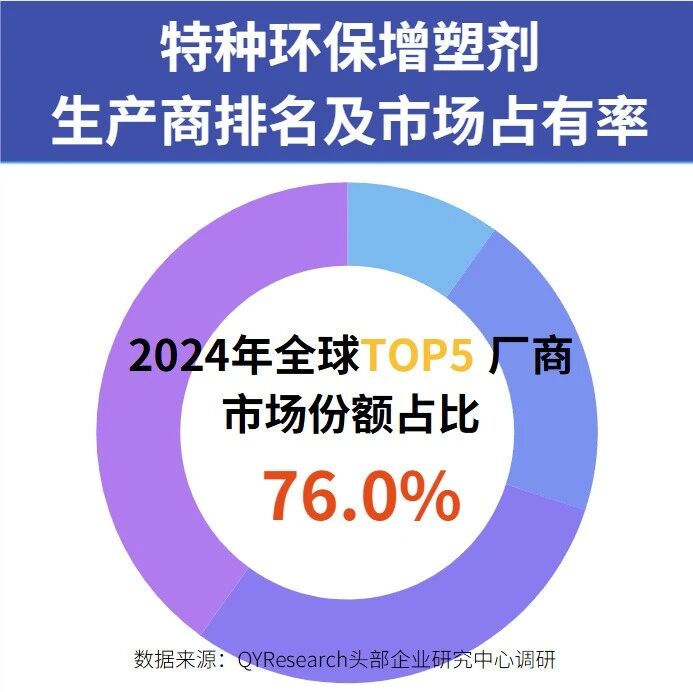
Core Insights - The article discusses the growing market for specialty eco-friendly plasticizers, which are designed to meet strict environmental regulations and high-performance requirements, replacing traditional phthalate-based plasticizers [1][2]. Market Overview - The global market for specialty eco-friendly plasticizers is projected to reach $3.56 billion by 2031, with a compound annual growth rate (CAGR) of 6.0% over the coming years [1]. Industry Trends - There is a rising demand from consumers and brands for health and sustainability, leading to the adoption of low-toxicity or bio-based plasticizers in food packaging, baby products, and daily consumer goods [7]. - The packaging industry, particularly in food and flexible packaging, is experiencing explosive growth in demand for non-toxic, recyclable, and biodegradable materials [7]. - High-safety industries such as automotive and medical are driving the need for safer, more specialized, and eco-friendly plasticizers to meet regulatory requirements and reduce brand risks [7]. Market Opportunities - Stricter environmental regulations globally are increasing the demand for eco-friendly alternatives to phthalate plasticizers [8]. - Consumer concerns regarding health and environmental protection are prompting companies to seek low-toxicity and biodegradable plasticizers [9]. - Technological advancements in bio-based plasticizers, such as epoxy soybean oil, are reducing production costs and enhancing market competitiveness [10]. Market Challenges - The production costs of specialty eco-friendly plasticizers are high due to the use of renewable plant oils or bio-based raw materials, which are more expensive than traditional phthalate plasticizers [11]. - The supply chain is vulnerable to fluctuations, as the production and pricing of eco-friendly plasticizers depend significantly on natural raw materials, which can be affected by climate, crop conditions, and international trade policies [11]. - There is a lack of awareness among some downstream companies and consumers regarding the performance, cost-effectiveness, and long-term benefits of eco-friendly plasticizers, which may slow down their adoption [12].
行业聚焦:全球双离合变速箱油市场头部企业份额调研(附Top10 厂商名单)
QYResearch· 2025-09-30 03:34
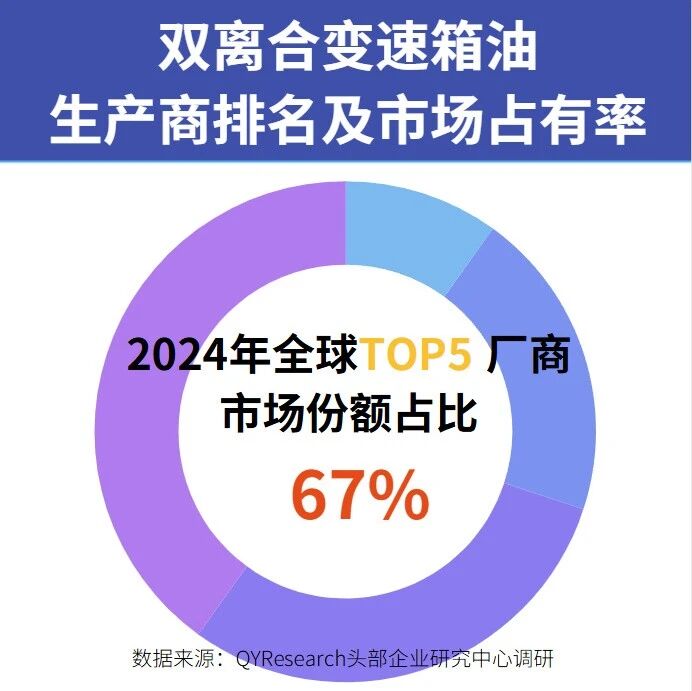
Core Viewpoint - The article discusses the growing demand for dual-clutch transmission fluid (DCTF) driven by the increasing penetration of dual-clutch transmissions in vehicles, alongside stringent fuel economy and carbon emission regulations globally [2][9]. Global Trends and Driving Factors - The market for dual-clutch transmission fluid is expanding due to the superior thermal management capabilities of dual-clutch transmissions, which enhances their market penetration [2]. - Stringent global fuel economy and carbon emission regulations are pushing for high-performance, low-viscosity DCTF products, leading to technological advancements and market growth [2]. - The global market for dual-clutch transmission fluid is projected to reach USD 703 million by 2031, with a compound annual growth rate (CAGR) of 3.2% in the coming years [2]. Competitive Landscape - The dual-clutch transmission fluid market is highly concentrated, dominated by major players such as ExxonMobil, Shell, and TotalEnergies, which hold approximately 67% of the market share [6][9]. - The leading companies leverage strong R&D capabilities and established relationships with major automotive manufacturers, creating significant technical barriers to entry for new competitors [2][9]. Product Segmentation - Wet dual-clutch transmission fluid is the dominant product type, accounting for about 70% of the market share [8][9]. - The market is segmented into various applications, including passenger vehicles and commercial vehicles [13]. Opportunities and Challenges - The rapid growth of hybrid vehicles, which often utilize dual-clutch technology, presents a significant opportunity for the dual-clutch transmission fluid market [11]. - Challenges include the impact of electric vehicles on traditional transmission markets, which may limit long-term demand growth [10]. - High-quality requirements for DCT fluids lead to substantial R&D and certification costs, posing barriers for new entrants [10]. Industry Development Insights - The increasing awareness of vehicle maintenance and the growing automotive ownership in emerging markets like Asia-Pacific are expected to drive stable growth in the aftermarket for dual-clutch transmission fluid [11].
行业聚焦:全球汽车电池泄漏检测传感器市场头部企业份额调研(附Top10 厂商名单)
QYResearch· 2025-09-29 01:56
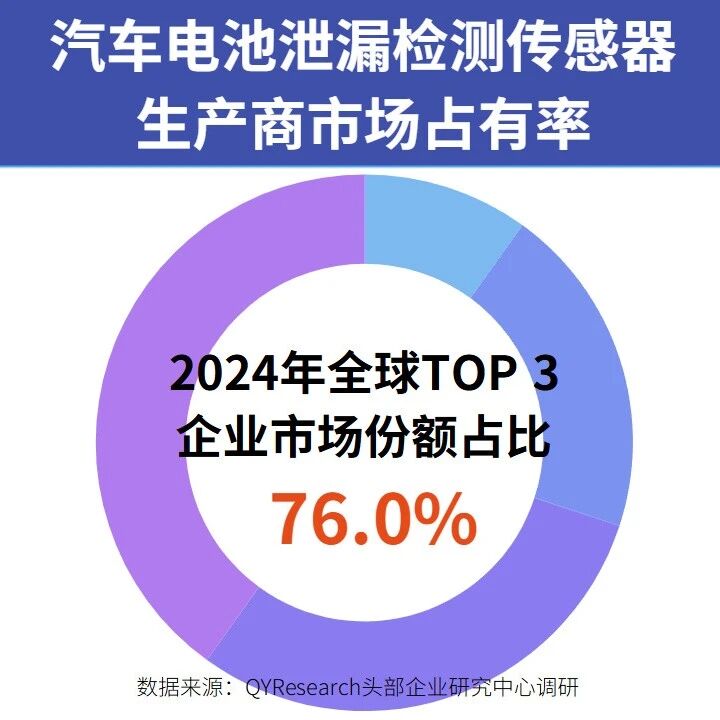
Core Insights - The article discusses the automotive battery leak detection sensor market, highlighting its importance in ensuring the safety of electric vehicle batteries and projecting significant market growth in the coming years [1]. Market Overview - The global automotive battery leak detection sensor market is expected to reach $70 million by 2031, with a compound annual growth rate (CAGR) of 10.0% over the next few years [1]. Key Manufacturers - Major manufacturers in the global automotive battery leak detection sensor market include INFICON, Shenzhen Weitek Intelligent Instrument Co., Ltd., and Marposs, with the top three companies holding approximately 76.0% market share in 2024 [6]. Industry Chain Analysis Upstream - The upstream segment consists of core components and materials supply, including semiconductor chips, gas-sensitive and pressure-sensitive elements, substrates, electrode materials, and calibration gases. This segment has high technical barriers and relies on imports for some key materials and high-end chips [7]. Midstream - Midstream companies are responsible for the research, design, and manufacturing of leak detection sensors, which include gas leak sensors, pressure sensors, humidity sensors, and liquid level sensors. The focus is on detection accuracy, response speed, and long-term reliability, with a trend towards smart, miniaturized products integrated with battery management systems (BMS) [8]. Downstream - The downstream segment primarily includes electric vehicle manufacturers and battery system integrators, who embed sensors into battery modules and thermal management systems for real-time monitoring of battery safety. The demand in this segment is growing due to rising electric vehicle sales and stricter battery safety regulations [9]. Driving Factors - The rapid expansion of the electric vehicle market, increasing battery safety standards, and heightened societal concern over battery safety incidents are driving the demand for leak detection sensors. Automakers and battery companies are investing more in enhancing battery safety, supported by regulatory policies creating a rigid demand for these sensors [10]. Obstacles - The reliance on imports for core components like high-performance gas-sensitive materials and specialized chips leads to higher costs. Additionally, ensuring stable operation of sensors in complex environments (high temperature, humidity, electromagnetic interference) increases product development and quality control pressures [11]. Industry Development Trends - Future sensors are expected to integrate deeply with battery management systems (BMS) for multi-parameter intelligent detection. The monitoring scope will expand from single electrolyte detection to include hydrogen, coolant, and environmental humidity. With advancements in domestic alternatives and reduced production costs, products are anticipated to evolve towards higher reliability, lower power consumption, and miniaturization, becoming standard safety configurations for electric vehicle batteries [12].
行业聚焦:全球数控角度头市场头部企业份额调研(附Top10 厂商名单)
QYResearch· 2025-09-29 01:56
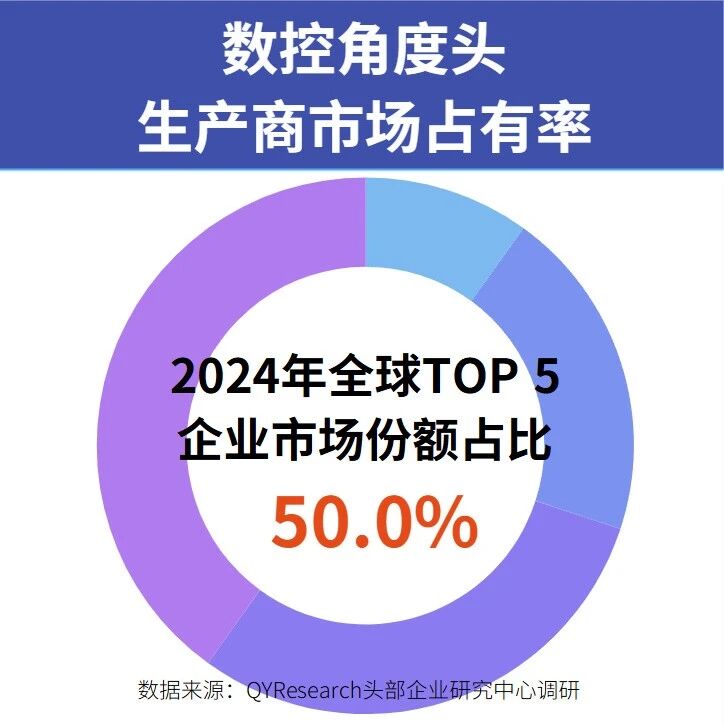
Core Insights - The article discusses the CNC angle head, a high-precision machine tool accessory designed for CNC milling machines and machining centers, enabling multi-angle processing such as 90°, 45°, and 360° [1] - The global CNC angle head market is projected to reach USD 110 million by 2031, with a compound annual growth rate (CAGR) of 3.2% in the coming years [1] Market Overview - CNC angle heads are widely used in industries such as aerospace, automotive, and mold manufacturing, enhancing processing efficiency and precision while reducing production costs [1] - The supply chain consists of upstream suppliers of precision bearings, gears, and tool holders; midstream manufacturers and system integrators; and downstream CNC machine manufacturers and end-users [1] Market Trends - Increasing demand for high-precision machining in aerospace, automotive, and electronics sectors is driving the need for CNC angle heads [6] - The advancement of automation and Industry 4.0 has led to the development of smart angle heads integrated with sensors and data analytics, crucial for improving production efficiency [7] - The widespread adoption of multi-axis machining centers requires angle heads to be more flexible and reliable to meet complex processing tasks [8] Market Opportunities - Companies like Heimatec are introducing AI-driven angle heads for predictive maintenance and performance optimization [9] - Manufacturers are focusing on modular and lightweight designs to enhance flexibility and reduce machine load for diverse processing needs [10] - The use of advanced materials and coatings in angle heads improves durability and wear resistance, extending tool life and maintaining precision [11] Market Challenges - High initial investment costs for CNC angle heads, including equipment procurement, installation, and operator training, can be a financial burden for small and medium-sized enterprises [12] - The complexity of technology and operational requirements necessitates specialized technical knowledge, posing challenges in hiring and retaining skilled personnel [12] - The reliance on a few suppliers for high-precision components makes the supply chain vulnerable to geopolitical events and economic instability [12] Competitive Landscape - Major global manufacturers of CNC angle heads include BIG DAISHOWA, Gerardi, Nikken Kosakusho Works, MST Corporation, and mimatic Tool System, with the top five companies holding approximately 50% market share in 2024 [5]
行业聚焦:全球三筒洗衣机市场头部企业份额调研(附Top5 厂商名单)
QYResearch· 2025-09-29 01:56
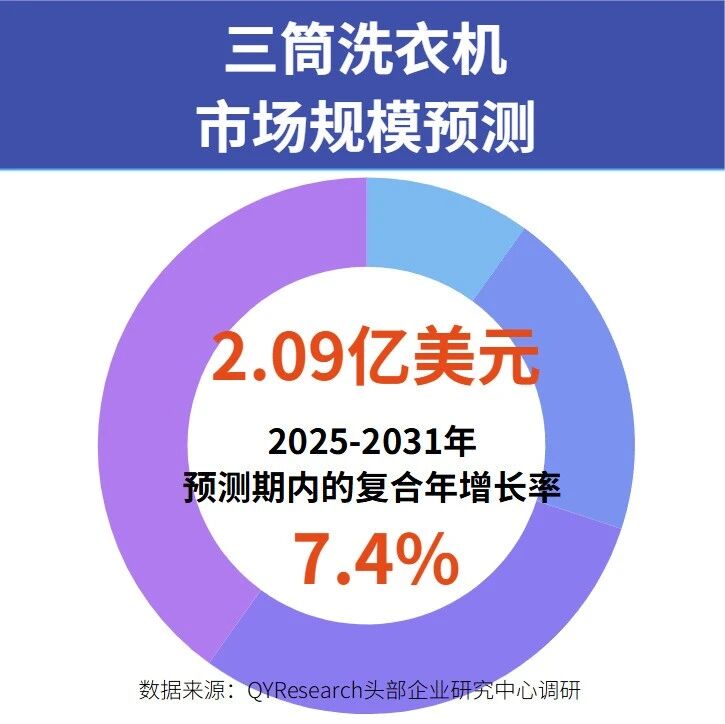
Core Viewpoint - The three-tub washing machine is an innovative high-end product in the global home appliance sector, designed for high-income households and tech-savvy consumers seeking efficiency and space optimization. It allows simultaneous washing of different types of clothing, significantly enhancing convenience and saving time [2][10]. Market Overview - The global market for three-tub washing machines is in its emerging stage, with a projected market size of $126 million in 2024, expected to grow to $209 million by 2031, reflecting a compound annual growth rate (CAGR) of 7.4% from 2025 to 2031 [2][10]. Industry Development Trends - **Continuous Technological Innovation**: The technology of three-tub washing machines is evolving, with features like independent operation of each tub, specialized water intake, drainage systems, and washing programs. High-end models also include drying functions, improving washing efficiency and reducing noise [7]. - **User-Centric Design Philosophy**: There is a growing demand for health-conscious washing solutions that prevent cross-contamination. The three-tub washing machine meets this need by allowing for categorized washing based on fabric type and dirt level [7]. - **Intensifying Market Competition**: The market is becoming increasingly competitive, with brands like Haier, Little Swan, and Hisense entering the fray, leading to heightened competition in technology, pricing, and marketing strategies [7]. Development Opportunities - **Growing Demand for Healthy Washing**: As consumer awareness of hygiene increases, the ability of three-tub washing machines to isolate different types of clothing presents a significant market opportunity [8]. - **Addressing Space Constraints in Small Homes**: The compact design of three-tub washing machines offers a solution for small households, combining washing and drying functions in a space-efficient manner [8]. - **Expansion into Commercial Applications**: Beyond residential use, there is potential for three-tub washing machines in commercial settings such as hotels and laundromats, further expanding market opportunities [8]. Challenges in the Industry - **High Production Costs**: The complexity of manufacturing three-tub washing machines results in higher production costs compared to single-tub models, which may limit market penetration, especially among price-sensitive consumers [8]. - **Intense Market Competition**: The market is characterized by fierce competition, with many products lacking genuine innovation beyond the additional tub feature, necessitating continuous improvement in service quality and product offerings [8]. - **Technological Limitations**: Current models face challenges related to noise reduction, vibration control, and space utilization, indicating a need for further technological advancements [8]. Future Outlook - The future development of three-tub washing machines is expected to be influenced by advancements in compact design, inverter and direct-drive motor technologies, AI-based washing cycle optimization, and eco-friendly water and energy-saving systems. The demand for smart, time-saving appliances in urban areas is likely to drive growth beyond the luxury market segment [10].




全球半导体塑封机行业总体规模、主要企业国内外市场占有率及排名
QYResearch· 2025-09-29 01:56
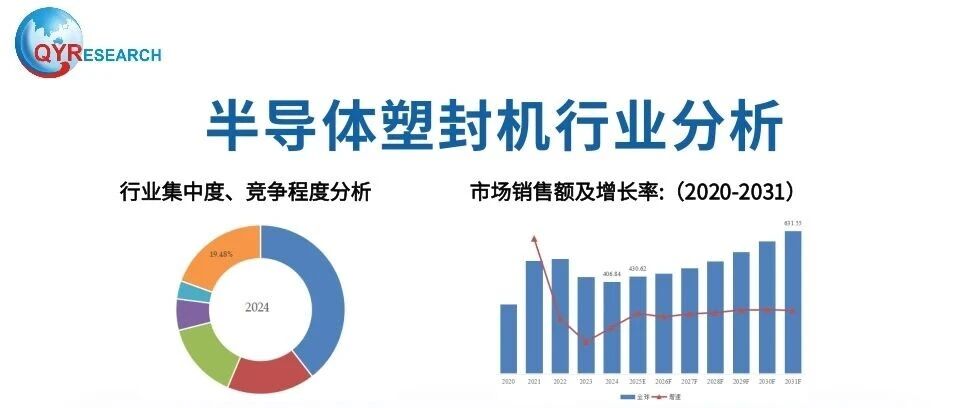
Core Viewpoint - The article discusses the development and trends in the semiconductor packaging industry, particularly focusing on the plastic packaging machines, highlighting the growth potential in the Chinese market and the shift towards advanced packaging technologies. Group 1: Semiconductor Packaging Process - The semiconductor production process includes wafer manufacturing, testing, packaging, and testing, with packaging being crucial for electrical and signal connections as well as physical protection of integrated circuits [1] - The encapsulation process involves injecting packaging materials into molds to protect semiconductor chips, which is essential due to environmental conditions that could lead to chip failure [1] Group 2: Industry Development Overview - China is actively promoting the integrated circuit industry as a strategic pillar, with a focus on high-quality development and self-sufficiency in manufacturing processes, equipment, and materials [4] - The domestic integrated circuit market is experiencing steady growth, supported by strong internal demand and a clear trend towards domestic substitution, despite global economic fluctuations [4] Group 3: Characteristics of the Semiconductor Packaging Machine Industry - The trend towards high reliability in packaging machines is becoming critical, especially for automotive and industrial-grade chips, where performance metrics like temperature control and operational consistency are essential [6] - Advanced packaging technologies are driving the need for equipment upgrades, with T-Molding and C-Molding market shares expected to diverge [7][8] Group 4: Automation and Localization - The introduction of automation and intelligence in packaging machines enhances efficiency and consistency, reducing reliance on manual labor [9] - The demand for domestic equipment is increasing as local semiconductor companies expand their production capacities, with several emerging firms gaining market share [9] Group 5: Market Size and Forecast - The global semiconductor packaging machine market is projected to reach USD 406 million in 2024, with a compound annual growth rate (CAGR) of 6.59% expected until 2031 [11] - The Chinese market is anticipated to grow from USD 179 million in 2024 to USD 275 million by 2031, representing approximately 44% of the global market [11] Group 6: Market Share and Key Players - Major players in the international market include Towa, Besi, ASMPT, and Sanan Optoelectronics, with the top five companies holding about 80.79% of the market share [15] - In the Chinese market, the leading companies also include Towa, Besi, ASMPT, and Sanan Optoelectronics, with the top five accounting for approximately 77.24% of the market [15] Group 7: Policy Support - The Chinese government has implemented various policies to support the semiconductor industry, including tax incentives for companies involved in integrated circuit design, equipment, materials, packaging, and testing [16][17][18]
中国灌溉控制器市场现状研究分析与发展前景预测报告
QYResearch· 2025-09-28 04:23
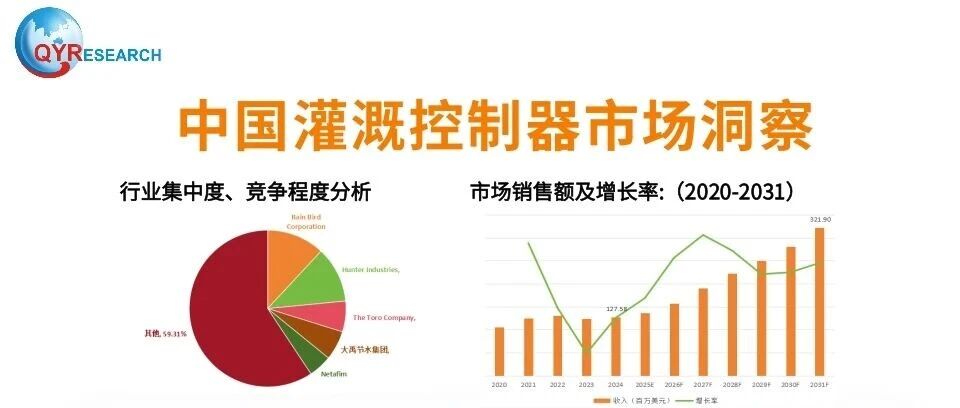
Core Insights - The Chinese irrigation controller market is experiencing rapid growth, driven by the advancement of smart agriculture, urban greening, and water-saving policies, with a market size projected to reach $128 million in 2024 and $322 million by 2031, reflecting a compound annual growth rate (CAGR) of 15.39% [3][8]. Market Overview - The market is diversifying in terms of product types and applications, with smart controllers dominating the market, expected to account for approximately 65% of revenue in 2024 [7][11]. - The primary product categories include smart controllers, timer controllers, and basic controllers, each catering to different user needs and application scenarios [7][11]. Application Areas - Farms are the largest application area for irrigation controllers, with significant demand for automation and precision irrigation due to extensive planting areas [8]. - Orchards are increasingly adopting irrigation control systems, particularly in southern hilly regions, driven by the promotion of integrated water and fertilizer technologies [8]. - Greenhouses require precise control and data interaction, making them a key area for smart controller deployment [8]. - Non-agricultural applications include sports fields and urban landscaping, which demand uniform coverage and timely irrigation [8]. Competitive Landscape - Major players in the Chinese market include Rain Bird Corporation, Hunter Industries, The Toro Company, Dayu Water-saving Group, and Netafim, with the top five companies accounting for over 40% of sales revenue in 2024 [11][17]. - The market is characterized by a trend towards smart solutions, diverse application scenarios, and significant urban-rural disparities [11]. Industry Chain - The industry chain consists of upstream components such as sensors and electronic parts, midstream manufacturers of irrigation controllers, and downstream customers including agricultural growers and municipal greening units [13]. Policy Environment - Key policies promoting efficient water-saving irrigation technologies and the integration of smart irrigation facilities are outlined in various national plans, including the "14th Five-Year" agricultural green development plan and the "National Water Conservation Action Plan" [15].