量子位

Search documents
速报!MEET2026嘉宾阵容再更新,观众报名从速
量子位· 2025-11-30 05:09
Core Insights - The MEET2026 Smart Future Conference will focus on cutting-edge technologies and industry developments that have garnered significant attention throughout the year [1] - The theme "Symbiosis Without Boundaries, Intelligence to Ignite the Future" emphasizes how AI and smart technologies penetrate various industries, disciplines, and scenarios, becoming a core driving force for societal evolution [2] Group 1: Conference Highlights - The conference will cover hot topics in the tech circle this year, including reinforcement learning, multimodal AI, chip computing power, AI in various industries, and AI going global [3] - It will feature the latest collisions between academic frontiers and commercial applications, showcasing leading technological achievements from infrastructure, models, and product industries [4] - The event will also include the authoritative release of the annual AI rankings and the annual AI trend report [5][116] Group 2: Notable Speakers - Zhang Yaqin, President of Tsinghua University's Intelligent Industry Research Institute and an academician of the Chinese Academy of Engineering, has extensive experience in AI and digital video technologies [11][12] - Sun Maosong, Executive Vice President of Tsinghua University's AI Research Institute, has led numerous national projects in AI research [15] - Wang Zhongyuan, Director of the Beijing Academy of Artificial Intelligence, has a strong background in AI core technology development and has published over 100 papers [19] Group 3: Industry Impact - The annual AI rankings initiated by Quantum Bit have become one of the most influential lists in the AI industry, evaluating companies, products, and individuals across three dimensions [117] - The annual AI trend report will analyze ten significant AI trends based on technological maturity, implementation status, and potential value, highlighting representative institutions and best cases [118] - The conference aims to attract thousands of tech professionals and millions of online viewers, establishing itself as an annual barometer for the smart technology industry [122]





AIGC检测为何频频“看走眼”?腾讯优图揭秘:问题可能出在数据源头
量子位· 2025-11-30 05:09
Core Insights - The rapid development of AIGC technology has led to the generation of highly realistic content with simple prompts, but it also poses significant security risks such as fake news, identity fraud, and copyright infringement [1] - AI-generated image detection has become a fundamental security capability in the AIGC era, yet existing detectors perform well on benchmark datasets but struggle in real-world scenarios [1][3] - Tencent's Youtu Lab, in collaboration with research teams from East China University of Science and Technology and Peking University, has proposed the Dual Data Alignment (DDA) method to systematically suppress biased features and enhance the generalization ability of detectors across different models and data domains [1][18] Problem Identification - The root cause of detection issues lies in the construction of training data, where detectors rely on biased features rather than learning the essential characteristics that distinguish real from fake [3][4] - Systematic differences between real and AI-generated images lead to the learning of "shortcut strategies" by detection models, resulting in high accuracy on specific datasets but poor performance when faced with modified images [4] Proposed Solution - The DDA method aims to eliminate biases in training data through reconstruction and alignment, consisting of three main steps: pixel alignment, frequency alignment, and mixup [7][14] - Pixel alignment uses Variational Autoencoder (VAE) technology to reconstruct real images, ensuring consistency in content and resolution [8] - Frequency alignment addresses the loss of high-frequency information in JPEG-compressed real images, ensuring that the reconstructed images do not introduce new biases [9][12] - The final step involves mixing real and aligned generated images to enhance the alignment of true and false data [13] Experimental Results - The DDA method was evaluated under strict conditions, training a single universal model and testing it across various unknown and cross-domain datasets [15] - In a comprehensive test involving 11 different benchmarks, DDA outperformed in 10 of them, achieving a minimum accuracy (min-ACC) that was 27.5 percentage points higher than the second-best method [18] - The detection accuracy on the challenging "In-the-wild" dataset Chameleon reached 82.4%, demonstrating the model's effectiveness in real-world scenarios [18]


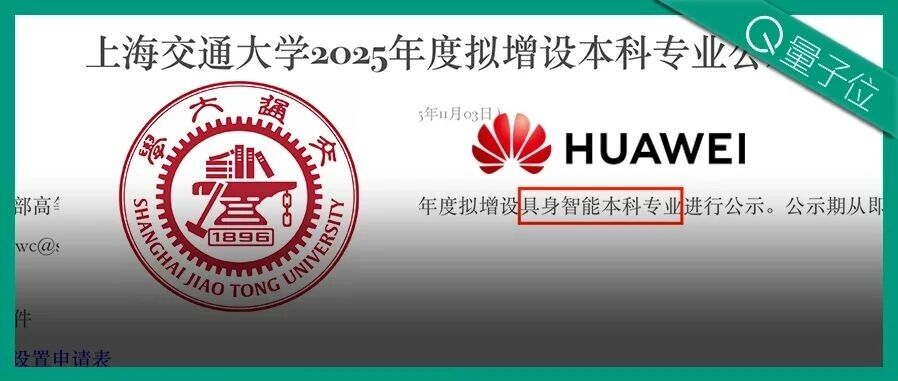
全球首个具身智能本科专业!上海交大公告,联合华为培养,李飞飞高徒带队
量子位· 2025-11-30 05:09
Core Viewpoint - Shanghai Jiao Tong University (SJTU) is set to establish an undergraduate program in Embodied Intelligence, marking a pioneering move in China and globally, as no other institution has offered this as a standalone major [1][2][4]. Group 1: Program Details - The new program will be part of the School of Artificial Intelligence, granting an engineering degree with a four-year study duration [5][6]. - The expected annual enrollment is 30 students, with 25 anticipated to continue to further education, representing approximately 83% [5][6]. - The program aims to address the talent gap in the field by integrating knowledge from artificial intelligence, mechanical engineering, and computer science [7][10]. Group 2: Market Context - The embodied intelligence market in China is projected to reach 5.295 billion yuan this year, accounting for about 27% of the global market [7]. - The global market for embodied intelligence is expected to grow from $17.09 billion in 2024 to $124.26 billion in ten years [7]. Group 3: Institutional Background - SJTU has a strong foundation in embodied intelligence, with leading faculty members and established research platforms [20][27]. - The program will be led by Professor Lu Ce Wu, who has significant academic and entrepreneurial experience in the field [13][17]. Group 4: Industry Collaboration - The program is designed to produce high-quality talent for the industry, with partnerships for student training, including Huawei and the National Local Joint Innovation Center for Humanoid Robots [5][11]. - Other universities in China are also planning to establish similar programs, indicating a growing interest in embodied intelligence education [28][31]. Group 5: Broader Trends - The establishment of the program reflects a broader trend of increasing investment and interest in embodied intelligence across academia and industry, reminiscent of the AI boom in 2018 [41]. - Numerous collaborations between universities and companies are emerging, enhancing the practical application of embodied intelligence technologies [33][39].
中文屋提出者逝世,曾当众“调戏”Hinton被记了半辈子
量子位· 2025-11-30 05:09
Core Viewpoint - The article discusses the legacy of philosopher John Searle, particularly his famous "Chinese Room" thought experiment, which challenges the notion of machine understanding in artificial intelligence [1][3][4]. Group 1: John Searle's Contributions - John Searle passed away at the age of 93, leaving behind a significant impact on the philosophy of artificial intelligence [1]. - The "Chinese Room" thought experiment, proposed in 1980, is considered a classic in the philosophy of AI, questioning whether machines can truly "understand" or merely simulate understanding [3][4]. - Searle's argument posits that while machines can manipulate symbols, they do not possess genuine understanding, emphasizing the difference between syntax (form) and semantics (meaning) [52][54]. Group 2: The Chinese Room Experiment - The experiment involves an English speaker in a room who uses a rulebook to respond to Chinese characters without understanding the language, illustrating that the person inside the room does not comprehend Chinese despite producing correct responses [49][52]. - Searle's conclusion is that computational processes do not equate to human understanding, as machines operate on a syntactical level without grasping the semantic content [53][56]. - The ongoing debate surrounding AI's ability to understand language continues, with the "Chinese Room" serving as a reference point for discussions about the nature of understanding in AI systems [57][59]. Group 3: Academic and Cultural Context - Searle's choice of Chinese for the thought experiment reflects cultural stereotypes and the idea of a language that is operationally complex yet difficult to understand for English speakers [70][73]. - The article highlights the philosophical tensions between Searle and other AI pioneers, such as Geoffrey Hinton, who later suggested that large language models do exhibit a form of understanding through their statistical processing of language [64][65]. - Searle's legacy is marked by both his intellectual contributions and the controversies surrounding his later years, including allegations of sexual harassment that affected his reputation [41][42].

量子位编辑作者招聘
量子位· 2025-11-30 05:09
Core Viewpoint - The article emphasizes the ongoing AI boom and invites individuals to join the company "Quantum Bit" to track AI advancements and become content experts in various AI-related fields [1]. Group 1: Job Opportunities - The company is hiring for three main directions: AI Industry, AI Finance, and AI Product, with positions available for both experienced professionals and fresh graduates [2][4]. - Positions are full-time and based in Beijing, with opportunities for mentorship and professional growth [3][6]. Group 2: Job Responsibilities - **AI Industry Direction**: Focus on infrastructure innovations including chips, AI infrastructure, and cloud computing [5]. - **AI Finance Direction**: Track venture capital and financial reports in the AI sector, analyzing capital movements within the industry [6]. - **AI Product Direction**: Monitor the application and hardware developments of AI, including software products and hardware implementations [10]. Group 3: Candidate Requirements - Candidates should have a basic understanding of chips, GPUs, NPUs, servers, and cloud computing, with a preference for those with technical backgrounds in engineering or computer science [11]. - For the AI Finance role, candidates should be data-sensitive and interested in financial reports and strategic planning [9]. - The AI Product role requires candidates to be keen on AI product experiences and familiar with major terminal manufacturers [10]. Group 4: Company Achievements - By 2025, Quantum Bit aims to have over 2.4 million subscribers on WeChat and more than 7 million users across platforms, with a daily reading volume exceeding 2 million [12]. - The company is recognized as the top new media outlet in the AI and frontier technology sector according to third-party data platforms [12].

做「最内行」的AI职业搭档Agent丨对话小麦招聘
量子位· 2025-11-29 06:02
Core Insights - The recruitment industry is undergoing rapid transformation due to AI, which is expected to reshape the entire job-seeking process by enhancing understanding and connection between job seekers and employers [4][5][21]. - Traditional recruitment apps primarily focus on resume optimization and Q&A assistance, failing to address the core issue of information overload for job seekers [3][4]. Group 1: AI's Impact on Recruitment - AI is expected to reduce recruitment costs significantly, from hundreds of thousands to a few thousand, while increasing efficiency by several orders of magnitude, thus activating previously unserviceable job positions [6][20]. - The recruitment process is fundamentally about information alignment, where AI can rewrite the understanding between individuals and opportunities, addressing the core pain point of information asymmetry [9][16]. Group 2: Business Model and Market Dynamics - Traditional job platforms operate on a "traffic monetization" model, while the new approach focuses on "result delivery," aiming for users to find suitable opportunities more quickly and accurately [9][39]. - The AI recruitment market is viewed as an incremental market, with the potential for increased transaction density and frequency as more companies and individuals are willing to pay for enhanced experiences [20][21]. Group 3: Product Design and Functionality - The key to successful AI recruitment products lies in understanding the business context and providing comprehensive information and context for better matching [27][30]. - AI agents should possess advisory-level judgment and the ability to provide professional services at scale, utilizing extensive information and semantic understanding [10][30]. Group 4: Current Market Landscape - The AI recruitment sector is still in its early stages, with leading players continuously adjusting their strategies and seeking product-market fit (PMF) [11][37]. - The penetration rate of AI in recruitment remains low, with many users still relying on traditional services, indicating significant room for growth [37][38]. Group 5: Future Outlook - AI is not expected to completely replace human recruiters but rather enhance their efficiency, especially in complex recruitment scenarios where trust and nuanced understanding are crucial [24][25]. - The integration of AI in recruitment is anticipated to evolve, with a focus on creating a data feedback loop that allows continuous learning and improvement of the matching process [29][43].

速报!MEET2026嘉宾阵容再更新,观众报名从速
量子位· 2025-11-29 04:02
Core Insights - The MEET2026 Smart Future Conference will focus on cutting-edge technologies and industry developments that have garnered significant attention throughout the year [1] - The theme "Symbiosis Without Boundaries, Intelligence to Ignite the Future" emphasizes how AI and smart technologies penetrate various industries, disciplines, and scenarios, becoming a core driving force for societal evolution [2] Group 1: Conference Highlights - The conference will cover hot topics in the tech circle this year, including reinforcement learning, multimodal AI, chip computing power, AI in various industries, and AI going global [3] - It will feature the latest collisions between academic frontiers and commercial applications, showcasing leading technological achievements from infrastructure, models, and product industries [4] - The event will also include the authoritative release of the annual AI rankings and the annual AI trend report [5][116] Group 2: Notable Speakers - Zhang Yaqin, President of Tsinghua University's Intelligent Industry Research Institute and an academician of the Chinese Academy of Engineering, has extensive experience in AI and digital video technologies [11][12] - Sun Maosong, Executive Vice President of Tsinghua University's AI Research Institute, has led numerous national projects in AI research [15] - Wang Zhongyuan, Director of the Beijing Academy of Artificial Intelligence, has a strong background in AI core technology development and has published over 100 papers [19] Group 3: Industry Impact - The annual AI rankings initiated by Quantum Bit have become one of the most influential lists in the AI industry, evaluating companies, products, and individuals across three dimensions [117] - The annual AI trend report will analyze ten significant AI trends based on technology maturity, implementation status, and potential value, highlighting representative organizations and best cases [118] - The conference aims to attract thousands of tech professionals and millions of online viewers, establishing itself as an annual barometer for the smart technology industry [122]


量子位编辑作者招聘
量子位· 2025-11-29 04:02
Core Viewpoint - The article emphasizes the ongoing AI boom and invites individuals to join the company "Quantum Bit," which focuses on tracking AI advancements and has established itself as a leading content platform in the industry [1]. Recruitment Opportunities - The company is hiring for three main directions: AI Industry, AI Finance, and AI Product, with positions available for both experienced professionals and fresh graduates [2][4]. - All positions are full-time and based in Beijing, Zhongguancun [2]. Job Responsibilities - **AI Industry Direction**: Focus on infrastructure innovations including chips, AI infrastructure, and cloud computing [5]. - **AI Finance Direction**: Track venture capital and financial reports in the AI sector, monitoring capital movements within the industry [6]. - **AI Product Direction**: Monitor advancements in AI applications and hardware terminals [6]. Benefits of Joining - Employees will gain first-hand exposure to the latest AI technologies and products, enhancing their understanding of the AI landscape [6]. - The company promotes the use of new AI tools to improve work efficiency and creativity [6]. - Opportunities to build personal influence through writing original content and engaging with industry leaders [6]. - New hires will receive mentorship from senior editors to accelerate their professional growth [6]. - The company offers competitive salaries and comprehensive benefits including social insurance, meal allowances, and performance bonuses [6]. Company Overview - As of 2025, Quantum Bit has over 2.4 million subscribers on WeChat and more than 7 million users across the internet, with a daily reading volume exceeding 2 million [12]. - It is recognized as the top new media outlet in the AI and frontier technology sector according to third-party data platforms [12].

华尔街尬捧TPU学术界懵了:何恺明5年前就是TPU编程高手,多新鲜~
量子位· 2025-11-29 04:02
Core Viewpoint - The article discusses the implications of Meta's potential multi-billion dollar TPU order from Google, highlighting the competitive dynamics between Google and NVIDIA in the AI hardware market, and questioning the perceived advantages of both companies' technologies [1][2][3]. Group 1: Market Reactions - Following the news of Meta's TPU order, NVIDIA's stock experienced a significant drop, losing over $300 billion in market value, while Google's stock rose, adding approximately $150 billion in market capitalization [1][2]. - The Wall Street Journal interpreted this as a challenge to NVIDIA's market dominance by Google [3]. Group 2: Technical Insights - Industry experts argue that the excitement around Google's TPU is misplaced, as major companies like Meta and xAI have been utilizing TPU technology for years [3][4]. - OpenAI's Clive Chan noted that Google's TPU has been integral to various AI models, including Gemini and Claude, and that Meta's use of TPU is not surprising [5][10]. Group 3: Cost and Performance Analysis - A comparative analysis by Artificial Analysis revealed that Google's TPU v6e offers significantly lower performance per dollar compared to NVIDIA's H100, with TPU v6e costing $5.13 for a specific workload versus H100's $1.06 [13][14]. - The latest TPU v7 has comparable performance metrics to NVIDIA's GB200, with TPU v7 achieving 4.6 PFLOP/s at a power consumption of approximately 1000 watts [18][19]. Group 4: Strategic Implications - Analysts suggest that Google's sale of TPU is not primarily for profit but to secure production capacity, leveraging contracts with Meta and Apple to ensure chip supply [20][21]. - This strategy may limit opportunities for smaller chip companies, as Google’s agreements with manufacturers could restrict access to production resources [24][28].



混元OCR模型核心技术揭秘:统一框架、真端到端
量子位· 2025-11-29 04:02
Core Insights - Tencent's HunyuanOCR model is a commercial-grade, open-source, lightweight OCR-specific visual language model with 1 billion parameters, combining native ViT and lightweight LLM architectures [1] - The model excels in perception capabilities (text detection and recognition, complex document parsing) and semantic abilities (information extraction, text-image translation), winning the ICDAR 2025 DIMT challenge and achieving SOTA results on OCRBench for models under 3 billion parameters [2] Model Performance and Popularity - HunyuanOCR ranks in the top four on Hugging Face's trending list, has over 700 stars on GitHub, and was integrated by the vllm official team on Day 0 [3] Team Achievements - The HunyuanOCR team has achieved three major breakthroughs: 1. Unified efficiency, supporting various tasks like text detection, complex document parsing, and visual question answering within a lightweight framework [5] 2. Simplified end-to-end architecture, eliminating dependencies on pre-processing and reducing deployment complexity [6] 3. Data-driven innovations using high-quality data and reinforcement learning to enhance OCR task performance [8] Core Technology - HunyuanOCR focuses on lightweight model structure design, high-quality pre-training data production, application-oriented pre-training strategies, and task-specific reinforcement learning [11] Lightweight Model Structure - The model employs an end-to-end training and inference paradigm, requiring only a single inference to achieve complete results, avoiding common issues of error accumulation in traditional architectures [14][19] High-Quality Data Production - The team built a large-scale multimodal training corpus with over 200 million "image-text pairs," covering nine core real-world scenarios and over 130 languages [21] Pre-Training Strategy - HunyuanOCR uses a four-stage pre-training strategy focusing on visual-language alignment and understanding, with specific stages dedicated to long document processing and application-oriented training [29][32] Reinforcement Learning Approach - The model innovatively applies reinforcement learning to enhance performance, using a hybrid strategy for structured tasks and LLM-based rewards for open-ended tasks [36] Data Quality and Reward Design - The data construction process emphasizes quality, diversity, and difficulty balance, utilizing LLM to filter low-quality data and ensuring effective training [39] - Adaptive reward designs are implemented for various tasks, ensuring precise and verifiable outputs [40][42]