量子位

Search documents
「世界理解」维度看AI视频生成:Veo3和Sora2水平如何?新基准来了
量子位· 2025-10-27 08:26
Core Insights - The article discusses the significant advancements in Text-to-Video (T2V) models, particularly highlighting the recent success of Sora2 and questioning whether T2V models have achieved true "world model" capabilities [1] - A new evaluation framework called VideoVerse has been proposed to assess T2V models on their understanding of event causality, physical laws, and common sense, which are essential for a "world model" [1][3] Evaluation Framework - VideoVerse aims to evaluate T2V models based on two main perspectives: dynamic aspects (event following, mechanics, interaction, material properties, camera control) and static aspects (natural constraints, common sense, attribution correctness, 2D layout, 3D depth) [3] - Each prompt corresponds to several binary evaluation questions, with event following measured through sequence consistency using Longest Common Subsequence (LCS) [4][16] Prompt Construction - The team employs a multi-stage process to ensure the authenticity, diversity, and evaluability of prompts, sourcing data from daily life, scientific experiments, and science fiction [8][9] - Event and causal structures are extracted using advanced language models to convert natural language descriptions into event-level structures, laying the groundwork for evaluating "event following" [10][11] Evaluation Methodology - The evaluation combines QA and LCS scoring, focusing on event following, dimension-specific questions, and overall scoring that reflects both logical sequence and physical details [5][18] - The introduction of hidden semantics aims to assess whether models can generate implicit consequences that are not explicitly stated in prompts [20][22] Experimental Findings - The team evaluated various open-source and closed-source models, finding that open-source models perform comparably in basic dimensions but lag significantly in world model capabilities [28] - Even the strongest closed-source model, Sora2, shows notable deficiencies in "hidden semantics following" and certain physical/material inferences [29] Conclusion and Future Directions - VideoVerse provides a comprehensive evaluation framework aimed at shifting the focus from merely generating realistic visuals to understanding and simulating the world [40] - The team has open-sourced data, evaluation code, and a leaderboard, encouraging further research to enhance world model capabilities [41]


美团视频生成模型来了!一出手就是开源SOTA
量子位· 2025-10-27 05:37
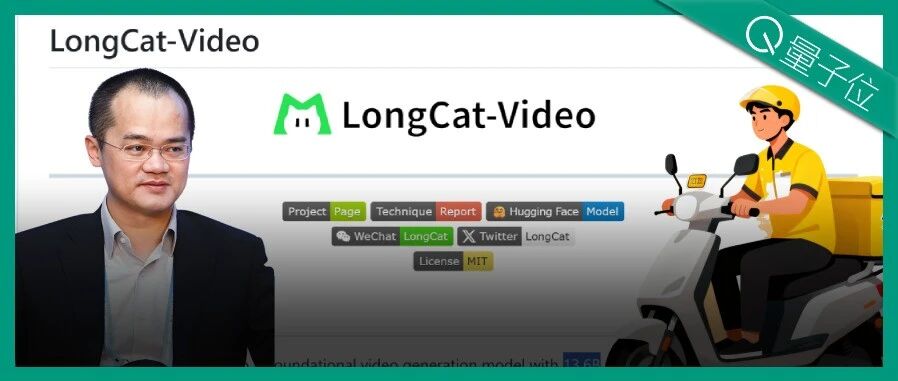
Core Viewpoint - Meituan has launched an open-source video model named LongCat-Video, which supports text-to-video and image-to-video generation, showcasing significant advancements in video generation technology [1][39]. Group 1: Model Features - LongCat-Video has 13.6 billion parameters and can generate videos lasting up to five minutes, demonstrating a strong understanding of real-world physics and semantics [1][12][39]. - The model excels in generating 720p, 30fps videos with high semantic understanding and visual presentation capabilities, ranking among the best in open-source models [18][62]. - It can maintain consistency in generated videos, addressing challenges such as detail capture and complex lighting effects [19][24]. Group 2: Technical Innovations - LongCat-Video integrates three main tasks: text-to-video, image-to-video, and video continuation, using a Diffusion Transformer framework [41]. - The model employs a unique training approach that directly pre-trains on video continuation tasks, mitigating cumulative errors in long video generation [46][48]. - It utilizes advanced techniques like block sparse attention and a from-coarse-to-fine generation paradigm to enhance video generation efficiency [52][53]. Group 3: Performance Evaluation - In internal benchmarks, LongCat-Video outperformed models like PixVerse-V5 and Wan2.2-T2V-A14B in overall quality, with strong performance in visual quality and motion quality [62][63]. - The model achieved a top score in common-sense dimensions, indicating its superior ability to model the physical world [64]. Group 4: Broader Context - This is not the first instance of Meituan venturing into AI; the company has previously released various models, including LongCat-Flash-Chat and LongCat-Flash-Thinking, showcasing its commitment to AI innovation [65][68].
OpenAI产品线拉出来吓我一跳,奥特曼不愧是YC出身
量子位· 2025-10-27 05:37
Core Insights - OpenAI has adopted a strategy similar to major internet companies, focusing on expanding its product lines while leveraging its distribution channel, ChatGPT, which has approximately 1 billion users [2][4][27] - The approach involves creating a strong core application to monopolize distribution, followed by rapid experimentation with various products to identify viable offerings [25][28][30] Product Line Overview - OpenAI is developing a diverse range of products, including: - Collaborative tools for real-time interaction among ChatGPT users [9] - New AI models combining traditional large language models with reasoning capabilities [10] - ChatGPT-agent for creating and editing spreadsheets and presentations [11] - An AI-integrated web browser (Atlas) [12] - AI programming assistant (A-SWE) that simulates advanced software engineering tasks [14] - Humanoid robots and AI-driven personal devices [15][16] - Social media features for sharing ChatGPT usage experiences [17] - Personalized shopping recommendations within ChatGPT [19] - Customized models for internal AI tools based on unique client data [20] - Music generation AI for creating music from scratch [21] - The foundational ChatGPT chatbot [22] Strategic Goals - The strategy aims to first monetize through direct revenue-generating products like the AI programming assistant and then create an immersive ecosystem to retain users [32][33] - Future aspirations include integrating AI into everyday life through robots and personal devices, expanding the influence of AI beyond the virtual realm [34] Innovation and Risk Management - OpenAI's approach minimizes innovation risks by allowing for product failures without jeopardizing the core user base [29] - This strategy reflects a shift in the competitive landscape of AI, moving towards ecosystem-based competition rather than isolated breakthroughs [36] Historical Context - The current strategy is influenced by CEO Sam Altman's previous experience at Y Combinator, where the focus was on rapid growth through diverse product offerings [39][40] - OpenAI has transitioned from a purely academic institution to an AI-driven internet company, balancing profit pursuits with its mission to ensure AGI benefits humanity [43][45]

人工智能年度榜单火热报名中!五大奖项,寻找AI+时代的先锋力量
量子位· 2025-10-27 05:37
Core Viewpoint - The article announces the launch of the "2025 Artificial Intelligence Annual Awards" to recognize outstanding contributions in the AI industry, encouraging participation from various enterprises and individuals [1][2]. Group 1: Award Categories - The awards will be evaluated across three main dimensions: Enterprises, Products, and Individuals, with five specific award categories [2][4]. - Categories include: - 2025 AI Leading Enterprises - 2025 AI Potential Startups - 2025 AI Outstanding Products - 2025 AI Outstanding Solutions - 2025 AI Focus Individuals [5][6]. Group 2: Evaluation Criteria - For the 2025 AI Leading Enterprises, criteria include being registered in China or primarily serving the Chinese market, having a strong presence in AI or related industries, and demonstrating significant breakthroughs in technology or market expansion over the past year [6]. - The 2025 AI Potential Startups will focus on innovative companies with high investment value and growth potential, requiring a viable business model and market recognition [12]. - The 2025 AI Outstanding Products will be assessed based on business capabilities, technical capabilities, capital capabilities, and overall comprehensive abilities [11]. - The 2025 AI Outstanding Solutions will evaluate innovative applications of AI across various industries, focusing on their impact and implementation success [18]. - The 2025 AI Focus Individuals will be recognized for their significant contributions to AI technology and commercialization, requiring a proven track record of leadership and industry influence [23]. Group 3: Event Details - The registration for the awards is open until November 17, 2025, with results to be announced at the MEET2026 Intelligent Future Conference [22]. - The MEET2026 conference will gather leaders from technology, industry, and academia to discuss transformative changes in the AI sector [25][26].

拜拜了GUI!中科院团队“LLM友好”计算机使用接口来了
量子位· 2025-10-27 05:37
Core Viewpoint - The article discusses the limitations of current LLM agents in automating computer operations, attributing the main bottleneck to the traditional command-based graphical user interface (GUI) that has been in use for over 40 years [2][4]. Group 1: Issues with Current LLM Agents - Current LLM agents face two major pain points: low success rates and inefficiency when handling complex tasks [7]. - The command-based design of GUIs requires LLMs to perform both strategic planning and detailed operational tasks, leading to inefficiencies and increased cognitive load [6][9]. - Human users excel in visual recognition and quick decision-making, while LLMs struggle with visual information and have slower response times [8]. Group 2: Proposed Solution - Declarative Interfaces - The research team proposes a shift from command-based to declarative interfaces (GOI), allowing LLMs to focus on high-level task planning while automating the underlying navigation and interaction [10][12]. - GOI separates the strategy (what to do) from the mechanism (how to do it), enabling LLMs to issue simple declarative commands [14][15]. - The implementation of GOI involves two phases: offline modeling to create a UI navigation graph and online execution using a simplified interface [16][19]. Group 3: Experimental Results - The introduction of GOI significantly improved performance, with success rates increasing from 44% to 74% when using the GPT-5 model [21]. - Failure analysis showed that after implementing GOI, 81% of failures were due to strategic errors rather than mechanism errors, indicating a successful reduction in low-level operational mistakes [24][25]. Group 4: Future Implications - The research suggests that GOI provides a clear direction for designing interaction paradigms that are more suitable for large models [27]. - It raises the question of whether future operating systems and applications should natively offer LLM-friendly declarative interfaces to facilitate the development of more powerful and versatile AI agents [28].

特斯拉世界模拟器亮相ICCV!VP亲自解密端到端自动驾驶技术路线
量子位· 2025-10-27 05:37
Core Viewpoint - Tesla has unveiled a world simulator for autonomous driving, showcasing its potential to generate realistic driving scenarios and enhance the training of AI models for self-driving technology [1][4][12]. Group 1: World Simulator Features - The simulator can create new challenging scenarios for autonomous driving tasks, such as unexpected lane changes by other vehicles [4][5]. - It allows AI to perform driving tasks in existing scenarios, avoiding pedestrians and obstacles [7][9]. - The generated scenario videos can also serve as a gaming experience for human users [9]. Group 2: End-to-End AI Approach - Tesla's VP Ashok Elluswamy emphasized that end-to-end AI is the future of autonomous driving, applicable not only to driving but also to other intelligent scenarios like the Tesla Optimus robot [12][13][14]. - The end-to-end neural network utilizes data from various sensors to generate control commands for the vehicle, contrasting with modular systems that are easier to develop initially but less effective in the long run [17]. - The end-to-end approach allows for better optimization and handling of complex driving situations, such as navigating around obstacles [18][21]. Group 3: Challenges and Solutions - One major challenge for end-to-end autonomous driving is evaluation, which Tesla addresses with its world simulator that trains on a vast dataset [22][24]. - The simulator can also facilitate large-scale reinforcement learning, potentially surpassing human performance [24]. - Other challenges include the "curse of dimensionality," interpretability, and safety guarantees, which require processing vast amounts of data [26][27][28]. Group 4: Data Utilization - Tesla collects data equivalent to 500 years of driving every day, using a complex data engine to filter high-quality samples for training [29][30]. - This extensive data collection enhances the model's generalization capabilities to handle extreme situations [30]. Group 5: Technical Approaches in the Industry - The industry is divided between two main approaches: VLA (Vision-Language Architecture) and world models, with companies like Huawei and NIO representing the latter [38][39]. - VLA proponents argue it leverages existing internet data for better understanding, while world model advocates believe it addresses the core issues of autonomous driving [41][42]. - Tesla's approach is closely watched due to its historical success in selecting effective strategies in autonomous driving development [43][44].


相机参数秒变图片!新模型打通理解生成壁垒,支持任意视角图像创作
量子位· 2025-10-27 03:31
Core Viewpoint - The article discusses the introduction of the Puffin unified multimodal model, which integrates the understanding of camera parameters and the generation of corresponding perspective images, addressing previous limitations in multimodal models [2][12]. Research Motivation - The ability to understand scenes from any perspective and hypothesize about the environment beyond the field of view allows for the mental recreation of a real-world with free viewpoints [8]. - Cameras serve as crucial interfaces for machines to interact with the physical world and achieve spatial intelligence [9]. Model Design - The Puffin model combines language regression and diffusion-based generation capabilities, enabling understanding and creation of scenes from any angle [12]. - A geometric-aligned visual encoder is introduced to maintain geometric fidelity while ensuring strong semantic understanding, addressing performance bottlenecks in existing models [14]. Thinking with Camera Concept - The concept of "thinking with camera" allows for the decoupling of camera parameters in a geometric context, establishing connections between spatial visual cues and professional photography terminology [20][21]. - The model incorporates spatially constrained visual cues and professional photography terms to bridge the gap between low/mid-level camera geometry and high-level multimodal reasoning [22][23]. Shared Thinking Chain - A shared thinking chain mechanism is introduced to unify the reasoning processes between controllable image generation and understanding tasks, enhancing the model's ability to generate accurate spatial structures [28]. Puffin-4M Dataset - The Puffin-4M dataset consists of approximately 4 million image-language-camera triples, addressing the scarcity of multimodal datasets in the spatial intelligence domain [29][30]. Experimental Results - Puffin demonstrates superior performance in camera understanding tasks, achieving significant improvements in accuracy compared to existing methods [36][38]. - The model's robustness is evident in various scene configurations, showcasing its capability for controllable image generation [41]. Applications - Puffin can assist in the insertion of virtual 3D objects into natural scene images through precise camera parameter predictions [43]. - The model can be flexibly extended to various cross-perspective tasks, including spatial imagination and world exploration, maintaining spatial consistency in generated results [44]. Future Plans - The team aims to enhance Puffin's cross-perspective capabilities and expand its application to video generation and understanding centered around camera parameters, promoting broader use in dynamic and immersive scenarios [45].
OpenAI IPO计划第一步曝光,奥特曼骚操作看傻华尔街
量子位· 2025-10-27 03:31
Core Insights - OpenAI is moving closer to an IPO as SoftBank approves an additional $22.5 billion investment, contingent on OpenAI completing its restructuring by the end of the year [2][9] - The total investment in OpenAI has now reached $30 billion, including a previous $7.5 billion investment [8] - OpenAI's valuation has surged to $260 billion following a $41 billion funding round announced in April [10] Group 1: Investment and Restructuring - SoftBank's new investment is part of a strategy to transition OpenAI from a non-profit to a public benefit corporation, paving the way for an IPO [9] - If OpenAI fails to complete the restructuring by the deadline, the investment amount could decrease from $30 billion to $20 billion [11] - The restructuring is critical for OpenAI to secure the full investment and enhance its market position [7] Group 2: Negotiation Tactics - OpenAI's CEO, Sam Altman, has been noted for bypassing traditional investment banking and legal channels, negotiating directly with major tech firms like NVIDIA and AMD [4][13] - Altman’s negotiation style has been described as unconventional, focusing on trust rather than detailed financial agreements [21][31] - Key executives involved in these negotiations include Greg Brockman, Sarah Friar, and Peter Hoeschele, who bring significant experience from previous roles in finance and technology [14][17][19] Group 3: Major Deals and Partnerships - Altman negotiated a staggering $1.5 trillion chip deal, with NVIDIA committing $100 billion in investment while OpenAI agreed to purchase $350 billion worth of chips [25] - The partnership with AMD includes a warrant for OpenAI to purchase up to 10% of AMD shares at $0.01 each, in exchange for a commitment to buy 6GW of chips [28] - A collaboration with Oracle worth $300 billion over five years emerged from a chance encounter, highlighting the importance of relationships in securing deals [30]

这种眼镜我建议外卖快递小哥人手一个
量子位· 2025-10-27 03:31
Core Viewpoint - Amazon has introduced a smart glasses prototype named "Amelia" for its delivery personnel, aimed at enhancing logistics efficiency and safety through AI and computer vision technology [5][19]. Group 1: Product Features and Functionality - The smart glasses allow delivery personnel to scan packages, receive walking directions, and obtain delivery confirmations without needing to look down at a device [6][20]. - The glasses are equipped with a display screen, two cameras, and a flashlight for low-light conditions, and they can be customized for users with vision impairments [8][10]. - The system includes a vest that houses the control system, providing 8-10 hours of battery life to meet the demands of a full workday [11][10]. - Future versions of the glasses are expected to include features like real-time defect detection and alerts for potential hazards, such as pets at delivery locations [14][20]. Group 2: Market Context and Competition - Amazon plans to mass-produce the smart glasses by mid-2026, with an initial production run of approximately 100,000 units [18]. - The introduction of "Amelia" is seen as a strategic move to compete with Meta in the smart glasses market, as Amazon is also developing a consumer-grade model called "Jayhawk" [22][23]. - The smart glasses market is experiencing significant growth, with Meta's second-generation smart glasses projected to sell 1.42 million units in 2024, potentially exceeding 4 million units in 2025 [24]. Group 3: Industry Trends and Future Outlook - Major tech companies, including Apple and Google, are intensifying their efforts in the smart glasses sector, indicating a competitive landscape [25][26]. - The domestic market is also witnessing a surge in interest, with companies like Xiaomi and Huawei entering the AI glasses space [28]. - The price point for smart glasses is crucial for mass adoption, with estimates suggesting that a price below 2000 yuan could facilitate entry into the mainstream market [30][32].


99%的AI产品都没有真正的护城河,初创产品需要做好「细分场景+生态协同」 | 对话AI播客工具Podwise
量子位· 2025-10-26 08:13
Core Viewpoint - The article discusses the emerging business potential of AI podcasting tools, highlighting various startups that are innovating in this niche market, particularly focusing on Podwise, which aims to enhance podcast consumption and knowledge management through AI technology [2][4]. Summary by Sections Overview of AI Podcasting - The market for AI podcasting tools is still developing, with startups exploring different directions [2]. - Podwise is identified as a key player, focusing on transforming linear audio into structured knowledge that is retrievable and reusable [8]. Podwise's Target Audience and Features - Podwise targets users who treat podcasts as learning materials, such as investors, content creators, and lifelong learners [8]. - The tool offers features like transcription, summarization, and integration with knowledge management systems like Notion and Obsidian, addressing the pain points of long podcast reviews and information retrieval [8][11]. Product-Market Fit and User Engagement - Podwise's founders emphasize the importance of identifying product-market fit (PMF) through user engagement and willingness to pay, rather than just user numbers [11][34]. - The tool's success is attributed to its ability to meet the needs of specific user groups, leading to a high conversion rate from free to paid users [34][39]. Competitive Advantages - Podwise boasts higher transcription accuracy compared to generic ASR tools by leveraging its deep understanding of podcast content [11][29]. - Unique features include speaker recognition across different podcasts and the ability to handle long-form content, which is common in the podcasting space [30][31]. Growth Strategies - The company focuses on appearing in active user communities and leveraging platforms like Xiaohongshu and Reddit for organic growth [45][46]. - Podwise has implemented affiliate marketing strategies to engage content creators and expand its user base [48]. Product Development and User Feedback - The development process is driven by user feedback collected through various channels, ensuring that new features align with user needs [49][50]. - The team prioritizes features that enhance the core value of the product, avoiding unnecessary complexity [58]. Future Directions - Podwise plans to continue refining its core functionalities while exploring new product opportunities within the podcasting ecosystem [58][79]. - The focus remains on knowledge acquisition from "hardcore" podcasts, avoiding diversification into unrelated areas [58].