digihuman(835670)

Search documents
云知声获三项国际领先认证,领跑医疗、端侧AI与数字人多个赛道
Sou Hu Cai Jing· 2025-11-05 00:34
Core Insights - The article highlights the advancements made by Yunzhisheng in the field of AGI technology, particularly in four key areas: voice technology, medical large models, edge AI, and digital human technology, showcasing China's strong capabilities in artificial intelligence [1] Group 1: Medical Large Model - The "multi-modal medical vertical large model" integrates diverse medical data, achieving over 90% accuracy in liver focal lesion detection and significantly outperforming human averages in clinical exams, thus supporting the intelligent transformation of the healthcare industry [2][3] Group 2: Edge AI and Digital Human Technology - The "refined small model on chip" technology optimizes AI model performance on edge chips, reducing resource consumption by over 100 times while maintaining excellent interaction quality, addressing traditional challenges in edge model performance [6] - The "multi-modal emotional intelligent digital human" technology creates high-fidelity digital humans capable of natural behavior and emotional expression, applicable in various sectors such as customer service and education [6] Group 3: Comprehensive AI Industry Strategy - Yunzhisheng has established a four-layer technical architecture that connects technology, scenarios, and data, enhancing its core competitiveness in the AI industry and facilitating the development of specialized digital experts across various verticals [7] - The breakthroughs in four internationally leading technologies strengthen the company's foundational technology and ensure a complete link from research and development to implementation, aiming to accelerate the commercialization of cutting-edge innovations [7]


稳步发展数字人民币 货币层次定位有望优化
Shang Hai Zheng Quan Bao· 2025-11-04 19:09
Core Insights - The development of digital RMB is transitioning from pilot exploration to systematic improvement, with the People's Bank of China (PBOC) emphasizing the need for steady development and optimization of the digital RMB management system [1][2] Group 1: Limitations of M0 Positioning - The non-interest-bearing nature of digital RMB reduces the willingness of individuals and enterprises to hold it, as it lacks the value appreciation feature that traditional bank accounts offer [2] - The disconnection between digital RMB and the banking account system complicates user experience, hindering its potential to enhance monetary policy transmission and financial regulation [2][3] - The single-functionality of digital RMB limits its usage scenarios, as it currently only supports payment functions, unlike third-party platforms that offer diverse services [2] Group 2: Need for M1 Transition - There is a growing consensus on the necessity to transition digital RMB from M0 to M1 to address its limitations, as M1 would allow it to be recognized as a liability of commercial banks, thus integrating it into their balance sheets [4][5] - Two proposed pathways for this transition include digitizing deposits to create a seamless connection between bank accounts and digital wallets, and introducing a new savings form that allows funds to be transferred to digital wallets while still being counted as bank liabilities [4][5] Group 3: Enhancing Bank Incentives - The current 100% reserve requirement for digital RMB limits banks' ability to profit from traditional lending spreads, reducing their motivation to promote digital RMB [6] - Experts suggest regulatory reforms to unify technical standards, lower development costs for banks, and allow digital RMB to be classified as a bank liability to enable lending and interest income [6][7] - Banks are encouraged to view digital RMB as an opportunity for customer acquisition and service development, creating high-frequency payment scenarios and leveraging transaction data for targeted marketing and risk management [7]
数字人民币板块11月4日跌1.86%,汉威科技领跌,主力资金净流出37.38亿元

Sou Hu Cai Jing· 2025-11-04 09:14
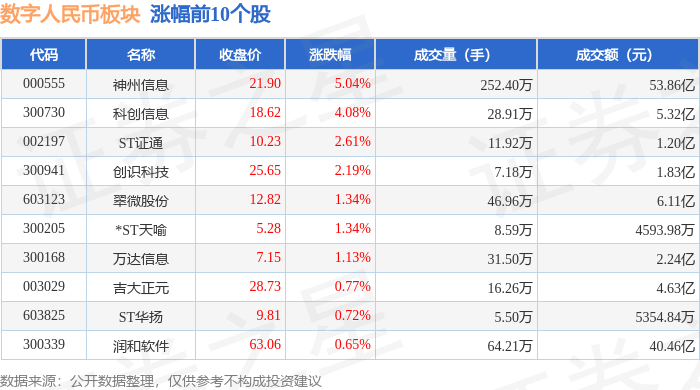
Market Overview - The digital RMB sector experienced a decline of 1.86% on November 4, with Hanwei Technology leading the drop [1] - The Shanghai Composite Index closed at 3960.19, down 0.41%, while the Shenzhen Component Index closed at 13175.22, down 1.71% [1] Stock Performance - Notable gainers in the digital RMB sector included: - Shenzhou Information (Code: 000555) with a closing price of 21.90, up 5.04% and a trading volume of 2.524 million shares, totaling 5.386 billion yuan [1] - Kexin Information (Code: 300730) closed at 18.62, up 4.08% with a trading volume of 289,100 shares, totaling 532 million yuan [1] - Major decliners included: - Hanwei Technology (Code: 300007) closed at 52.88, down 6.70% with a trading volume of 237,000 shares [2] - Information Development (Code: 300469) closed at 66.05, down 3.90% with a trading volume of 65,600 shares [2] Capital Flow - The digital RMB sector saw a net outflow of 3.738 billion yuan from major funds, while retail investors contributed a net inflow of 2.736 billion yuan [2][3] - The breakdown of capital flow for selected stocks showed: - Wanda Information (Code: 300168) had a net inflow of 29.26 million yuan from major funds, but a net outflow of 16.25 million yuan from retail investors [3] - Kexin Information (Code: 300730) recorded a net inflow of 23.41 million yuan from major funds, with a net outflow of 47.67 million yuan from retail investors [3]
数字人龙虎榜:营业部净买入1332.55万元
Zheng Quan Shi Bao Wang· 2025-11-04 09:13
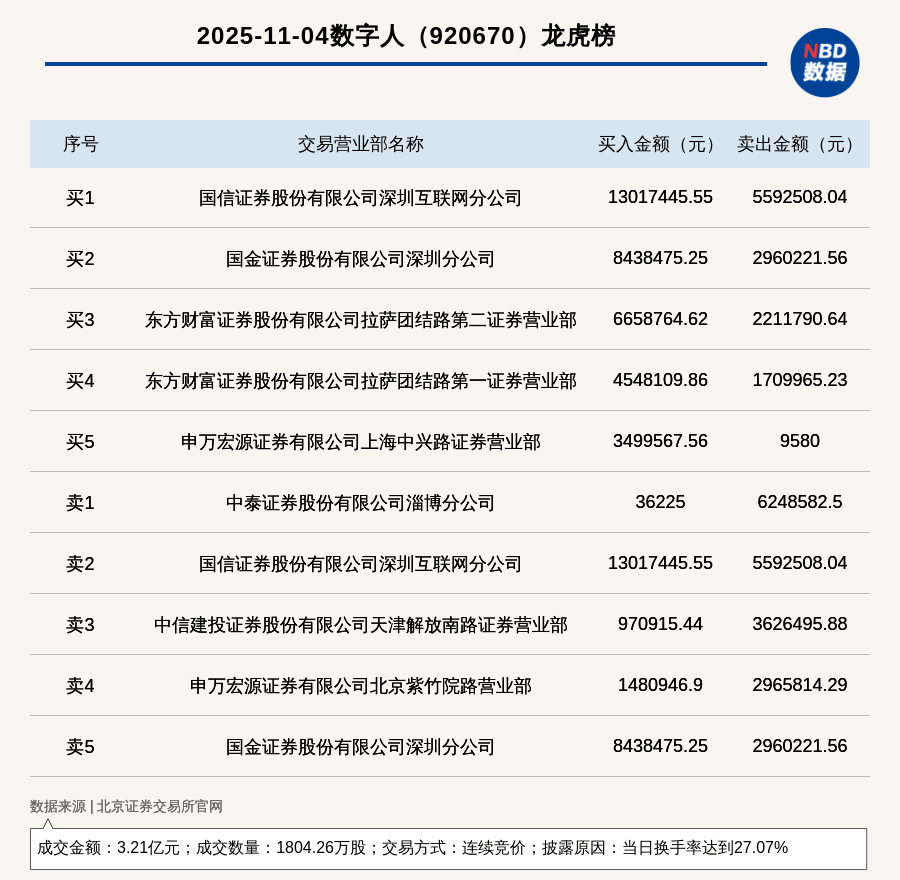
Core Insights - Digital Human (920670) experienced an increase of 8.25% in stock price with a turnover rate of 27.07% and a transaction volume of 321 million yuan, indicating strong trading activity [1] - The stock was listed on the "Dragon and Tiger List" due to its high turnover rate, with a net buying amount of 13.33 million yuan from brokerage seats [1] - Over the past six months, the stock has appeared on the Dragon and Tiger List seven times, with an average price increase of 1.09% the following day and an average increase of 2.33% over the next five days [1] Trading Activity - The top five brokerage seats accounted for a total transaction volume of 63.98 million yuan, with a buying amount of 38.65 million yuan and a selling amount of 25.33 million yuan, resulting in a net buying of 13.33 million yuan [1] - The largest buying brokerage was Guosen Securities Co., Ltd. Shenzhen Internet Branch, with a buying amount of 13.02 million yuan, while the largest selling brokerage was Zhongtai Securities Co., Ltd. Zibo Branch, with a selling amount of 6.25 million yuan [1] Detailed Brokerage Data - The top five buying brokerages and their respective buying amounts (in million yuan) are as follows: - Guosen Securities Shenzhen Internet Branch: 13.02 - Guojin Securities Shenzhen Branch: 8.44 - Dongfang Caifu Securities Lhasa Tuanjie Road Second Branch: 6.66 - Dongfang Caifu Securities Lhasa Tuanjie Road First Branch: 4.55 - Shenwan Hongyuan Securities Shanghai Zhongxing Road Branch: 3.50 [1] - The top five selling brokerages and their respective selling amounts (in million yuan) are as follows: - Zhongtai Securities Zibo Branch: 6.25 - Guosen Securities Shenzhen Internet Branch: 5.59 - CITIC Securities Tianjin Jiefang South Road Branch: 0.97 - Shenwan Hongyuan Securities Beijing Zizhu Yuan Road Branch: 2.96 - Guojin Securities Shenzhen Branch: 2.96 [1]
北交所上市公司数字人登龙虎榜:当日换手率达到27.07%
Sou Hu Cai Jing· 2025-11-04 09:04
Core Points - Digital Human (920670) listed on the Beijing Stock Exchange reached a turnover rate of 27.07% on November 4, 2025, with a trading volume of 18.04 million shares and a transaction value of 321 million yuan [1][2]. Trading Activity - The top buying seat was Guosen Securities Co., Ltd. Shenzhen Internet Branch, purchasing shares worth approximately 13.02 million yuan [1][2]. - The top selling seat was Zhongtai Securities Co., Ltd. Zibo Branch, selling shares worth approximately 6.25 million yuan [1][2]. - Other notable buying and selling activities included: - Guojin Securities Co., Ltd. Shenzhen Branch bought approximately 8.44 million yuan and sold about 2.96 million yuan [2]. - Dongfang Caifu Securities Co., Ltd. Lhasa Tuanjie Road Second Securities Branch bought approximately 6.66 million yuan and sold about 2.21 million yuan [2].
(粤港澳全运会)十五运会秀科技含量 无人驾驶、数字人显“身手”
Zhong Guo Xin Wen Wang· 2025-11-04 06:23
Core Insights - The 15th National Games, set to open on November 9, showcases advanced technology, including autonomous vehicles, digital volunteers, and energy-saving innovations [1][3]. Group 1: Technological Innovations - Autonomous vehicles made their debut during the torch relay, marking a significant advancement in transportation technology for the event [1]. - The event features a "digital volunteer" system, which provides 24-hour intelligent consultation services, reducing labor costs by 30% and improving response efficiency by 50% [3][4]. - The "metaverse cloud sports village" alleviates venue capacity pressure and traffic congestion, allowing for an immersive viewing experience via mobile devices [3][4]. Group 2: Environmental Sustainability - The event emphasizes green technology, including low-carbon renovations of sports venues and the use of a "cooling device" that reflects sunlight and achieves zero-energy cooling [4]. - The cooling technology is estimated to provide approximately 300,000 watts of cooling power, saving 200,000 kilowatt-hours of electricity and reducing carbon emissions by over 100 tons during the event [4]. Group 3: Weather Support - Advanced weather forecasting technologies, including a "hundred-meter, minute-level" prediction system, support the event by providing accurate weather information crucial for athletes [4].

连续三年亏损、目标1亿硅基劳动力仅完成0.8% “数字人”制造商硅基智能冲刺港股
Mei Ri Jing Ji Xin Wen· 2025-11-04 02:26
Core Viewpoint - Nanjing Silicon-based Intelligent Technology Group Co., Ltd. has submitted its prospectus to the Hong Kong Stock Exchange, aiming to provide 100 million silicon-based labor forces by 2025, despite facing significant challenges and having only delivered 80,000 so far [1][7]. Financial Performance - The company has experienced three consecutive years of losses, totaling over 318 million yuan, with losses of 111 million yuan, 95.91 million yuan, and 112 million yuan from 2022 to 2024 [3]. - In the first half of this year, the company reported a net loss of 8.29 million yuan but achieved an adjusted net profit of 5.29 million yuan, with an adjusted net profit margin of 1.6% [3]. - Revenue has shown significant growth, increasing from 223 million yuan in 2022 to 655 million yuan in 2024, with 326 million yuan recorded in the first half of 2025 [3]. Revenue Sources - The primary revenue streams for the company come from silicon-based intelligent voice, digital human video, digital human live streaming, and intelligent interaction, primarily serving large clients [3]. - The revenue contribution from five major clients has increased significantly, from 56.4% in 2022 to 87.5% in the first half of 2025, with the largest client contributing 64.4% of revenue in 2023 [3]. Market Position and Challenges - The company aims to differentiate its "silicon-based labor" from traditional human labor, but has only achieved 0.8% of its ambitious goal [6][7]. - The digital human industry is experiencing rapid growth but faces challenges in technology implementation and commercialization, with the Chinese market projected to reach 15.5 billion yuan by 2030 [7]. - Different industries exhibit varying demand for digital humans, with faster adoption in finance and e-commerce compared to more regulated sectors like healthcare and education [7]. Future Plans - The company plans to use the funds raised from its IPO for research and development, marketing, and global acquisitions and partnerships [7].
年入6.55亿,南航80后校友卖数字人,全国第一,腾讯押注
3 6 Ke· 2025-11-03 23:24
Core Insights - The article discusses the emergence and evolution of digital human agents, which are transforming from marketing tools to intelligent labor forces capable of handling various tasks in sectors like finance, education, and healthcare [1][2][11]. Company Overview - Silicon-based Intelligence, founded in 2017, is preparing for a Hong Kong IPO and has achieved a 32.2% market share in China, ranking second globally in the digital human sector [2][9]. - The company's revenue grew from 223 million yuan in 2022 to 655 million yuan in 2024, reflecting a compound annual growth rate (CAGR) of 71.5% [2][9]. - The company has developed the "Yan Emperor Model" and a full-stack digital human technology, serving over 40 industries with more than 80,000 digital human agents [8][9]. Market Trends - The global market for digital human agents has expanded from 1.3 billion yuan in 2021 to 4.1 billion yuan in 2024, with an average annual growth rate of 44.7% [11]. - The demand for digital human agents is driven by the deepening digital transformation of enterprises, labor shortages in countries like Japan and South Korea, and the explosion of cross-border e-commerce [12][14][15]. Competitive Landscape - The industry remains fragmented with low concentration, allowing specialized vendors to compete based on technical expertise and responsiveness to specific scenarios [5][16]. - Major players like Baidu and Tencent pose significant competition, while new entrants can focus on niche markets to differentiate themselves [16][19]. Technological Evolution - Digital human agents are evolving from simple virtual representations to capable entities that can independently handle tasks and possess professional judgment [18]. - The transition opens new growth opportunities but also increases competition complexity, requiring a focus on comprehensive capabilities including algorithms, application scenarios, and industry adaptation [18][20].
数字人换手率23.07%,龙虎榜上榜营业部合计净卖出977.63万元
Zheng Quan Shi Bao Wang· 2025-11-03 15:26
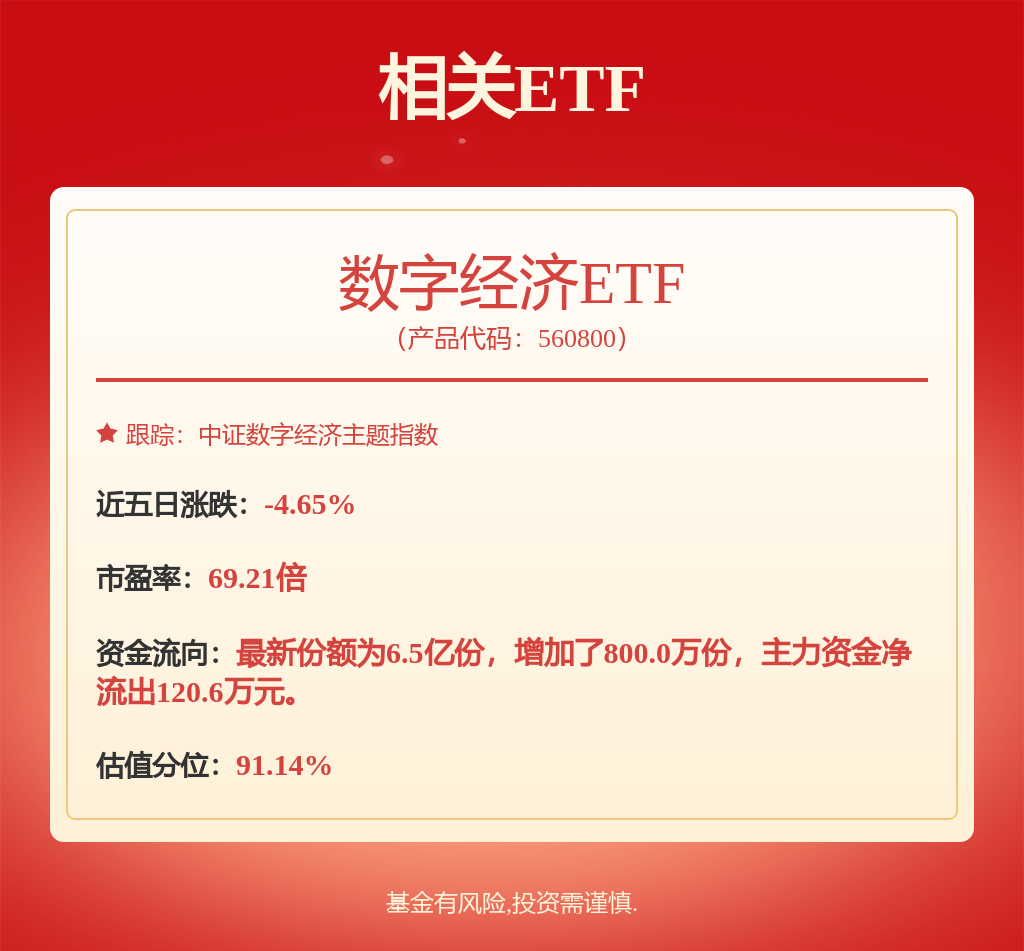
Group 1 - The stock of Digital People (920670) experienced a decline of 6.20% with a turnover rate of 23.07% and a trading volume of 272 million yuan, indicating significant market activity [1][2] - The stock was listed on the trading board due to its high turnover rate, with a net selling amount of 9.7763 million yuan from brokerage seats [2][3] - Over the past six months, the stock has appeared on the trading board six times, with an average price drop of 0.34% the day after listing and an average decline of 3.57% in the following five days [3] Group 2 - The top buying brokerage was Guojin Securities Shenzhen Branch, with a purchase amount of 6.9775 million yuan, while the top selling brokerage was Guoxin Securities Shenzhen Internet Branch, with a selling amount of 13.0175 million yuan [2][3] - The Digital Economy ETF, which tracks the China Securities Digital Economy Theme Index, has seen a decline of 4.65% over the past five days, with a price-to-earnings ratio of 69.21 times [6] - The ETF's latest share count is 650 million, with an increase of 8 million shares, and a net outflow of 1.206 million yuan in principal funds [6]
央行副行长陆磊:运用数字人民币探索跨境支付新方案
2 1 Shi Ji Jing Ji Bao Dao· 2025-11-03 14:19
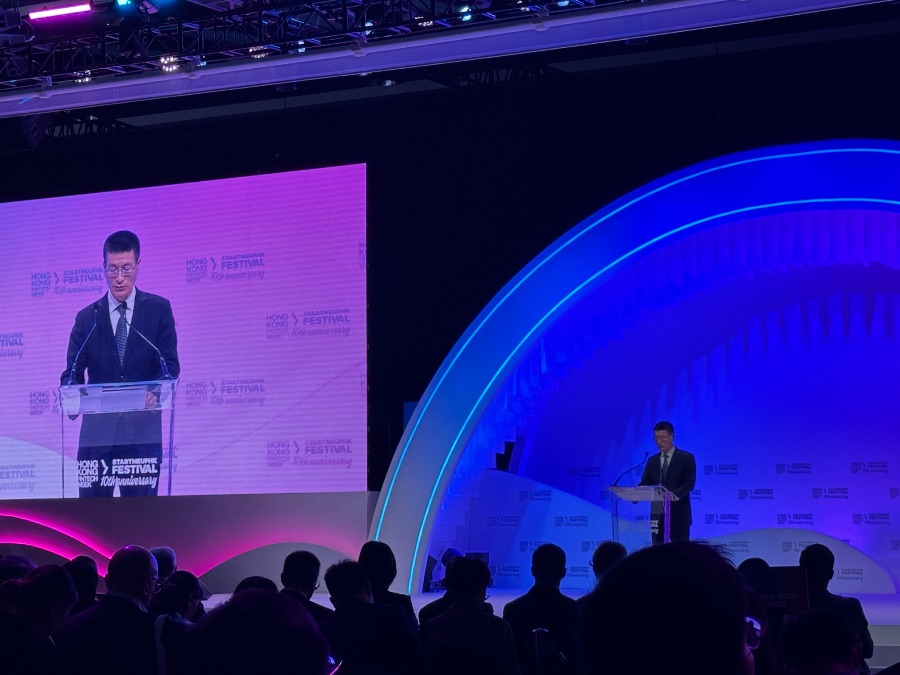
Core Insights - The People's Bank of China (PBOC) emphasizes the importance of cross-border payment cooperation with Hong Kong, leveraging financial technology innovations to enhance economic integration [1] - The digital yuan is being actively explored for cross-border payment solutions, with China being a pioneer in the development and application of central bank digital currencies (CBDCs) [1][2] - The establishment of the Digital Yuan International Operation Center in Shanghai and the Digital Yuan Operation Management Center in Beijing marks a significant step in the infrastructure for digital currency [2][3] Group 1 - The PBOC is expanding the Renminbi Cross-Border Payment System (CIPS) in Hong Kong and promoting interconnectivity between rapid payment systems [1] - The digital yuan international operation center in Shanghai has launched three major platforms: cross-border digital payment, blockchain service, and digital asset platforms [2] - The digital yuan operation management center in Beijing will oversee the core infrastructure of the digital yuan system and promote its development [3] Group 2 - The PBOC is pushing for a multilateral central bank digital currency bridge to explore new paradigms in cross-border payments [5] - The digital yuan cross-border payment platform is designed to facilitate bilateral cooperation with various monetary authorities, enhancing cross-border connectivity [5] - The integration of the "blockchain + digital asset" dual platform aims to improve regulatory efficiency and asset digitization, thereby optimizing economic resource allocation [5]