
TINGYI(00322)

Search documents
康师傅进入“魏宏丞时代”:创始人三子接棒,职业经理人时代落幕
Guan Cha Zhe Wang· 2025-12-18 12:30
Core Viewpoint - The leadership transition at Master Kong marks a return to family management after a decade of professional management, with Wei Hongcheng set to take over as CEO in 2026, following the retirement of Chen Yingrang in 2025 [1][4]. Company Announcement - Master Kong's announcement signifies the end of a managerial era, as the company returns to family leadership with Wei Hongcheng, the third son of founder Wei Yingzhou, stepping into the CEO role [4]. - The transition follows a series of strategic moves, including Wei Yingzhou's retirement to a senior advisory role in 2019 and the appointment of his sons to key positions within the company [4]. Leadership Profile - Wei Hongcheng, 43, holds degrees from Imperial College London and Harvard Business School, and has experience at Blackstone and PepsiCo before joining Master Kong in 2015 [5]. - He has been credited with effective strategic decision-making in the beverage segment, contributing to steady revenue and profit growth during his tenure [5]. - Wei Hongcheng currently holds 5 million shares and 1.385 million stock options in the company, with an estimated total compensation of approximately 9.37 million yuan for 2024 [5]. Performance Challenges - Master Kong's performance has been under pressure, with a reported revenue of 80.651 billion yuan in 2024, reflecting a minimal year-on-year increase of 0.3% [8]. - The company experienced a revenue decline of 2.7% in the first half of 2025, with total revenue of 40.092 billion yuan, and a net profit increase of 20.5% to 2.271 billion yuan [8][10]. - The beverage segment, which contributes nearly 70% of total revenue, saw a decline of 2.6% in sales, marking the first drop in beverage sales since 2021 [10][11]. Market Dynamics - The convenience food market is facing challenges due to changing consumer habits, with a shift towards delivery services impacting sales of instant noodles and packaged beverages [8][12]. - The company reported a 2.5% decline in instant noodle sales in the first half of 2025, with various product categories experiencing mixed performance [13]. - The overall market for instant noodles is under pressure, with a need for innovation to meet evolving consumer demands [14]. Strategic Outlook - The transition to family management is seen as a potential advantage for long-term strategic execution, as Wei Hongcheng takes over amid declining revenues and shrinking distribution channels [17]. - The ability of the new CEO to identify new growth opportunities within the existing framework established by previous leadership will be crucial for Master Kong's future [18].


康师傅换帅,创始人43岁儿子接棒,去年薪酬约937万
2 1 Shi Ji Jing Ji Bao Dao· 2025-12-18 12:13
Group 1 - The current CEO of Master Kong, Chen Yingrang, will retire on December 31, 2025, and Wei Hongcheng has been appointed as the new CEO effective January 1, 2026 [1] - Wei Hongcheng, aged 43, is the brother of the chairman Wei Hongming and the grandson of the founder Wei Yingzhou, holding degrees from Imperial College London and Harvard Business School [3] - As of the announcement date, Wei Hongcheng holds 5 million shares and 1.385 million stock options in the company, with a total compensation of approximately 9.37 million yuan for 2024 [4] Group 2 - For the first half of 2025, Master Kong reported revenues of 40.092 billion yuan, a year-on-year decrease of 2.7%, while the gross profit margin increased by 1.9 percentage points to 34.5% [4] - The company's net profit attributable to shareholders was 2.271 billion yuan, reflecting a year-on-year increase of 20.5% [4] - The core business of Master Kong, particularly the instant noodle segment, saw a revenue decline of 2.5% to 13.465 billion yuan, and the tea beverage segment dropped by 6.3% to 10.67 billion yuan, impacting overall beverage revenue which fell by 2.6% to 26.359 billion yuan [4] Group 3 - The decline in tea beverage revenue may indicate changing market demand for sugary tea products, and the number of marketing distributors has decreased from 67,215 to 63,806 [5] - The number of direct retail stores also declined from 220,623 to 219,124 [5] - Price increases in tea beverages, particularly for the 1L iced tea, are likely to have affected sales [6]
康师傅换帅,创始人43岁儿子接棒,去年薪酬约937万
21世纪经济报道· 2025-12-18 12:11
Core Viewpoint - The announcement of the retirement of current CEO Chen Yingrang and the appointment of Wei Hongcheng as the new CEO of Master Kong Holdings, effective January 1, 2026, marks a significant leadership transition for the company [1][4]. Group 1: Leadership Transition - Current CEO Chen Yingrang will retire on December 31, 2025, and Wei Hongcheng has been appointed as the new CEO [1]. - Wei Hongcheng, aged 43, is the brother of the board chairman Wei Hongming and the grandson of the founder Wei Yingzhou. He holds a bachelor's degree from Imperial College London and an MBA from Harvard Business School [4]. - Wei Hongcheng has been an executive director since 2019 and is currently the chairman of Master Kong Beverages [4]. Group 2: Financial Performance - In the first half of 2025, Master Kong Holdings reported revenues of 40.092 billion yuan, a decrease of 2.7% year-on-year [4]. - The gross profit margin increased by 1.9 percentage points to 34.5%, while the net profit attributable to shareholders rose by 20.5% to 2.271 billion yuan [4]. - The core business of instant noodles saw a revenue decline of 2.5% to 13.465 billion yuan, and the tea beverage segment experienced a 6.3% drop in revenue to 10.67 billion yuan, impacting overall beverage revenue which fell by 2.6% to 26.359 billion yuan [4]. Group 3: Market Challenges - The decline in tea beverage revenue may indicate changing consumer demand for sugary tea products [4]. - The number of marketing distributors decreased from 67,215 to 63,806, and the number of direct retailers fell from 220,623 to 219,124, which may have affected sales [5]. - Price increases in tea beverages, particularly for 1L iced tea, are likely to have impacted sales negatively [5].

民族品牌康师傅CEO焕新 坚定不移推动高质量发展
Zhong Guo Jin Rong Xin Xi Wang· 2025-12-18 11:47
Core Viewpoint - The announcement of Chen Yingrang's retirement as CEO of Master Kong Holdings effective January 1, 2026, and the appointment of Wei Hongcheng as the new CEO marks a significant leadership transition for the company [1][5]. Group 1: Leadership Transition - Chen Yingrang has been with the company since February 2013, achieving notable accomplishments in talent development, external partnerships, food safety, and technology platform construction [5]. - Wei Hongcheng, aged 43, has served as an executive director since January 1, 2019, and has a strong educational background with a degree from Imperial College London and an MBA from Harvard Business School [5]. - Under Wei Hongcheng's leadership, Master Kong Beverages has seen steady revenue and profit growth, focusing on consumer demand and sustainable development [5]. Group 2: Company Mission and Vision - Master Kong aims to promote Chinese culinary culture and aspires to be a respected enterprise, committing to high-quality development and continuous investment in product innovation, brand building, and channel expansion [6]. - The company has consistently ranked among the top three in Kantar's "Top Ten Preferred Brands by Chinese Consumers" for 12 consecutive years, reaching 900 million consumers annually [6]. Group 3: Sustainable Development Initiatives - Master Kong has invested over 2 billion yuan in various social responsibility initiatives, including disaster relief, social care, and educational support over the past 33 years [7]. - The company has received multiple accolades for its sustainability efforts, including being named a founding member of the United Nations' "Sustainable Food Systems Advisory Committee" in 2024 [7].
康师傅控股委任43岁魏宏丞为CEO,系董事长魏宏名胞弟
Sou Hu Cai Jing· 2025-12-18 11:11
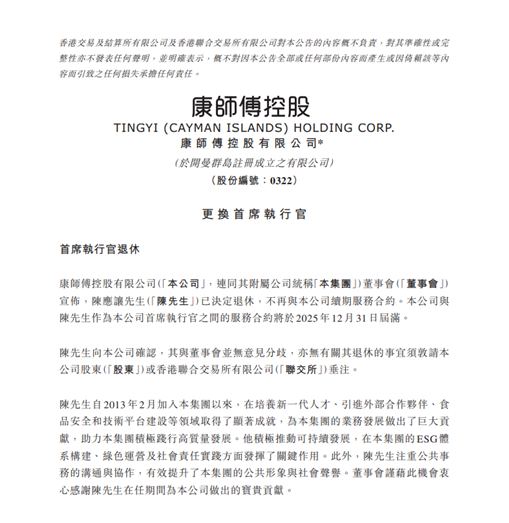
Core Viewpoint - The announcement of CEO Chen Yingrang's retirement and the appointment of Wei Hongcheng as the new CEO of Master Kong Holdings marks a significant leadership transition for the company [3][4]. Group 1: Leadership Changes - Chen Yingrang has decided to retire and will not renew his service contract, which is set to expire on December 31, 2025 [3]. - Wei Hongcheng will be appointed as the new CEO effective January 1, 2026, while continuing his role as an executive director [4]. - Wei Hongcheng, aged 43, has been an executive director since January 1, 2019, and holds degrees from Imperial College London and Harvard Business School [4]. Group 2: Company Performance - For the first half of 2025, Master Kong Holdings reported revenues of 40.092 billion yuan, a year-on-year decrease of 2.7% [4]. - The gross profit margin increased to 34.5%, reflecting a year-on-year growth of 1.9 percentage points [4]. - The profit attributable to shareholders rose to 2.271 billion yuan, marking a year-on-year increase of 20.5% [4].
康师傅首席执行官陈应让将退休,魏宏丞接任
Xin Lang Cai Jing· 2025-12-18 08:48
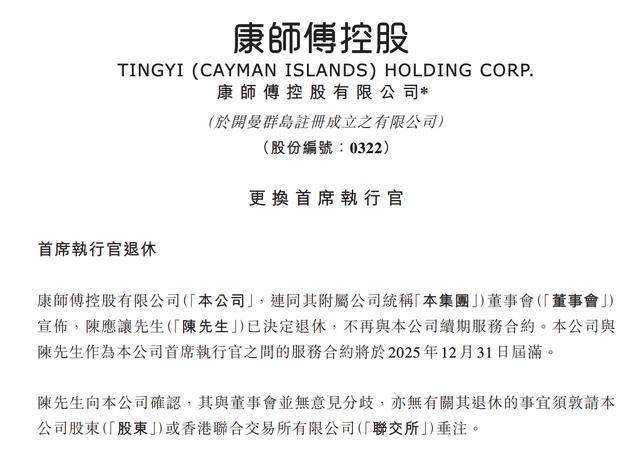
资料显示,魏宏丞现年43岁,自2019年1月1日起出任康师傅集团执行董事。此前,魏宏丞于2015年2月 起获委任为康师傅饮品董事,并自2019年起担任董事长。 12月18日,康师傅控股在港交所公告,首席执行官陈应让已决定退休,不再与公司续期服务合约。合约 将于2025年12月31日届满。董事会宣布委任魏宏丞为公司首席执行官,自2026年1月1日起生效。魏宏丞 亦将继续担任执行董事。 ...
康师傅控股宣布委任魏宏丞为首席执行官,自2026年1月1日起生效
Cai Jing Wang· 2025-12-18 07:08
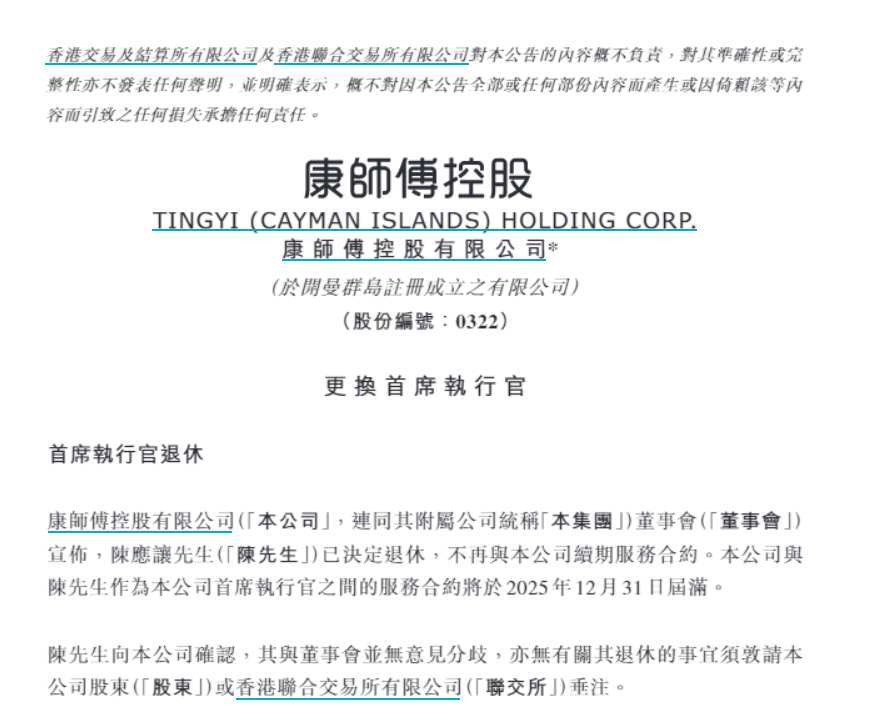
Core Viewpoint - The announcement reveals the retirement of Chen Yingrang as CEO of Master Kong Holdings, effective December 31, 2025, and the appointment of Wei Hongcheng as the new CEO starting January 1, 2026 [1] Company Announcement - Chen Yingrang has decided to retire and will not renew his service contract with the company [1] - The board has appointed Wei Hongcheng as the new CEO, effective January 1, 2026, while he will continue to serve as an executive director [1] - Wei Hongcheng is the brother of Wei Hongming, the chairman and executive director, and their family holds 100% of the major shareholder, Ting Hsin (Cayman Islands) Holdings Co., Ltd [1] - As of the announcement date, Wei Hongcheng holds 5 million shares of the company and has options to subscribe for 1.385 million shares [1]
民族品牌康师傅完成CEO更迭 高质量发展战略获新一代领导接力
Zheng Quan Shi Bao Wang· 2025-12-18 07:00
Core Viewpoint - The announcement of the CEO transition at Master Kong Holdings marks a significant step in the company's commitment to high-quality development and sustainable strategies, ensuring a smooth management transition as the company continues to evolve in the fast-moving consumer goods sector [2][3]. Group 1: Management Transition - Current CEO Chen Yingrang will retire on December 31, 2025, and will not renew his contract, with Executive Director Wei Hongcheng appointed as the new CEO effective January 1, 2026 [2]. - Chen Yingrang has been with the company since February 2013, focusing on talent development, external collaboration, food safety, and technology platform construction, significantly contributing to the company's growth and ESG framework [2]. - Wei Hongcheng has been with Master Kong since February 2015 and has led the beverage division since 2019, achieving steady revenue and profit growth while emphasizing consumer needs and innovation [2][3]. Group 2: Company Mission and Strategy - Master Kong emphasizes its mission to "promote Chinese food culture and become a respected enterprise," committing to high-quality development through product innovation, brand building, and channel expansion [3]. - The management transition reflects continuity and stability in governance, with Wei Hongcheng's deep involvement in operations expected to support strategic advancement and drive growth amid consumer upgrades and sustainability trends [3]. Group 3: Sustainability and Social Responsibility - Master Kong is recognized as a leading Chinese fast-moving consumer goods brand, consistently ranking in the top three of Kantar's "Top Ten Preferred Brands in China" for 12 consecutive years, reaching 900 million consumers annually [4]. - The company adheres to the "Home Green, Health is Wealth" philosophy in sustainability, investing nearly 2 billion yuan in various social initiatives over 33 years, including disaster relief and educational support [4]. - Master Kong has received multiple accolades for its sustainability efforts, including being named a founding member of the UN's "Sustainable Food Systems Advisory Committee" and recognized as an "Industry Best Progress Company" in the 2025 Standard & Poor's Global "Sustainability Yearbook (China Edition)" [4].
康师傅控股委任魏宏丞为首席执行官
Zhi Tong Cai Jing· 2025-12-18 04:25
Group 1 - The core announcement is that Mr. Chen Yingrang has decided to retire and will not renew his service contract with the company [1] - The service contract between the company and Mr. Chen, who serves as the Chief Executive Officer, will expire on December 31, 2025 [1] - Mr. Wei Hongsheng has been appointed as the new Chief Executive Officer, effective from January 1, 2026, and he will continue to serve as an executive director [1]
康师傅控股(00322)委任魏宏丞为首席执行官
智通财经网· 2025-12-18 04:23
Group 1 - The core point of the article is the retirement of Mr. Chen Yingrang, the current CEO of Master Kong Holdings, who will not renew his service contract with the company [1] - Mr. Chen's service contract as CEO will expire on December 31, 2025 [1] - Mr. Wei Hongcheng has been appointed as the new CEO, effective from January 1, 2026, and he will continue to serve as an executive director [1]