Sinopec Corp.(00386)

Search documents
港股异动 | 石油股涨幅居前 OPEC+明年一季度暂停增产 三桶油业绩相较海外巨头韧性凸显
Zhi Tong Cai Jing· 2025-11-03 02:17
消息面上,周日,OPEC+在线上会议后表示,以沙特为首的八个成员国将在12月提高产量13.7万桶/ 日,这与10月和11月的增产幅度一致。但该组织同时宣布,考虑到季节性因素,将在明年1-3月暂停增 产,意味着OPEC+的增产计划踩下刹车。该消息推升油价,布伦特原油一度升至每桶65美元以上, WTI原油在每桶61美元附近。 智通财经APP获悉,石油股涨幅居前,截至发稿,中国石油(00857)涨3.62%,报8.31港元;中国海油 (00883)涨3.69%,报20.5港元;上海石化(00338)涨1.5%,报1.35港元;中国石化(00386)涨1.45%,报4.19 港元。 光大证券发布研报称,2025年三季度,受油价下跌和炼化景气度低迷影响,国际油气巨头的经营业绩同 比下滑,埃克森美孚、雪佛龙、壳牌、道达尔归母净利润分别同比-14.3%、-33.9%、-9.6%、-13.4%, 中国石油、中国海油前三季度归母净利润跌幅小于多数国际油气巨头,在油价下行期的业绩韧性凸 显,"三桶油"在油价下行期的业绩体现出一定的穿越周期属性。此外,"三桶油"继续加强增储上产,长 期价值凸显。 ...

10月31日港股回购一览
Zheng Quan Shi Bao Wang· 2025-11-03 02:12
Core Viewpoint - On October 31, 33 Hong Kong-listed companies conducted share buybacks, totaling 21.84 million shares and an aggregate amount of HKD 152 million [1][2]. Group 1: Buyback Details - China COSCO Shipping Holdings (中远海控) repurchased 3 million shares for HKD 40.71 million, with a highest price of HKD 13.750 and a lowest price of HKD 13.350, bringing its total buyback amount for the year to HKD 4.447 billion [1][2]. - Guo Sheng Tang (固生堂) repurchased 582,000 shares for HKD 16.59 million, with a highest price of HKD 28.680 and a lowest price of HKD 28.340, totaling HKD 284 million in buybacks for the year [1][2]. - Sinopec Limited (中国石油化工股份) repurchased 3.652 million shares for HKD 15.12 million, with a highest price of HKD 4.170 and a lowest price of HKD 4.110, accumulating HKD 871 million in buybacks for the year [1][2]. Group 2: Buyback Rankings - The highest buyback amount on October 31 was from China COSCO Shipping Holdings at HKD 40.71 million, followed by Guo Sheng Tang at HKD 16.59 million [1][2]. - In terms of share quantity, Sinopec Limited led with 3.652 million shares repurchased, followed by China COSCO Shipping Holdings with 3 million shares and Linklogis Technology (联易融科技-W) with 2.34 million shares [1][2].
股市必读:中国石化(600028)10月31日主力资金净流入4095.36万元,占总成交额4.11%
Sou Hu Cai Jing· 2025-11-02 18:30
Core Viewpoint - China Petroleum & Chemical Corporation (Sinopec) reported a stock price of 5.47 RMB as of October 31, 2025, reflecting a decline of 1.08% with a trading volume of 182.38 million shares and a total transaction value of 999.7 million RMB [1]. Trading Information Summary - On October 31, 2025, the net inflow of main funds was 40.95 million RMB, accounting for 4.11% of the total transaction value; meanwhile, retail funds had a net inflow of 24.49 million RMB, representing 2.46% of the total transaction value [2][3]. - The net outflow of speculative funds was 65.44 million RMB, which constituted 6.56% of the total transaction value [2]. Company Announcement Summary - On October 31, 2025, Sinopec repurchased 3,652,000 H-shares at a maximum price of 4.17 HKD and a minimum price of 4.11 HKD, totaling 15,124,758 HKD; additionally, the company repurchased 11,400,070 A-shares at a maximum price of 5.5 RMB and a minimum price of 5.43 RMB, amounting to 62,288,277.1 RMB [2][3]. - All repurchased shares are intended for cancellation, and the repurchase authorization resolution was approved on May 28, 2025, allowing for a total repurchase of up to 2,404,929,260 shares [2]. - As of October 31, 2025, the total issued shares for H-shares and A-shares were 23,945,350,600 and 97,232,263,098 respectively, with no treasury shares [2].

510亿!中石化、中石油、中海油,出手布局这些赛道
Sou Hu Cai Jing· 2025-11-02 15:43
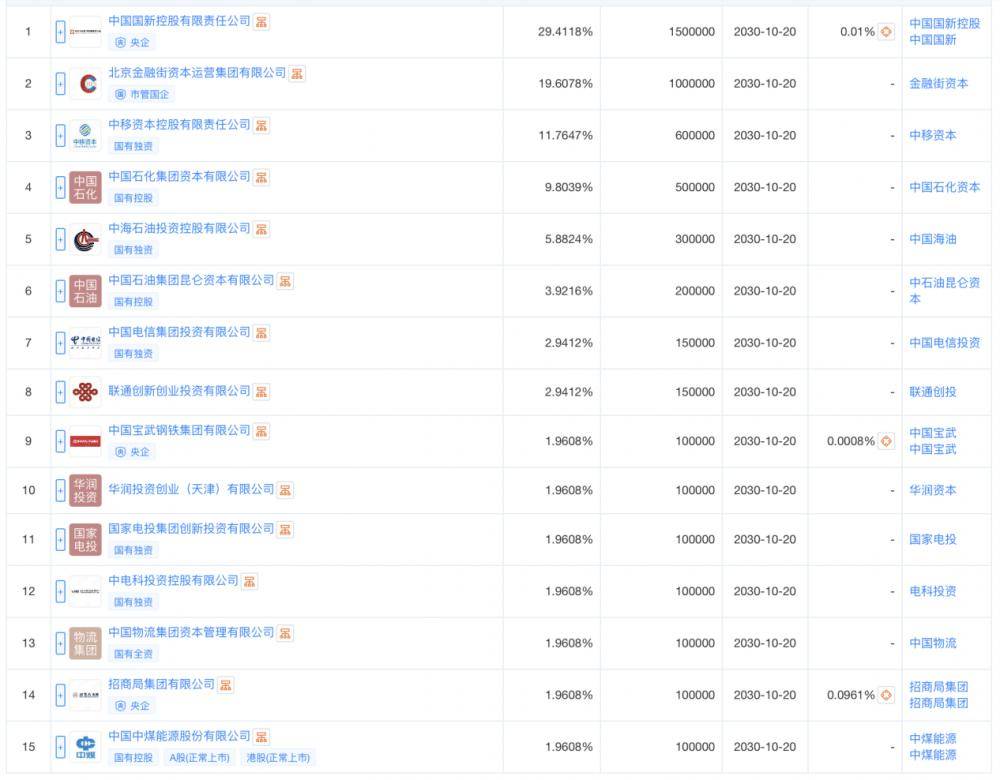
中国石化集团资本、中国石油集团昆仑资本、中国电信集团投资等均为各自领域龙头央企的专业投资平台,代表着产业端的核心需求与技术积 淀,或使基金突破单纯的资金供给属性。比如, 在新一代信息技术领域,中移资本与中国电信集团投资可提供5G场景验证与产业链协同;在 新能源与新材料领域,中国石化、中国石油的资本平台能衔接能源化工产业的技术转化需求与应用场景,为被投企业提供从技术研发到商业化 落地的全链条支撑。 近年来,在政策层面一直在积极引导国资央企发展战略新兴产业。其中,在2024年年底,国务院国资委、国家发展改革委联合出台政策措施, 推动中央企业创业投资基金高质量发展,支持中央企业发起设立创业投资基金, 重点投早、投小、投长期、投硬科技。 今年7月,全国首批首支中央企业创业投资母基金—— 诚通科创投资基金正式落地,规划总规模300亿元,首期规模100亿元,由中国诚通牵 头,联合中国石化、中国航油及海淀区政府共同出资设立,重点布局 新材料、先进制造、新一代信息技术三大核心领域。 | 1 | | 中国国新控股有限责任公司 居 | 29.4118% | 1500000 | 2030-10-20 | 0.01% > | 中国国 ...


510亿!中石化、中石油、中海油,出手布局这些赛道
DT新材料· 2025-11-02 14:42
Group 1 - The Central Enterprise Strategic Emerging Industry Development Special Fund, initiated by the State-owned Assets Supervision and Administration Commission (SASAC), has been launched in Beijing with an initial scale of 51 billion yuan [1] - China Reform Holdings Corporation Limited (China Guoxin) is the largest shareholder with a contribution of 15 billion yuan, holding 34.8837% of the fund [1] - Other contributors include major state-owned enterprises such as Sinopec, CNOOC, and China Mobile, among others, indicating strong backing from leading companies in various sectors [1][2] Group 2 - The fund aims to support the development of strategic emerging industries, focusing on areas such as artificial intelligence, aerospace, high-end equipment, and quantum technology [2][3] - It will adopt a strategy of "combining production and investment" and prioritize early, small, hard, and long-term investments in key future industries [2][3] - The fund is positioned to enhance the core functions and competitiveness of state-owned enterprises by addressing industrial weaknesses and promoting innovation [2][3] Group 3 - Recent policy initiatives emphasize the development of strategic emerging industries, with a focus on new energy, new materials, and low-altitude economy, which are expected to create significant market opportunities [3][4] - The fund is part of a broader effort to establish venture capital funds that support early-stage investments in hard technology, aligning with national economic development goals [4] - The establishment of the fund reflects a trend towards leveraging state-owned enterprise resources to foster innovation and technological advancement in key sectors [3][4]

千亿险资系私募基金,最新动向曝光
Zhong Guo Zheng Quan Bao· 2025-11-02 04:10
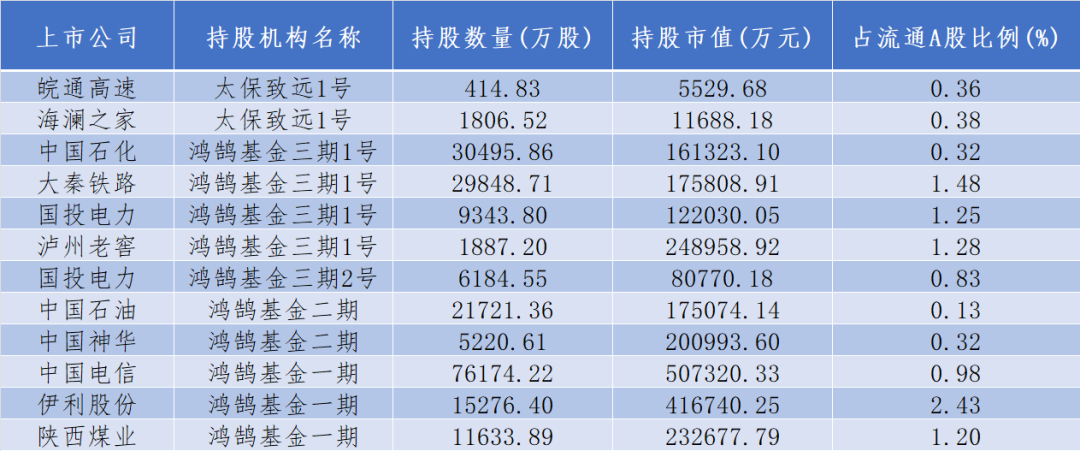
Core Insights - The trial reform for long-term investment of insurance funds has accelerated this year, with the latest holdings of insurance-related private equity funds revealed following the disclosure of listed companies' Q3 reports [1][9] - Five insurance-related private equity funds have disclosed their latest holdings, with significant investments in companies such as Sinopec, Daqin Railway, Guotou Power, Luzhou Laojiao, Anhui Expressway, and HLA [1][4] Holdings Summary - As of the end of Q3, Taibao Zhiyuan No. 1 Private Securities Investment Fund has appeared in the top ten circulating shareholders of Anhui Expressway and HLA, holding 4.1483 million shares and 18.0652 million shares respectively [3][6] - The holdings of five insurance-related private equity funds are detailed in a table, showing the number of shares, market value, and percentage of circulating A-shares for each listed company [5] - The Honghu Fund Phase III No. 1 has emerged as a major shareholder in Sinopec, Daqin Railway, Guotou Power, and Luzhou Laojiao, with holdings of 304.9586 million shares, 298.4871 million shares, 93.438 million shares, and 18.872 million shares respectively [6][7] Investment Focus - The insurance-related private equity funds are primarily concentrated in sectors such as petrochemicals, transportation, coal, public utilities, food and beverage, telecommunications, and textiles, with many holdings being industry leaders characterized by high dividends and low volatility [7][10] - The ongoing trial reform has seen the number of operational insurance-related private equity funds increase to seven, with a total approved scale of 222 billion yuan [9][10]


透视“三桶油”业绩:油价下跌背后,化工板块成痛点
Xin Lang Cai Jing· 2025-11-02 01:11
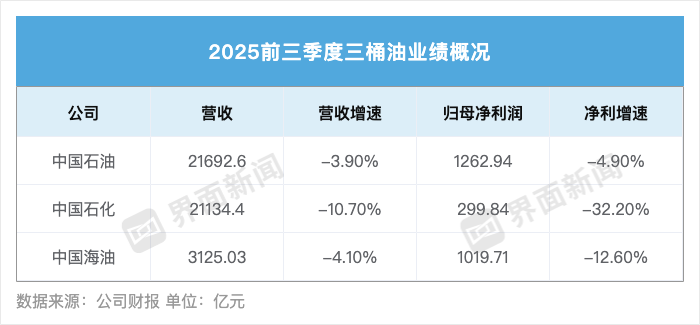
Core Viewpoint - The performance of the "Big Three" oil companies in China has declined in both revenue and net profit for the first three quarters of 2025, primarily due to falling international oil prices, continuing the trend observed in the first half of the year [1][2]. Financial Performance Summary - China National Petroleum Corporation (CNPC) reported a net profit of 126.29 billion yuan, a year-on-year decrease of 4.9%, the smallest decline among the three [1][2]. - China Petroleum & Chemical Corporation (Sinopec) had a net profit of 29.98 billion yuan, down 32.2%, marking the largest decline [1][2]. - China National Offshore Oil Corporation (CNOOC) achieved a net profit of 101.97 billion yuan, a decrease of 12.6% [1][2]. Revenue and Profitability Analysis - CNPC's revenue was 2169.26 billion yuan, with a revenue decline of 3.9% [2]. - Sinopec's revenue was 2113.44 billion yuan, experiencing a 10.7% drop [2]. - CNOOC's revenue stood at 312.50 billion yuan, down 4.1% [2]. - CNOOC had the highest net profit margin at 32.63%, compared to CNPC's 5.82% and Sinopec's 1.42% [4]. Cash Flow and Production Insights - CNPC led in net cash flow from operating activities with 343.1 billion yuan, a year-on-year increase of 3% [4]. - CNOOC followed with a net cash flow of 171.75 billion yuan, down 6% [4]. - Sinopec reported a net cash flow of 114.78 billion yuan, up 13%, the largest increase among the three [4]. - All three companies saw an increase in oil and gas equivalent production, with CNPC at 1.377 billion barrels (up 2.6%), CNOOC at 578 million barrels (up 6.7%), and Sinopec at 394 million barrels (up 2.2%) [8]. Market Conditions and Price Trends - The average price of Brent crude oil was $70.93 per barrel, down 14.3% year-on-year, while West Texas Intermediate (WTI) averaged $66.73 per barrel, a decrease of 14.1% [5]. - The average oil prices realized by the companies also fell, with CNOOC down 13.6%, CNPC down 14.7%, and Sinopec down 13.3% [6]. - Natural gas prices saw a slight increase for CNOOC (up 1%) while CNPC and Sinopec experienced declines [6]. Strategic Outlook - Sinopec and CNPC are focusing on upgrading their refining businesses, but their chemical segments have underperformed, impacting their net profit margins [9]. - Sinopec's chemical segment reported a loss of 7.43 billion yuan, worsening from a loss of 5.58 billion yuan the previous year [9]. - Domestic demand for refined oil products is declining, affecting sales for both CNPC and Sinopec [9]. - CNOOC plans to engage in hedging activities to mitigate risks associated with market price fluctuations [12].
首次世界五百强断崖差距:日本149家,美151家,中国3家,现在呢
Sou Hu Cai Jing· 2025-11-01 12:12
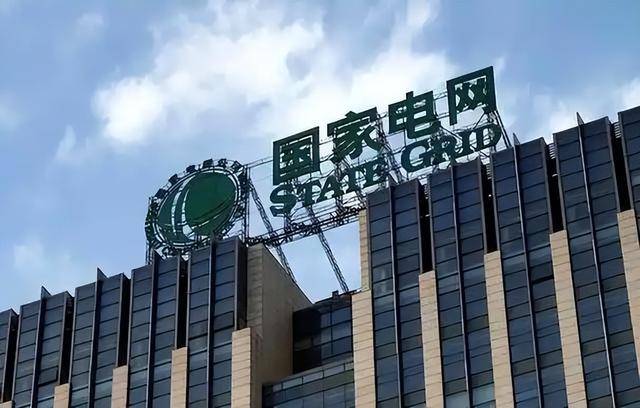
Group 1 - In 1995, China had only 3 companies in the Fortune Global 500, while the US had 151 and Japan had 149, indicating a significant gap in economic strength [2] - As of August 2024, the US remains the leader in the Fortune Global 500 with 139 companies, showcasing its long-standing economic dominance [4][6] - Walmart, Amazon, and State Grid are among the top three companies in the 2024 ranking, with Walmart generating revenue of $648.125 billion, Amazon at $574.785 billion, and State Grid at $545.9475 billion [9][11] Group 2 - Japan's presence in the Fortune Global 500 has significantly declined from 149 companies in 1995 to only 40 in the latest ranking, reflecting its economic struggles [12] - Japan's economic growth peaked in the 1980s but has since faced challenges due to reliance on traditional manufacturing and an aging population [16][19] - The decline in Japan's economic power is attributed to factors such as the bursting of the economic bubble and a lack of innovation in emerging sectors like AI and renewable energy [17][19] Group 3 - China has made remarkable progress, with a total of 133 companies, including those from Taiwan, in the Fortune Global 500, indicating a strong economic presence [21] - The increasing number of private companies like Xiaomi, Huawei, and Tencent in the rankings demonstrates the growing vitality of China's private sector [21] - China's achievements are attributed to its resilience in the face of external pressures, particularly from the US, which has attempted to hinder China's development through trade and technology wars [23][25][26]


LP圈发生了什么
投资界· 2025-11-01 07:54
Core Insights - The article highlights the establishment of various investment funds across different regions in China, focusing on strategic industries and innovation-driven sectors. Group 1: Fund Establishments - A central enterprise strategic emerging industry development fund was launched in Beijing with an initial scale of 510 billion RMB, involving major state-owned enterprises as contributors [2] - The Zhejiang Social Security Science and Technology Innovation Fund was established with an initial scale of 500 billion RMB, aimed at supporting key areas of technological innovation [3] - The first biomanufacturing industry fund in Shanghai was initiated, combining resources from industry leaders and venture capital to drive technological breakthroughs [4] Group 2: Regional Funds - Chengdu established a high-level talent innovation and entrepreneurship fund, focusing on early-stage investments to support talent and technology transfer [5][6] - Dongguan's Songshan Lake completed the registration of a 100 billion RMB mother fund to promote technological finance and regional industrial upgrades [7] - Wuhan launched its first concept verification fund group with an annual funding pool of 112.5 million RMB to support startup projects [8] Group 3: Sector-Specific Funds - The Hebei Xiong'an concept verification fund was set up with a focus on aerospace information and biotechnology, with an initial scale of 20 million RMB [9] - The Jilin Province Ice and Snow Economy Fund was established with a total scale of 500 million RMB, targeting the ice and snow tourism and technology sectors [11] - The Zhuhai Zuguang New Intelligence Fund was launched to support high-end intelligent manufacturing, marking a significant step in the region's industrial investment [12] Group 4: Investment Strategies - The Chengdu fund emphasizes market-oriented operations to facilitate talent and technology commercialization [6] - The Dongguan fund aims to create a comprehensive fund system covering the entire lifecycle of enterprises through collaboration with various investment institutions [7] - The Jiangsu Yangzhou Aerospace Industry Fund focuses on strategic emerging industries, leveraging a significant capital structure to enhance investment capabilities [14]

中国石油化工股份(00386.HK)10月31日回购1512.48万港元,已连续2日回购
Zheng Quan Shi Bao Wang· 2025-10-31 14:59
Core Points - China Petroleum & Chemical Corporation (Sinopec) has conducted share buybacks, with the latest occurring on October 31, where it repurchased 3.652 million shares at a price range of HKD 4.110 to HKD 4.170, totaling HKD 15.1248 million [1] - The stock closed at HKD 4.130 on the same day, reflecting a 0.24% increase, with a total trading volume of HKD 472 million [1] - Since October 30, the company has repurchased shares for two consecutive days, totaling 8.428 million shares and an aggregate buyback amount of HKD 34.8477 million, during which the stock has seen a cumulative decline of 2.13% [2] Buyback Summary - Year-to-date, Sinopec has executed 23 buyback transactions, repurchasing a total of 179 million shares for an aggregate amount of HKD 809 million [3] - Detailed buyback transactions include: - October 31: 365.20 thousand shares at a maximum price of HKD 4.170 and a minimum price of HKD 4.110, totaling HKD 15.1248 million - October 30: 477.60 thousand shares at a maximum price of HKD 4.220 and a minimum price of HKD 4.100, totaling HKD 19.7230 million - September 26: 453.00 thousand shares at a maximum price of HKD 4.070 and a minimum price of HKD 4.050, totaling HKD 18.4045 million [3]