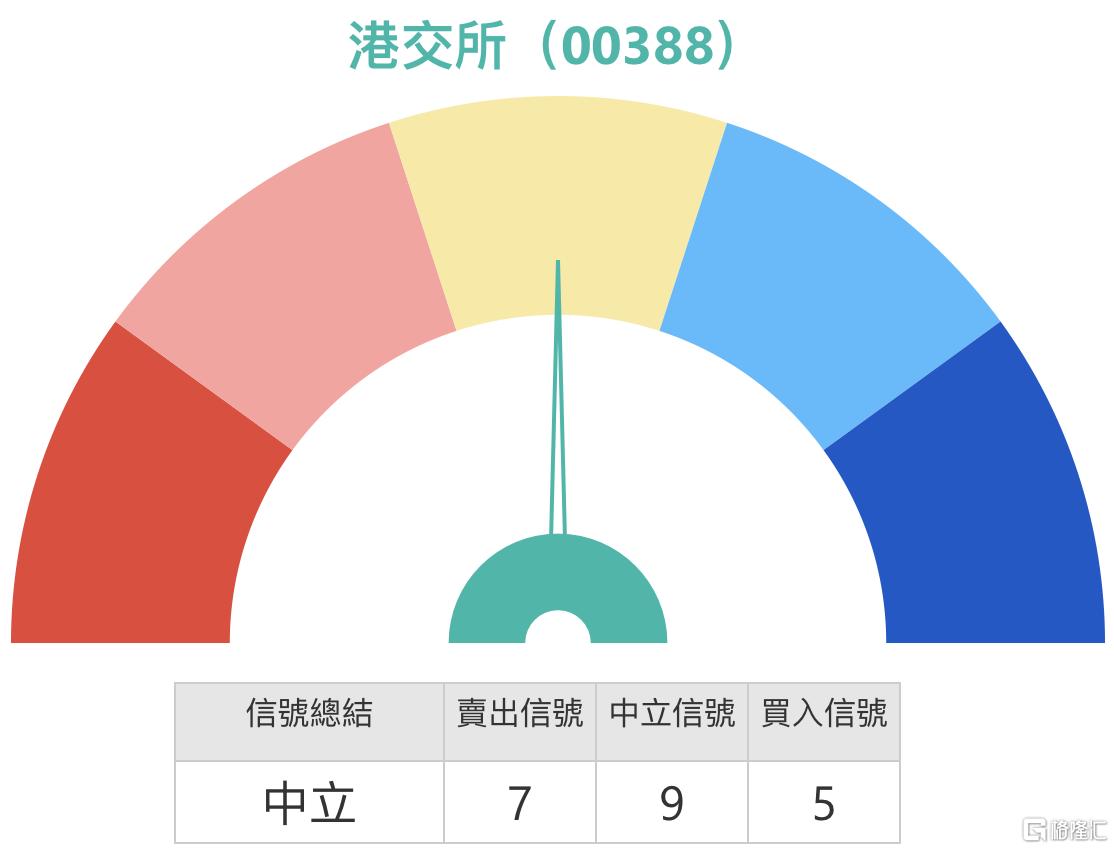
HKEX(00388)

Search documents
港交所短線走勢膠著,衍生工具如何捕捉技術機會?
Ge Long Hui· 2025-12-24 21:11
Core Viewpoint - The Hong Kong stock market atmosphere is improving, leading to a stabilization in the stock price of Hong Kong Exchanges and Clearing Limited (HKEX), currently at HKD 408.6, with a slight increase of 0.44% [1]. Technical Analysis and Key Price Levels - HKEX is currently in a critical short-term consolidation range, facing resistance from multiple moving averages above the current price, with the 10-day moving average at HKD 403.08, and the 30-day and 60-day moving averages at HKD 410.85 and HKD 421.87 respectively [2]. - Key support levels are identified at HKD 403 and HKD 395, while resistance levels are at HKD 419 and HKD 428, with the price action in the coming days determining whether it will break upwards or retreat [2]. Market Sentiment - Investors are optimistic that if HKEX can stabilize, a short-term target may be set at HKD 415, with some aggressive investors looking at higher strike call options, indicating a belief in potential significant upward movement [4]. Derivative Products: Review and Strategy Tools - Historical performance shows that derivative products like call warrants and bull certificates can effectively capture short-term volatility, with examples showing significant price increases of 52% and 50% within two days during a recent market rally [5]. - For bullish investors, high-leverage call options and bull certificates are recommended, while bearish investors may consider put options or bear certificates to hedge against potential declines [6][12]. Product Selection Strategy - Investors should align their product choices with their market outlook, with high-leverage call options available for those expecting upward movement, and put options or bear certificates for those anticipating a downturn [6][12].

2025年港股IPO集资额重夺全球第一 毕马威:预计明年集资额达3500亿港元
智通财经网· 2025-12-24 06:49
对于香港证监会、港交所联合发函予 IPO 保荐人,关注申报资料质素。刘大昌称,鉴于今年香港IPO市 场复苏,行业中介人手调配有挑战,不过香港一向对上市文件的要求很严谨,本次监管机构的关注,有 利中长线保持质量。 李镇国表示,这只是香港证监会及港交所的提点,"要同大家讲,维持整体质量,不要因为数量多,就 偷工减料。"他称,要维持香港一定水平,同时要保证有足够资源应付众多新股(IPO)申请上市的工作。 刘大昌指,美国富豪马斯克旗下 SpaceX 已表示最快明年启动上市,其估值已达8000亿美元。另外,人 工智能巨企 OpenAI 据报亦可能明年上市,估值据报达7800亿美元,而房利美及房贷美(又称两房),美 国政府可能会将其私营化,一旦落实上市,集资额料亦大。 不过,澳洲会计师公会(CPA)2025年大中华区分会副会长、财经事务委员会副主席梁佑庭及瑞银全球投 资银行部副主席及亚洲企业客户部联席主管李镇国均预期,港交所明年在全球 IPO 市场中集资亦会继 续夺冠。但李镇国表示,不排除明年亦有如宁德时代般集资逾400亿港元的IPO可能,他估计,单是明 年一季度便会有数宗集资过百亿港元的IPO。 此外,李镇国预期,明年 ...
港交所:港股今日下午起休市 12月29日恢复正常交易
Jin Rong Jie· 2025-12-24 02:29
Summary of Key Points Core Viewpoint - The Hong Kong stock market will have a shortened trading day on December 24, 2023, and will be closed for two full days on December 25 and 26, 2023, with normal trading resuming on December 29, 2023 [1] Trading Schedule - The Hong Kong stock market will only operate in the morning on December 24, 2023, and will close at 13:00 [1] - The market will be closed for the entire day on December 25 and 26, 2023, with both southbound and northbound trading suspended during this period [1] - Normal trading activities will resume on December 29, 2023 [1]
智通港股通资金流向统计(T+2)|12月24日
智通财经网· 2025-12-23 23:36
Core Insights - Tencent Holdings (00700), Alibaba-W (09988), and Hong Kong Exchanges (00388) ranked as the top three in net inflow of southbound funds, with net inflows of 1.114 billion, 1.047 billion, and 309 million respectively [1] - China Mobile (00941), Luoyang Molybdenum (03993), and CICC (03908) led the market in net outflows, with net outflows of -1.055 billion, -179 million, and -177 million respectively [1] Net Inflow Summary - Tencent Holdings (00700) had a net inflow of 1.114 billion, representing a 10.22% increase in share price to 614.000 [2] - Alibaba-W (09988) saw a net inflow of 1.047 billion, with a 10.23% increase in share price to 145.300 [2] - Hong Kong Exchanges (00388) recorded a net inflow of 309 million, with a 23.18% increase in share price to 407.000 [2] Net Outflow Summary - China Mobile (00941) experienced the highest net outflow of -1.055 billion, with a -42.32% change in share price to 83.900 [2] - Luoyang Molybdenum (03993) had a net outflow of -179 million, with a -24.13% change in share price to 18.770 [2] - CICC (03908) recorded a net outflow of -177 million, with a -20.14% change in share price to 20.340 [2] Net Inflow Ratio Summary - Southern Hong Kong Stock Connect (03432) had a net inflow ratio of 100.00% with a net inflow of 10.7 million [3] - Southern East-West Select (03441) recorded a net inflow ratio of 82.25% with a net inflow of 5.2606 million [3] - Sinopec Kantons Holdings (00934) had a net inflow ratio of 63.87% with a net inflow of 3.9369 million [3] Net Outflow Ratio Summary - 361 Degrees (01361) had the highest net outflow ratio of -76.65% with a net outflow of -17.4897 million [3] - Ark Health (06086) recorded a net outflow ratio of -58.86% with a net outflow of -3.4293 million [3] - iFlytek Medical Technology (02506) had a net outflow ratio of -57.58% with a net outflow of -3.3443 million [3]



贝莱德减持香港交易所约9.80万股 每股作价约398.09港元

Zhi Tong Cai Jing· 2025-12-23 11:22
Group 1 - BlackRock reduced its stake in Hong Kong Exchanges and Clearing (00388) by 98,029 shares at a price of HKD 398.0933 per share, totaling approximately HKD 39.0247 million [1] - After the reduction, BlackRock's latest shareholding stands at approximately 63,371,100 shares, representing a holding percentage of 4.99% [1]
贝莱德减持香港交易所(00388)约9.80万股 每股作价约398.09港元
智通财经网· 2025-12-23 11:13
智通财经APP获悉,香港联交所最新资料显示,12月18日,贝莱德减持香港交易所(00388)9.8029万股, 每股作价398.0933港元,总金额约为3902.47万港元。减持后最新持股数目约为6337.11万股,最新持股 比例为4.99%。 ...
香港交易所:2026年起香港过渡至无纸证券市场 推进资本市场现代化进程
智通财经网· 2025-12-23 09:40
Core Viewpoint - The Hong Kong Stock Exchange (HKEX) plans to transition to a paperless securities market (USM) by 2026, enhancing market accessibility, resilience, and competitiveness [1] Group 1: USM Implementation and Benefits - The USM will modernize market operations, allowing investors to hold and manage securities more efficiently through digital means [2] - The transition to USM will eliminate paper documents for listed securities, reducing manual operations and increasing operational efficiency [2] - Investors will benefit from simplified processes and clearer information, leading to lower costs, fewer delays, and higher certainty [1][3] Group 2: Market Infrastructure and Efficiency - The existing central clearing and settlement system will remain, ensuring service levels are maintained while shortening the securities transfer and registration process [3] - The elimination of paper documents will reduce risks and delays associated with physical operations, ultimately enhancing market capacity and processing speed [3] - The USM will also contribute to sustainability by reducing the carbon footprint associated with printing, transporting, and storing paper documents [3] Group 3: Industry Collaboration and Transition - The implementation of USM requires collaboration across the industry, with securities transitioning in phases [4] - During the transition, both paper and paperless securities will operate concurrently to ensure market readiness and continuity [4] - HKEX will work closely with intermediaries and issuers to plan and implement necessary system optimizations and conduct training for market participants [4] Group 4: Fee Structure and Market Optimization - HKEX will adjust the fee structure to make it simpler, fairer, and more predictable, aligning with the needs of a digitalized operation [5] - Recent market optimization measures have already improved trading convenience and increased market liquidity, such as the severe weather trading arrangements and new IPO pricing mechanisms [5]
港交所拟优化每手买卖单位的做法值得A股借鉴
Guo Ji Jin Rong Bao· 2025-12-23 08:40
Group 1 - The Hong Kong Stock Exchange (HKEX) has published a consultation document seeking market opinions on optimizing the trading unit framework to enhance trading, settlement, and clearing efficiency [1] - The proposed changes include consolidating the trading units into eight standard options and lowering the minimum value guideline for each trading unit from HKD 2,000 to HKD 1,000 to avoid "negative value trading" [1] - The eight standard trading units will include 1 share, 50 shares, 100 shares, 500 shares, 1,000 shares, 2,000 shares, 5,000 shares, and 10,000 shares [1] Group 2 - The A-share market currently has a fixed trading unit of 100 shares, which has become limiting, especially for high-priced stocks like Kweichow Moutai, where buying one unit requires over CNY 100,000 [2] - The A-share market could benefit from adopting HKEX's approach by adjusting the trading unit for high-priced stocks to 10 shares, creating two tiers: 100 shares for stocks below CNY 500 and 10 shares for stocks at CNY 500 and above [2] - This adjustment would lower the investment threshold for high-priced stocks and potentially improve liquidity [2] Group 3 - In addition to adjusting trading units, the A-share market should also optimize the minimum subscription unit for new stock issuances, currently set at 500 shares, which limits participation for small investors [3] - A proposed adjustment would lower the minimum subscription unit to 100 shares, significantly increasing the chances of winning a subscription for small investors [3] - For larger new stock issuances, differentiated arrangements could be made, such as maintaining a 500-share minimum for issuances over 1 billion shares and increasing it to 1,000 shares for those over 2 billion shares [3]
“联通先生”李小加:从沪港通到滴灌通|我们的四分之一世纪
Jing Ji Guan Cha Bao· 2025-12-23 07:56
Core Insights - The article highlights the career of Li Xiaojia, known as "Mr. Connect," who has played a pivotal role in linking Chinese enterprises with international capital throughout his financial career [3][4] - Li Xiaojia's initiatives, including the establishment of the Hong Kong-Shanghai Stock Connect (沪港通), have significantly advanced the interconnectivity of financial markets between China and the world [5][6][7] - The article also discusses Li Xiaojia's recent venture, Drip Irrigation Capital (滴灌通), which aims to connect global capital with small and micro enterprises, addressing the financial needs of the grassroots economy [12][13] Interconnectivity Initiatives - In 2012, Li Xiaojia and the then-chairman of the Shanghai Stock Exchange sketched the initial concept for the Stock Connect on a napkin, which later evolved into a formalized trading mechanism [5][6] - The Stock Connect was officially launched on November 17, 2014, marking a significant step towards the mutual opening of capital markets between mainland China and Hong Kong [7][8] - Subsequent initiatives like the Shenzhen-Hong Kong Stock Connect and Bond Connect followed the same foundational logic established by the Stock Connect [7][8] Challenges and Reforms - The article outlines the challenges faced in implementing reforms, particularly regarding the acceptance of dual-class share structures, which were initially met with resistance due to concerns over fairness and regulatory integrity [9][10] - The successful listing of Xiaomi in 2018 under a dual-class share structure marked a significant milestone in these reforms, demonstrating the potential for innovation within Hong Kong's financial market [10][11] Drip Irrigation Capital - Drip Irrigation Capital was founded to provide financial services to small and micro enterprises, which have traditionally been underserved by conventional financial products [12][13] - The company aims to create a sustainable investment model that balances risk and return, particularly in the context of high capital costs associated with overseas financing [12][13] - The venture has undergone multiple phases of development, with the current focus on standardizing cash flow assets from small enterprises to meet the investment needs of larger institutional investors [14][15]
港柬金融合作开启新篇章:点心债与两地上市"双引擎"驱动资本市场互联互通
Sou Hu Cai Jing· 2025-12-23 05:45
Group 1 - The core objective of the visit by the Cambodian delegation to Hong Kong is to deepen financial cooperation and promote connectivity between the capital markets of Cambodia and Hong Kong [1] - Discussions focused on key topics such as the implementation of Dim Sum bonds (offshore RMB bonds), dual listing mechanisms, and collaboration between brokers to facilitate cross-border capital inflow [1][3] - The Cambodian Securities and Exchange Commission (SERC) aims to enhance cooperation with the Hong Kong Stock Exchange (HKEX) and establish a more systematic and actionable framework for bilateral capital market collaboration [3] Group 2 - The SERC Chairman emphasized the importance of dual listing and international financing channels, aiming to guide more Cambodian companies to list in Hong Kong after their domestic listings [3] - The Cambodian Chamber of Commerce President highlighted the country's economic reforms and the potential for international capital to drive growth, governance, and market confidence [4] - The Chairman of the Cambodian Securities Company expressed intentions to deepen cooperation with Haitong International, focusing on cross-border investments and dual listings [5][6] Group 3 - A two-phase approach for RMB bond issuance was outlined: the first phase involves supporting top Cambodian companies to issue Dim Sum bonds in Hong Kong, while the second phase aims to facilitate the issuance of RMB-denominated bonds within Cambodia [7] - Future efforts will include coordinating visits from Hong Kong partners to Cambodia to promote project-based cooperation and expedite the issuance of Dim Sum bonds and dual listings [8] - The Cambodian delegation has established a clearer roadmap for advancing institutional cooperation with Hong Kong in capital markets, aiming to attract long-term capital and resources [8]