
HKEX(00388)

Search documents
高盛最新增持股票名单曝光:联想、华虹半导体等位列其中




Ge Long Hui· 2025-10-08 10:12
Core Viewpoint - Goldman Sachs released its October Asia-Pacific strategy report, highlighting a list of recommended stocks based on the "earnings revision leading indicator" criterion, focusing on Hong Kong and Chinese concept stocks [1] Group 1: Recommended Stocks - Tencent (00700.HK) is included in the list of recommended stocks [1] - Alibaba-W (09988.HK) is also featured as a buy recommendation [1] - Xiaomi-W (01810.HK) is highlighted as a potential investment opportunity [1] - AIA Group (01299.HK) is part of the recommended stocks [1] - Pinduoduo (PDD.US) is listed among the buy stocks [1] - Hong Kong Exchanges and Clearing (00388.HK) is included in the recommendations [1] - Ping An Insurance (02318.HK) is mentioned as a buy [1] - Kuaishou-W (01024.HK) is part of the recommended list [1] - Techtronic Industries (00669.HK) is highlighted as a potential investment [1] - China Pacific Insurance (02328.HK) is included in the buy recommendations [1] - Lenovo Group (00992.HK) is featured in the list [1] - ZTO Express-W (02057.HK) is also recommended [1] - Hua Hong Semiconductor (01347.HK) is part of the buy list [1] - Kingdee International (00268.HK) is included in the recommendations [1] - GDS Holdings Limited-SW (09698.HK) is highlighted as a potential investment [1] - AAC Technologies (02018.HK) is part of the recommended stocks [1] - BYD Electronic (00285.HK) is included in the buy recommendations [1] - China International Capital Corporation (03908.HK) is featured in the list [1] - Weichai Power (02338.HK) is mentioned as a buy [1] - CRRC Corporation (01766.HK) is included in the recommendations [1] - JD Logistics (02618.HK) is part of the recommended stocks [1] - Swire Pacific A (00019.HK) is highlighted as a potential investment [1] - Miniso Group (09896.HK) is included in the buy recommendations [1] - Times Electric (03898.HK) is part of the recommended list [1] - Haitian International (01882.HK) is also featured in the recommendations [1]
港股8日跌0.48% 收报26829.46点
Xin Hua Wang· 2025-10-08 09:11
Market Performance - The Hang Seng Index fell by 128.31 points, a decrease of 0.48%, closing at 26,829.46 points [1] - The National Enterprises Index dropped by 49.51 points, closing at 9,523.87 points, a decline of 0.52% [1] - The Hang Seng Tech Index decreased by 36.11 points, closing at 6,514.19 points, down by 0.55% [1] Blue Chip Stocks - Tencent Holdings decreased by 0.37%, closing at 675 HKD [1] - Hong Kong Exchanges and Clearing fell by 0.76%, closing at 445 HKD [1] - China Mobile dropped by 0.78%, closing at 83.2 HKD [1] - HSBC Holdings declined by 0.27%, closing at 110.6 HKD [1] Local Hong Kong Stocks - Cheung Kong Holdings increased by 1.39%, closing at 37.96 HKD [1] - Sun Hung Kai Properties rose by 1.23%, closing at 94.35 HKD [1] - Henderson Land Development fell by 0.22%, closing at 27.1 HKD [1] Chinese Financial Stocks - Bank of China decreased by 0.95%, closing at 4.16 HKD [1] - China Construction Bank fell by 0.14%, closing at 7.28 HKD [1] - Industrial and Commercial Bank of China dropped by 1.06%, closing at 5.6 HKD [1] - Ping An Insurance decreased by 0.94%, closing at 52.75 HKD [1] - China Life Insurance fell by 0.37%, closing at 21.78 HKD [1] Oil and Petrochemical Stocks - China Petroleum & Chemical Corporation remained unchanged, closing at 4.08 HKD [1] - China National Petroleum Corporation increased by 0.42%, closing at 7.15 HKD [1] - CNOOC Limited fell by 1.39%, closing at 18.5 HKD [1]






高盛10月买入名单出炉:腾讯、联想、华虹半导体等24只个股在列
智通财经网· 2025-10-08 08:31
Core Viewpoint - Goldman Sachs released its October Asia-Pacific strategy report, highlighting a list of recommended stocks based on the "Earnings Revisions Leading Indicator" criteria, focusing on Hong Kong and Chinese concept stocks [1] Group 1: Recommended Stocks - The report includes a list of stocks recommended for purchase, which are: - Tencent (00700.HK) - Alibaba-W (09988.HK) - Xiaomi-W (01810.HK) - AIA (01299.HK) - Pinduoduo (PDD.US) - Hong Kong Exchanges and Clearing (00388.HK) - Ping An Insurance (02318.HK) - Kuaishou-W (01024.HK) - Techtronic Industries (00669.HK) - China Pacific Insurance (02328.HK) - Lenovo Group (00992.HK) - ZTO Express-W (02057.HK) - Hua Hong Semiconductor (01347.HK) - Kingdee International (00268.HK) - GDS Holdings-SW (09698.HK) - AAC Technologies (02018.HK) - BYD Electronic (00285.HK) - China International Capital Corporation (03908.HK) - Weichai Power (02338.HK) - CRRC Corporation (01766.HK) - JD Logistics (02618.HK) - Swire Pacific A (00019.HK) - Miniso Group (09896.HK) - Times Electric (03898.HK) - Haitian International (01882.HK) [1]
智通ADR统计 | 10月8日
智通财经网· 2025-10-07 23:03
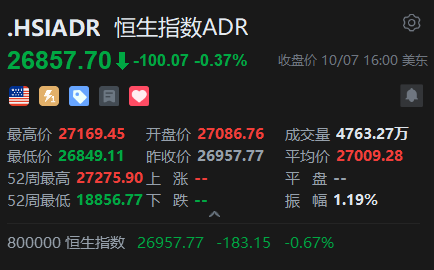
Market Overview - The Hang Seng Index (HSI) closed at 26,857.70, down by 100.07 points or 0.37% as of October 7, 16:00 Eastern Time [1] - The index reached a high of 27,169.45 and a low of 26,849.11 during the trading session, with a trading volume of 47.63 million [1] - The HSI's 52-week high is 27,275.90 and the low is 18,856.77, indicating a trading range of 1.19% [1] Blue-Chip Stocks Performance - Major blue-chip stocks mostly declined, with HSBC Holdings closing at HKD 110.069, down 0.75% from the Hong Kong market close [2] - Tencent Holdings closed at HKD 670.363, down 1.05% compared to the Hong Kong market close [2] Individual Stock Movements - Tencent Holdings (00700) saw a slight increase of 0.59% to HKD 677.500, but its ADR price was HKD 670.363, reflecting a decrease of 7.137 [3] - Alibaba Group (09988) decreased by 2.49% to HKD 180.500, with its ADR price at HKD 176.415, down by 4.085 [3] - HSBC Holdings (00005) increased by 0.91% to HKD 110.900, while its ADR price was HKD 110.069, down by 0.831 [3] - Other notable declines include Xiaomi Group (01810) down 2.09% to HKD 53.850 and JD.com (09618) down 2.14% to HKD 137.200 [3]





前三季度港交所IPO融资额全球居首,深企积极赴港上市加速国际化
Xin Lang Cai Jing· 2025-10-07 00:28
Core Viewpoint - There has been a significant influx of overseas capital into emerging markets this year, with Hong Kong stocks becoming a popular choice for companies looking to go public, as evidenced by the leading financing figures in global exchanges [1] Group 1: Market Trends - In the first three quarters of this year, the Hong Kong Stock Exchange ranked first globally with over 180 billion HKD in financing [1] - The rising valuations of Hong Kong stocks have attracted numerous companies, particularly from Shenzhen, to consider listing in Hong Kong [1] Group 2: Company Strategies - Shenzhen companies are leveraging the opportunity of H-share issuance to attract international investors [1] - These companies are actively promoting their globalization strategies through listings in Hong Kong [1]
前三季度港交所IPO融资额全球居首 深企积极赴港上市加速国际化
Xin Lang Cai Jing· 2025-10-07 00:04
Core Insights - There has been a significant influx of overseas capital into emerging markets this year, with Hong Kong stocks becoming a popular choice for companies looking to go public [1] - According to Deloitte, the Hong Kong Stock Exchange ranked first globally in terms of fundraising, with over 180 billion HKD raised in the first three quarters [1] - A total of 66 new stocks were listed in Hong Kong during the first three quarters, raising over 180 billion HKD, a substantial increase compared to only 45 new stocks raising less than 60 billion HKD in the same period last year [1] - The increase in fundraising is attributed to the concentration of large new stock issuances from mainland China, with CATL's H-share raising 41 billion HKD, making it the largest new stock issuance globally this year [1] Company Highlights - Among the successful companies that went public in Hong Kong, four are from Shenzhen: Chow Tai Fook, Peak Technology, Daheng New Epoch Technology, and Health 160 [1] - Peak Technology successfully issued shares to establish an "A+H" dual listing structure, becoming the first stock in the Hong Kong semiconductor industry focused on motor drive control chips [1] - Peak Technology raised a total of 2.259 billion HKD, which will enhance its research and development capabilities and expand its overseas sales network, thereby increasing its competitiveness in the global market [1]


Tan Su Shan, CEO of Southeast Asia’s largest bank, is Fortune’s most powerful woman in Asia for 2025
Fortune· 2025-10-06 20:00
Core Insights - The 2025 ranking of Asia's most powerful women business leaders highlights the influence of executives from the finance and tech sectors, driven by the AI boom and evolving financial flows [1] Group 1: Top Executives - Tan Su Shan, CEO of DBS, is recognized as Asia's most powerful woman in business, leading Southeast Asia's largest bank through challenges like trade wars and the rise of cryptocurrencies [2] - Grace Wang, founder of Luxshare, ranks second, successfully acquiring new clients despite U.S.-China tensions, including OpenAI [3] - Meng Wanzhou, CFO of Huawei, is third, focusing on making China self-sufficient in advanced technology and increasing production of AI chips [4] - Bonnie Chan, CEO of HKEX, is fourth, as Hong Kong's stock exchange sees a resurgence with significant IPOs [5] - Kathy Yang, rotating CEO of Foxconn, rounds out the top five, shifting revenue focus from iPhones to server assembly for companies like Nvidia [6] Group 2: Regional Representation - Mainland China, Hong Kong, and Macau dominate the ranking with 34 executives, followed by Singapore with 15, and India and Thailand each contributing eight [7] Group 3: Broader Influence - Fortune's list also acknowledges women leaders outside of business, emphasizing their impact in sports, pop culture, and policymaking [8] - The rise of Asian pop culture, exemplified by K-pop group Blackpink, showcases the region's growing global profile [9] - In politics, female leaders like Singapore's Josephine Teo and Tokyo's Yuriko Koike are shaping their nations' ambitions in AI and finance [10] - Professional sports see influential figures like Naomi Osaka and Eileen Gu, who embrace their heritage while gaining international recognition [11]

Women power on show as top female financial leaders gather in Hong Kong next month
Yahoo Finance· 2025-10-06 09:30
Hong Kong will host its first summit among female financial leaders next month, the Women Chief Executives Hong Kong (WCE HK) announced on Monday. The November 3 event is set to become the city's largest gathering of senior women leaders in finance, bringing together more than 200 C-suite senior executives, including global CEOs and chief financial officers (CFOs). "This unparalleled gathering underscores Hong Kong's pivotal role in fostering international dialogue on leadership and its global calibre," ...
香港交易所(00388) - 截至2025年9月30日止月份之股份发行人的证券变动月报表
2025-10-03 08:30
FF301 第 1 頁 共 10 頁 v 1.1.1 股份發行人及根據《上市規則》第十九B章上市的香港預託證券發行人的證券變動月報表 | 截至月份: | 2025年9月30日 | 狀態: 新提交 | | --- | --- | --- | | 致:香港交易及結算所有限公司 | | | | 公司名稱: | 香港交易及結算所有限公司 | | | 呈交日期: | 2025年10月3日 | | | I. 法定/註冊股本變動 | 不適用 | | | 備註: | | | | 香港交易所並無法定股本,及其股本並無股份面值。 | | | FF301 II. 已發行股份及/或庫存股份變動 | 1. 股份分類 | 普通股 | | 股份類別 | 不適用 | | 於香港聯交所上市 (註1) | 是 | | | --- | --- | --- | --- | --- | --- | --- | --- | --- | | 證券代號 (如上市) | 00388 | | 說明 | 股份 | | | | | | 多櫃檯證券代號 | 80388 | RMB 說明 | | 股份 | | | | | | | | 已發行股份(不包括庫存股份)數目 ...
上市亮点 | 欢迎全球第二大新股在香港交易所敲锣
Sou Hu Cai Jing· 2025-10-02 21:46
Group 1 - Zijin Gold International Limited (HK.2259) successfully listed on the Hong Kong Stock Exchange, marking the second largest IPO globally this year [1] - This listing exemplifies the trend of mainland Chinese companies leveraging the Hong Kong capital market for international expansion [1] - The Hong Kong Stock Exchange will continue to play a vital role in connecting high-quality Chinese enterprises with international capital, supporting their globalization efforts [1]