
CCB(00939)

Search documents
建设银行(00939.HK):2月23日南向资金增持1590.1万股
Sou Hu Cai Jing· 2026-02-23 19:29
Group 1 - Southbound funds increased their holdings in China Construction Bank (00939.HK) by 15.901 million shares on February 23 [1] - Over the past 5 trading days, southbound funds have increased their holdings for 5 days, with a total net increase of 51.2832 million shares [1] - In the last 20 trading days, there have been 16 days of net increases, totaling 270 million shares [1] Group 2 - As of now, southbound funds hold 34.779 billion shares of China Construction Bank, accounting for 14.46% of the company's total issued ordinary shares [1] - China Construction Bank is a commercial bank with main business segments including corporate banking and personal banking [1] - The bank's corporate banking services include corporate deposits, loans, asset custody, trade financing, international settlement, and value-added services [1]



银行股分红大比拼!谁才是真现金奶牛?
Sou Hu Cai Jing· 2026-02-22 08:54
Core Viewpoint - The article highlights the significant cash dividends offered by major Chinese banks, positioning them as reliable investment options compared to traditional financial products in a volatile market [2][10]. Dividend Overview - In 2024, the total dividends from China's six major state-owned banks are expected to exceed 420 billion yuan, accounting for 78% of the entire banking sector's dividends [6]. - Industrial and Commercial Bank of China (ICBC) leads with a total dividend payout of 109.8 billion yuan, followed by China Construction Bank (CCB) with nearly 100 billion yuan [6]. - Agricultural Bank of China (ABC) and Bank of China (BOC) each exceed 60 billion yuan in annual dividends, showcasing strong performance [6]. Dividend Policy and Stability - The China Securities Regulatory Commission encourages cash dividends, with state-owned banks maintaining a dividend payout ratio of over 30% [9]. - Some joint-stock banks, like China Merchants Bank, have even higher payout ratios exceeding 35% [9]. - The introduction of mid-year dividends alongside annual dividends effectively doubles the cash flow for investors [9]. Yield Comparison - The average dividend yield for major state-owned banks ranges from 4.2% to 5.8% in A-shares, with Hong Kong shares reaching around 7% [9]. - Agricultural Bank of China boasts an average dividend yield of 6.41% over the past five years, significantly outperforming the current one-year fixed deposit rate of approximately 1.5% [9]. Investment Characteristics - Bank stocks are characterized by consistent dividends, making them suitable for conservative investors and long-term holdings [10]. - The article emphasizes that bank stocks are not about capital gains but rather about stable cash flow and dividends, providing a sense of security for investors [10]. - The low volatility of bank stocks makes them ideal for retirement planning and managing family savings [10].



黄金跌价,金条降价,2026年02月19日,国内黄金最新价格,各大银行黄金金条最新价格
Sou Hu Cai Jing· 2026-02-21 06:02
Core Viewpoint - The domestic gold market experienced slight fluctuations on February 19, 2026, with gold prices showing a minor decline, impacting the prices of gold bars and various gold products [1] Group 1: Gold Purity Standards and Prices - Gold products with a gold content greater than 990‰ are classified as "foot gold," with various purity levels available in the market, including ≥990‰, ≥999‰, ≥99.99%, and ≥99.999% [1] - High-purity gold, such as 99.99% and 99.999%, is ideal for high-end jewelry due to its excellent color and malleability, while 9999 gold is favored by investors for its higher value retention [1] - The latest prices for various gold products are as follows: - Domestic gold 9995: 1103.80 CNY/gram - Domestic gold 9999: 1103.80 CNY/gram - Domestic 9999 foot gold: 1110.40 CNY/gram - Domestic foot gold: 1124.00 CNY/gram - Domestic gold: 1108.50 CNY/gram - Domestic investment gold bars: 1122.00 CNY/gram [1] Group 2: Bank Gold Bar Quotes - The latest gold bar prices from various banks are as follows: - Industrial and Commercial Bank of China: 1105.14 CNY/gram for Ru Yi gold bars [2] - China Construction Bank: 1109.80 CNY/gram for Long Ding gold bars [3] - Minsheng Bank: 1127.50 CNY/gram for gold bars [4] - Bank of Communications: 1129.20 CNY/gram for gold bars [5] - Ping An Bank: 1129.50 CNY/gram for He Xie Ping An gold bars [6] - The gold bar prices from banks are subject to real-time fluctuations, and it is recommended to consult the respective banks for the most accurate pricing [7][8]

智通ADR统计 | 2月21日
智通财经网· 2026-02-20 23:59
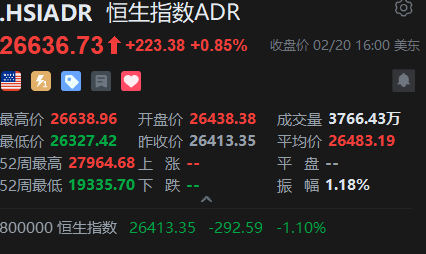
Group 1 - Major blue-chip stocks mostly rose, with HSBC Holdings closing at HKD 137.775, up 2.59% from the previous close in Hong Kong [2] - Tencent Holdings closed at HKD 531.758, an increase of 1.87% from the previous close in Hong Kong [2] Group 2 - Tencent Holdings reported a latest price of HKD 522.000, down HKD 11.000 or 2.06%, with an ADR price of HKD 531.758, showing an increase of HKD 9.758 compared to the Hong Kong stock price [3] - Alibaba Group (W) had a latest price of HKD 147.100, down HKD 7.600 or 4.91%, with an ADR price of HKD 150.874, reflecting an increase of HKD 3.774 compared to the Hong Kong stock price [3] - HSBC Holdings had a latest price of HKD 134.300, up HKD 0.100 or 0.07%, with an ADR price of HKD 137.775, indicating an increase of HKD 3.475 compared to the Hong Kong stock price [3]





智通ADR统计 | 2月20日
智通财经网· 2026-02-19 23:23
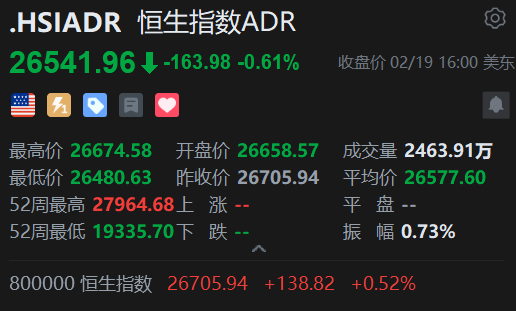
Market Overview - The Hang Seng Index (HSI) closed at 26,541.96, down by 163.98 points or 0.61% on February 19 [1] - The index opened at 26,658.57, reached a high of 26,674.58, and a low of 26,480.63, with a trading volume of 24.6391 million [1] Major Blue-Chip Stocks Performance - HSBC Holdings closed at HKD 135.722, up by 1.13% compared to the previous close [2] - Tencent Holdings closed at HKD 532.399, down by 0.11% compared to the previous close [2] Stock Price Movements - Tencent Holdings (00700) latest price is HKD 533.000, with a slight increase of 1.000 or 0.19% [3] - Alibaba Group (09988) latest price is HKD 154.700, down by 0.700 or 0.45% [3] - HSBC Holdings (00005) latest price is HKD 134.200, down by 1.500 or 1.11% [3] - AIA Group (01299) latest price is HKD 82.350, up by 2.050 or 2.55% [3] - Meituan (03690) latest price is HKD 82.050, down by 0.100 or 0.12% [3] - JD.com (09618) latest price is HKD 105.900, down by 0.500 or 0.47% [3]
智通港股通资金流向统计(T+2)|2月19日
智通财经网· 2026-02-18 23:32
Key Points - Tencent Holdings (00700), Yingfu Fund (02800), and Shandong Gold (01787) ranked the top three in net inflow of southbound funds, with net inflows of 736 million, 423 million, and 393 million respectively [1] - Alibaba-W (09988), SMIC (00981), and Hua Hong Semiconductor (01347) ranked the top three in net outflow of southbound funds, with net outflows of -524 million, -391 million, and -199 million respectively [1] - In terms of net inflow ratio, Nanhua Futures (02691), Southern East Select (03441), and Oculent (00501) led the market with ratios of 70.54%, 59.14%, and 56.33% respectively [1] - In terms of net outflow ratio, Zhengzhou Bank (06196), China Energy Construction (03996), and Hongye Futures (03678) had the highest ratios at -50.51%, -49.70%, and -48.03% respectively [1] Top 10 Net Inflow Stocks - Tencent Holdings (00700) had a net inflow of 736 million with a net inflow ratio of 5.67% and a closing price of 548.000 [2] - Yingfu Fund (02800) recorded a net inflow of 423 million with a net inflow ratio of 5.13% and a closing price of 27.480 [2] - Shandong Gold (01787) saw a net inflow of 393 million with a net inflow ratio of 31.27% and a closing price of 40.180 [2] - Bilibili-W (09626) had a net inflow of 335 million with a net inflow ratio of 27.53% and a closing price of 252.800 [2] - China National Offshore Oil Corporation (00883) recorded a net inflow of 301 million with a net inflow ratio of 22.88% and a closing price of 24.800 [2] Top 10 Net Outflow Stocks - Alibaba-W (09988) experienced a net outflow of -524 million with a net outflow ratio of -6.30% and a closing price of 160.100 [2] - SMIC (00981) had a net outflow of -391 million with a net outflow ratio of -6.39% and a closing price of 70.000 [2] - Hua Hong Semiconductor (01347) recorded a net outflow of -199 million with a net outflow ratio of -15.56% and a closing price of 99.600 [2] - Changfei Optical Fiber (06869) saw a net outflow of -172 million with a net outflow ratio of -5.33% and a closing price of 107.500 [2] - WISCO (01208) had a net outflow of -168 million with a net outflow ratio of -32.19% and a closing price of 10.160 [2] Top 10 Net Inflow Ratios - Nanhua Futures (02691) had a net inflow ratio of 70.54% with a net inflow of 5.40 million and a closing price of 11.230 [3] - Southern East Select (03441) recorded a net inflow ratio of 59.14% with a net inflow of 5.74 million and a closing price of 11.650 [3] - Oculent (00501) had a net inflow ratio of 56.33% with a net inflow of 1.45 million and a closing price of 103.900 [3] Top 10 Net Outflow Ratios - Zhengzhou Bank (06196) had a net outflow ratio of -50.51% with a net outflow of -3.13 million and a closing price of 1.150 [3] - China Energy Construction (03996) recorded a net outflow ratio of -49.70% with a net outflow of -16.96 million and a closing price of 1.180 [3] - Hongye Futures (03678) had a net outflow ratio of -48.03% with a net outflow of -5.22 million and a closing price of 3.220 [3]


国有大行主导手机银行市场,生态嵌入构筑护城河
Jing Ji Guan Cha Wang· 2026-02-18 05:47
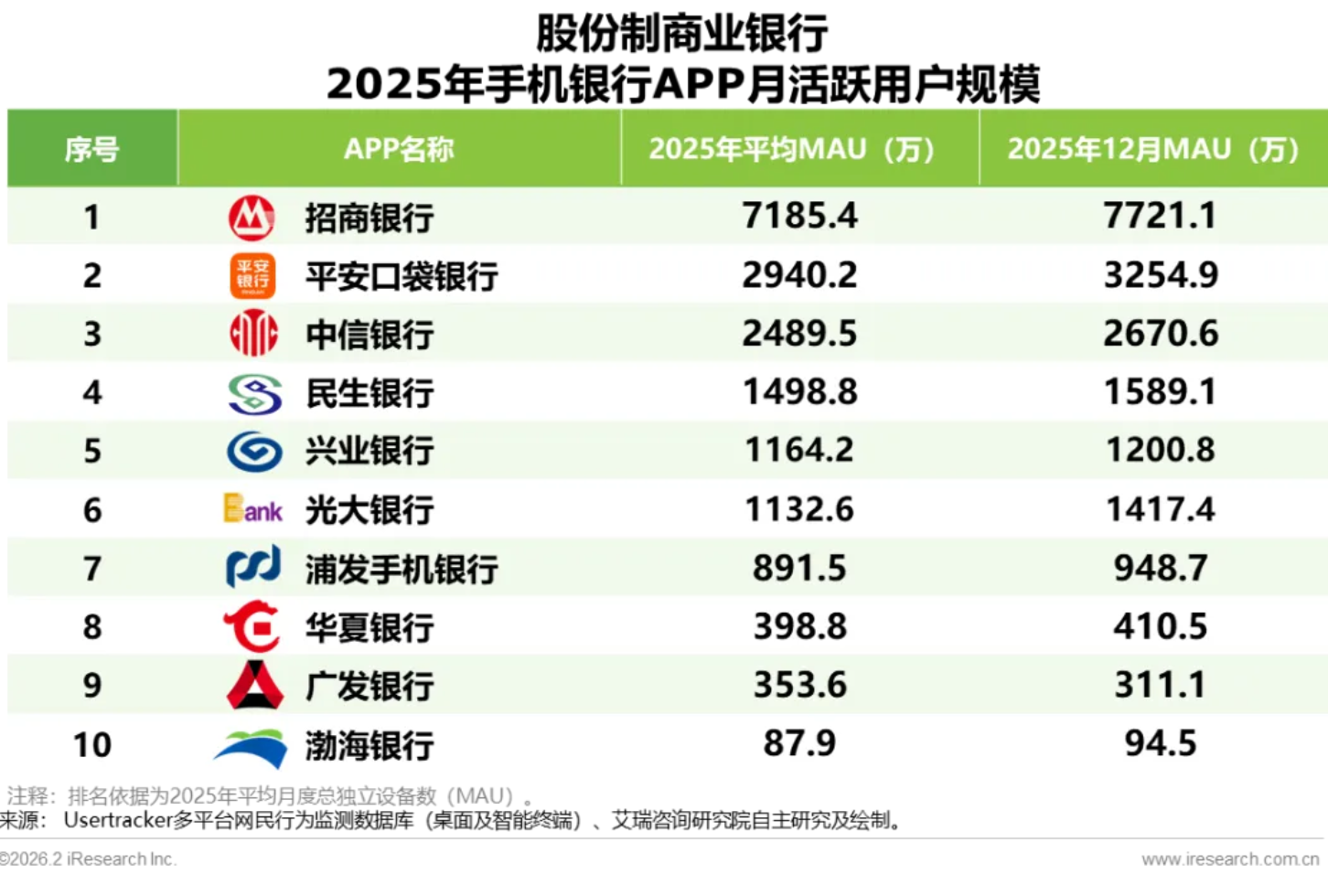
Core Insights - The Chinese mobile banking market is entering a stage of stock competition in 2025, with monthly active users (MAU) stabilizing between 648 million and 739 million [2] - State-owned commercial banks dominate the market due to their ecological embedding advantages, with Agricultural Bank of China leading at 249 million MAU, followed by Industrial and Commercial Bank of China (194 million) and China Construction Bank (109 million) [2] - Private banks are expected to collectively exit the top 50 MAU rankings in 2025 due to a lack of offline branch support and local living ecosystems [2] Group 1: Major Players - Agricultural Bank of China has the highest MAU at 249 million, followed by Industrial and Commercial Bank of China with 194 million and China Construction Bank with 109 million, forming the first tier of banks [2] - China Bank and Postal Savings Bank have MAUs exceeding 50 million, constituting the second tier [2] - China Merchants Bank leads the joint-stock banks with 71.85 million MAU, while Ping An Bank and CITIC Bank form the second tier, with other joint-stock banks generally below 20 million MAU [2] Group 2: Market Dynamics - The core advantage of state-owned banks lies in their "full-scenario integration" capabilities, embedding services deeply into high-frequency life scenarios such as government affairs, social security, healthcare, and education [2] - Agricultural Bank of China extends its services to rural areas through intelligent service matching and customer customization, while Industrial and Commercial Bank of China utilizes its "Gong Xiao Zhi" model for interactive service [2] - Regional banks like Jiangsu Bank, Beijing Bank, and Ningbo Bank show stable performance by focusing on local markets, with some rural commercial banks like Fujian Rural Credit exceeding 4.5 million MAU, indicating the sustainability of localized operations in the stock market [2]

流量红利枯竭 存量博弈下银行APP被迫断臂求生
Jing Ji Guan Cha Wang· 2026-02-18 05:44
Core Insights - The Chinese mobile banking market is transitioning from "scale expansion" to "value cultivation," indicating a saturation of user growth and the end of the traffic dividend period [2] - Different types of banks are exhibiting varied development trends in this new landscape [2] State-Owned Commercial Banks - The six major state-owned banks dominate the mobile banking market, with Agricultural Bank of China leading with over 250 million monthly active users (MAUs) [2] - The top three banks, including Industrial and Commercial Bank of China and China Construction Bank, have MAUs of nearly 200 million and over 100 million, respectively [2] - All six major banks reported positive month-on-month growth in MAUs, with ICBC leading at a 6.1% growth rate [2] Joint-Stock Commercial Banks - Joint-stock banks are seeking to carve out a niche in the saturated market, with China Merchants Bank leading among them with over 70 million MAUs [3] - Some banks like Everbright Bank and CITIC Bank showed significant month-on-month growth rates of 11.0% and 9.2%, respectively [3] - The performance of joint-stock banks is mixed, with some experiencing negative growth [3] Urban Commercial Banks - Urban commercial banks are growing rapidly, with 17 banks making it to the top 50 list, led by Ningbo Bank with 3.644 million MAUs and a growth rate of 43.9% [3] - The growth is attributed to localized strategies that enhance customer engagement [3] Rural Commercial Banks and Credit Cooperatives - Rural commercial banks and credit cooperatives also performed well, with 17 banks in the top 50, led by Fujian Rural Credit with 781.6 thousand average MAUs [4] - 12 out of these 17 banks reported positive month-on-month growth [4] Private Banks - Private banks are facing significant challenges, with only WeBank making it to the top 50 list in the first half of 2025, experiencing a 27.3% decline in MAUs [4] - The competitive landscape has shifted, making it difficult for online-only private banks to maintain their initial advantages [4] Conclusion - State-owned banks leverage "ecosystem" advantages to solidify their market position, while joint-stock banks focus on "professional" opportunities [5] - Urban commercial banks establish a strong local presence, whereas private banks struggle to survive in the competitive environment [5] - The future of banking will require a focus on creating irreplaceable value for users through technology and insights into user behavior [5]

2.7分钟定生死 手机银行存量厮杀谁在“断臂”,谁在“吃肉”?
Jing Ji Guan Cha Wang· 2026-02-18 04:57
Core Insights - The report by iResearch indicates that the monthly active users (MAU) of mobile banking apps in China have stabilized after fluctuating between 648 million and 739 million, signaling a ceiling in user growth and a shift from acquiring new users to enhancing existing user engagement [2] - User behavior is undergoing a structural reversal, with the effective daily usage time per device dropping from 4.9 minutes in 2023 to around 2.7 minutes by mid-2025, leading to a focus on high-frequency, short-duration, and functional usage [2] - Financial institutions are compelled to streamline operations and focus resources on core transaction scenarios to survive in this competitive landscape, where efficiency and precision are paramount [2] Mobile Banking Market Overview - The top three banks in terms of MAU are Agricultural Bank of China (2.49 billion), Industrial and Commercial Bank of China (1.94 billion), and China Construction Bank (1.09 billion), with all six major state-owned banks ranking in the top ten [3][5][6] - Private banks, represented by WeBank and MYbank, have faced significant setbacks, with many dropping out of the top 50 MAU rankings by 2025 [4] Competitive Landscape - State-owned banks are solidifying their dominance through extensive customer bases and integrated ecosystems, leveraging services embedded in high-frequency life scenarios such as government services and healthcare [7] - Joint-stock commercial banks are adopting a "specialized and precise" survival strategy, with China Merchants Bank leading among them with 71.85 million MAU, focusing on wealth management and intelligent interaction [8][10] - Regional banks are thriving by deeply engaging with local markets, while private banks struggle due to high customer acquisition costs and lack of local ecosystem support [13][14] Future Outlook - The mobile banking market is transitioning from a phase of scale expansion to one of value cultivation, with state-owned banks building moats through ecosystems, joint-stock banks seeking niches through specialization, and regional banks solidifying their local roots [14] - The ability to create irreplaceable value in a limited user engagement environment will be crucial, with technology applications such as AI reshaping service processes and enhancing risk management [15][16]

中国建设银行取得面向主机系统的测试数据处理方法及系统专利
Sou Hu Cai Jing· 2026-02-17 09:26
Group 1 - The core point of the article is that China Construction Bank has obtained a patent for a testing data processing method and system aimed at host systems, with the patent granted under announcement number CN115495356B and the application date being September 2022 [1] Group 2 - China Construction Bank, established in 2004 and located in Beijing, primarily engages in monetary financial services, with a registered capital of 26,160,038.1459 million RMB [1] - The bank has made investments in 37 companies and participated in 5,000 bidding projects, indicating its active role in the market [1] - In terms of intellectual property, the bank holds 1,890 trademark records and 5,000 patent records, along with 149 administrative licenses [1]