SMIC(00981)

Search documents
港股通成交活跃股追踪 三花智控近一个月首次上榜





Zheng Quan Shi Bao Wang· 2025-12-04 13:39
Core Insights - On December 4, 2023, Sanhua Intelligent Control made its debut on the Hong Kong Stock Connect active trading list for the first time in a month, with a trading volume of 0.853 billion HKD and a net sell of 0.057 billion HKD, closing up by 7.70% [1] Trading Activity Summary - The total trading volume of active stocks on the Hong Kong Stock Connect on December 4 was 28.218 billion HKD, accounting for 37.28% of the day's total trading amount, with a net buying amount of 1.402 billion HKD [1] - Alibaba-W led the trading volume with 5.318 billion HKD, followed by Tencent Holdings and Xiaomi Group-W with trading amounts of 5.271 billion HKD and 4.995 billion HKD, respectively [1] - The most frequently listed stocks in the past month were Alibaba-W and Tencent Holdings, each appearing 22 times, indicating strong interest from Hong Kong Stock Connect investors [1] Individual Stock Performance - Sanhua Intelligent Control's trading details on December 4 included a trading volume of 0.853 billion HKD, a net sell of 0.057 billion HKD, and a closing price of 34.960 HKD, reflecting a daily increase of 7.70% [1] - Other notable stocks included: - Tencent Holdings: Trading volume of 5.271 billion HKD, net sell of 1.346 billion HKD, closing price of 612.000 HKD, daily increase of 0.16% [1] - Xiaomi Group-W: Trading volume of 4.995 billion HKD, net buy of 0.232 billion HKD, closing price of 41.980 HKD, daily increase of 4.38% [1] - Alibaba-W: Trading volume of 5.318 billion HKD, net sell of 0.010 billion HKD, closing price of 154.400 HKD, daily increase of 0.52% [1]
12月4日港股通净买入14.80亿港元
Zheng Quan Shi Bao Wang· 2025-12-04 13:34
Group 1 - The Hang Seng Index rose by 0.68% to close at 25,935.90 points on December 4, with a net inflow of HKD 1.48 billion through the southbound trading channel [1] - The total trading volume for the southbound trading on December 4 was HKD 75.688 billion, with a net buy of HKD 1.48 billion [1] - In the Shanghai-Hong Kong Stock Connect, the trading volume was HKD 46.347 billion with a net sell of HKD 1 billion, while the Shenzhen-Hong Kong Stock Connect had a trading volume of HKD 29.341 billion with a net buy of HKD 2.481 billion [1] Group 2 - In the top ten active stocks for the Shanghai-Hong Kong Stock Connect, Tencent Holdings had the highest trading amount of HKD 37.50 billion, followed by Alibaba-W and Xiaomi Group-W with HKD 29.39 billion and HKD 26.78 billion respectively [1] - The stock with the highest net buy was the Tracker Fund of Hong Kong (盈富基金) with a net buy of HKD 2.107 billion, closing up by 0.77% [1] - Tencent Holdings had the highest net sell amount of HKD 1.919 billion, closing up by 0.16% [1] Group 3 - In the Shenzhen-Hong Kong Stock Connect, Alibaba-W led with a trading amount of HKD 23.79 billion, followed by Xiaomi Group-W and Tencent Holdings with HKD 23.16 billion and HKD 15.21 billion respectively [2] - The stock with the highest net buy in the Shenzhen-Hong Kong Stock Connect was Xiaomi Group-W with a net buy of HKD 0.794 billion, closing up by 4.38% [2] - The stock with the highest net sell in the Shenzhen-Hong Kong Stock Connect was Kuaishou-W with a net sell of HKD 0.094 billion, closing up by 0.15% [2]


港股通12月4日成交活跃股名单

Zheng Quan Shi Bao Wang· 2025-12-04 13:31
Market Overview - On December 4, the Hang Seng Index rose by 0.68%, with southbound funds totaling HKD 756.88 billion in trading volume, including HKD 385.84 billion in buying and HKD 371.04 billion in selling, resulting in a net buying amount of HKD 14.80 billion [1] Southbound Trading Activity - The southbound trading through Stock Connect (Shenzhen) had a cumulative trading volume of HKD 293.41 billion, with net buying of HKD 24.81 billion, while the Stock Connect (Shanghai) recorded a cumulative trading volume of HKD 463.47 billion, resulting in a net selling of HKD 10.00 billion [1] Active Stocks - Alibaba-W had the highest trading volume among southbound funds at HKD 53.18 billion, followed closely by Tencent Holdings at HKD 52.71 billion and Xiaomi Group-W at HKD 49.95 billion [1] - The top net buying stocks included the Tracker Fund of Hong Kong (盈富基金) with a net buying amount of HKD 26.06 billion, followed by WuXi Biologics (药明生物) with HKD 3.16 billion and Xiaomi Group-W with HKD 2.32 billion [1] Continuous Net Buying and Selling - Three stocks experienced continuous net buying for more than three days, with Meituan-W leading at six days, followed by Xiaomi Group-W at five days and Xpeng Motors-W at three days. The total net buying amounts were HKD 22.89 billion for Meituan-W, HKD 20.53 billion for Xiaomi Group-W, and HKD 1.67 billion for Xpeng Motors-W [2] - The stocks with the highest net selling included Semiconductor Manufacturing International Corporation (中芯国际) and Tencent Holdings, with total net selling amounts of HKD 34.49 billion and HKD 24.60 billion, respectively [2] Summary of Active Stocks on December 4 - The following table summarizes the active stocks with their trading amounts, net buying/selling, and daily price changes: | Code | Name | Trading Amount (HKD million) | Net Buying (HKD million) | Daily Change (%) | |-------|--------------------|------------------------------|--------------------------|-------------------| | 02800 | Tracker Fund | 284623.16 | 260585.86 | 0.77 | | 02269 | WuXi Biologics | 51978.36 | 31558.31 | 7.09 | | 01810 | Xiaomi Group-W | 499493.94 | 23169.32 | 4.38 | | 09868 | Xpeng Motors-W | 73564.27 | 10257.11 | 1.06 | | 01347 | Hua Hong Semiconductor | 159937.95 | 5363.70 | 3.11 | | 00883 | CNOOC | 47173.84 | 3007.07 | 0.92 | | 09880 | UBTECH Robotics | 73333.99 | 954.58 | 3.66 | | 03690 | Meituan-W | 171510.39 | 856.38 | 2.29 | | 09988 | Alibaba-W | 531828.80 | -117.31 | 0.52 | | 02050 | Sanhua Intelligent Control | 85349.48 | -5657.75 | 7.70 | | 01024 | Kuaishou-W | 54889.05 | -9372.22 | 0.15 | | 00981 | Semiconductor Manufacturing International | 260990.47 | -45829.01 | 3.87 | | 00700 | Tencent Holdings | 527122.94 | -134592.99 | 0.16 |
智通港股通活跃成交|12月4日
智通财经网· 2025-12-04 11:06
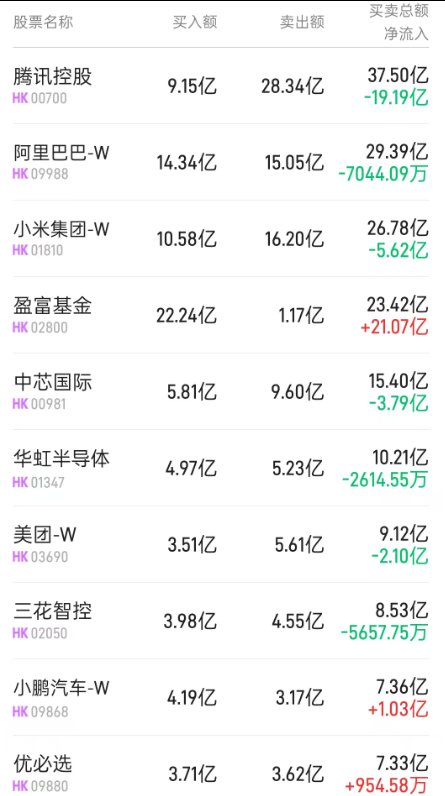
Core Insights - On December 4, 2025, Tencent Holdings (00700), Alibaba-W (09988), and Xiaomi Group-W (01810) were the top three companies by trading volume in the southbound trading of the Stock Connect, with trading amounts of 3.75 billion, 2.939 billion, and 2.678 billion respectively [1] - In the southbound trading of the Shenzhen-Hong Kong Stock Connect, Alibaba-W (09988), Xiaomi Group-W (01810), and Tencent Holdings (00700) also ranked as the top three, with trading amounts of 2.379 billion, 2.316 billion, and 1.521 billion respectively [1] Southbound Trading Highlights - **Top Active Companies in Southbound Trading (Hong Kong Stock Connect)** - Tencent Holdings (00700): Trading amount of 3.75 billion, net buy of -1.919 billion - Alibaba-W (09988): Trading amount of 2.939 billion, net buy of -70.44 million - Xiaomi Group-W (01810): Trading amount of 2.678 billion, net buy of -562 million - Other notable companies include Yingfu Fund (02800) with a trading amount of 2.342 billion and a net buy of 2.107 billion [2] - **Top Active Companies in Southbound Trading (Shenzhen-Hong Kong Stock Connect)** - Alibaba-W (09988): Trading amount of 2.379 billion, net buy of 69.27 million - Xiaomi Group-W (01810): Trading amount of 2.316 billion, net buy of 794 million - Tencent Holdings (00700): Trading amount of 1.521 billion, net buy of 573 million - Other notable companies include SMIC (00981) with a trading amount of 1.07 billion and a net buy of -79.37 million [2]
北水动向|北水成交净买入14.8亿 内资抢筹盈富基金(02800)超26亿港元
智通财经网· 2025-12-04 09:57
Summary of Key Points Core Viewpoint - The Hong Kong stock market experienced significant net inflows from northbound trading, with a total net buy of 14.8 billion HKD on December 4, 2023, indicating strong investor interest in certain stocks while others faced net selling pressure [1]. Group 1: Stock Performance - The top net bought stocks included 盈富基金 (02800) with a net buy of 26.05 billion HKD, 药明生物 (02269) with a net buy of 3.15 billion HKD, and 小米集团-W (01810) with a net buy of 2.31 billion HKD [4][5]. - The stocks with the highest net selling included 腾讯 (00700) with a net sell of 13.45 billion HKD, 中芯国际 (00981) with a net sell of 4.58 billion HKD, and 三花智控 (02050) with a net sell of 5657.75 million HKD [5][6]. Group 2: Market Insights - 中金公司 suggests that the upcoming US-China meetings may support risk assets, recommending an overweight position in Chinese stocks ahead of the meetings [4]. - 浦银国际 expresses optimism for the CXO sector by 2026, citing potential growth in overseas biopharmaceutical financing due to anticipated interest rate cuts [4]. - The semiconductor industry shows divergence, with 华虹半导体 (01347) receiving a net buy of 5363 million HKD, while 中芯国际 (00981) faced significant net selling [5]. Group 3: Company Developments - 小米集团's president announced significant investments in AI, indicating progress beyond expectations in AI models and applications [5]. - 优必选 (09880) signed a strategic cooperation agreement with 卓世科技, aiming for the deployment of 10,000 robots over the next five years [6]. - 中海油 (00883) reported the production commencement of a new oil field project, expecting peak production of approximately 16,900 barrels of oil equivalent per day by 2026 [5].

中芯国际(00981):毛利率小幅上涨,利润依然承压
Waton Financial· 2025-12-04 08:59
Investment Rating - The investment rating for the company is "Hold" [2] Core Insights - The financial performance of the company shows an overall upward trend, with revenue reaching $2,381.82 million, a year-on-year increase of 9.7%, and a net profit of $191.76 million, which is up 28.87% year-on-year and 44.74% quarter-on-quarter [5][12] - The gross margin has slightly increased to 22%, exceeding the management's guidance of 18-20%, and the capacity utilization rate has risen to 95.8%, a quarter-on-quarter increase of 3% [5][12] - The growth in revenue is primarily driven by strong domestic demand, particularly in the automotive and industrial sectors, which saw a year-on-year revenue increase of 65% [6][14] Financial Performance - In Q3 2025, the company reported a revenue of $2,381.82 million, reflecting a 9.7% year-on-year growth, and a net profit of $191.76 million, which is a 28.87% increase year-on-year and a 44.74% increase quarter-on-quarter [5][12] - The gross margin for the quarter was 22%, surpassing the management's guidance, and the capacity utilization rate improved to 95.8% [5][12] Business Development - Revenue from the smartphone market declined by 5.3% year-on-year, while revenue from tablets and PCs grew by 1.7%. Consumer electronics revenue increased by 11.8%, and automotive and industrial revenue surged by 65%, which is the main driver of revenue growth [6][14] - The Chinese market remains the primary revenue source, accounting for 86.2% of total revenue, highlighting strong domestic demand [14][15] Profit Forecast - The company forecasts revenue growth from $8,029.92 million in 2024 to $11,376.79 million in 2027, with a compound annual growth rate (CAGR) of approximately 10% [9] - The net profit is expected to increase from $492.75 million in 2024 to $823.51 million in 2027, with a significant year-on-year growth of 48.65% in 2025 [9] Capital Expenditure and R&D Investment - In Q3, the company reported R&D expenses of approximately $14.47 billion, a year-on-year increase of 13.6%, and capital expenditures of $170.65 billion, a quarter-on-quarter increase of 25.98% [16] - The company is focusing on expanding its production capacity and advancing its technology platforms to meet the growing demand in various sectors [16][18]
港股收评:恒科指涨1.45%,科技股集体回暖,有色金属股转跌
Ge Long Hui A P P· 2025-12-04 08:44
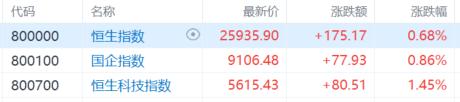
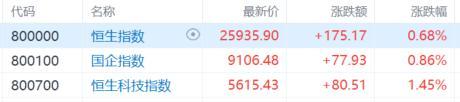
Market Overview - The Hong Kong stock market showed a rebound in sentiment, with the Hang Seng Technology Index rising by 1.45% to above 5600 points, while the Hang Seng Index increased by 0.68% to 25935 points, and the National Enterprises Index rose by 0.86% to 9106 points [1][2]. Sector Performance - Large technology stocks collectively rose, with notable gains from Xiaomi (over 4%) and Meituan (over 2%). The pharmaceutical sector saw a surge in orders for flu medications, with some stocks in this category performing strongly [2][4]. - The semiconductor sector was active, with companies like Cambrian increasing chip production by three times, leading to a rise in semiconductor stocks [2][9]. - The biopharmaceutical sector experienced significant gains, with WuXi AppTec rising over 9% and other related stocks also showing strong performance due to increased demand for flu medications [6][8]. - The automotive, real estate, and pharmaceutical sectors showed positive movements, while the restaurant and gaming sectors faced declines [3][13][15]. Notable Stocks - Horizon Robotics saw a rise of over 6%, while Xiaomi and Trip.com also reported gains of over 4% and 3%, respectively [4][5]. - In the biopharmaceutical space, WuXi AppTec and other related stocks saw increases of over 8% [6]. - The robotics sector was strong, with companies like CloudMinds and others showing significant gains [7][8]. - The entertainment sector also saw some upward movement, with Lemon Films rising over 5% [11][12]. Capital Flows - Southbound funds recorded a net inflow of 1.48 billion HKD, indicating positive investor sentiment towards Hong Kong stocks [19]. Future Outlook - Analysts predict that the Hong Kong stock market may experience fluctuations in the coming months, with the Hang Seng Index expected to range between 23500 and 30500 points in 2026. Recommendations include buying on dips and focusing on sectors such as technology, high-end manufacturing, and renewable energy [21].


港股收评:恒科指涨1.45%,科技股回暖,药品类股集体强势
Ge Long Hui· 2025-12-04 08:39
Market Overview - The Hong Kong stock market showed a rebound in sentiment, with the Hang Seng Technology Index rising by 1.45% to above 5600 points, while the Hang Seng Index increased by 0.68% to 25935 points, and the National Enterprises Index rose by 0.86% to 9106 points [1][2]. Sector Performance - Large technology stocks collectively rose, with notable gains from Xiaomi (over 4%) and Meituan (over 2%). The pharmaceutical sector saw a surge, with orders for flu treatment drugs increasing nearly ninefold, leading to strong performance in related stocks [2][4]. - The semiconductor sector was active, with companies like Cambrian aiming to triple chip production, and stocks such as Horizon Robotics and SMIC also showing significant gains [2][9]. - The biopharmaceutical sector experienced substantial growth, with WuXi AppTec rising over 9% and other related stocks also performing well due to increased demand for flu medications [6]. - The robotics sector was strong, with companies like Cloudwalk and Horizon Robotics seeing gains of over 7% [7]. - The entertainment sector showed positive movement, with Lemon Films rising over 5% amid a strong box office performance during the holiday season [11]. Individual Stock Movements - Notable individual stock performances included: - Horizon Robotics: +6.97% [5] - Xiaomi Group: +4.38% [5] - WuXi AppTec: +9.09% [6] - Cloudwalk: +8.67% [8] - Conversely, the restaurant sector faced declines, with Shanghai Xiaonan falling over 4% [13]. Capital Flows - Southbound funds recorded a net inflow of 1.48 billion HKD, with the Hong Kong Stock Connect (Shanghai) showing a net sell of 1 billion HKD and the Hong Kong Stock Connect (Shenzhen) showing a net buy of 2.481 billion HKD [19]. Future Outlook - Analysts predict that the Hong Kong stock market may experience fluctuations, with the Hang Seng Index expected to range between 23500 and 30500 points in 2026. Recommendations include buying on dips and focusing on sectors such as technology, high-end manufacturing, and renewable energy [21].

中芯国际涨2.79%,成交额43.92亿元,人气排名17位!后市是否有机会?附走势预测
Xin Lang Cai Jing· 2025-12-04 07:42
Core Viewpoint - SMIC (Semiconductor Manufacturing International Corporation) shows a positive market performance with a 2.79% increase in stock price, reaching a market capitalization of 917.87 billion yuan [1]. Company Overview - SMIC is the largest integrated circuit manufacturing enterprise group in mainland China, recognized for its advanced technology and comprehensive support [4]. - The company specializes in integrated circuit wafer foundry services across various technology nodes, providing design services, IP support, and photomask manufacturing [4]. - As of September 30, 2025, SMIC reported a revenue of 49.51 billion yuan, marking an 18.22% year-on-year growth, and a net profit of 3.82 billion yuan, reflecting a 41.09% increase [8]. Investment and Shareholding - The National Integrated Circuit Industry Investment Fund holds a 1.61% stake in SMIC, indicating government support [3]. - As of September 30, 2025, the number of shareholders increased to 336,200, with an average of 6,134 shares held per shareholder [8]. Market Position - SMIC ranks second globally among pure-play foundries and first among mainland Chinese companies based on the latest sales figures for 2024 [4]. - The stock is currently ranked 17th in terms of popularity in the A-share market on Sina Finance [2]. Technical Analysis - The average trading cost of SMIC shares is 122.37 yuan, with the stock price fluctuating between resistance at 119.22 yuan and support at 108.18 yuan, suggesting potential for range trading [7]. Fund Flow Analysis - The net inflow of funds today was 351 million yuan, with the stock showing no significant trend in major fund movements [5][6].

劳动力市场萎缩推升降息预期,港股通周三净流入 23 亿港元
Sou Hu Cai Jing· 2025-12-04 05:26
港股通周三净流入 23 亿港元,其中小米集团(01810.HK)净流入最多,达 8.7 亿港元,其次是阿里巴巴 (09988.HK)。另一方面,腾讯控股(00700.HK)录得最大净流出,达 7.3 亿港元,其次是中芯国际 (00981.HK)。 来源:凯基证券 大市点评 周三美股开盘之前,薪资处理机构 ADP 报告称,11 月私营部门就业人数意外减少3.2 万人,而经济学 家此前预计当月为增加 4 万人。这份数据表现不佳,显示劳动力市场萎缩,使交易员增大了美联储在下 周货币政策会议上降息的预期。根据 CME FedWatch 工具,市场目前预计美联储在下週三降息的可能性 为 89%,远高于11月中旬时预测的几率。投资者预期较低的利率环境将刺激贷款增长并给美国经济带 来提振,这推动金融股股价週三走高。 ...