SMIC(00981)

Search documents
恒指午盘上涨2.18%,恒生科技指数飙升3.38%,壁仞科技大涨超72%


Mei Ri Jing Ji Xin Wen· 2026-01-02 04:19
Market Performance - The Hang Seng Index increased by 2.18%, reaching 26,189.79 points [1] - The Hang Seng Tech Index surged by 3.38%, closing at 5,702.56 points [1] - The Hang Seng China Enterprises Index rose by 2.26%, ending at 9,115.17 points [1] - The market recorded a half-day trading volume of 76.869 billion HKD [1] Notable Stock Movements - Wallen Technology experienced a significant increase of over 72% [1] - Hua Hong Semiconductor rose by 9.89% [1] - Baidu Group-SW saw a gain of 7.45% [1] - Sanhua Intelligent Control increased by 6.37% [1] - NetEase-S rose by 5.87% [1] - Li Auto-W gained 4.93% [1] - SMIC increased by 4.9% [1] - Trip.com Group-S rose by 4.33% [1] - Huatai Securities increased by 4.04% [1] Declining Stocks - Global New Material International fell by 8.99% [1] - 361 Degrees dropped by 10.89% [1] - Goldwind Technology increased by 17.15% [1] - Derin Holdings rose by 14.22% [1]
港股,全线暴涨!人民币狂拉!
证券时报· 2026-01-02 03:48
Core Viewpoint - The Hong Kong stock market opened positively, with significant gains across major indices, indicating a bullish sentiment in the market [1][2]. Market Performance - As of the report, the Hang Seng Index and the Hang Seng China Enterprises Index both surged over 2%, while the Hang Seng Technology Index rose by 3.65% [2]. - The semiconductor index experienced a remarkable increase of 8.3% [4]. - Notable stocks included Hua Hong Semiconductor, which rose over 10%, and SMIC, which increased by 4.63% [7]. Company Announcements - Hua Hong Semiconductor announced plans to acquire a 97.4988% stake in Huahong Micro through a share issuance to four counterparties, along with a fundraising initiative [7]. - Baidu's stock surged nearly 8% following its announcement of a listing application for Kunlun Chip on the Hong Kong Stock Exchange, indicating strong market interest in tech IPOs [7]. Currency and Economic Outlook - The offshore RMB appreciated against the USD, surpassing 6.97, reaching a high of 6.9678, the highest since May 2023 [8]. - Analysts at Galaxy Securities predict that the Federal Reserve's interest rate decisions will become clearer after April 2026, which may positively impact Hong Kong stock valuations and attract foreign investment [8]. Investment Themes - Suggested investment themes include: 1. **Technology Innovation**: With a focus on self-reliance in technology during the 14th Five-Year Plan, the technology sector is expected to be a major investment theme, with significant growth potential in leading companies [9]. 2. **Cyclical Industries**: Sectors such as steel, construction materials, electrical equipment, and paper are anticipated to benefit from supply-side reforms, leading to improved supply-demand dynamics and profitability [9]. 3. **Consumer Sector**: The consumer sector, particularly in service consumption and new consumption models, is expected to see growth due to strategies aimed at expanding domestic demand [9]. Overall Market Outlook - The Hong Kong stock market is expected to experience a phase of both profit and valuation increases, driven by favorable policies and economic recovery [8][9].



港股半导体概念股集体走强 华虹半导体涨近10%
Jin Rong Jie· 2026-01-02 02:25
Group 1 - Semiconductor stocks in Hong Kong experienced a collective surge, with Huahong Semiconductor rising nearly 10% [1] - Chipone Technology increased by nearly 5% [1] - SMIC saw a rise of over 4% [1] - China Electronics Huada Technology and ASMPT both rose by over 3% [1]
2025年度科创板排行榜
Wind万得· 2026-01-01 22:38
Market Sector - The Sci-Tech 50 Index increased by 35.92% in 2025, ranking third among various sector indices, outperforming both the Shanghai 50 and Shenzhen 50 indices [1][3] - By the end of 2025, the total market capitalization of the Sci-Tech Board reached 11.12 trillion yuan, an increase of 4.4 trillion yuan from 6.72 trillion yuan at the end of 2024, representing a growth rate of 65.38%, which is higher than other sectors [3] - The total trading volume of the Sci-Tech Board in 2025 was 37.79 trillion yuan, with an average trading volume per stock of 629.82 million yuan, which is lower than the average trading volumes of the Shanghai and Shenzhen main boards and the ChiNext [5][6] - The average daily turnover rate for the Sci-Tech Board in 2025 was 3.37%, higher than that of the Shanghai main board but lower than that of the Shenzhen main board and ChiNext [7] - At the end of 2025, the price-to-book ratio of the Sci-Tech Board was 5.61 times, higher than that of the ChiNext and the Shanghai and Shenzhen main boards [11] - By the end of 2025, the financing balance of the Sci-Tech Board reached 270.33 billion yuan, an increase of 125.03 billion yuan from the beginning of the year [13] - The securities lending balance of the Sci-Tech Board at the end of 2025 was 0.925 billion yuan, an increase of 0.0466 billion yuan from the beginning of the year [15] Individual Stocks - By the end of 2025, SMIC led with a market capitalization exceeding 600 billion yuan, followed by Cambrian (571.615 billion yuan) and Haiguang Information (521.605 billion yuan), with three companies including Moore Threads (276.33 billion yuan), BeiGene (263.457 billion yuan), and Muxi (232.098 billion yuan) surpassing 200 billion yuan [17] - Excluding the significant fluctuations on the first day of new stock listings, Weiqi New Materials had the highest increase of 1820.29% in 2025, followed by Shijia Photon (442.55%), Pinming Technology (428.78%), and Dongxin Co. (427.51%) [21] - By the end of 2025, Cambrian had the highest financing balance at 15.121 billion yuan, followed by SMIC (13.691 billion yuan), Haiguang Information (7.221 billion yuan), and Lanke Technology (6.197 billion yuan) [23] - Haiguang Information had the highest securities lending balance at 34.2342 million yuan, followed by Cambrian (31.6128 million yuan) and SMIC (28.4114 million yuan), with Guodun Quantum and Tuojing Technology exceeding 20 million yuan in securities lending [25] Issuance - By the end of 2025, there were 600 companies listed on the Sci-Tech Board, with 18 new stocks successfully issued in 2025, a 20% increase from 15 in 2024 [28] - The companies issued in 2025 were distributed across four Wind Sci-Tech thematic industries, with the new generation information technology industry leading with 10 companies, followed by the biotechnology industry with 5 companies, and new materials and high-end equipment manufacturing industries with 1 company each [30] - Among the companies issued in 2025, 10 met the first standard for listing, which requires positive net profits for the last two years and a cumulative net profit of no less than 50 million yuan, or positive net profit for the last year and operating income of no less than 100 million yuan, with an expected market value of no less than 1 billion yuan [33] - In terms of geographical distribution, Beijing led with 5 companies, followed by Jiangsu with 3, with North China (Beijing) and East China (Jiangsu, Zhejiang, Fujian, Shanghai) accounting for over 70% [36] - The total IPO financing for Sci-Tech Board companies in 2025 was 37.844 billion yuan, a year-on-year increase of 187.83%, with 13 companies raising over 1 billion yuan, 4 companies raising between 500 million to 1 billion yuan, and 1 company raising under 500 million yuan [39] - In the IPO financing of 2025, Moore Threads led with 8 billion yuan, followed by Xi'an Yicai (4.636 billion yuan) and Muxi (4.197 billion yuan), with four companies raising over 2 billion yuan [43]





半导体行业的2026,三大关键词
财联社· 2026-01-01 15:00
Core Viewpoint - The semiconductor industry is expected to experience significant growth in 2026, driven by three key trends: storage, AI, and domestic production. A global supply-demand gap in storage is anticipated to persist, while AI-related capital expenditures and innovations in domestic chip design are set to rise sharply [4][5]. Group 1: Storage - The storage market saw a dramatic price increase in 2025, with major players forecasting that shortages will continue into 2026. Micron's Chief Business Officer highlighted a significant gap between supply and demand [6]. - TrendForce predicts that capital expenditures in the storage sector will rise, with DRAM spending increasing from $53.7 billion to $61.3 billion (14% YoY) and NAND spending from $21.1 billion to $22.2 billion (5% YoY) [6]. - Major PC manufacturers like Lenovo, HP, and Dell are planning to raise prices and adjust product specifications in response to rising storage costs, with Lenovo already notifying customers of upcoming price hikes [7]. Group 2: AI - The AI sector continues to thrive, with global cloud service providers expected to increase capital expenditures by 40% to $600 billion in 2026, driven by demand for AI applications [9]. - The shift from training to inference in AI models is anticipated to boost the demand for ASIC chips, with projections of over 800,000 units shipped in 2026 [9]. - Companies like Chipone have reported a significant increase in new orders, indicating strong demand for customized chip solutions [9]. Group 3: Domestic Production - The domestic semiconductor design sector is experiencing rapid growth, with the number of companies increasing from 1,380 in 2017 to 3,901 in 2025, and sales revenue growing at a compound annual growth rate (CAGR) of 19% [12]. - The utilization rates of domestic foundries like SMIC and Hua Hong Semiconductor have rebounded, benefiting from the rise of local chip design firms and a trend towards localized manufacturing [12]. - In the foundry segment, advanced logic production is expected to double, with significant expansions planned by companies like SMIC and Huahong [15].


中芯国际(688981):中芯南方增资助力长期产能建设 中芯北方收购有望提升盈利能力
Xin Lang Cai Jing· 2026-01-01 02:31
Group 1: Key Events - Semiconductor Manufacturing International Corporation (SMIC) Southern signed a new joint venture contract and capital increase agreement, raising its registered capital to $10.1 billion, with SMIC's shareholding increasing to 41.56% [1] - The capital increase involved five contributors, with a total cash contribution of $7.778 billion, enhancing SMIC Southern's net assets significantly [2] Group 2: Financial Implications - SMIC Southern's net assets are expected to double following the capital increase, with a current net asset value of 57.462 billion RMB [2] - The acquisition of a 49% stake in SMIC Northern will allow SMIC to fully own the subsidiary, enhancing its financial metrics, including net profit and net assets [3][4] - Post-acquisition, SMIC's net profit is projected to increase by 19.4%, and net assets are expected to rise by 13.6% [4] Group 3: Strategic Support - The participation of the National Integrated Circuit Fund III in the capital increase signals strong governmental support for domestic wafer foundry manufacturers [2] - The capital operations are expected to bolster SMIC's capacity expansion and long-term performance growth, particularly in the AI chip sector [5][6]
智通港股通持股解析|1月1日



智通财经网· 2026-01-01 00:35
Core Insights - The top three companies by stockholding ratio in the Hong Kong Stock Connect are China Telecom (71.90%), GCL-Poly Energy (69.96%), and Da Zhong Public Utilities (68.75%) [1][2] - The companies with the largest increase in stockholding over the last five trading days include SMIC (+1.092 billion), China Merchants Bank (+1.052 billion), and Hong Kong Exchanges and Clearing (+790 million) [1][2] - The companies with the largest decrease in stockholding over the last five trading days include China Mobile (-3.216 billion), Tencent Holdings (-1.107 billion), and the Tracker Fund of Hong Kong (-465 million) [1][2] Stockholding Ratios - China Telecom (00728) holds 99.79 million shares with a stockholding ratio of 71.90% [2] - GCL-Poly Energy (01330) holds 28.3 million shares with a stockholding ratio of 69.96% [2] - Da Zhong Public Utilities (01635) holds 36.7 million shares with a stockholding ratio of 68.75% [2] - Other notable companies in the top 20 include China Shenhua (66.39%) and China Merchants Energy (64.43%) [2] Recent Trading Activity - The top three companies with increased holdings in the last five trading days are: - SMIC (00981): +1.092 billion, +15.28 million shares [2][3] - China Merchants Bank (03968): +1.052 billion, +19.92 million shares [2][3] - Hong Kong Exchanges and Clearing (00388): +790 million, +1.93 million shares [2][3] - The top three companies with decreased holdings in the last five trading days are: - China Mobile (00941): -3.216 billion, -39.36 million shares [2][3] - Tencent Holdings (00700): -1.107 billion, -1.84 million shares [2][3] - Tracker Fund of Hong Kong (02800): -465 million, -18.01 million shares [2][3]
北水成交净买入34.49亿 北水全年净买入港股逾1.4万亿港元 创历史纪录新高
Zhi Tong Cai Jing· 2025-12-31 14:22
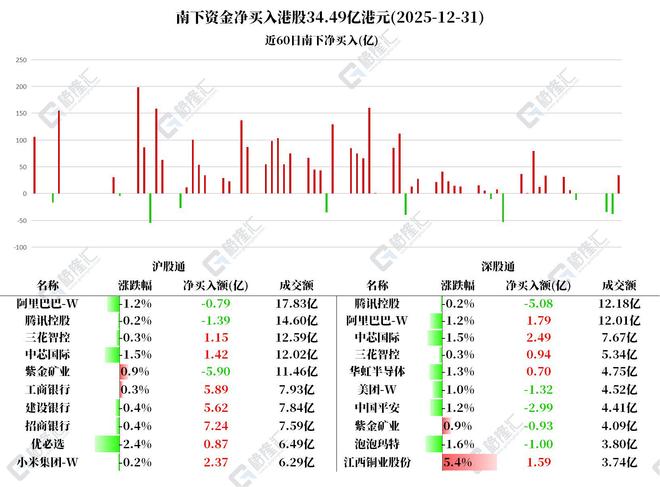
Group 1: Market Overview - On December 31, the Hong Kong stock market saw a net inflow of 34.49 billion HKD from northbound funds, with 30.97 billion HKD from the Shanghai Stock Connect and 3.51 billion HKD from the Shenzhen Stock Connect. This marks a record high net inflow of 1.41 trillion HKD for the year, significantly up from approximately 807.9 billion HKD in 2024 [2]. Group 2: Key Stocks - The most net bought stocks by northbound funds included China Merchants Bank (招商银行) with 7.24 billion HKD, Industrial and Commercial Bank of China (工商银行) with 5.88 billion HKD, and China Construction Bank (建设银行) with 5.61 billion HKD [6]. - The most net sold stocks were Zijin Mining (紫金矿业) with a net outflow of 6.82 billion HKD and Tencent (腾讯) with a net outflow of 6.46 billion HKD [7]. Group 3: Sector Performance - The banking sector is expected to benefit from a stable macro-financial environment, with projections indicating that bank interest margins may have bottomed out and risks in the real sector are easing. This is anticipated to lead to income and profit recovery in the banking industry [6]. - Semiconductor stocks, particularly SMIC (中芯国际), received significant net buying, with 3.91 billion HKD, driven by price increases in the 8-inch BCD process platform by approximately 10% [6]. Group 4: Specific Company Insights - Jiangxi Copper (江西铜业) saw a net inflow of 1.58 billion HKD, while Zijin Mining faced a net outflow of 6.82 billion HKD. The National Development and Reform Commission emphasized the need for optimizing the management of the copper smelting industry, which may impact future production levels [7]. - Xiaomi Group (小米集团) received a net inflow of 2.37 billion HKD, supported by government policies promoting consumer electronics [7].



图解丨2025年最后一天,南下资金大举买入中资银行股
Xin Lang Cai Jing· 2025-12-31 12:33
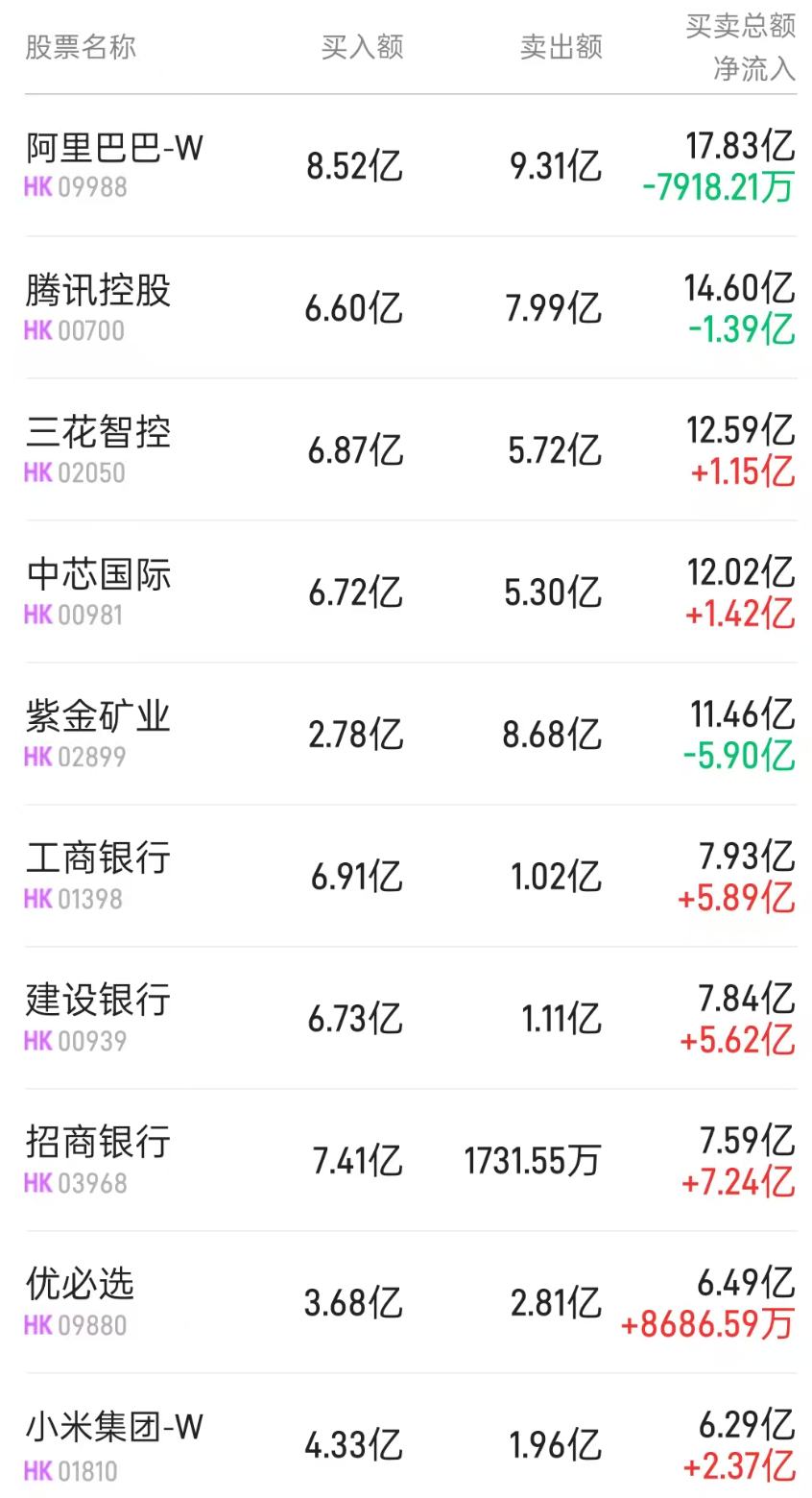
Group 1 - Southbound funds net bought Hong Kong stocks worth 3.449 billion HKD today [1] - The top net purchases included China Merchants Bank at 724 million HKD, Industrial and Commercial Bank of China at 589 million HKD, and China Construction Bank at 562 million HKD [1] - Notable net sales included Zijin Mining at 682 million HKD, Tencent Holdings at 646 million HKD, and China Ping An at 298 million HKD [1] Group 2 - Southbound funds have recorded a continuous net sell of Tencent for five consecutive days, totaling 3.94334 billion HKD [2]


智通港股通活跃成交|12月31日
智通财经网· 2025-12-31 11:03
Core Insights - On December 31, 2025, Alibaba-W (09988), Tencent Holdings (00700), and Sanhua Intelligent Control (02050) ranked as the top three companies by trading volume in the Southbound Stock Connect, with trading amounts of 1.783 billion, 1.460 billion, and 1.259 billion respectively [1] - In the Shenzhen-Hong Kong Stock Connect, Tencent Holdings (00700), Alibaba-W (09988), and SMIC (00981) were the top three companies by trading volume, with amounts of 1.218 billion, 1.201 billion, and 0.767 billion respectively [1] Southbound Stock Connect Trading Activity - The top three active companies in the Southbound Stock Connect by trading amount were: - Alibaba-W (09988): 1.783 billion with a net buy of -79.182 million - Tencent Holdings (00700): 1.460 billion with a net buy of -139 million - Sanhua Intelligent Control (02050): 1.259 billion with a net buy of 115 million [2] - Other notable companies included: - SMIC (00981): 1.202 billion with a net buy of 142 million - Zijin Mining (02899): 1.146 billion with a net buy of -590 million [2] Shenzhen-Hong Kong Stock Connect Trading Activity - The top three active companies in the Shenzhen-Hong Kong Stock Connect by trading amount were: - Tencent Holdings (00700): 1.218 billion with a net buy of -508 million - Alibaba-W (09988): 1.201 billion with a net buy of 179 million - SMIC (00981): 0.767 billion with a net buy of 249 million [2] - Other notable companies included: - Sanhua Intelligent Control (02050): 0.534 billion with a net buy of 93.908 million - Huahong Semiconductor (01347): 0.475 billion with a net buy of 69.942 million [2]