LENOVO GROUP(00992)

Search documents
联想集团与敦煌市签署城市超级智能体战略合作协议
Xin Hua Cai Jing· 2025-11-07 14:06
Core Insights - Lenovo Group has signed a strategic cooperation agreement with Dunhuang City, Gansu Province, to leverage its "full-stack AI" strategy and urban super-intelligent body technology to drive intelligent transformation in various sectors including culture and tourism, agriculture, low-altitude economy, and urban governance [2][3] Group 1: Strategic Cooperation - The partnership aims to establish a new benchmark for smart city construction along the Silk Road, assisting Dunhuang in entering the era of Smart City 4.0 [2] - The collaboration will utilize Lenovo's advanced technologies in AI, big data, IoT, and cloud computing, combined with Dunhuang's unique cultural tourism resources and geographical advantages [2][3] Group 2: Technology Framework - Lenovo's urban super-intelligent body is based on advanced large model technology and a multi-agent collaborative architecture, forming a leading "1+N intelligent body" technology system [3] - The "1" represents a unified super-intelligent core that integrates four key engines: multi-modal perception, cognitive reasoning, decision planning, and intelligent orchestration, capable of processing vast amounts of heterogeneous data in real-time [3] - The "N" signifies multiple specialized intelligent bodies trained on domain-specific large models, equipped with capabilities for understanding domain knowledge, complex scenario reasoning, and parallel processing of multiple tasks [3] Group 3: Implementation and Recognition - Lenovo's urban super-intelligent body has been implemented in various cities across China, including Wuyishan, Yichang, Hohhot, Shanghai Hongkou, Shaanxi Xixian New Area, and Shenzhen Guangming District [4] - The initiative has received recognition, winning the "2025 Digital Government Innovation Solution" award from the China Internet Association for its innovative technology architecture and extensive practical applications [4]

联想集团与敦煌市共建城市超级智能体 加速丝路古城智能化
Zheng Quan Ri Bao· 2025-11-07 12:41
Core Insights - Lenovo Group has signed a strategic cooperation agreement with Dunhuang City to promote intelligent transformation in various sectors, leveraging Lenovo's AI strategy and technology advantages [2][3] - The partnership aims to establish a new benchmark for smart city construction along the Silk Road, facilitating Dunhuang's transition into the Smart City 4.0 era [2][4] Group 1: Strategic Cooperation - The agreement emphasizes mutual benefits, compliance with laws, and the integration of smart technology with urban development [4] - Lenovo's City Super Intelligent Body will utilize advanced AI technologies, including deep learning and natural language processing, to create a city-level intelligent system [4][5] Group 2: Sector-Specific Applications - In the cultural tourism sector, AI will be used for the digital protection and inheritance of Dunhuang's cultural heritage, enhancing visitor experiences through data-driven management [5] - The agricultural sector will benefit from smart agriculture systems aimed at precision management and brand development for local products [5] - The low-altitude economy will be supported through the development of related industries in conjunction with Dunhuang International Airport [5] - Urban governance will see improvements through real-time monitoring and intelligent regulation of city operations [5] Group 3: Future Directions - Lenovo plans to continue applying large model technology across various sectors, contributing to the creation of smarter, more efficient, and livable modern cities [5]
联想集团董事长兼CEO杨元庆:以“人本智能”推动AI普惠
Xin Hua Cai Jing· 2025-11-07 12:10
Core Viewpoint - Lenovo Group's Chairman and CEO Yang Yuanqing emphasizes the importance of a "human-centered intelligence" approach in the AI era, advocating for technology goals aligned with human values, practices that bridge development gaps, and a multi-stakeholder governance system to establish "human-centered intelligence" as the foundation of a shared digital future [2][3]. Group 1: AI Innovation and Human-Machine Interaction - The current wave of AI model innovation is not only about creative functionalities like text-to-image and text-to-code but also about redefining human-machine interaction, making human-machine collaboration a new paradigm [2]. - The shift from "Internet+" to "AI+" signifies a transition from enhancing connectivity to emphasizing "human-centric power," where the ability to harness AI becomes a new productive force driving industrial transformation [2]. Group 2: Hybrid AI and User-Centric Development - Hybrid AI is seen as an effective pathway for empowering various industries, focusing on user-centered personal superintelligence and smart devices, which can evolve into "intelligent twins" for individuals and enterprises [3]. - The new human-machine relationship necessitates a fresh perspective on AI development, where technology companies are responsible for ensuring that AI innovations align with human needs and ethical standards [3]. Group 3: Initiatives for Human-Centered Intelligence - Lenovo Group, as a proponent of the "human-centered intelligence" concept, has initiated the "Human-Centered Intelligence Development and Governance Initiative" in collaboration with various organizations, aiming to create an AI ecosystem that prioritizes human welfare and ethical considerations [4]. - The initiative has already attracted participation from 50 companies and institutions, highlighting a collective commitment to promoting the "human-centered intelligence" development philosophy [4].
联想集团杨元庆:以“人本智能”推动AI普惠
Zheng Quan Shi Bao Wang· 2025-11-07 09:22
Group 1 - Lenovo Group was awarded the "Outstanding Contribution Award" at the 2025 World Internet Conference for its leadership in green and intelligent supply chain construction and its pioneering practices in empowering education and public welfare with AI technology [1] - CEO Yang Yuanqing emphasized the company's commitment to continue innovating with cutting-edge AI technology and to actively undertake corporate social responsibility, contributing to China's modernization and social economic progress [1] - Yang Yuanqing published an article in "China Cybersecurity" magazine, advocating for a human-centered approach to AI that aims to bridge the development gap and enhance governance systems, positioning "human-centered intelligence" as a foundational value for a shared digital future [1] Group 2 - The impact of "Artificial Intelligence+" on various industries is characterized by "human-centric power," where the ability to harness AI has become a new driving force for industrial transformation [2] - The current trend of hybrid AI is seen as an effective path for empowering various sectors, focusing on user-centered personal superintelligence and customized local models for enterprises [2] - Lenovo Group, along with the China ESG 30 Forum, initiated the "Human-Centered Intelligence Development and Governance Initiative," which has attracted 50 companies and organizations to commit to promoting a human-centered AI development ecosystem [2]
内涵华为苹果手机?联想:Air别乱叫
Guan Cha Zhe Wang· 2025-11-07 04:13
Core Viewpoint - Lenovo is leveraging the recent popularity of "Air phones" to promote its newly launched motoX70 Air, while subtly criticizing Apple and Huawei's offerings in the same category [1][4]. Group 1: Product Comparison - The motoX70 Air is lighter and thinner than Huawei's Mate70 Air, with a thickness of 5.99 mm and weight of 159 grams, compared to Huawei's 6.6 mm and approximately 208 grams [4]. - However, the motoX70 Air is thicker than Apple's iPhone Air, which measures 5.64 mm and weighs 165 grams [4]. - The starting price of the motoX70 Air is 2599 yuan, making it the cheapest among the three "Air" phones [9]. Group 2: Performance and Features - The motoX70 Air is equipped with a Qualcomm Snapdragon 7 Gen4 processor, which is not a flagship processor, limiting its gaming performance compared to Apple's A19 Pro [9]. - In terms of camera capabilities, the motoX70 Air lacks a telephoto lens, which restricts its long-distance photography, while Huawei's Mate70 Air features a red maple color camera and a 12MP telephoto lens with stabilization [9]. - The battery capacity of the motoX70 Air is 4800 mAh, larger than the iPhone Air's 3149 mAh, but significantly smaller than the Mate70 Air's 6500 mAh [9]. Group 3: Market Position - Lenovo's Motorola brand still has some presence in the European and American markets, primarily through foldable phones, occasionally ranking in the top five in Europe [11]. - However, the brand's presence in the Chinese market remains low, and it has not entered the top five globally [11].


重返全球第三!联想平板出货量同比大涨23% 加速推进AI终端进阶
Ge Long Hui· 2025-11-07 03:50
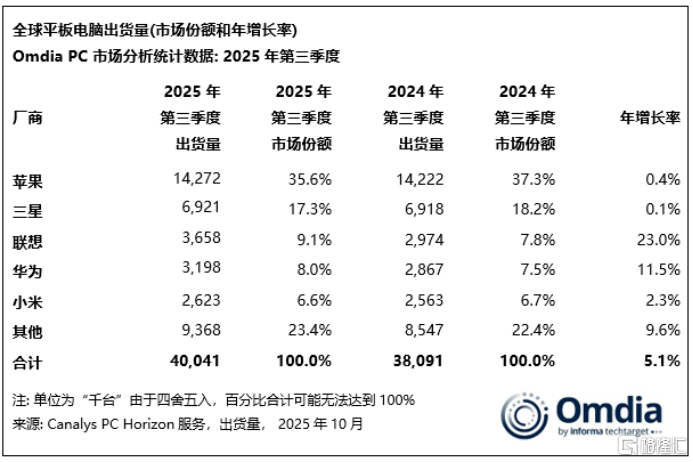
Core Insights - The global tablet market has seen continuous growth for seven consecutive quarters, with a year-on-year increase of 5% to 40 million units in Q3 2025, driven by seasonal stocking and promotional activities [1][4] - Lenovo has emerged as a leader in the tablet market with a remarkable year-on-year shipment growth rate of 23%, surpassing Huawei to reclaim the third position globally with a market share of 9.1% [1][4] - In the Chromebook segment, Lenovo also leads with a year-on-year growth rate of 54.6%, indicating strong competitive strength in both tablet and Chromebook markets [1][4] Tablet Market Overview - The total global tablet shipments reached 40.041 million units in Q3 2025, reflecting a 5.1% increase from 38.091 million units in Q3 2024 [2] - Major competitors include Apple with a 0.4% growth, Samsung with a 0.1% growth, and Huawei with an 11.5% growth, indicating a slowdown in growth for leading brands [4] - Lenovo's success is attributed to its strategic regional focus and deep engagement in specific market segments, particularly in the EMEA region [4] Chromebook Market Overview - Lenovo's Chromebook shipments reached 1.404 million units in Q3 2025, capturing a market share of 33.0%, up from 22.0% in the previous year [3] - Other competitors in the Chromebook market include Acer and ASUS, with significant fluctuations in their year-on-year growth rates [3] AI Technology Impact - Lenovo's growth in the tablet market is significantly supported by the integration of AI technology, enhancing its product offerings and positioning in the market [4][6] - The company's collaboration with partners like NVIDIA and Intel is pivotal in transforming tablets into "AI terminals," reflecting a proactive approach to the global AI trend [4] - The overall demand for powerful AI-capable devices is expected to surge, with Lenovo poised to leverage its hybrid AI strategy and large shipment scale for competitive advantage [6]
重返全球第三!联想(00992)平板出货量同比大涨23% 加速推进AI终端进阶
智通财经网· 2025-11-07 03:19
Core Insights - The global tablet market experienced a 5% year-over-year growth in Q3 2025, reaching 40 million units shipped, marking the seventh consecutive quarter of growth [1][3] - Lenovo led the industry with a remarkable 23% year-over-year increase in tablet shipments, surpassing Huawei to reclaim the third position in the global tablet market with a 9.1% market share [1][2] - Lenovo also excelled in the Chromebook segment, achieving a 54.6% year-over-year growth rate, highlighting its strong competitive position in the tablet sector [1][2] Market Performance - The overall tablet market growth was driven by seasonal stocking ahead of overseas holidays and promotional events in the Asia-Pacific region, particularly during the Double 11 sales [3] - Lenovo's tablet shipments reached 3.7 million units, significantly benefiting from its expansion in the commercial tablet business across Europe, the Middle East, and Africa (EMEA) [3] AI Integration - Lenovo's high growth in the tablet market is attributed to the comprehensive empowerment of its terminal products through AI technology, collaborating with partners like NVIDIA and Intel to transform tablets into "AI terminals" [4] - In the PC market, Lenovo achieved a market share of 25.5% with a year-over-year growth rate of 17.3%, outperforming the market average of 9.4% and all major competitors [4][5] Future Trends - The demand for terminal devices with strong AI capabilities is expected to surge, with Lenovo establishing a first-mover advantage in the emerging edge AI market through its "hybrid AI" strategy and large shipment volumes [6]
Omdia:全球平板出货量连续两年增长, 2025年第三季度同比上涨5%,联想增长率最高重返市场第三
Canalys· 2025-11-07 01:00
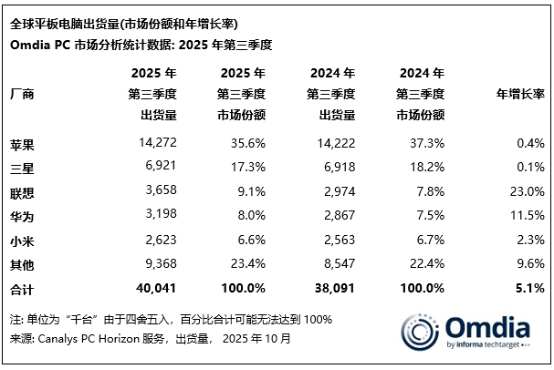
Core Insights - The global tablet market is projected to continue its growth, with shipments reaching 40 million units in Q3 2025, marking a 5% year-over-year increase and achieving the seventh consecutive quarter of growth [2][5] - Strong demand from the Middle East and Central Europe, along with sustained purchasing power from Chinese consumers, are key drivers of this growth [2][5] - The GIGA 2.0 education initiative by the Japanese government has significantly boosted Chromebook tablet shipments, contributing to overall market growth [2][8] Tablet Market Overview - In Q3 2025, global tablet shipments totaled 40.041 million units, up 5.1% from 38.091 million units in Q3 2024 [5] - Apple maintained its leading position with shipments of 14.272 million units, showing no growth compared to the previous year [5] - Lenovo led among major manufacturers with a 23% increase in shipments to 3.7 million units, driven by its commercial tablet business expansion in EMEA [5] - Samsung's shipments remained stable at 6.921 million units, while Huawei and Xiaomi saw growths of 11.5% and 2.3%, respectively [5] Chromebook Market Overview - The Chromebook market experienced a 3.1% year-over-year growth in Q3 2025, with total shipments reaching 4.247 million units [9] - Lenovo dominated the Chromebook segment with shipments of 1.404 million units, a remarkable 54.6% increase [9] - Acer held an 18% market share with shipments of 0.8 million units, while HP's shipments declined by 15.3% to 0.7 million units [9] - The GIGA 2.0 project in Japan is also expanding Chromebook deployments in other markets, particularly in Central and Eastern Europe and North America [8]

智通港股沽空统计|11月7日
智通财经网· 2025-11-07 00:31
Short Selling Ratios - Anta Sports (82020) has the highest short selling ratio at 100.00% with a short selling amount of 440,500 HKD [1][2] - Lenovo Group (80992) follows with a short selling ratio of 88.65% and a short selling amount of 803,600 HKD [1][2] - Xiaomi Group (81810) ranks third with a short selling ratio of 75.57% and a short selling amount of 1,474,100 HKD [1][2] Short Selling Amounts - Alibaba (09988) leads in short selling amount with 2.261 billion HKD and a short selling ratio of 16.63% [1][2] - Tencent Holdings (00700) is second with a short selling amount of 1.662 billion HKD and a short selling ratio of 19.83% [1][2] - Semiconductor Manufacturing International Corporation (00981) ranks third with a short selling amount of 926 million HKD and a short selling ratio of 10.37% [1][2] Deviation Values - Shengjing Bank (02066) has the highest deviation value at 60.67% with a short selling ratio of 72.42% [1][2] - Xiaomi Group (81810) also shows a significant deviation value of 47.28% [1][2] - The third highest deviation value is not specified but is noted to be 39.69% for an unspecified stock [1][2]



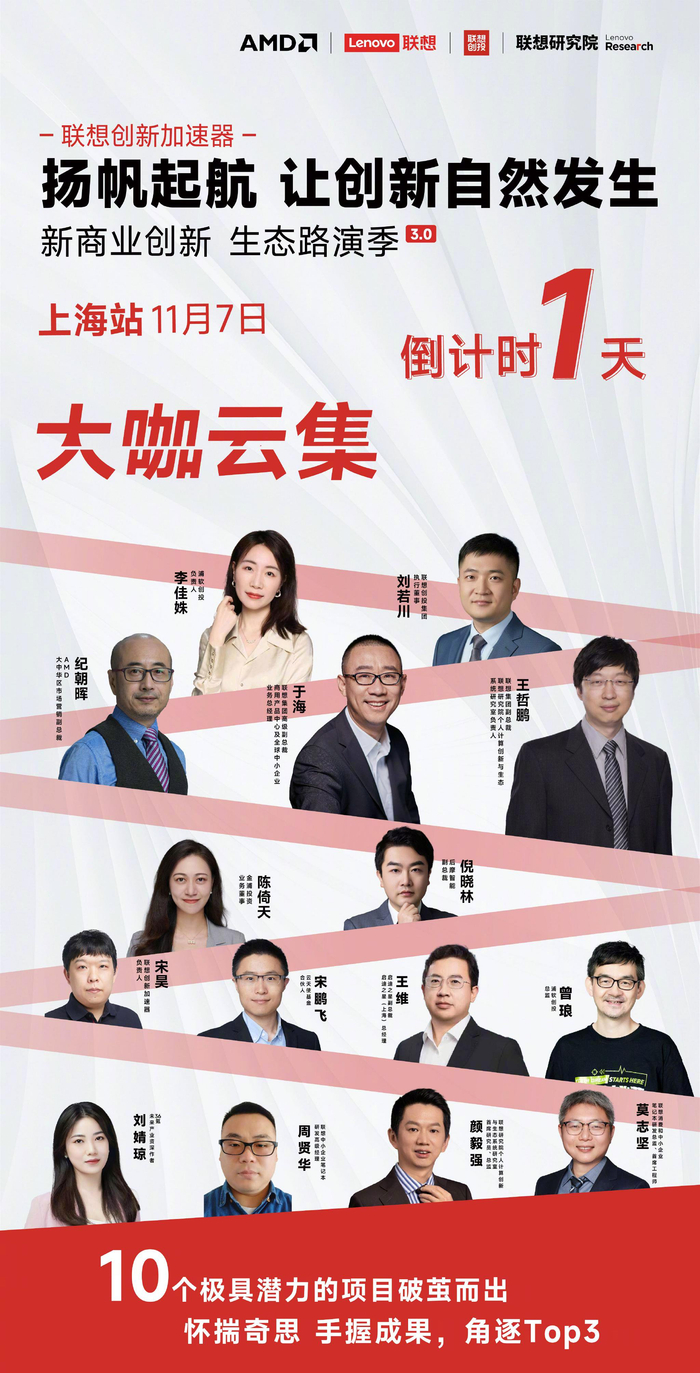
联想新商业创新生态路演季3.0上海站明日启幕,10项目角逐Top3
3 6 Ke· 2025-11-06 10:51
Group 1 - Lenovo, in collaboration with AMD and other partners, will unveil new AI ecosystem opportunities at an event in Shanghai on November 7 [1] - The event will feature discussions led by Lenovo executives and industry leaders on innovation [1] - Ten potential projects covering areas such as edge intelligence and chips will compete for the top three positions to win the "Lenovo Innovation Accelerator" full-chain ecological empowerment [1][4] Group 2 - The event aims to foster innovation and showcase the practical application of technology in the industry [1] - The competition highlights the emergence of promising projects that are ready to make an impact [4]