CNCB(00998)

Search documents
中信银行发布服务业经营主体个人经营贷款财政贴息政策客户问题解答
Jin Tou Wang· 2025-11-12 03:16
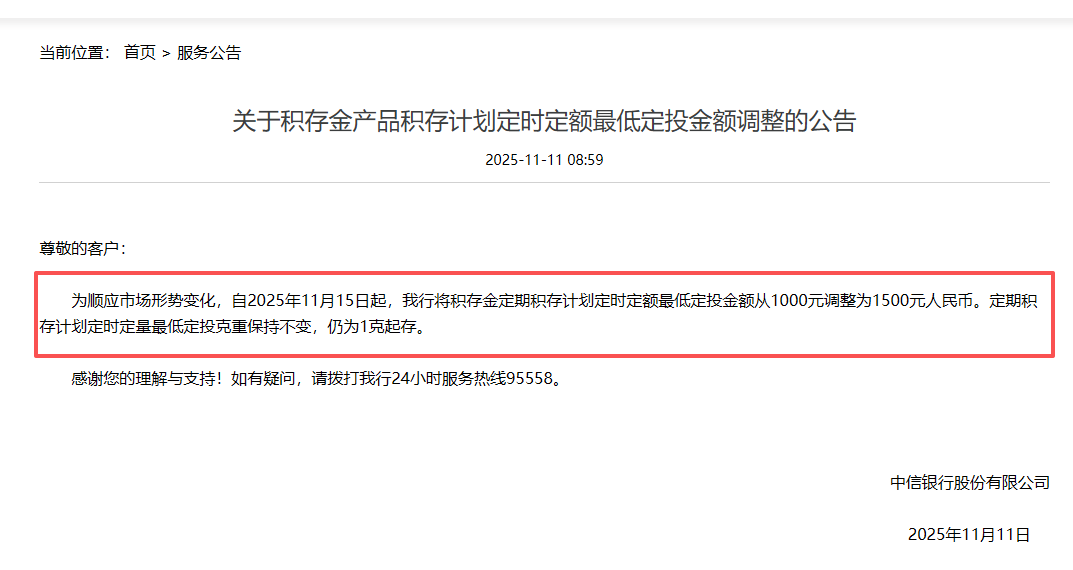
2025年11月12日,中信银行(601998)发布公告称,为贯彻落实党中央、国务院关于大力提振消费、全 方位扩大国内需求的决策部署,降低服务业经营主体融资成本,助力激发消费市场活力,促进经济加快 向好发展,根据《服务业经营主体贷款贴息政策实施方案》(财金〔2025〕81号)工作部署,中信银行 积极有序推动相关实施工作,现就客户关注问题解答如下: (1)客户申请贷款的经营主体为餐饮住宿、健康、养老、托育、家政、文化娱乐、旅游、体育8类消费 领域。 (2)2025年3月16日至2025年12月31日期间,客户与中信银行完成个人经营贷款的贷款合同签订且相关 贷款资金发放至经营主体。 (3)贷款资金合规用于改善消费基础设施和提升社会服务能力。 (4)客户完成《中信银行服务业经营主体个人贷款财政贴息补充协议》签署。如客户未签署补充协 议,视为放弃本笔贷款财政贴息,不影响贷款的申请、办理及使用。 (5)借款合同按约定足额偿还本金及利息。 (6)贴息申请经省级财政、民政、人力资源社会保障、商务、文化和旅游、卫生健康、体育等相关管 理部门审核通过。 1.问:中信银行财政贴息的服务业经营主体个人经营贷款产品范围有哪些? 答: ...

银行收紧淘金路!建行黄金积存业务调整 多家银行门槛提至千元
Bei Ke Cai Jing· 2025-11-12 02:37
Core Viewpoint - The recent adjustments in gold accumulation business rules by major banks, including China Construction Bank and CITIC Bank, reflect the increasing volatility in gold prices and the need to protect investor interests. These changes include raising minimum investment thresholds and revising transaction rules to manage market risks effectively [1][3][4]. Group 1: Changes in Banking Rules - China Construction Bank revised its gold accumulation business rules, effective November 15, 2025, adjusting the monthly accumulation starting amount to 1200 yuan, with increments of 10 yuan [1]. - CITIC Bank announced an increase in the minimum investment amount for its gold accumulation plan from 1000 yuan to 1500 yuan, effective the same date [1][6]. - The new rules emphasize "price-volume balance," allowing banks to adjust transaction quotes based on market conditions, including international and domestic gold price trends, trading positions, and liquidity [4][6]. Group 2: Market Conditions and Price Trends - After a period of correction, gold prices have resumed an upward trend, with international gold prices reaching 4140 USD per ounce and domestic prices at 948.23 yuan per gram on November 11 [2][9]. - The fluctuations in gold prices are attributed to various factors, including geopolitical events and investor profit-taking, leading to significant daily price changes [9][10]. Group 3: Implications for Investors - The adjustments in gold accumulation business rules are seen as a response to the heightened investment risks associated with volatile gold prices, potentially limiting participation from small investors [3][8]. - The changes may also affect liquidity and increase transaction costs for short-term trading, as banks have the authority to adjust buy-sell spreads based on market conditions [6][8]. - Analysts suggest that while the long-term outlook for gold remains positive, investors should be cautious of increased market volatility and the impact of currency fluctuations on gold import costs [11].

金价波动 银行连调积存金业务
Bei Jing Shang Bao· 2025-11-11 15:49
Core Insights - Construction Bank and Citic Bank announced updates to their gold accumulation business, reflecting a shift in banking strategies to enhance service quality and respond to market changes [1][4] Group 1: Changes in Gold Accumulation Business - Construction Bank revised its "Personal Gold Accumulation Business Product Introduction and Trading Rules," effective November 15, 2025, focusing on transaction pricing and large redemptions [1][3] - Citic Bank raised the minimum investment for its gold accumulation plan from 1,000 yuan to 1,500 yuan, effective November 15, 2025, while maintaining the minimum weight for periodic accumulation at 1 gram [4] Group 2: Service Quality and Risk Management - The revisions by Construction Bank include an increase in the minimum daily accumulation and self-selected accumulation starting amount to 1,200 yuan, and an extension of trading hours to Saturday 2:30 AM [2][4] - The bank's pricing mechanism will consider various factors, including international and domestic gold price trends, trading positions, and market liquidity, indicating a focus on risk control and market stability [3][4] - The adjustments reflect a broader trend among banks to shift from "expanding scale" to "improving quality," enhancing customer engagement while managing business risks and liquidity [4]
监管研究系列三:存款非银化对流动性风险指标的影响与测算
KAIYUAN SECURITIES· 2025-11-11 14:12
Investment Rating - The investment rating for the banking industry is "Positive" (maintained) [1] Core Insights - The report highlights the ongoing trend of deposit non-bankization, which is leading to a marginal decline in liquidity indicators for banks. This trend is particularly pronounced among large banks, with a notable increase in the proportion of non-bank deposits [12][16] - The liquidity coverage ratio (LCR) and net stable funding ratio (NSFR) are critical indicators for banks, and the report provides quantitative assessments of how deposit non-bankization impacts these metrics. The effects are manageable for major banks, with LCR expected to remain above 120% even under significant conversion scenarios [4][34] Summary by Sections 1. Deposit Non-Bankization and Liquidity Management - The process of deposit non-bankization is intensifying the demand for banks to manage liquidity indicators more stringently. Since May 2025, the growth rate of personal fixed deposits has been declining, with large banks showing a decrease in monthly increments compared to the same period in 2024 [12][16] - The report quantifies the impact of deposit non-bankization on LCR and NSFR for major banks, indicating that even with a 70% conversion of personal fixed deposits to non-bank deposits, the LCR for most large banks is expected to remain above 120% [4][34] 2. Liquidity Indicator Management - The management of LCR focuses on maintaining liquidity asset reserves, while NSFR management emphasizes improving the liability structure. Issuing long-term interbank certificates of deposit is highlighted as an effective method to optimize these liquidity indicators [5][22] - The report details how the conversion of personal fixed deposits to non-bank deposits affects various liquidity risk indicators, with specific calculations provided for LCR and NSFR under different conversion scenarios [18][23] 3. Investment Recommendations - The report suggests a tiered investment strategy: - Core holdings should focus on large state-owned banks, benefiting from institutions like Agricultural Bank of China and Industrial and Commercial Bank of China - Core allocations should include leading comprehensive banks such as China Merchants Bank and CITIC Bank - Flexible allocations can target regional banks like Jiangsu Bank and Chongqing Bank [6][19]



金价大涨,多家银行宣布:上调!
Sou Hu Cai Jing· 2025-11-11 13:18
Core Insights - Several banks have adjusted the thresholds for gold accumulation business in response to the recent rise in international gold prices, which have surpassed $4100 per ounce [1][3]. Group 1: Bank Adjustments - China Construction Bank announced an increase in the daily accumulation starting amount from 1000 RMB to 1200 RMB, effective November 15, 2025 [1]. - CITIC Bank has raised the minimum investment amount for its regular gold accumulation plan from 1000 RMB to 1500 RMB, also effective November 15, 2025 [3]. - The last adjustment by CITIC Bank occurred in March 2024, when the minimum investment was raised from 500 RMB to 1000 RMB [5]. Group 2: Market Context - The recent surge in international gold prices has been significant, with London gold prices exceeding $4141 per ounce at the time of reporting [5]. - In addition to the changes in accumulation thresholds, Zheshang Bank has adjusted the daily limit for physical gold redemption through its JD Finance channel to 10,000 RMB, effective November 18, while maintaining an annual limit of 200,000 RMB [5].


多家银行宣布,上调积存金起购门槛
新华网财经· 2025-11-11 11:44
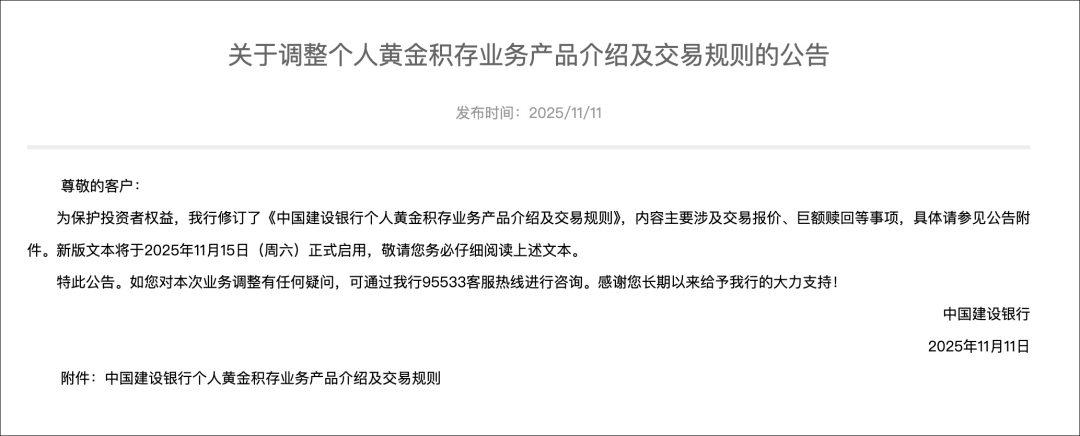
Core Viewpoint - The recent adjustments in gold accumulation business thresholds by banks are likely a response to the rising international gold prices, aimed at mitigating market risks [4][6][11]. Group 1: Bank Adjustments - On November 11, China CITIC Bank announced an increase in the minimum investment amount for its gold accumulation plan from 1000 RMB to 1500 RMB, effective from November 15, 2025, while maintaining the minimum weight requirement at 1 gram [1][7]. - China Construction Bank also revised its gold accumulation business rules, raising the daily accumulation starting amount from 1000 RMB to 1200 RMB, effective from November 15, 2025 [2][3][8]. - This marks the second adjustment by China Construction Bank in 2023, having previously raised the starting amount from 800 RMB to 1000 RMB in April [9]. Group 2: Market Context - The adjustments coincide with a significant rise in international gold prices, with spot gold reaching approximately 4140 USD per ounce as of November 11 [6][11]. - Industry experts suggest that these changes are intended to control potential risks associated with increased trading activity in the gold market, particularly to prevent irrational trading behaviors among small investors [4][9]. Group 3: Historical Trends - The adjustments reflect a broader trend in the banking sector, with multiple banks raising their gold accumulation thresholds throughout 2023, indicating a shift towards higher entry points for investors [11][12]. - Since March 2023, several banks, including China Construction Bank and others, have progressively increased their minimum investment amounts, with some banks raising thresholds from as low as 600 RMB to over 1000 RMB [11][12].

1500元!银行积存金起购门槛再刷新高
Di Yi Cai Jing· 2025-11-11 10:27
Group 1 - Several banks have raised the minimum investment threshold for gold accumulation plans, with Citic Bank increasing the minimum investment amount from 1000 RMB to 1500 RMB effective November 15, 2025 [1] - China Construction Bank has revised its personal gold accumulation business rules, raising the daily accumulation starting amount from 1000 RMB to 1200 RMB, effective November 15 [2] - International gold prices have surged, with spot gold reaching as high as 4140 USD [3] Group 2 - On November 3, multiple banks, including Industrial and Commercial Bank of China (ICBC) and China Construction Bank, announced a suspension of certain gold accumulation services, including real-time purchases and physical gold exchanges [3] - ICBC later announced the resumption of its gold accumulation services on the same day [3]
中国建设银行、中信银行发布重要公告:调整!
Mei Ri Jing Ji Xin Wen· 2025-11-11 08:51
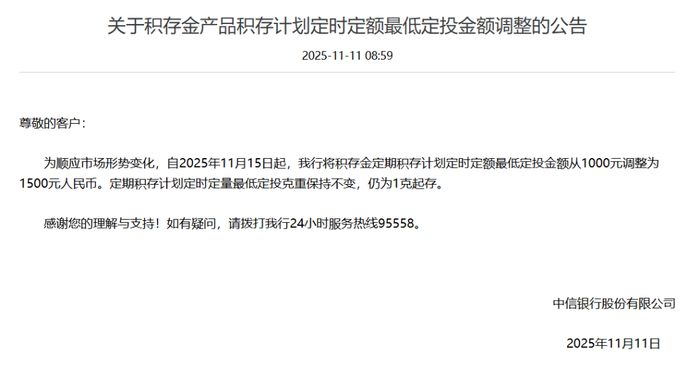
Core Insights - International gold prices have returned to $4,100, prompting banks to adjust the thresholds for gold accumulation-related businesses [1] Group 1: Company Adjustments - China Construction Bank announced an adjustment to its personal gold accumulation business, increasing the daily accumulation starting amount from 1,000 RMB to 1,200 RMB, effective November 15, 2025 [1] - CITIC Bank also announced a change, raising the minimum investment amount for its regular gold accumulation plan from 1,000 RMB to 1,500 RMB, while maintaining the minimum weight for investment at 1 gram, effective November 15, 2025 [1]
多家银行宣布,上调积存金起购门槛
财联社· 2025-11-11 08:19
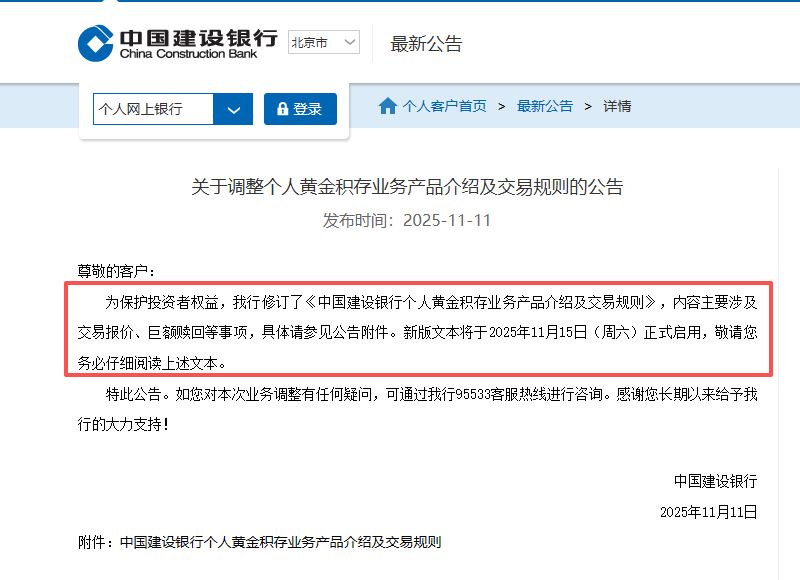
Core Viewpoint - The recent adjustments in gold accumulation business thresholds by banks are a response to the rising international gold prices, aimed at mitigating potential market risks [6][8]. Group 1: Bank Adjustments - On November 11, China CITIC Bank announced an increase in the minimum investment amount for its gold accumulation plan from 1000 RMB to 1500 RMB, effective from November 15, 2025 [1][8]. - China Construction Bank also revised its gold accumulation business rules, raising the daily accumulation starting amount from 1000 RMB to 1200 RMB, effective from November 15, 2025 [3][4]. - This marks the second adjustment by China Construction Bank within the year, having previously raised the minimum amount from 800 RMB to 1000 RMB in April 2023 [10]. Group 2: Market Context - The adjustments coincide with a significant rise in international gold prices, with spot gold reaching approximately 4140 USD per ounce as of November 11 [7][8]. - Industry experts suggest that these changes are intended to control potential risks associated with increased trading activity in the gold market, particularly to prevent irrational trading behaviors among smaller investors [10][11]. Group 3: Historical Trends - Throughout 2023, banks have progressively raised the thresholds for gold accumulation, with notable increases from 600 RMB to 650 RMB or 700 RMB earlier in the year, and further adjustments in the latter half of the year [11][12]. - The current adjustments have set new historical highs for the minimum investment amounts in gold accumulation plans across the banking sector [13].

最高至1500元,国际金价重回4100美元后,多家银行再上调积存金起购门槛
Feng Huang Wang· 2025-11-11 07:20
Core Viewpoint - The recent increase in international gold prices has prompted banks to raise the minimum investment thresholds for gold accumulation products, indicating a strategy to mitigate market risks associated with gold investments [2][4][8]. Group 1: Bank Adjustments - China CITIC Bank announced an increase in the minimum investment amount for its gold accumulation plan from 1,000 RMB to 1,500 RMB, effective November 15, 2025 [1][5]. - China Construction Bank revised its gold accumulation product rules, raising the minimum daily accumulation amount from 1,000 RMB to 1,200 RMB, also effective November 15, 2025 [3][6]. - This marks the second adjustment by China Construction Bank in 2023, having previously raised the minimum amount from 800 RMB to 1,000 RMB in April [7]. Group 2: Market Context - As of November 11, 2023, spot gold prices surged nearly 3% to reach approximately 4,120 USD per ounce, with further increases noted [4][8]. - The adjustments in minimum investment thresholds by banks coincide with a notable rise in gold market activity, suggesting a proactive approach to manage potential risks from increased volatility [2][6][8]. Group 3: Industry Trends - The trend of raising minimum investment thresholds for gold accumulation products has been observed across multiple banks, with many increasing their thresholds from 600 RMB to 650 RMB or 700 RMB earlier in the year [9][10]. - The cumulative effect of these adjustments has led to record-high minimum purchase amounts for gold accumulation products in the industry [11].