CSN(01055)

Search documents
南方航空(600029):Q2投资损失收窄 看好全货机盈利潜力释放
Xin Lang Cai Jing· 2025-09-02 04:24
25Q2 客公里收益同比降幅收窄,看好全货机潜力盈利释放。我们测算25Q2公司整体客收下滑4.9%,其 中国内同比-3.9%、国际同比-8.0%,国内和国际客公里收益降幅均较25Q1 收窄(25Q1 国内同 比-6.0%、国际同比-10%),国际线降幅较大我们认为或与公司加大短途国际航线运力投放有关(25H1 公司国际ASK 同比+23%)。货运方面,上半年子公司南航物流引进2 架777F,南航物流盈利表现整体 稳健,25H1 南航物流营收94.0 亿元,同比+1.9%,净利润16.0亿元,同比-6.5%,盈利表现受到上半年 关税影响,看好全货机潜在盈利释放。 25Q2 单位扣油成本同比上涨,油价回落缓解单位成本上涨压力。25Q2 公司单位成本同比-5.4%,我们 测算25Q2 单位燃油成本、扣油成本分别为0.12、0.31 元,同比-22%、+3.7%,二季度扣油成本同比上 涨,达到近几个季度较高水平,但油价下降缓解了成本压力。此外25Q2 公司财务费用同比改善,汇率 小幅升值贡献单季度盈利改善,我们测算25Q2 公司汇兑收益约2600 万元,上年同期24Q2 汇兑亏损3.3 亿元。 川航投资损失收窄,但所 ...

民生证券给予南方航空推荐评级:Q2投资损失收窄,看好全货机盈利潜力释放
Sou Hu Cai Jing· 2025-09-02 02:52
Group 1 - Minsheng Securities issued a report on September 2, recommending Southern Airlines (600029.SH, latest price: 5.94 yuan) [1] - The report highlights that the year-on-year decline in passenger kilometer revenue is narrowing in Q2 2025, indicating potential profitability from all-cargo aircraft [1] - Unit fuel costs increased year-on-year in Q2 2025, but the decline in oil prices alleviates the pressure from rising unit costs [1] - The report notes that the investment loss from Sichuan Airlines has narrowed, but increased income tax expenses have negatively impacted after-tax profits [1]
南方航空(600029):Q2投资损失收窄,看好全货机盈利潜力释放
Minsheng Securities· 2025-09-02 02:19
Investment Rating - The report maintains a "Recommended" rating for the company [4][6] Core Views - The company reported a revenue of 863 billion yuan for H1 2025, a year-on-year increase of 1.8%, with a net loss attributable to shareholders of 15.3 billion yuan [1] - The reduction in investment losses from Sichuan Airlines and the decline in oil prices contributed to the improvement in financial performance [3] - The company is optimistic about the profit potential of its all-cargo aircraft and the recovery of ticket prices in the industry [4] Financial Performance Summary - For Q2 2025, the company achieved a revenue of 429 billion yuan, a year-on-year increase of 6.7%, with a net loss of 7.9 billion yuan [1] - The overall passenger revenue decline narrowed to 4.9% in Q2 2025, with domestic and international passenger kilometer revenue declines of -3.9% and -8.0%, respectively [2] - The logistics subsidiary, China Southern Airlines Logistics, generated a revenue of 94.0 billion yuan in H1 2025, a year-on-year increase of 1.9% [2] Cost and Profitability Analysis - In Q2 2025, the unit cost decreased by 5.4% year-on-year, while the unit fuel cost decreased by 22% [3] - The company recorded a pre-tax profit of 6.0 billion yuan in H1 2025, up from 1.6 billion yuan in H1 2024, despite a significant increase in income tax expenses [3] - The report forecasts a net profit attributable to shareholders of 18.4 billion yuan for 2025, with projections of 42.4 billion yuan and 76.7 billion yuan for 2026 and 2027, respectively [4][5]
三大航上半年业绩揭晓:东航减亏最多,国际航线助力业绩回暖
Sou Hu Cai Jing· 2025-09-01 18:33
Core Viewpoint - The three major Chinese airlines, Air China, China Eastern Airlines, and China Southern Airlines, reported a significant reduction in losses for the first half of 2025, with a total loss reduction of 2.008 billion yuan compared to the previous year [1][3]. Group 1: Performance Highlights - China Eastern Airlines showed the most notable performance, reducing losses by 1.337 billion yuan, the highest among the three airlines [1]. - Air China followed closely, with a loss reduction of 976 million yuan [1]. - China Southern Airlines experienced a year-on-year increase in net losses by 305 million yuan; however, after excluding non-recurring losses, its losses decreased by 1.431 billion yuan [1][3]. Group 2: Revenue and Cost Management - The strong performance of international routes was a key driver for the improvement in the airlines' results, with double-digit year-on-year growth in passenger revenue, capacity input, and passenger turnover for all three airlines [1]. - Effective cost control and a decline in fuel prices contributed to reduced expenditures, with cost increases for all three airlines not exceeding 5% year-on-year [1]. Group 3: Strategic Initiatives - China Eastern Airlines opened 14 new international routes, becoming the domestic airline with the most international destinations, with capacity input and passenger turnover for international routes increasing by 24.38% and 28.74%, respectively [1]. - China Southern Airlines plans to enhance performance through optimizing sales rhythm, product innovation, and capitalizing on the peak season for cargo [3]. - Air China emphasized the importance of cost control through centralized, collaborative, and refined management, achieving savings in major cost areas such as fuel, landing, catering, and maintenance [3]. Group 4: Challenges and Future Outlook - Despite the positive performance in the first half, the airlines face challenges in achieving profitability for the full year due to intensified market competition, declining ticket prices, and uncertainties in the international environment [3]. - The airlines are focusing on optimizing route networks, enhancing cost control, and innovating products to improve competitiveness and work towards the goal of turning profitable for the year [3].



南航暑期在沈运输旅客142万人次 单日出港旅客量创历史新高
Xin Hua Cai Jing· 2025-09-01 12:25
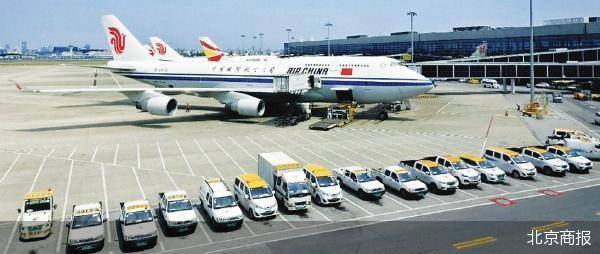
Core Insights - China Southern Airlines (CSA) has increased flight capacity and optimized route layout during the summer travel season to enhance passenger experience and ensure smooth travel for customers [1] - From July 1 to August 31, CSA executed 8,858 flights in and out of Shenyang, carrying 1.42 million passengers, representing a 9% and 5% increase in flight volume and passenger numbers compared to the same period last year [1] - On August 17, CSA set a record by carrying 12,445 outbound passengers from Shenyang [1] Flight Operations - To meet travel demand, CSA upgraded certain domestic routes, such as Shenyang to Guiyang, from connecting flights to direct flights, saving transfer time for passengers [1] - CSA deployed wide-body aircraft on popular tourist routes to enhance travel experience, particularly on routes to Shanghai, Hangzhou, and Urumqi [1] International Routes - The demand for routes to Japan and South Korea remained high, prompting CSA to increase capacity on flights from Shenyang to Seoul and Osaka [1] - During the summer travel period, CSA operated over 500 round-trip flights on Japan-Korea routes, carrying 83,000 passengers [1] - The Shenyang to Tokyo route was particularly popular, achieving an average load factor of 92%, while flights to Seoul maintained an average load factor of 88% with two daily flights [1] Domestic Connectivity - CSA has increased the frequency of flights from key domestic source cities to Shenyang, ensuring sufficient capacity on routes from Guangzhou, Shanghai, Shenzhen, Nanjing, Wuhan, and Zhengzhou, making it more convenient for tourists to reach Shenyang [1]
航司半年报:三大航营收稳步增长 春秋航空蝉联“最赚钱航司”
2 1 Shi Ji Jing Ji Bao Dao· 2025-09-01 11:48
Core Viewpoint - The A-share listed airlines have shown a significant reduction in losses for the first half of 2025, with state-owned airlines still in the red but improving, while private airlines have turned profitable, indicating a contrasting performance in the industry [2][5]. Financial Performance - The three major state-owned airlines (Air China, China Eastern Airlines, and China Southern Airlines) reported a combined loss of 4.77 billion yuan, a reduction of 2.008 billion yuan compared to the previous year [2]. - China Eastern Airlines had the least loss among the three, with a net loss of 1.431 billion yuan, a reduction of 1.337 billion yuan year-on-year [3]. - The revenue for the three major airlines showed growth: Air China at 80.757 billion yuan (up 1.6%), China Eastern at 66.822 billion yuan (up 4.09%), and China Southern at 86.291 billion yuan (up 1.77%) [2]. International Operations - China Eastern Airlines expanded its international operations significantly, opening 14 new international routes and restoring flight numbers to over 110% of 2019 levels [3]. - Air China and China Southern Airlines also increased their international capacity, with Air China's international passenger capacity up 16.7% and China Southern's up 22.5% [4]. Cost Control Measures - Cost control has become a critical focus for the airlines, with China Eastern Airlines implementing a "cost hard battle" plan to manage expenses effectively [6]. - The airlines reported a decrease in fuel costs, with Air China, China Eastern, and China Southern seeing reductions of 10.34%, 8.08%, and 9.15% respectively [7]. Market Conditions - The average ticket price for domestic economy class fell by 6.9% year-on-year in the first half of 2025, indicating ongoing pressure on pricing [8]. - The recovery of international routes remains incomplete, with the overall market still facing challenges in returning to pre-pandemic levels [8].

三大航司2025年上半年运输规模同步扩大,营收均实现同比增长
Cai Jing Wang· 2025-09-01 07:21
Core Viewpoint - The three major Chinese airlines, Air China, China Eastern Airlines, and China Southern Airlines, have reported significant revenue growth and reduced losses for the first half of 2025, driven by operational scale expansion, cost optimization, fleet upgrades, and digital transformation initiatives [1][2]. Financial Performance - Air China achieved operating revenue of 80.757 billion yuan, a year-on-year increase of 1.6% - China Eastern Airlines reported operating revenue of 66.822 billion yuan, up 4.09% year-on-year - China Southern Airlines continued its growth trend with operating revenue of 86.291 billion yuan - Despite remaining in a loss position, all three airlines showed significant reductions in losses: - China Eastern Airlines' net loss attributable to shareholders was 1.431 billion yuan, a reduction of 1.337 billion yuan from the previous year - Air China's net loss attributable to shareholders was 1.806 billion yuan, down 977 million yuan year-on-year - China Southern Airlines reported a net loss of 1.533 billion yuan, maintaining a low loss scale [1]. Operational Expansion - The three airlines have expanded their transportation scale, which has been a solid support for revenue growth: - China Southern Airlines carried 83.28 million passengers, a year-on-year increase of 4.83% - China Eastern Airlines achieved a total transportation turnover of 135.06 billion ton-kilometers, up 11.89% year-on-year, with passenger volume reaching 73.1696 million, an increase of 8.03% - Air China recorded a capacity input of 177.576 billion seat-kilometers, a 3.37% increase, with passenger transport of 77.114 million, up 2.87% - International routes have become a significant driver of operational recovery, with China Eastern Airlines' international and regional route available seat kilometers (ASK) increasing by 24.38% year-on-year [2]. Fleet Optimization - The airlines are focusing on fleet construction to optimize their core revenue source, the passenger business: - China Eastern Airlines introduced 24 new aircraft and retired 12 old ones, with a current fleet size of 816 aircraft, including 11 C919 domestic aircraft - Air China added 9 aircraft, including 1 A320, 5 B737, 1 C919, and 2 C909, while retiring 5 aircraft, totaling 934 aircraft with an average age of 10.28 years - China Southern Airlines introduced 37 aircraft and retired 11, enhancing operational efficiency and laying the foundation for future energy-saving and service upgrades [3]. Digital Transformation - Digital transformation has become a strategic focus for the three airlines to enhance operational efficiency and optimize service experience: - Air China is promoting AI applications, including smart customer service and intelligent maintenance, with in-flight meal booking services covering all domestic flights - China Eastern Airlines is expanding cross-border e-commerce logistics in the cargo sector to improve operational efficiency through digital means - In addition to internal operational optimization, the airlines are actively expanding their international route networks while consolidating their domestic market positions [4]. Business Layout - The airlines are enhancing their business layout by strengthening domestic market foundations and expanding international route networks: - China Eastern Airlines has seen significant growth in international routes - Air China is increasing coverage of remote area routes to enhance the value of its regional network - China Southern Airlines is optimizing its domestic and international route structure, increasing flights from Xinjiang to Central Asia - The management of China Southern Airlines anticipates a significant increase in passenger volume and seat occupancy during the summer travel season, although ticket prices are expected to decline year-on-year [4].
三大航这半年:国航、东航减亏,国际航线成“关键引擎”
Bei Jing Shang Bao· 2025-08-31 04:54
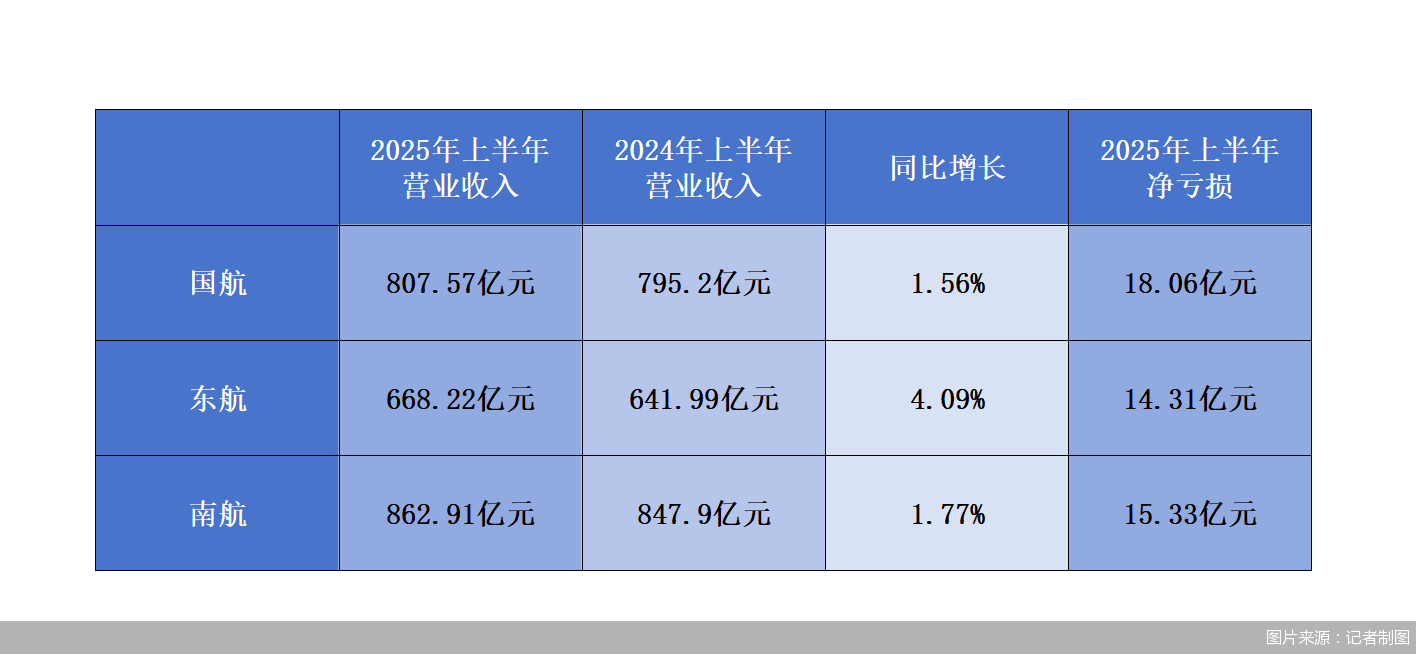
Core Viewpoint - The three major airlines in China have collectively reduced their losses by 2.008 billion yuan in the first half of 2025, with international routes being a key factor for performance improvement [1][3]. Financial Performance - The total loss for the three major airlines in the first half of 2025 was 4.77 billion yuan, a reduction of 2.008 billion yuan year-on-year [3]. - Air China reported a revenue of 80.757 billion yuan, a year-on-year increase of 1.56%, with a net loss of 1.806 billion yuan, reduced by 976 million yuan [2][3]. - Eastern Airlines achieved a revenue of 66.822 billion yuan, up 4.09% year-on-year, with a net loss of 1.431 billion yuan, reduced by 1.337 billion yuan [2][3]. - Southern Airlines reported a revenue of 86.291 billion yuan, a 1.77% increase, but a net loss of 1.533 billion yuan, which is an increase in loss by 305 million yuan [2][3]. International Route Performance - International passenger revenue for the three airlines saw significant growth, with Air China's international revenue up 16.09%, Eastern Airlines up 20.34%, and Southern Airlines up 15.74% [7]. - Eastern Airlines expanded its international route network by opening 14 new international routes, becoming the domestic airline with the most international destinations [7]. - The capacity and passenger turnover for international routes increased significantly, with Eastern Airlines' international capacity up 24.38% and passenger turnover up 28.74% [7]. Cost Management - The three airlines managed to keep their cost increases below 5% year-on-year, with specific increases of 1.14% for Air China, 3.27% for Eastern Airlines, and 0.17% for Southern Airlines [11]. - The decline in fuel prices contributed to a significant reduction in fuel costs, with Air China, Eastern Airlines, and Southern Airlines seeing decreases of 10.34%, 8.08%, and 9.15% respectively [11]. - Eastern Airlines implemented a cost management committee to enhance control over major costs, achieving a 9.5% reduction in average bridge time at major airports [12]. Future Strategies - The airlines plan to capitalize on the traditional peak season for cargo and explore new routes, including Southern Airlines' focus on the South American market [13][15]. - Eastern Airlines aims to enhance its network layout and increase domestic and international flight offerings, particularly targeting emerging markets in the Middle East, Africa, and South America [15].
\t南方航空(600029.SH)上半年净亏损15.33亿元
Ge Long Hui· 2025-08-30 04:01
Group 1 - The core viewpoint of the article is that China Southern Airlines reported a revenue of 86.291 billion yuan for the first half of the year, reflecting a year-on-year growth of 1.77% [1] - The company experienced a net loss attributable to shareholders of 1.533 billion yuan during the same period [1] - The basic earnings per share for the company were reported at -0.08 yuan [1]
南方航空2025年中报简析:增收不增利
Zheng Quan Zhi Xing· 2025-08-29 22:42
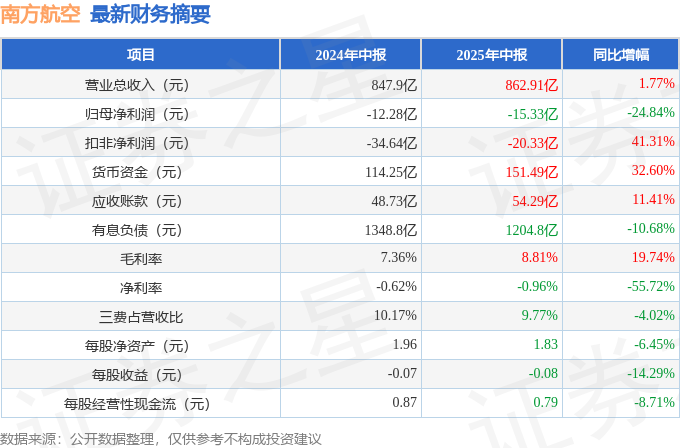
Core Viewpoint - China Southern Airlines reported an increase in revenue but a significant decline in net profit for the first half of 2025, indicating challenges in profitability despite higher sales [1] Financial Performance - Total operating revenue reached 86.291 billion yuan, a year-on-year increase of 1.77% [1] - Net profit attributable to shareholders was -1.533 billion yuan, a decrease of 24.84% year-on-year [1] - In Q2 2025, operating revenue was 42.884 billion yuan, up 6.71% year-on-year, while net profit was -0.786 billion yuan, an increase of 60.38% year-on-year [1] - Gross margin improved to 8.81%, up 19.74% year-on-year, while net margin decreased to -0.96%, down 55.72% year-on-year [1] - Total expenses (selling, administrative, and financial) amounted to 8.427 billion yuan, accounting for 9.77% of revenue, a decrease of 4.02% year-on-year [1] Key Financial Ratios - Earnings per share (EPS) was -0.08 yuan, a decrease of 14.29% year-on-year [1] - Cash flow per share was 0.79 yuan, down 8.71% year-on-year [1] - Return on Invested Capital (ROIC) for the previous year was 2.2%, indicating weak capital returns [1] - The company has recorded a median ROIC of 2.37% over the past decade, with a particularly poor performance in 2022 at -10.05% [1] Debt and Cash Flow - Cash and cash equivalents increased by 32.60% to 15.149 billion yuan [1] - Interest-bearing liabilities decreased by 10.68% to 120.48 billion yuan [1] - The ratio of cash to current liabilities is 13.38%, and the average operating cash flow to current liabilities over the past three years is 19.14% [3] Fund Holdings - The largest fund holding China Southern Airlines is the ICBC Convertible Bond Fund, with 40.9963 million shares, newly entering the top ten holdings [4] - Other notable funds include GF Ruiyi Leading Mixed A and Fortune China Tourism Theme ETF, which have increased their holdings [4]