
HUA HONG SEMI(01347)

Search documents
华虹半导体:对 2026 年晶圆平均销售价格回升前景更为谨慎,评级下调至中性;新目标价 59 港元
2025-10-19 15:58
Summary of Hua Hong Semiconductor Conference Call Company Overview - **Company**: Hua Hong Semiconductor - **Sector**: Semiconductors - **Focus**: Pure foundry primarily engaged in 200mm and 300mm wafer processing, specializing in semiconductors for specialty applications such as embedded non-volatile memory (eNVM) and power discrete [12][13] Key Points and Arguments Downgrade and Price Objective - **Rating Change**: Downgraded from Buy to Underperform due to cautious outlook on wafer ASP and margin recovery in 2026 [1][3] - **New Price Objective**: HK$59, based on a 2x P/B (2026E), reflecting a more conservative valuation compared to the previous HK$44.5 [3][44] Inventory and Demand Dynamics - **Inventory Pressure**: Rising inventory levels among China's semiconductor chipmakers are expected to limit ASP increases in 2026, with a revised assumption of 5% ASP growth (down from 10%) [2][16] - **Demand Growth**: Chip shipment growth in China has slowed significantly, with 0%/11%/6% YoY growth in June/July/August 2025, compared to 16-40% YoY in the previous periods [2][15] Financial Forecasts - **Profitability Outlook**: Estimated operating profit margin (OPM) of 4% in 2026, improving from -4% in 2025 but below the 10-year average of 10% [2][31] - **Net Income Projections**: Adjusted net income forecast for 2026 is US$216 million, with a gradual recovery expected in subsequent years [4][42] Capacity Expansion and Acquisitions - **Acquisition of Huali Micro**: Plans to acquire Huali Micro (Fab5) announced, but details are pending. This acquisition is expected to enhance long-term competitiveness by increasing revenue and capacity [1][3] - **Capacity Growth**: Completion of Fab9 in 2026 could increase total 12" wafer capacity by 38%, with total wafer shipment expected to grow by 26% in 2026 [31][37] Market Position and Valuation - **Market Share Risks**: Aggressive capacity expansion by competitors like SMIC poses downside risks to Hua Hong's market share and profitability [3][13] - **Valuation Comparison**: Hua Hong's current P/B of 2.6x (2026E) is higher than the average of 3.2x for China foundry/OSATs, indicating a rich valuation [60] Cash Flow and Capital Expenditure - **Free Cash Flow**: Negative free cash flow expected due to high capital expenditures for Fab9 construction, projected at US$2-3 billion per year [45][46] - **Operating Cash Flow**: Operating cash inflow is expected to remain below US$1.5 billion, leading to negative free cash flow in the near term [45][46] Additional Important Insights - **Sales Mix**: Sales exposure to overseas markets has decreased from over 40% in 2017-2019 to less than 20% by 2024, indicating a shift towards domestic markets [42] - **ASP and Margin Trends**: Wafer ASP stabilization is anticipated in 1H25, but overall margins are expected to remain below 20% by the end of 2026 due to inventory pressures [39][40] This summary encapsulates the critical insights from the conference call regarding Hua Hong Semiconductor's current position, challenges, and future outlook in the semiconductor industry.
港股通10月17日成交活跃股名单
Zheng Quan Shi Bao Wang· 2025-10-17 15:04
Market Overview - On October 17, the Hang Seng Index fell by 2.48%, with southbound trading totaling HKD 153.005 billion, comprising HKD 79.654 billion in buying and HKD 73.351 billion in selling, resulting in a net buying amount of HKD 6.303 billion [1] Southbound Trading Details - Southbound trading through the Stock Connect (Shenzhen) recorded a total transaction amount of HKD 58.715 billion, with buying at HKD 29.681 billion and selling at HKD 29.034 billion, leading to a net buying of HKD 0.647 billion [1] - Southbound trading through the Stock Connect (Shanghai) had a total transaction amount of HKD 94.290 billion, with buying at HKD 49.973 billion and selling at HKD 44.317 billion, resulting in a net buying of HKD 5.656 billion [1] Active Stocks - Alibaba-W had the highest transaction amount among southbound stocks at HKD 137.12 billion, with a net selling of HKD 21.53 billion and a closing price drop of 4.22% [1] - Other notable stocks included SMIC with a transaction amount of HKD 98.39 billion and a net selling of HKD 15.78 billion, and Xiaomi Group-W with a transaction amount of HKD 58.48 billion and a net buying of HKD 4.14 billion [2] Continuous Net Buying - Two stocks, Xiaomi Group-W and Pop Mart, have seen continuous net buying for over three days, with Xiaomi Group-W leading at a total net buying of HKD 74.03 billion over 10 days, followed by Pop Mart with HKD 14.68 billion over 4 days [2]





港股通(深)净买入6.47亿港元
Zheng Quan Shi Bao Wang· 2025-10-17 15:04
Market Overview - On October 17, the Hang Seng Index fell by 2.48%, closing at 25,247.10 points, while southbound funds through the Stock Connect recorded a net purchase of 6.303 billion HKD [1][3] - The total trading volume for the Stock Connect on the same day was 153.005 billion HKD, with a net buying amount of 6.303 billion HKD [1][3] Trading Activity - In the Shanghai Stock Connect, the trading volume was 94.290 billion HKD with a net purchase of 5.656 billion HKD; in the Shenzhen Stock Connect, the trading volume was 58.715 billion HKD with a net purchase of 0.647 billion HKD [1][3] - The most actively traded stock in the Shanghai Stock Connect was Alibaba-W, with a trading amount of 8.411 billion HKD, followed by SMIC and Xiaomi Group-W, with trading amounts of 5.454 billion HKD and 3.257 billion HKD, respectively [1][2] Stock Performance - In terms of net buying, Meituan-W led with a net purchase of 648 million HKD, despite its closing price dropping by 4.30% [1][2] - Alibaba-W experienced the highest net selling amount of 1.112 billion HKD, with a closing price decline of 4.22% [1][2] - In the Shenzhen Stock Connect, Alibaba-W also topped the trading volume with 5.302 billion HKD, while SMIC and Xiaomi Group-W followed with 4.385 billion HKD and 2.591 billion HKD, respectively [2]

北水成交净买入63.03亿 北水继续抛售中芯华虹 全天抢筹美团超11亿港元
Zhi Tong Cai Jing· 2025-10-17 11:10
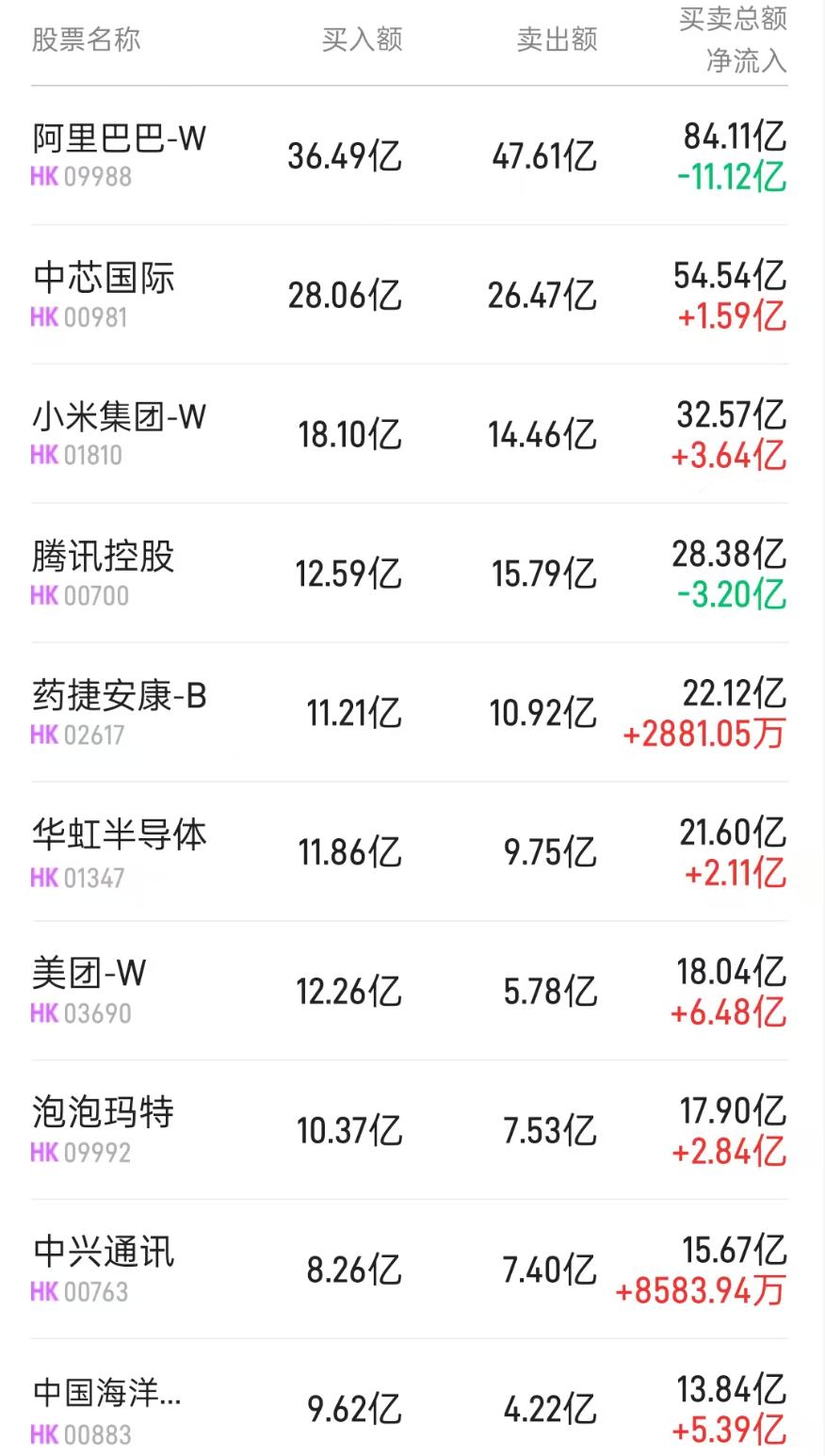
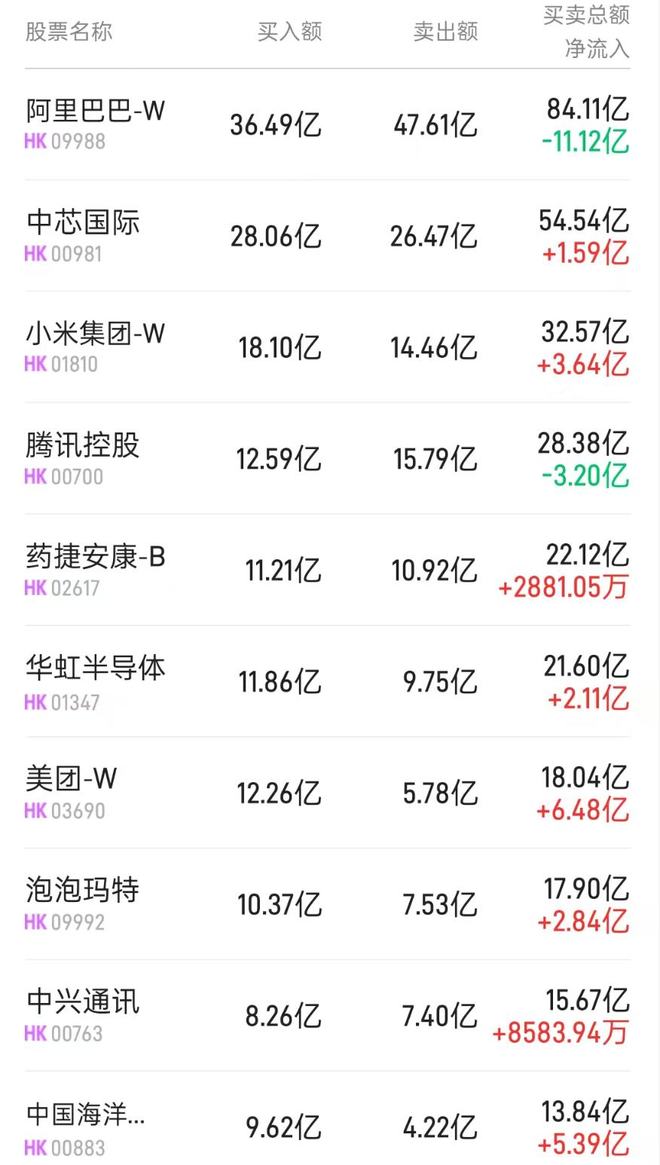
Core Insights - The Hong Kong stock market saw a net inflow of 63.03 billion HKD from northbound trading, with the Shanghai Stock Connect contributing 56.56 billion HKD and the Shenzhen Stock Connect contributing 6.47 billion HKD [1] Group 1: Stock Performance - The most bought stocks included Meituan-W (03690), Tracker Fund of Hong Kong (02800), and CNOOC (00883) [1] - The most sold stocks included Alibaba-W (09988), SMIC (00981), and Hua Hong Semiconductor (01347) [1] Group 2: Detailed Stock Transactions - Alibaba-W (09988) had a buy amount of 36.49 billion HKD and a sell amount of 47.61 billion HKD, resulting in a net outflow of 11.12 billion HKD [2] - SMIC (00981) saw a buy amount of 28.06 billion HKD and a sell amount of 26.47 billion HKD, resulting in a net inflow of 1.59 billion HKD [2] - Meituan-W (03690) had a buy amount of 12.26 billion HKD and a sell amount of 5.78 billion HKD, resulting in a net inflow of 6.48 billion HKD [2] Group 3: Market Trends and News - Meituan announced an upgrade to its "Prosperity Plan" for restaurant merchants, allocating an additional 2.8 billion HKD to support profit retention and healthy development [6] - CNOOC received a net inflow of 5.39 billion HKD, with analysts suggesting that stable oil prices and high dividends could enhance its valuation [6] - Alibaba's significant net outflow of 21.53 billion HKD comes amid the launch of its Double 11 promotional campaign, with substantial investments in marketing [8]

北水动向|北水成交净买入63.03亿 北水继续抛售中芯华虹 全天抢筹美团(03690)超11亿港元
Zhi Tong Cai Jing· 2025-10-17 10:09
Core Insights - The Hong Kong stock market saw a net inflow of 63.03 billion HKD from northbound trading on October 17, with the Shanghai-Hong Kong Stock Connect contributing 56.56 billion HKD and the Shenzhen-Hong Kong Stock Connect contributing 6.47 billion HKD [1] Group 1: Stock Performance - Meituan-W (03690) received the highest net inflow of 11.49 billion HKD, supported by its "Prosperity Plan" aimed at helping restaurant merchants [4] - Alibaba-W (09988) faced the largest net outflow of 21.53 billion HKD, as it prepares for the Double 11 shopping festival [6][7] - Semiconductor stocks, including SMIC (00981) and Hua Hong Semiconductor (01347), experienced significant net outflows of 15.78 billion HKD and 8.92 billion HKD respectively, due to heightened export controls from the U.S. [6] Group 2: Sector Insights - The oil sector, particularly CNOOC (00883), saw a net inflow of 5.39 billion HKD, with analysts predicting stable oil prices and strong earnings due to high dividends [5] - Xiaomi Group-W (01810) attracted a net inflow of 4.14 billion HKD, with market fluctuations influenced by various news events [5] - Pop Mart (09992) gained a net inflow of 3.94 billion HKD, driven by the popularity of its "Starry People" series and upcoming product launches [6]
港股收盘(10.17) | 恒指收跌2.48% 科技股集体下挫 老铺黄金(06181)逆市涨超3%
智通财经网· 2025-10-17 08:48
Market Overview - The credit crisis among U.S. regional banks has intensified, leading to a decline in U.S. stock markets and a significant drop in Hong Kong stocks, with the Hang Seng Index falling nearly 3% at one point [1] - The Hang Seng Index closed down 2.48% at 25,247.1 points, with a total turnover of HKD 314.62 billion, while the Hang Seng Tech Index dropped 4.05% [1] - For the week, the Hang Seng Index fell 3.97%, the Hang Seng China Enterprises Index fell 3.7%, and the Hang Seng Tech Index fell 7.98% [1] Blue Chip Performance - Hansoh Pharmaceutical (03692) rose 2.13% to HKD 36.5, contributing 1.43 points to the Hang Seng Index, after signing a licensing agreement with Roche for its ADC HS-20110, with a total deal value of USD 1.53 billion [2] - Chow Tai Fook (01929) increased by 5.02%, while Link REIT (00101) rose 0.57% [2] - BYD Electronic (00285) fell 8.13%, negatively impacting the index by 4.21 points [2] Sector Performance - Major tech stocks collectively declined, with Alibaba down over 4% and Tencent nearly 2% [3] - Chip stocks saw significant losses, with ZTE Corporation down over 12% and Hua Hong Semiconductor down nearly 7% [3][4] - The photovoltaic sector continued to decline, with rumors about a multi-crystalline silicon storage platform being unsubstantiated, leading to further losses in solar stocks [4][6] Cryptocurrency Market - The cryptocurrency market experienced a sharp decline, with Bitcoin dropping nearly 5% to USD 104,986, and Ethereum down nearly 7% [6] - The decline was attributed to concerns over credit markets following recent events involving U.S. regional banks and the ongoing government shutdown [6] Notable Stock Movements - Lao Pu Gold (06181) rose 3.11% after announcing a price adjustment for its products, marking its third price change this year [7] - China Duty Free Group (01880) increased by 2.05% following the announcement of expanded duty-free shopping policies in Hainan [8] - NIO Inc. (09866) saw a 2.17% increase, responding to a lawsuit that is not related to its recent operational status [9] - Fuyao Glass (03606) fell 5.73% after announcing a leadership change and reporting Q3 revenue of approximately CNY 11.855 billion, up 18.86% year-on-year [10]


恒生科技指数跌超4%,中兴通讯跌超12%,中芯国际跌超6%



Di Yi Cai Jing Zi Xun· 2025-10-17 08:41
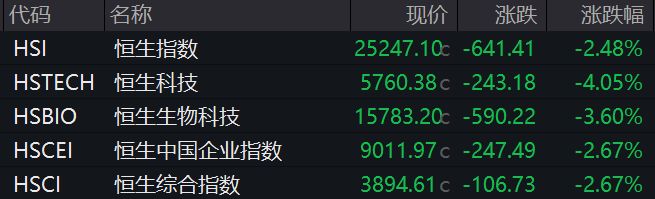
Market Performance - The Hang Seng Index closed at 25,247.10 points, down 2.48%, with a weekly decline of 3.97% [1] - The Hang Seng Tech Index closed at 5,760.38 points, down 4.05%, with a weekly decline of 7.98% [1] Individual Stock Movements - ZTE Corporation fell over 12%, Huahong Semiconductor dropped nearly 7%, and SMIC declined over 6% [2] - Baidu, Alibaba, and Meituan all experienced declines of over 4%, while Xiaomi and JD.com fell over 3% [2] - On the positive side, Jiajie Ankang rose over 22%, and Chow Tai Fook increased by over 5% [2] Sector Performance - The Hang Seng Biotechnology Index closed at 15,783.20 points, down 3.60% [2] - The Hang Seng China Enterprises Index closed at 9,011.97 points, down 2.67% [2] - The Hang Seng Composite Index closed at 3,894.61 points, also down 2.67% [2]
恒生科技指数跌超4%,中兴通讯跌超12%,中芯国际跌超6%
第一财经· 2025-10-17 08:30
Market Overview - As of October 17, the Hang Seng Index closed at 25,247.10 points, down 2.48%, with a weekly decline of 3.97% [1] - The Hang Seng Tech Index closed at 5,760.38 points, down 4.05%, with a weekly decline of 7.98% [1] Index Performance - The Hang Seng Index (HSI) decreased by 641.41 points, representing a decline of 2.48% [2] - The Hang Seng Tech Index (HSTECH) fell by 243.18 points, a decrease of 4.05% [2] - The Hang Seng China Enterprises Index (HSCEI) dropped by 247.49 points, down 2.67% [2] - The Hang Seng Composite Index (HSCl) declined by 106.73 points, also down 2.67% [2] Individual Stock Movements - ZTE Corporation experienced a decline of over 12% [2] - Hua Hong Semiconductor fell nearly 7% [2] - SMIC (Semiconductor Manufacturing International Corporation) dropped over 6% [2] - Baidu, Alibaba, and Meituan each saw declines of over 4% [2] - Xiaomi Group and JD Group both fell over 3% [2] - On the positive side,药捷安康 (Jiangsu Hengrui Medicine) rose over 22% [2] - Chow Tai Fook Jewelry Group increased by over 5% [2]

恒科指数跌幅扩大逾4% 华虹半导体跌近8% 阿里巴巴-W跌超5%
Zhi Tong Cai Jing· 2025-10-17 07:45
Group 1 - The Hang Seng Index experienced a significant decline, with a drop of over 4% by the end of trading [1] - Notable declines in individual stocks included BYD Electronics down 8.86% to HKD 37.46, Hua Hong Semiconductor down 7.73% to HKD 75.15, Alibaba down 5.02% to HKD 153.1, and Tencent down 2.42% to HKD 605 [1] Group 2 - The regional banking credit crisis in the U.S. has intensified, leading to a broad decline in U.S. stocks, with potential loan losses reported in the tens of millions of dollars [1] - Concerns over the quality of bank credit and asset transparency have increased, with analysts suggesting that unfavorable trade conditions are impacting valuations [1] - The recent events in regional banks have caused significant drops in U.S. stocks, raising fears of a repeat of the Silicon Valley Bank incident [1] Group 3 - Despite the challenges posed by trade disputes, the overall stability logic of the Hong Kong stock market has changed, supported by continuous inflows of southbound capital and anticipated interest rate cuts by the Federal Reserve [1] - The structural recovery in earnings is becoming a major driver for the Hong Kong stock market, with expectations for double-digit profit growth in Chinese stock indices next year [1]
港股异动 | 恒科指数跌幅扩大逾4% 华虹半导体(01347)跌近8% 阿里巴巴-W(09988)跌超5%
智通财经网· 2025-10-17 07:42
Core Viewpoint - The Hang Seng Index experienced a significant decline, with major stocks like BYD Electronics, Hua Hong Semiconductor, Alibaba, and Tencent facing substantial losses due to concerns over regional bank credit quality and a negative trading environment [1] Market Performance - The Hang Seng Index fell over 4% at the close, with BYD Electronics down 8.86% to HKD 37.46, Hua Hong Semiconductor down 7.73% to HKD 75.15, Alibaba down 5.02% to HKD 153.1, and Tencent down 2.42% to HKD 605 [1] Economic Concerns - The recent disclosure of loan issues by two regional banks in the U.S. has raised concerns about the quality of bank credit and asset transparency, leading to a broader sell-off in the U.S. stock market and impacting global markets [1] - Analysts suggest that the unfavorable trading environment is affecting valuations, particularly for stocks that have seen significant gains recently, which are now facing a potential correction [1] Market Dynamics - Despite the challenges posed by trade disputes, the Hong Kong stock market's stability is supported by continuous inflows of southbound capital and anticipated interest rate cuts by the Federal Reserve, which are expected to improve market liquidity [1] - The structural recovery in earnings is identified as a key driver for the Hong Kong stock market, with expectations for double-digit earnings growth for Chinese stock indices next year [1]