
港股市场流动性

Search documents
香港交易所(00388):港交所 2 月跟踪:联储降息预期下降致使海外流动性收紧,港股交投仍然维持历史高位
Changjiang Securities· 2026-03-12 09:07
Investment Rating - The report maintains a "Buy" rating for the company [2][6]. Core Insights - As of March 9, 2026, the company's PE ratio stands at 29.06x, which is in the 12th percentile historically since 2016, indicating a certain level of value for allocation. It is expected that with the continuous enhancement of the mutual access policy in the Hong Kong capital market, liquidity in the Hong Kong stock market will continue to rise, leading to an increase in overall market activity and valuation. The company is projected to achieve revenues and other income of HKD 365 billion, 391 billion, and 413 billion for 2026-2028, with net profit attributable to shareholders of HKD 226 billion, 241 billion, and 256 billion, corresponding to PE valuations of 22.9x, 21.4x, and 20.2x respectively [2][52]. Company Overview - The Hong Kong stock market experienced overall fluctuations in February, with the trading activity of listed securities on the Hong Kong Stock Exchange remaining high. The monthly average daily turnover (ADT) for February was HKD 2,468 billion, reflecting a decrease of 9.4% month-on-month and 17.0% year-on-year. However, the overall trading activity remains at historical highs [8][11][17]. Market Environment - The overall market trading remains high, and performance is expected to grow alongside market increases. The total market capitalization of Hong Kong stocks as of the end of February 2026 was HKD 498.76 billion, up 27.5% year-on-year, despite a month-on-month decrease of 1.8% [9][11]. Derivatives Market - In the derivatives market, both futures and options trading volumes increased month-on-month. The average daily volume (ADV) for futures was 68.4 million contracts, up 3.8% month-on-month but down 25.5% year-on-year. The ADV for options was 105.0 million contracts, showing a slight increase of 0.2% month-on-month but a decrease of 21.9% year-on-year [21][22]. Primary Market - The IPO scale in the Hong Kong stock market saw significant growth in February, with a total of 24 new stocks listed, raising a total of HKD 923 billion, which is a year-on-year increase of 1052.4%. The average scale of each IPO was HKD 38.5 billion, up 332.2% year-on-year [31][32].

香港交易所(00388.HK)港交所1月跟踪:港股IPO预计延续强劲复苏态势 市场热度大幅提升
Ge Long Hui· 2026-02-17 21:47
Core Viewpoint - The Hong Kong stock market showed strong performance in January, with high trading activity expected to continue, leading to anticipated growth in the performance of the Hong Kong Stock Exchange (HKEX) [1][2]. Market Performance - The Hong Kong stock market continued its upward trend, with the Hang Seng Index and Hang Seng Tech Index increasing by 6.9% and 3.7% respectively compared to the end of 2025 [1]. - The average daily trading (ADT) for HKEX in January was HKD 272.3 billion, representing a month-on-month increase of 46.4% and a year-on-year increase of 89.3% [1]. - Northbound trading ADT reached HKD 407.7 billion, with month-on-month and year-on-year increases of 77.5% and 122.6% respectively [1]. - Southbound trading ADT was HKD 121.3 billion, with month-on-month and year-on-year increases of 45.0% and 96.2% respectively [1]. Derivatives Market - The futures average daily volume (ADV) was 658,000 contracts, showing month-on-month and year-on-year increases of 27.3% and 11.9% respectively [1]. - The options ADV was 1,048,000 contracts, with month-on-month and year-on-year increases of 27.4% and 21.3% respectively [1]. - As of the end of January, the ADT for structured products was HKD 22 billion, with month-on-month and year-on-year increases of 47.7% and 91.0% respectively [1]. IPO Market - In January, the IPO scale in the Hong Kong stock market reached HKD 41.7 billion, with month-on-month and year-on-year increases of 58% and 598% respectively [2]. - A total of 13 new stocks were listed in January, with new structured products also seeing significant increases in numbers [2]. Interest Rates - Investment income-related rates for HKEX showed a downward trend, with the 6-month HIBOR at 2.89%, down 0.10 percentage points month-on-month [2]. Macro Environment - Domestic economic indicators showed a decline, with the manufacturing PMI at 49.30%, indicating a contraction [2]. - The U.S. job market showed improvement, with non-farm payrolls increasing by 130,000, which may affect interest rate expectations [2]. Investment Outlook - As of February 9, 2026, the company's PE ratio was 30.86x, indicating a reasonable valuation compared to historical levels [3]. - The company is expected to achieve revenues of HKD 30.1 billion, HKD 35.7 billion, and HKD 38.4 billion for 2025-2027, with corresponding net profits of HKD 17.7 billion, HKD 21.3 billion, and HKD 22.8 billion [3]. - The company is rated as a buy, with expectations of increased market liquidity and valuation due to ongoing policy support for the Hong Kong capital market [3].
香港交易所(00388):港交所 12 月跟踪:降息预期持续升温,港股流动性预计将持续改善
Changjiang Securities· 2026-01-18 13:15
Investment Rating - The report maintains a "Buy" rating for the company [7] Core Views - As of January 12, 2026, the company's PE ratio is 31.42x, positioned at the 24th percentile historically since 2016, indicating a certain level of investment value. It is expected that the continuous enhancement of the mutual market access policy will elevate liquidity in the Hong Kong capital market, leading to increased market activity and valuation. The company is projected to achieve revenues and other income of HKD 30.1 billion, HKD 32.7 billion, and HKD 35.1 billion for 2025, 2026, and 2027 respectively, with net profits attributable to shareholders of HKD 17.4 billion, HKD 19.2 billion, and HKD 20.8 billion, corresponding to PE valuations of 31.5x, 28.6x, and 26.3x respectively [2][50] Summary by Relevant Sections Market Environment - The Hong Kong stock market continued its upward trend in December, supported by domestic policy drivers and expectations of interest rate cuts from the Federal Reserve. The Hang Seng Index and Hang Seng Tech Index increased by 27.8% and 23.5% respectively compared to the end of 2024. The total market capitalization of listed securities on the Hong Kong Stock Exchange reached HKD 47.39 trillion, with a year-on-year increase of 34.2% [10][15] Trading Volume - The average daily trading (ADT) for the Hong Kong stock market in December was HKD 186 billion, reflecting a month-on-month decrease of 19.4% but a year-on-year increase of 31.0%. Northbound trading ADT was HKD 229.7 billion, down 5.5% month-on-month but up 11.6% year-on-year. Southbound trading ADT was HKD 83.6 billion, down 14.6% month-on-month but up 26.5% year-on-year [15][19] Derivatives Market - In December, the trading volume of futures and options decreased month-on-month. The average daily volume (ADV) for futures was 517,000 contracts, down 18.8% month-on-month and 12.6% year-on-year. The ADV for options was 823,000 contracts, down 18.9% month-on-month but up 13.5% year-on-year [19] Primary Market - The IPO scale in the Hong Kong market saw a significant year-on-year increase in December, with 26 new stocks listed, raising a total of HKD 25.7 billion, which is a 189% increase year-on-year but a 39% decrease month-on-month. The total number of new listings for 2025 was 117, with a cumulative scale of HKD 286 billion, representing a 224% year-on-year increase [29][30] Investment Income - As of the end of December, the relevant interest rates for investment income showed a general decline. The 6-month HIBOR was 2.99%, down 0.23 percentage points month-on-month and down 1.21 percentage points year-on-year [39] Macroeconomic Environment - The domestic economic outlook improved, with the manufacturing PMI for December at 50.10, indicating growth. The overseas liquidity is expected to enhance further due to a cooling job market and anticipated interest rate cuts by the Federal Reserve [43][45]
港股市场策略周报:近期港股微观流动性存在什么问题?-20251216
CMS· 2025-12-16 11:33
Market Overview and Outlook - The recent Hong Kong stock market has not stabilized following overseas interest rate cuts, primarily due to two internal liquidity issues: the implementation of new public fund benchmark regulations, which may lead to selling of some over-allocated Hong Kong stocks, and a significant demand for funds in the market [2][4] - Despite these narratives, the overall impact on the market is considered limited, with attention on upcoming U.S. non-farm payroll data that could reignite rate cut expectations if significantly below forecasts, potentially improving market sentiment [2][4] Industry and Index Recommendations - Recommended sectors include Internet (CSI 30), Non-ferrous Metals (CSI 931947), and Non-bank financials (CSI 931024) [4][17] - The Internet sector is highlighted for its strong cloud revenue growth and low valuations following recent declines [17] - The Non-ferrous Metals sector is expected to benefit from an impending interest rate cut cycle and global inflation trends [17] - The insurance sector is poised to gain from increased equity positions and expanding interest margins [17] Recent Market Performance - The Hong Kong stock market experienced more declines than gains last week, with the Hang Seng Index down 0.42% and the Hang Seng Tech Index down 0.43% [18][21] - The market saw limited sector performance, with only the financial and information technology sectors showing gains, while the energy sector led the declines [21][18] Micro Liquidity Analysis - The average daily trading volume in the Hong Kong market reached 2,071 million HKD, reflecting a 203 million HKD increase week-on-week, placing it in the 72.8 percentile over the past three years [25] - The 14-day RSI for the Hang Seng Index is at 42.6, indicating a neutral sentiment [27] Fund Flow Analysis - Southbound funds recorded a net outflow of 3.4 billion HKD for the first time in six months, while local and foreign funds saw simultaneous net inflows [30][37] - Local ETFs experienced a net inflow of 5.1 billion HKD last week, totaling 45.9 billion HKD year-to-date [31] - Foreign funds through ETFs net bought 2.63 million USD, with cumulative net inflows since 2024 reaching 14.4 billion USD [34] Valuation Levels - The current P/E ratio for the Hang Seng Index is 11.5, compared to a three-year median of 10.1 and an eight-year average of 10.1 [41] Funding Demand - As of December 12, the funding demand for Hong Kong-listed companies in December is estimated at 18.6 billion HKD, with IPO and placement needs at 9.8 billion and 8.1 billion HKD, respectively [45]
美联储降息平衡海外流动性,港股科技板块或仍是长期主线
Jin Rong Jie· 2025-12-16 03:16
Group 1 - The core viewpoint of the article highlights a collective decline in Hong Kong technology stocks, with the Hang Seng Technology Index dropping over 2% and major companies like Alibaba and Tencent experiencing significant losses [1] - The Federal Reserve's recent decision to cut interest rates by 25 basis points to a target range of 3.50%-3.75% is noted, which may influence global capital flows [1][19] - The liquidity environment in the Hong Kong market remains accommodative, supported by domestic policies emphasizing proactive fiscal measures and moderately loose monetary policies for the upcoming year [1][19] Group 2 - The National Index for Hong Kong Stock Connect Technology Index selects 30 leading technology companies based on market capitalization, R&D investment, and revenue growth, ensuring a focus on both scale and growth potential [4] - The index requires constituent stocks to have a compound revenue growth rate exceeding 10% over the past two years or an R&D expense ratio above 5%, with a flexible sample adjustment mechanism to maintain competitiveness [4] - The index's top five constituent stocks account for over 60% of its weight, indicating a high concentration compared to similar indices, which include major players like Alibaba, Tencent, and Xiaomi [7] Group 3 - The latest valuation of the Hong Kong Technology Index stands at 26.43 times PE, which is positioned at the 40.32 percentile since the index's inception, suggesting a relatively favorable valuation environment [10] - Recent data indicates a net outflow of 3.443 billion HKD from southbound funds, a significant decrease compared to the previous week, reflecting a shift in capital dynamics [15] - The article suggests that the technology sector may remain a long-term investment focus, with potential for rebound due to multiple favorable factors, while the consumer sector is expected to receive substantial policy support [19]


恒科指数跌幅扩大逾4% 华虹半导体跌近8% 阿里巴巴-W跌超5%
Zhi Tong Cai Jing· 2025-10-17 07:45
Group 1 - The Hang Seng Index experienced a significant decline, with a drop of over 4% by the end of trading [1] - Notable declines in individual stocks included BYD Electronics down 8.86% to HKD 37.46, Hua Hong Semiconductor down 7.73% to HKD 75.15, Alibaba down 5.02% to HKD 153.1, and Tencent down 2.42% to HKD 605 [1] Group 2 - The regional banking credit crisis in the U.S. has intensified, leading to a broad decline in U.S. stocks, with potential loan losses reported in the tens of millions of dollars [1] - Concerns over the quality of bank credit and asset transparency have increased, with analysts suggesting that unfavorable trade conditions are impacting valuations [1] - The recent events in regional banks have caused significant drops in U.S. stocks, raising fears of a repeat of the Silicon Valley Bank incident [1] Group 3 - Despite the challenges posed by trade disputes, the overall stability logic of the Hong Kong stock market has changed, supported by continuous inflows of southbound capital and anticipated interest rate cuts by the Federal Reserve [1] - The structural recovery in earnings is becoming a major driver for the Hong Kong stock market, with expectations for double-digit profit growth in Chinese stock indices next year [1]


中信证券:港股基本面预期向好的板块或持续获得市场关注
Zhong Zheng Wang· 2025-09-19 01:43
Core Insights - The Hong Kong stock market showed signs of stabilization and positive growth in the first half of the year, with net profit margins and return on equity remaining at high levels, indicating robust operational efficiency [1] - Sectors such as technology, pharmaceuticals, and materials exhibited high levels of prosperity, supporting the overall performance of the Hong Kong stock market, while non-bank and certain consumer sectors also performed well [1] - However, sectors like energy, utilities, real estate, and most consumer industries continue to face performance pressures [1] - The outlook for the Hong Kong stock market is optimistic, with expectations of a performance turnaround in underperforming sectors such as energy and essential consumer goods in the second half of the year [1] - Given the liquidity-driven nature of the current Hong Kong stock market, sectors with improving fundamental expectations are likely to continue attracting market attention [1]

中银国际:香港金管局“接钱”料对港股影响较小 恒指年底目标27500点
Sou Hu Cai Jing· 2025-08-08 08:42
Core Viewpoint - Bank of China International believes that the Hong Kong Monetary Authority's sale of US dollars for Hong Kong dollars has a minimal impact on the Hong Kong stock market, as the funds are primarily risk-averse and focused on high-interest deposits [1] Group 1: Market Liquidity and Trading Volume - Hong Kong stock market liquidity remains abundant, with an average daily trading volume of HKD 262.9 billion in July 2025, representing a year-on-year increase of 167% [1] - As of August 6, the average daily trading volume for August so far is HKD 233.5 billion, still at historically high levels [1] Group 2: Market Predictions - Bank of China International forecasts that the Hang Seng Index will reach 27,500 points by the end of December this year, which corresponds to a projected price-to-earnings ratio of 12.3 times, a premium of 5% over the average projected price-to-earnings ratio over the past 20 years [1] Group 3: Southbound Trading - Southbound trading has recorded a net inflow of RMB 833.2 billion year-to-date, reflecting a year-on-year growth of 109.8% [1] - The bank predicts that the net inflow from mainland to Hong Kong southbound trading will reach RMB 1.2 trillion in 2025, surpassing RMB 744 billion in 2024 and RMB 289.4 billion in 2023 [1]
AH股溢价创5年来新低 已有8家公司H股比A股贵
Xin Hua Cai Jing· 2025-07-21 09:16
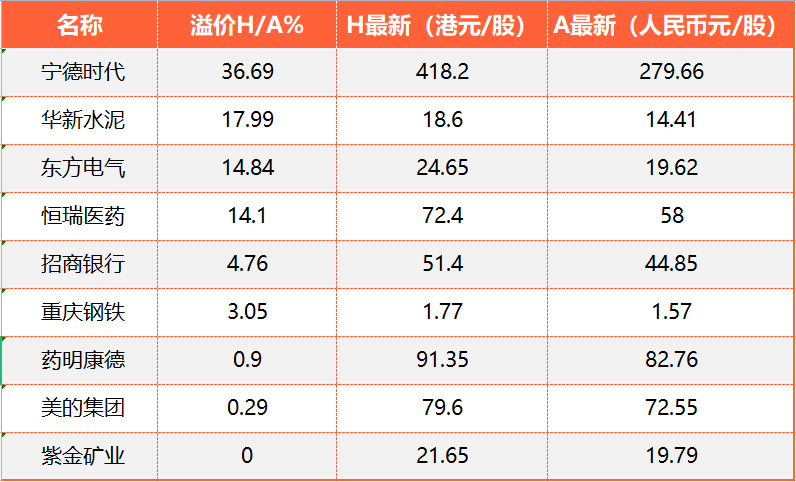
Core Viewpoint - The Hong Kong Hang Seng Index closed up 0.68% at 24,994.14 points, reaching a new high since February 2022, with significant contributions from state-owned enterprises [1] Group 1: Market Performance - The Hang Seng Index briefly surpassed the 25,000 points mark during trading [1] - The AH premium decreased by 0.67% to 125.44, marking the lowest level since June 2020, indicating a narrowing price gap between H-shares and A-shares [2] Group 2: Stock Movements - Major state-owned enterprises led the gains in the Hang Seng Index, with China Petroleum & Chemical Corporation rising by 5.53%, China National Petroleum Corporation by 3.61%, and China Shenhua Energy Company by 2.94% [1] - Several companies related to the Yarlung Tsangpo River hydropower project saw significant stock price increases, with Huaxin Cement, Dongfang Electric, and Chongqing Iron & Steel achieving daily price limits in A-shares, while their H-shares surged by 85.63%, 65.21%, and 25.53% respectively [2] Group 3: AH Share Premiums - As of July 21, the number of AH companies with H-shares priced higher than A-shares increased to 8, with CATL showing the highest premium of 36.69% [3] - Other companies with significant premiums included Huaxin Cement (17.99%), Dongfang Electric (14.84%), and Hengrui Medicine (14.1%) [3] Group 4: Market Trends and Outlook - The AH premium has remained low for the past month, with only 3 companies previously showing H-shares priced higher than A-shares [4] - Despite challenges such as external tariff pressures and a weakening domestic growth cycle, the Hong Kong market remains active, with a daily average trading volume of 2,406 million HKD, an increase of over 80% from 2024 [4] - The influx of southbound capital has also been robust, with an average daily inflow of 61.5 million HKD, nearly double the 34.7 million HKD from 2024 [4] Group 5: IPO and Market Dynamics - The number of companies listing in Hong Kong is increasing, with 10 A-share companies converting to H-shares, raising 70% of their funds from this transition [5] - Short-term AH premiums are constrained by a "hidden floor" due to dividend tax arrangements, while long-term macro factors supporting Hong Kong's capital market remain unchanged [5]




港股通50ETF(159712)涨超6.1%,市场流动性充裕提振非银板块弹性
Mei Ri Jing Ji Xin Wen· 2025-07-01 02:05
Group 1 - The current Hong Kong stock market has abundant liquidity, with a focus on the upward elasticity of the non-bank sector [1] - Since June, the Hong Kong stock market has shown recovery, with the Hang Seng Index up by 4.27% and the Hang Seng Tech Index up by 3.31%, outperforming the MSCI World Index which increased by 3.77% [1] - As of June 27, the overall market capitalization of Hong Kong stocks reached HKD 42.84 trillion, an increase of 6.31% compared to the end of May [1] Group 2 - Trading activity in the Hong Kong stock market has increased, with an average daily turnover (ADT) of HKD 229.44 billion, up by 9.12% month-on-month [1] - Southbound capital's ADT increased by 27.16%, accounting for 26.18% of the total turnover [1] - The trading volume of derivatives has also risen, with futures average daily volume (ADV) at 58,000 contracts, up by 6.30%, and options ADV at 82,000 contracts, up by 11.53% [1] Group 3 - The HIBOR rate has risen again since June, with the 6-month HIBOR reaching 2.38% as of June 27, an increase of 0.22 percentage points month-on-month, and a decrease of 4.2 percentage points year-to-date [1] - With HIBOR remaining high, the investment income of the Hong Kong Stock Exchange is expected to continue to rise [1] Group 4 - The Hong Kong Stock Connect 50 ETF tracks the Hong Kong Stock Connect 50 Index, which is compiled by China Securities Index Co., Ltd., selecting 50 large-cap stocks with good liquidity under the Stock Connect mechanism [1] - The index is calculated using a free-float market capitalization weighting method and sets a 10% weight limit for individual constituent stocks, reflecting the overall market performance of large-cap stocks in Hong Kong [2]